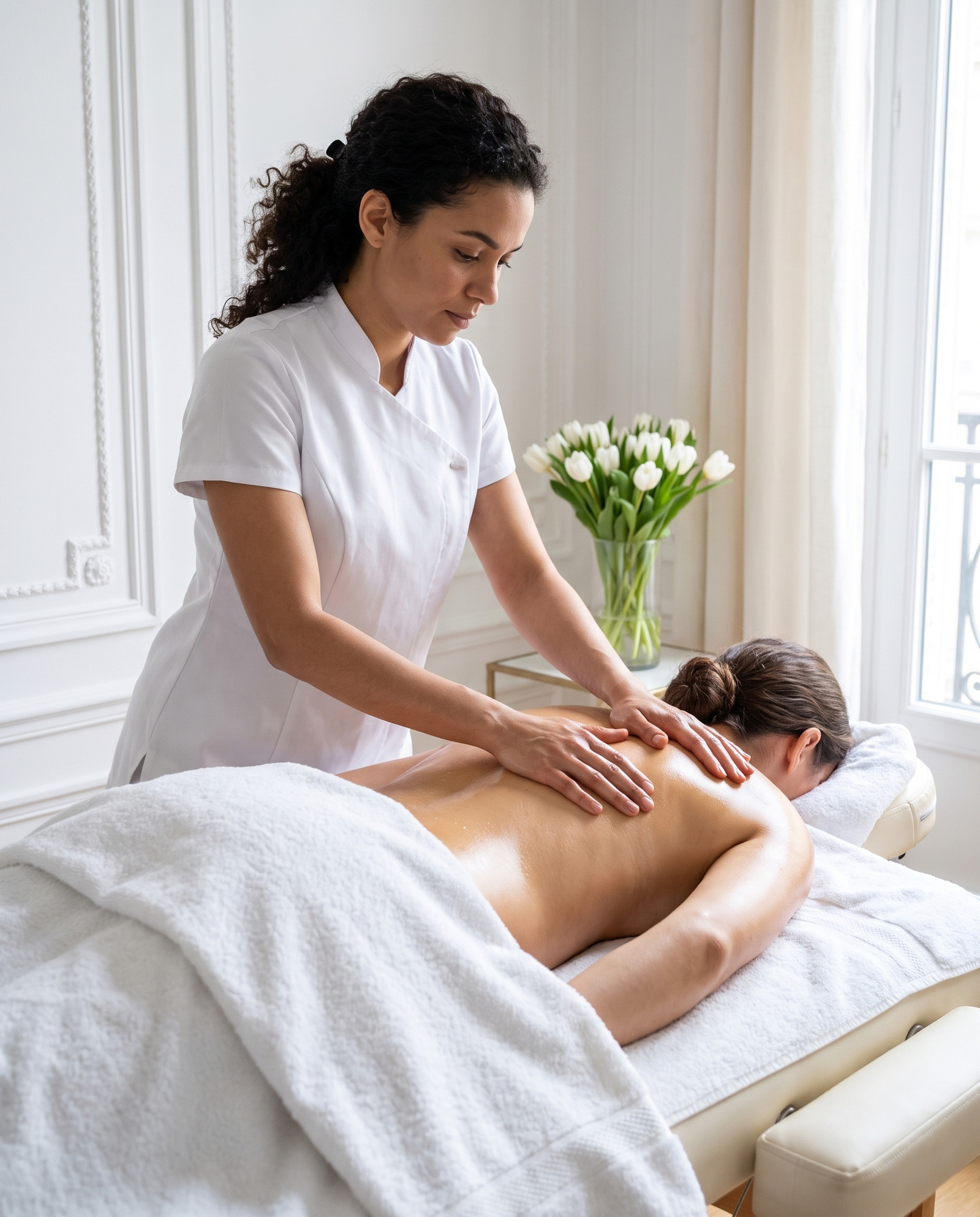
During the session, the body should slow down, not endure pain for the sake of a result.
The first result appears while you are still on the table: your breathing becomes calmer, your shoulders are less raised, your hands relax, and your thoughts stop tracking every task. Not everyone will fall asleep, and not everyone will experience a deep disconnection. A person accustomed to constant control may need most of the session just to feel the comfort of stillness.
A relaxation massage should not require gritting your teeth. Strong pressure may be pleasant for some, but pain triggers defensive tension and changes the goal of the session. Telling us "too strong", "I am cold", or "this scent irritates me" does not spoil the ritual. It allows us to adjust it.
- your breathing is less shallow, and you do not have to consciously slow it down
- your neck does not rise with every movement of the therapist
- the pressure is clear but does not cause reflexive tensing
- the temperature, scent, and positioning allow you to remain in one position
- you can say that something is uncomfortable without having to explain yourself
The first hour after the massage says more than the euphoria at the reception.
Immediately after the session, some people feel lightness, sleepiness, warmth, or a gentle slowing down. Others simply feel calmer. A lack of a spectacular "high" does not mean a lack of result. The most useful observation begins when you get dressed: do you turn your head more freely, do your shoulders drop without effort, and does your breathing remain calm after standing up?
Do not plan a sprint across the city immediately. A sudden entry into traffic jams, phone calls, and tasks can shorten your subjective relaxation. A dozen quiet minutes, water as you desire, and a light meal provide a gentler transition. You do not need to drink a specific, huge amount of fluid or "flush out toxins" — that is a popular story, not a requirement for a successful massage.
In the evening, the result is visible in your behaviour, not in the mirror.
A relaxation massage does not create an aesthetic result that needs to be photographed. Its outcome may appear as a reduced need to move your tense shoulders, an easier time finding a comfortable position on the sofa, or falling asleep more calmly. These are observations, not promises. One person will fall asleep faster, another will not notice a difference in sleep, even though their neck remains looser.
If you return to a night shift, alcohol, intense training, or long hours in front of a screen after a massage, do not judge the session solely by the quality of that night. Many factors affect sleep. A massage can create conditions for rest, but it does not control your entire evening and is not a treatment for insomnia.
Slight tenderness can happen the next day; severe pain is not the goal.
After the first session or deeper kneading, tissues may be sensitive for a short time. The difference between tenderness and injury is practical: slight sensitivity does not increase and does not hinder normal movement. Severe pain, significant swelling, extensive bruising, numbness, or weakness require contact with the salon, and depending on the symptoms, also a medical assessment.
The slogan "it must hurt to release" does not apply to a relaxation massage. If you feel like you have had an intense workout the next day, even though you asked for a gentle session, the pressure must be reduced or a different range chosen for the next visit. Deep tissue therapy is a separate goal and requires a different conversation.
Candles and silence improve the mood, but they should not pretend to be bodywork.
Atmosphere matters. Dimmed light, warmth, scent, and an hour without notifications can lower perceived tension even before the therapist touches your back. This is not a deception or "just a placebo". It is part of the experience of rest. The problem begins when the decor replaces attentive touch, and a general sense of luxury is meant to cover up ill-fitting pressure or the omission of reported areas.
You can separate these elements with a simple comparison. Before the session, check your head rotation in both directions, lift your shoulders, clench and relax your hands, and take three normal breaths. Repeat this after you get dressed. Do not look for the maximum range or a diagnosis. Observe whether the movement requires less effort and whether you automatically return to your previous tension.
- 01
Before entering
Name one sensation you want to observe: heavy shoulders, shallow breathing, or difficulty sitting still.
- 02
After the massage
Check the same thing without extending the result to your entire body. A looser neck does not automatically mean better sleep.
- 03
In the evening
See if the result lasted after returning to normal activities and what shortened it: the computer, driving, training, or a stressful conversation.
- 04
The next day
Assess your freedom of movement and tenderness. Do not demand a permanent change in habits from a single session.
If the only plus was the pleasant atmosphere, and your body defended itself against the pressure throughout the session, change the way of working or the therapist next time. If, however, movement became freer despite a simple interior and the lack of aromatherapy, the massage fulfilled its function without theatrical staging.
After a few days, everyday life returns — and that is exactly when the limit of the treatment is visible.
Immediate relaxation can last for a few hours or days. In J'ADORE data, it is assumed that the noticeable result of a single session can be observed from about a week to a few weeks, but this wide range is not a promise. A person who works in motion and sleeps regularly may maintain freedom longer than someone returning to constant overload.
A massage will not change the height of your monitor, resolve a conflict at work, or stop the habit of raising your shoulders. If tension always returns after two hours at a desk, the information is valuable: the problem also requires a change of workstation, movement breaks, or a physiotherapeutic assessment. Buying more and more frequent massages without working on the cause may only provide short windows of relief.
Results that a massage can support
short-term relaxation
- less perceived neck and shoulder tension
- calmer breathing after the session
- easier transition to rest
- greater awareness of the area you habitually tense
Results that a massage should not promise
treatment and permanent change
- curing chronic pain without a diagnosis
- eliminating anxiety disorders or insomnia
- repairing discopathy or a fresh injury
- permanently removing tension while the cause remains unchanged
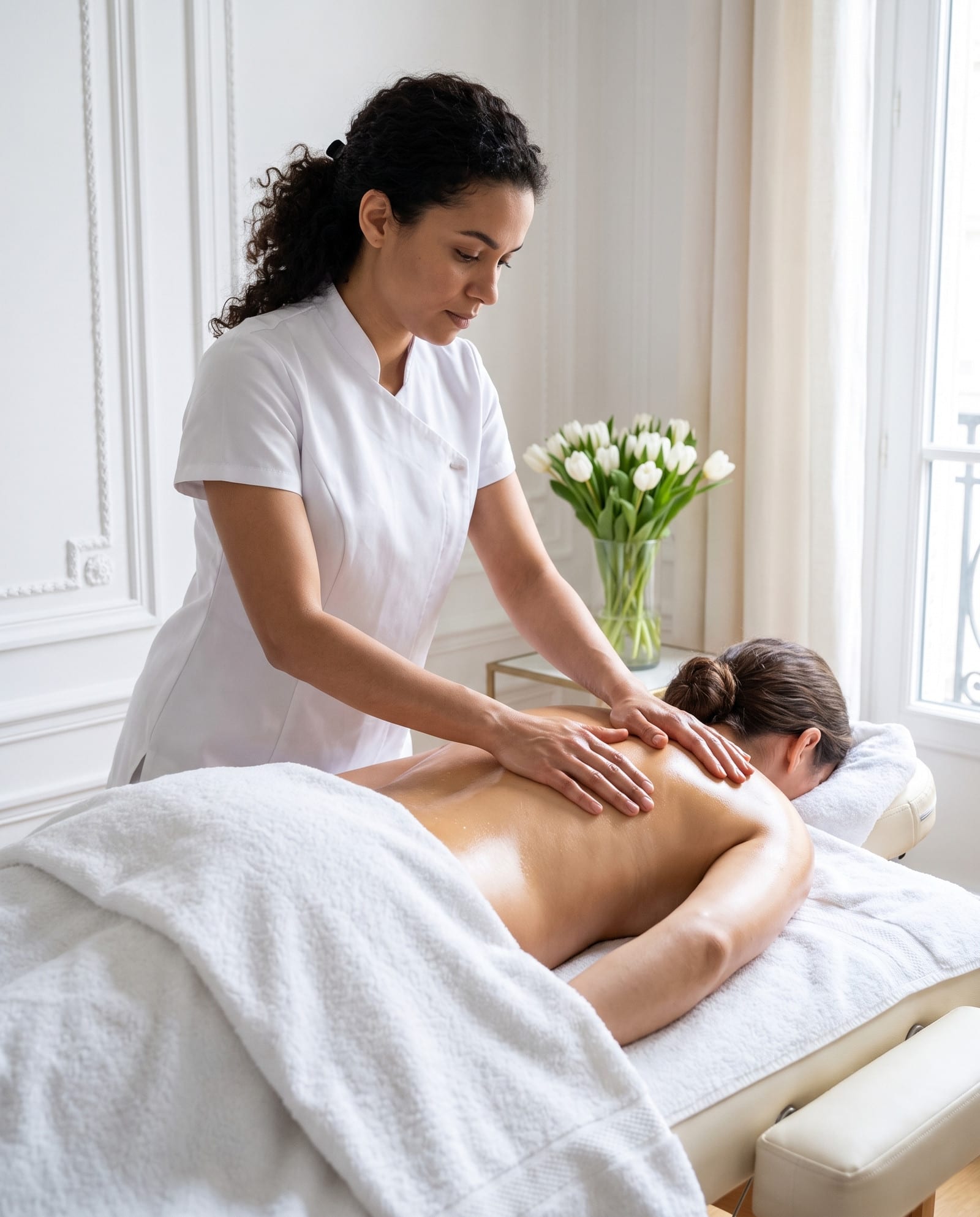
Regularity makes sense as a rhythm of rest, not as a treatment package
A single massage may be sufficient before a quiet weekend or after an intense period. Regular visits help those who need externally scheduled time without phones or tasks. Data from J'ADORE treatments shows that sessions are sometimes repeated every few weeks, but there is no mandatory rhythm for everyone.
A series should not be sold as therapy for chronic stress. It can create repeatable moments of regeneration and teach you to recognise tension earlier, but it does not replace psychotherapy, sleep disorder treatment or physiotherapy. If your main problem is pain that recurs, radiates or limits movement, you first need a proper assessment.
- Choose a frequency that you can maintain without financial pressure.
- Before each session, tell us what has changed since the last one.
- Do not increase the pressure just because your body has become accustomed to the touch.
- Every few visits, check whether the massage still addresses your main goal.
Scent, warmth and music can help or be a complete distraction
The relaxation effect does not come solely from hand technique. The sense of privacy, temperature, pace, sound and scent all matter. Someone with migraines, asthma, allergies or sensory hypersensitivity may react poorly to intense essential oils. Skipping the aroma does not diminish the value of the massage.
The same applies to conversation. One person relaxes in silence, while another needs brief contact and information about changing positions. The therapist should not force social chatter or total silence. A good ritual is predictable: you know which part of the body will be exposed and you can stop the session.
Not every day is a good day for a relaxation massage
You must reschedule your massage if you have a fever, an active infection, a fresh injury, an open wound or an acute skin inflammation in the area to be treated. Thrombosis and thromboembolic conditions are contraindications. After surgery, during active oncological treatment or with uncontrolled cardiovascular disease, you need the consent of your attending doctor.
Pregnancy requires a separate variant, appropriate positioning and qualifications; do not book a standard full-body massage without providing this information. Equally important are medications that increase bruising, sensory disorders and recent treatments in the area to be massaged. The therapist can only adjust the scope if they know the situation.
Relaxation massage in Krakow — location and how to assess the result
The J'ADORE INSTYTUT in Krakow is located at ul. Karmelicka 45/2B, 31-128 Krakow and is open from Monday to Saturday, 8:00–20:00. You can find current information about variants and availability on our website: relaxation massage in Krakow.
When booking, state your preferred pressure, sensitivity to scents, pregnancy, fresh injury and areas you do not want massaged. After your visit, do not look for proof in the form of a perfect mood. Check if it is easier to move your neck for a few hours, if you breathe more calmly and if you notice the moment of re-tensioning more quickly.
If the effect always disappears immediately after returning to the same activity after a few visits, bring this observation to your next conversation. Perhaps the time of the massage, the scope or the pressure needs to change. Perhaps ergonomics, a physiotherapy consultation or work on your sleep will make a bigger difference. A good wellness service does not keep a client at all costs; it knows how to indicate the moment when another relaxation ritual no longer addresses the main problem.