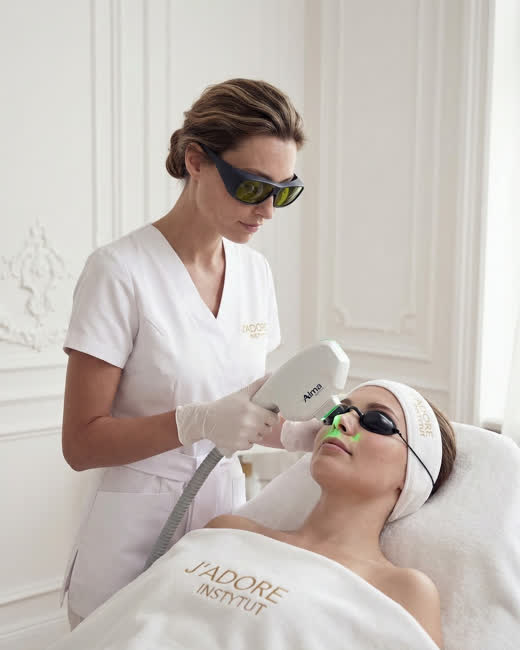
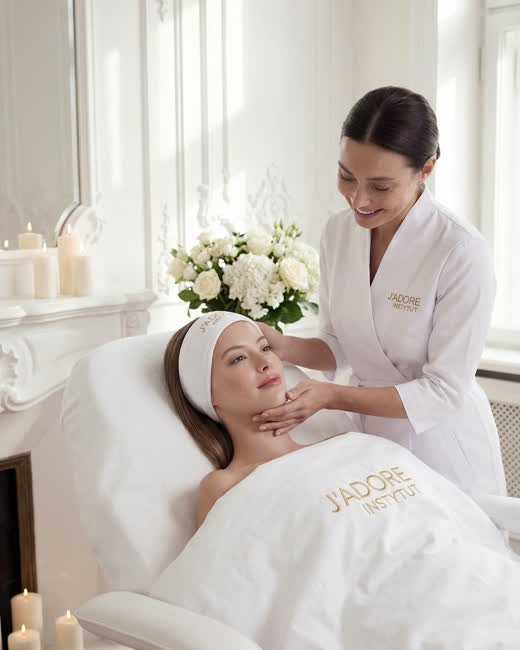
A treatment room at J'adore
FACIAL COSMETOLOGY
A sagging contour, a blurred jawline, asymmetric features, a "tense" face after a long day in front of a screen, tight masseter muscles from clenching your jaw — this isn't always simply about "age". Very often it's the fascia — a thin, elastic membrane that wraps around and connects all the muscles of the face.
When it tightens in one place, it pulls on the rest: the contour drops, features become tense and uneven. Zoga Face Integration is a fascial face lift method — it works using hands only, but differently from a classic massage. It slowly, deeply and precisely releases fascia and muscles, restoring the face's natural structure. It doesn't fill, doesn't block a muscle like Botox, and leaves no marks. The result — a lifted contour, a lighter, less "tired" expression — is visible from the first session, and it looks natural. At J'adore Instytut, the treatment is performed by a cosmetologist / facial massage specialist. Below is everything worth knowing before your first visit.
series of 4–6 sessions every 1–2 weeks + maintenance sessions once a month
How it works
Zoga Face Integration is a method of working on the facial fascia (myofascial integration). Fascia is a thin, elastic membrane that wraps around and connects all the muscles — it acts as one continuous network. When it tightens in one place — from stress, jaw clenching, one-sided chewing, hours in front of a screen — it pulls on everything else: the contour drops, features tense up, the face becomes asymmetric. Zoga releases these contractions slowly and deeply, restoring the face's natural alignment — the contour returns to place, tension eases.
This is a treatment without needles, lasers or injectable products — the entire effect comes from the specialist's hands working with a slow, deliberate movement (unlike dynamic, "tapping" massages). That's why there's no recovery period, and the lifting and relaxing effect is felt right after the session. It's a cosmetology treatment, and we treat it as such: no promises of a "miracle", but real, repeatable improvement with regularity.
Ideal for
Women's zone and men's zone
The goal is most often natural lifting, correction of asymmetry and contouring of the oval plus relaxation of a tense face. Women's skin tends to be thinner, and a common concern is also a glow before an event and maintaining the effects of aesthetic medicine. This is a classic Zoga Face in women.
What we work with
Men's fascia and expression muscles are often more tense — particularly around the masseters (jaw clenching), forehead and neck. Skin is thicker, with greater sebaceous activity. Goal: a healthier, less tired expression and real relief from tension, without changing your features — this is Zoga Face for men.
What we work with
Fun fact: for a long time, fascia was, in anatomy, "the thing you cut away and discard to reach the muscle". Only recent research has shown that it's actually one continuous, mobile network connecting the whole body — and that tension in one spot can pull on structures several centimetres away. That's why, in Zoga Face, the facial contour can be "pulled down" by a contraction that actually begins... lower, in the neck.
Safety
With Zoga Face there are no needles or devices — the entire risk, and the entire effect, depend on the hands and knowledge of the person performing the treatment. It's worth asking this in any salon:
Working on fascia isn't "stroking the face" — it's precise, deliberate release of specific muscle-fascial layers. At J'adore it's performed by a cosmetologist / trained facial massage specialist, familiar with the anatomy of expression muscles and the path of the fascia. This is the foundation of both effectiveness and safety.
Zoga Face is a specific, certified method of fascial work — a slow, deep movement, not dynamic "tapping". A "massage lift" under a different name can turn out to be an ordinary relaxation massage; ask about the training and what the sequence actually looks like.
Some phases (masseters, neck, deep release) feel intense, but shouldn't hurt. A good specialist adjusts the pressure to your sensitivity and explains what she's doing and why.
Red flag: a suspiciously cheap "fascial face lift" · A very low price for a "massage lift" is often a sign you'll get a short relaxation massage instead of genuine fascial work. Watch out too for promises of "a Botox-like effect" or "wrinkles gone for good after one treatment" — that's not how Zoga Face works. You have the right to ask what the treatment involves, how long it takes, and what training in the method the practitioner has. A good salon will answer without hesitation.
FACIAL COSMETOLOGY
Contraindications
Some contraindications are permanent, others temporary — in the latter case, we simply postpone the treatment until the situation resolves.
From the cosmetologist's chair
The most commonly forgotten issue: cold sores. Clients think, "it's only on my lip, but the treatment covers the whole face anyway". That's exactly why we postpone — intensive tissue work stimulates circulation and can spread an active virus. It's better to move the appointment by a few days.
This isn't a complete list — we'll discuss your conditions, medications and previous treatments individually during consultation; if in doubt, the specialist will recommend a medical consultation.

What to expect
Most important: the effect of a single session is real, but temporary. An immediate lift, a raised contour, a lighter expression and relaxation last from a few days to a week. Lasting improvement — a sculpted contour, better firmness, more even features, milder bruxism — builds through a series of 4–6 sessions.
The most common misunderstanding: someone comes once, sees a beautiful lift, and a week later writes that "the effect has gone". That doesn't mean it doesn't work — a single session is temporary by definition, because fascia "remembers" old tension and returns to habit. Zoga Face is series-based work: it takes several sessions to teach the tissue a new, lighter alignment that lasts longer.
The effect of a series fades gradually — the face doesn't "collapse" suddenly. That's why, after a course, we suggest less frequent maintenance sessions, which keep the shape without starting from zero.
Portfolio
A record of the work in our salons — the place where we publish treatment frames and, after photo sessions, results.
A record of results — in preparation. We publish photographs of our clients only with their consent.
Zoga Face and your lifestyle
Zoga Face doesn't break the skin, so there are few restrictions — the main point is simply not to irritate or overheat the skin right after intensive tissue work, and to support the result with hydration.
For a few hours after the treatment, let your skin absorb the serum and avoid heavy makeup. You can go straight back to work — the only visible change might be slight redness.
After work on the face, skin can be more sensitive to UV. Use SPF 30+ (50+ in summer) and avoid intensive sun exposure and sunbeds for a few days.
High temperatures dilate blood vessels and can worsen redness after stimulation. Sauna, hammam, a hot bath — best left for a day.
Chlorinated water can irritate freshly stimulated skin. It's best to visit the pool the next day.
Strong peels (acids) and retinol right after the treatment can over-irritate the skin. Return to them after 1–2 days, once any redness has faded.
Tissue work and drainage work best with good hydration — drink more water than usual on the day of the treatment and afterwards.
Zoga Face Integration
Zoga Face often gets lumped together with every "facial massage", or confused with aesthetic medicine — yet it does something different from both. Most often it complements them, rather than replacing them:
releases fascia and muscles from deep within
doesn't block a muscle like Botox, doesn't fill static folds; the effect of a single session is temporary
lift + drainage through dynamic massage
focuses on drainage and circulation, rather than the slow, structural fascial release seen in Zoga
switches off an overactive muscle
doesn't release fascia, doesn't sculpt the contour with massage, doesn't relax tissue — it silences the muscle pharmacologically
Combine with
Zoga Face pairs well with treatments that improve skin quality or volume. The order and gaps between treatments are decided by the specialist during consultation, but the logic stays consistent — treatments that break the skin come first, fascial work comes after:
I most often hear: „how is this different from Kobido?". Both methods are hands, but a different language of movement. Kobido is dynamic and strongly draining — great for swelling and for skin radiance. Zoga Face is slow and deep, working on the fascia and structural tension — it copes better with asymmetry and a „tense", overworked face. I often suggest alternating between the two.
Variants and care
Under the name "Zoga Face" in our offer, there are several variants — differing in scope (face alone vs face + neck and nape), extras (serum, mask), and whether you book a single session or a series. It's the specialist who chooses the intensity and sequence to suit your skin, your fascial tension zones and your goal — not a "ready-made package off the shelf".
Full fascial sequence for the face, neck and nape — an immediate, temporary effect.
Dla kogoFirst time, a lift before an event, "testing" the treatment.
A cycle of treatments every 1–2 weeks — effects build up and settle in, tissue learns a new alignment.
Dla kogoReal improvement in contour, asymmetry and tension; bruxism.
The treatment finishes with application of a serum (peptides, hyaluronic acid, vitamin C) and a mask — skin absorbs ingredients more intensely after manual work.
Dla kogoMature, dehydrated skin, in need of extra nourishment.
Focused on deep work on the masseters, temples, neck and nape.
Dla kogoBruxism, jaw clenching, tension headaches.
Fact: Where do the differences come from? From the scope of work (duration, face vs face + neck and nape), extras (serum, mask), and whether you book a single session or a course. The sequence chosen and the specialist's hand matter more than the package name — that's why we start with a consultation and an analysis of your skin and tension zones.
Price list
Checking free hours…
From the magazine
Editorial pieces on how this treatment works in practice — what happens during the session, how to prepare, where the limits are and what the first days after look like.
See also
The result lastssingle session a few days to a week; series — results settle inJ’adore Instytut
Please note. Zoga Face Integration is a cosmetology treatment (fascial lifting massage for the face), not a medical procedure — it's performed by a cosmetologist / facial massage specialist, without breaking the skin and without needles. This text is for information only and does not replace individual consultation. The choice of treatment, the number of sessions in a series, and contraindications are decided by the cosmetologist/specialist during consultation. Results are aesthetic and relaxing in nature.
Home care
Cosmetics matched to what your skin needs after a treatment — so the clinic effect lasts longer.
 skin firmnessPeel MissionLIFT TONIC 200mlView in the shop(opens in a new tab)
 post-treatment regenerationCell Fusion CDermagenis pH Biome SerumView in the shop(opens in a new tab)
 sun protectionDermaQuestSunArmor SPF50 30 mlView in the shop(opens in a new tab)
 skin firmnessMedidermaSens-Age Lift Firming Cream 50mlView in the shop(opens in a new tab)
 post-treatment regenerationMedMelanoSkinbiotic Elixir Probiotic Repair Serum 50 mlView in the shop(opens in a new tab)
 sun protectionSesdermaREPASKIN Silk Touch Color SPF50View in the shop(opens in a new tab)
 skin firmnessDermoMedica0.1% Retinal Cream 15 mlView in the shop(opens in a new tab)
 post-treatment regenerationVagheggiEmozioni Plus — Anti-Stress Face Mask 75mlView in the shop(opens in a new tab)