
WarszawaŻelazna 59WarszawaMińska 29AKrakówKarmelicka 45Warsaw · Krakow

Full perspective

LED therapy for men

Men's skin — a different environment, the same cellular mechanisms
Men's skin produces more sebum and is thicker, which favours inflammatory acne in the beard and forehead area. Add to that shaving irritation and redness. That's why with men we often work with the blue filter (for bacteria) and the yellow filter (for post-shave redness). This is LED therapy for men — a quick, discreet treatment with no visible trace, ideal for a work break.
Czas
several dozen minutes
Efekt
cumulative effect — lasts weeks to several months after the series
Regeneracja
none
Seria
series of 6–10 sessions (1–2× a week) + maintenance 1–2× a month
Wykonuje
experienced cosmetologist
ListenLED therapy — this whole page read aloud

When it's worth it — indications

  • Inflammatory acne — recurring pustules, papules, inflammation (blue filter).
  • Vascular skin and a tendency to flush — reactive skin that reddens at the slightest trigger (yellow filter).
  • Rosacea (redness component) — calming redness and strengthening blood vessels; with rosacea, always assessed individually.
  • Fine lines and loss of firmness — collagen stimulation from age 30 onwards (red filter).
  • Grey, tired skin lacking radiance — stimulating cell metabolism and microcirculation.
  • Skin needing regeneration after a treatment — after a peel, Dermapen or laser, LED shortens healing time and calms irritation.
  • Sensitive skin that doesn't tolerate aggressive treatments — LED is one of the gentlest treatments available.

The areas we work on

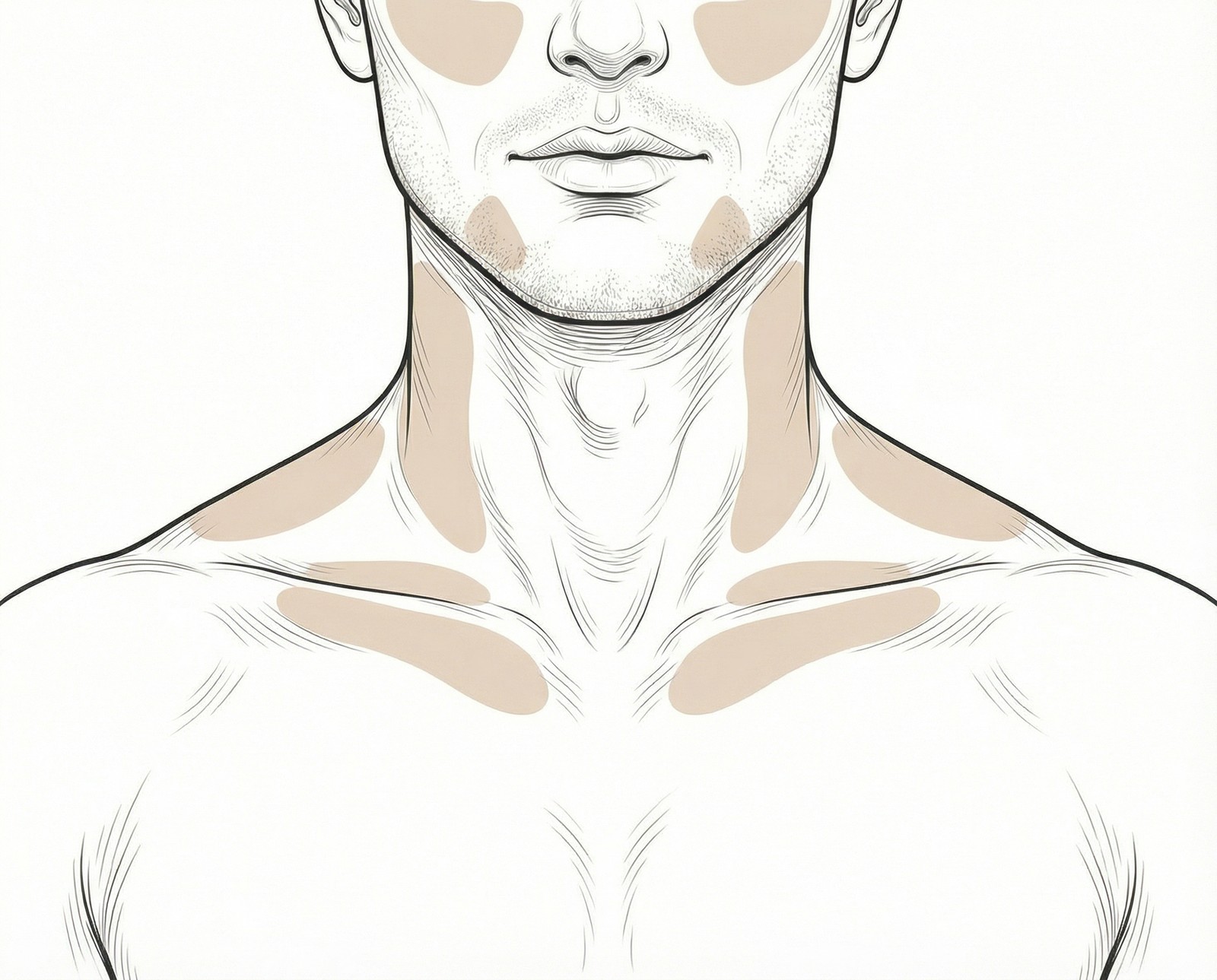
  1. inflammatory acne — papules and pustules in the beard area (blue);
  2. shaving irritation and redness (yellow);
  3. regeneration after Dermapen or a peel (red / infrared);
  4. zero downtime — shaving, training and meetings can all happen right after your visit without any issue.
Drawing of the treatment areas — face and neck, male figureForehead and templesCheeksJawlineNeck
Indicative map of the areas

Men's skin — a different environment, the same cellular mechanisms

Male skin is thicker, produces more sebum and is irritated daily by shaving. These anatomical characteristics have concrete consequences: a higher concentration of sebum encourages the proliferation of Cutibacterium acnes bacteria, regular mechanical irritation of the beard area maintains inflammation, and with age — despite seemingly slower ageing — collagen synthesis slows down regardless, and the skin loses firmness.
LED therapy addresses these mechanisms with a precision no cream can match. Blue light at 415 nm destroys acne-causing bacteria through the photo-oxidation of porphyrins — without antibiotics, without any risk of resistance. Red light at 633 nm activates fibroblasts to synthesise collagen types I and III — skin becomes denser and firmer cumulatively after a series. Infrared light at 830 nm works deeper than visible light: it speeds up healing, reduces pro-inflammatory cytokines, and shortens recovery after other treatments by 30–50%.

The beard area — a zone of high irritation

Shaving causes micro-injuries every day or every few days — on the same skin, in the same place. Shaving irritation, ingrown hairs and chronic redness around the jawline and neck aren't down to poor technique — they're the cumulative result of micro-injuries on skin that can't keep up with regeneration.
Red LED and 830 nm infrared reduce inflammation in the dermis, accelerate epidermal renewal and strengthen the barrier — the skin becomes less reactive to subsequent shaves. This does not change the daily routine, but it changes the starting point: the skin leaves the session less irritated than it entered.
Plan for chronic shaving irritation: a course of 6–8 sessions (red + infrared), then 1 session per month as maintenance.

Inflammatory acne and breakouts in the beard area

Active acne in the beard area is a tricky combination — anti-acne products irritate skin already stressed by shaving, and oral antibiotics carry systemic side effects. Blue LED at 415 nm destroys C. acnes through the photo-destruction of porphyrins, without chemicals and without contact with the skin's surface. No drying out, no bacterial resistance.
After 3–4 sessions, there's usually a noticeable reduction in new inflammatory breakouts. A full series (8 sessions, twice a week) brings a real reduction in acne — maintained with 1 session a month afterwards. We combine blue with red if you're also after collagen stimulation.

LED as an enhancement of Dermapen results

Dermapen is one of the treatments most frequently chosen by men — the results are measurable, the plan concrete. 830 nm infrared after Dermapen shortens recovery by 30–50% and enhances the collagen stimulation initiated by the micro-needling. That is why LED after micro-needling is not an option but a standard — one treatment works for the other.
If you have Dermapen regularly, LED is a natural next step. You can schedule an LED session directly after the treatment or within 48 hours — the specialist will determine the best time.

Frequently asked questions

Should I wait to shave before or after an LED session?
Before the session: come with a clean, oil-free face — you can shave normally in the morning. Don't apply aftershave balm right before the treatment, as products on the skin can limit how well the light penetrates. After the session: you can shave again the next day. Immediately after LED, the skin is metabolically activated — give it a few hours before any further mechanical irritation.
Does an LED session clash with strength training or intense exercise?
No — and that is one of the key advantages. 20 minutes under the lamp, zero downtime, you leave and head straight to the gym. The only recommendation after LED is SPF before going out — skin after photobiomodulation may absorb UV radiation more intensively. Many of our clients book an LED session before a workout or during their lunch break.
Will anyone notice I've been to the salon?
No one. LED leaves no visible trace at all: no redness, no flaking, no swelling. Your face looks exactly the same as before the treatment — or slightly fresher and better perfused if your skin has responded to the stimulation. No one will ask "what have you done to your face".
How many sessions do I really need to see a difference with acne?
The first results — fewer new inflammatory breakouts — usually appear after 3–4 sessions on a twice-weekly protocol. Full improvement comes after 8 sessions. That's 4 weeks at two sessions a week. It's not a quick fix, but a lasting effect — maintained with one session a month once the cycle is complete.
Can LED be combined with tretinoin or other retinoids that I use?
Retinoids and LED therapy are a compatible pair — with one caveat: on the day of your LED session, take a break from your retinoid (do not apply it in the evening before the treatment). Cells activated by LED absorb active ingredients more deeply, which with a strong retinoid could increase reactivity. The specialist will tailor the plan to your current skincare routine.

Where we offer it

LED therapy for men — we perform it in three J'ADORE INSTYTUT salons: two in Warsaw and one in Krakow.

  • WarsawŻelazna 59 · Wola · Mirów
  • WarsawMińska 29A · Praga-Południe · Kamionek
  • KrakowKarmelicka 45 · Stare Miasto · Piasek

Price list

    Book a visit

    Prices from the treatment price lists. The variant and number of treatments are determined by the specialist during the consultation.

    Book a visit