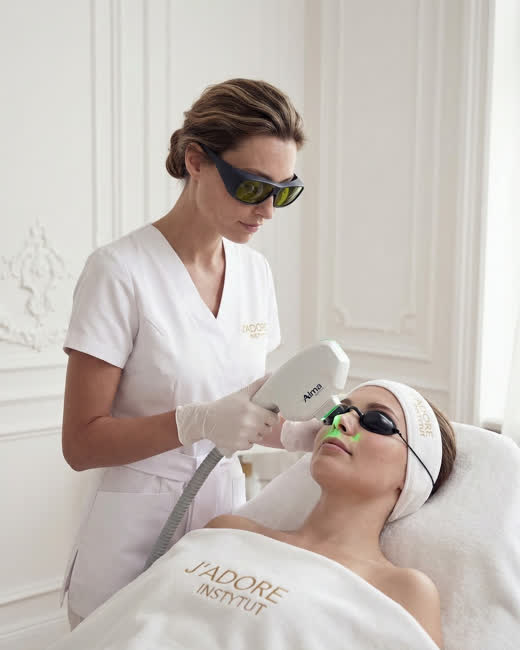
A treatment room at J'adore
FACIAL COSMETOLOGY
Acne that won't let go. Vascular skin that flushes at the slightest trigger.
Skin that's tired, grey, without firmness. LED therapy doesn't just mask these problems on the surface — it works with light at cellular level: red light prompts the skin to produce collagen, blue light destroys the bacteria behind inflammatory acne, yellow light calms redness and strengthens blood vessels. This is photobiomodulation — one of the best-researched non-invasive methods in cosmetology, not a "trendy gadget". At J'adore Instytut, LED therapy is a cosmetology treatment. The treatment is pain-free, doesn't break the skin's surface and needs no recovery time — many clients simply doze off under the lamp. Below you'll find everything worth knowing before your first session: how it works, whether it actually works, how many sessions you need, and why one session isn't enough.
series of 6–10 sessions (1–2× a week) + maintenance 1–2× a month
How it works
LED therapy is photobiomodulation — exposing the skin to light of a precisely chosen wavelength, emitted by LED diodes. Skin cells absorb this light and respond to it: mitochondria are stimulated to produce energy (ATP), repair processes are triggered, bacteria are destroyed, or inflammation is calmed. It all depends on the colour of the light — each colour reaches a different depth and does a different job.
This isn't a "trendy treatment from the internet". Light therapy has been studied since the 1970s — originally, among others, by NASA, to speed up tissue healing. Today it's one of the best-documented non-invasive methods in cosmetology. The key point: LED doesn't break the skin's surface — no needles, no puncturing, no exfoliation. The light works gently, but the effect builds gradually, session by session.
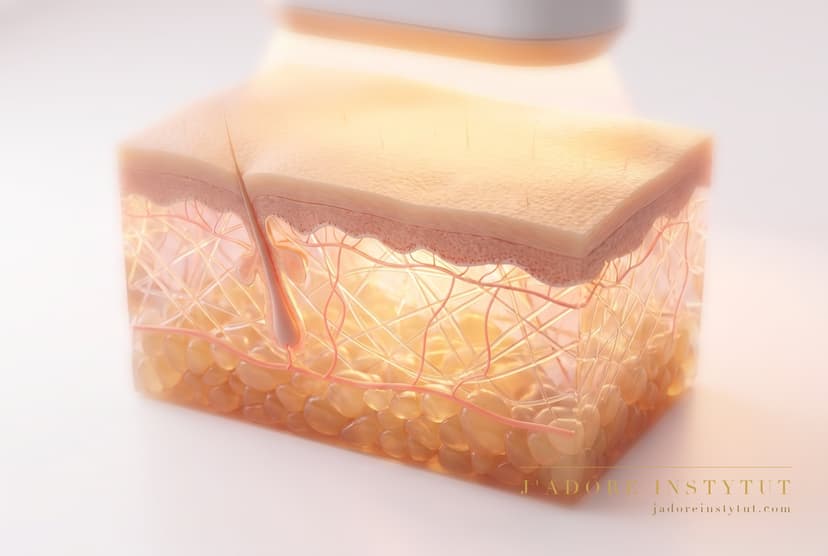
Fun fact: the same light that once helped astronauts heal wounds in microgravity now stimulates your skin to produce collagen in the salon. The mechanism is the same — a cell "fed" with light of the right wavelength works more efficiently.
Three colours of light
The most common misunderstanding: "LED is LED". Not true — a single device holds different filters, and a good result starts with matching the right colour to your particular concern. At J'adore, we use a professional LED lamp with red, blue and yellow filters (plus near-infrared for deeper regeneration).
Filters can be combined in a single session — for example blue plus red, when you're dealing with acne and also want to work on overall skin condition. The cosmetologist decides on the combination after assessing your skin.
Ideal for
Female and male needs
The most common goals are acne, capillaries and radiance, and after 30 — collagen support. Women's skin tends to be thinner and more reactive, so we often choose the yellow filter (soothing) and the red one (anti-ageing, freshness). This is a classic LED treatment for women — a gentle procedure that is easy to fit in between cleansing, HydraFacial or needle-free mesotherapy.
What we work with
Men's skin produces more sebum and is thicker, which favours inflammatory acne in the beard and forehead area. Add to that shaving irritation and redness. That's why with men we often work with the blue filter (for bacteria) and the yellow filter (for post-shave redness). This is LED therapy for men — a quick, discreet treatment with no visible trace, ideal for a work break.
What we work with
Safety
LED is one of the safest treatments available, but "safe" doesn't mean "it doesn't matter where or with whom". Three things determine the result — worth asking about at any salon:
A professional medical lamp delivers the right dose of energy (measured in J/cm²) to achieve a clinical effect. A home "LED gadget" has far lower power — hence its limited effectiveness.
Blue for acne, red for collagen, yellow for redness — the wrong colour means a wasted session. That's why a consultation and the cosmetologist's choice of light matter so much.
A single session isn't enough to judge the effect. A trustworthy salon sets out a realistic schedule from the start, rather than selling a "miracle after one go".
Red flags: what to watch out for ·
Contraindications
LED has very few contraindications, and some of them are temporary — in those cases, we simply postpone the treatment until the situation has passed.
From the cosmetologist's chair
The thing people most often forget: photosensitising medications. Clients say "I'm just taking an antibiotic for my skin" — and that's exactly when tetracyclines or isotretinoin matter. That's why I always ask about medications and home skincare before switching on the lamp. Better to postpone by a few days than risk irritation.
This is not a full list — your medications, conditions, phototype and previous treatments will be reviewed individually during your consultation. Pregnancy and breastfeeding: LED therapy does not emit UV and does not damage the skin, and is widely considered safe — nevertheless, please inform the specialist and we will select the appropriate settings.

Does it actually work
The most important thing to know: LED works cumulatively. One session gives a refresh, a calming effect and a light glow — but it's not a "wow after one go". The real difference — fewer breakouts, better firmness, a more even tone — appears after a series. Anyone who promises a miracle after one treatment isn't being honest about photobiomodulation.
I sometimes hear after the first session: "is that it? I can't see much." That's completely normal — light doesn't "redo" the skin in one day, it gradually prompts it to work. That's why we set out a plan for the full series from the start, not just a single visit. After 6–8 sessions, the conversation is quite different.
The second important thing: LED does not damage the skin, so the effect does not "reverse" abruptly. After a course, the skin maintains the improvement for weeks to a few months, and maintenance sessions allow the effect to be sustained for longer.
Portfolio
A record of the work in our salons — the place where we publish treatment frames and, after photo sessions, results.
A record of results — in preparation. We publish photographs of our clients only with their consent.
FACIAL COSMETOLOGY
LED therapy and your lifestyle
This treatment comes with very few restrictions — LED doesn't break the skin's surface and doesn't make it sun-sensitive. Still, a few rules help you get the most out of each session, especially when LED is combined with another treatment.
There's no redness or visible trace after the session — you can apply makeup right away and get straight back to work. Before the session, though, come with clean skin — cosmetics block the light.
LED doesn't make skin sun-sensitive (unlike peels or lasers). Even so, SPF 50+ is standard practice — it protects both the result and the skin itself. With very fair phototypes, it's worth avoiding strong sun for the first 24 hours.
You can train before and after the treatment — LED requires no recovery time and doesn't react to increased circulation.
After LED alone, sauna and pool are fine. The exception: when LED was the finishing step after an exfoliating treatment — in that case, follow the aftercare for that treatment instead.
Don't apply acids or retinoids on the day of your session (and often the day after) — let your skin rest and respond better to the light. Otherwise, continue your normal routine.
After LED alone, shaving is fine — yellow light actually soothes post-shave redness. If LED was combined with manual extraction, follow the cosmetologist's recommended waiting time.
LED therapy
LED is sometimes confused with laser, or treated as a "substitute" for cleansing. These are different tools — and they often complement each other rather than replace one another:
stimulates the skin with light, calms and regenerates it
doesn't mechanically remove blackheads, doesn't exfoliate the epidermis, doesn't fill wrinkles
cleanses the skin and removes build-up
on its own, it doesn't calm inflammation or stimulate collagen the way light does
controlled "damage" → strong remodelling
this isn't a "zero downtime" treatment like LED — and won't replace gentle redness-calming
Combine with
LED is the most versatile "finisher" in the salon — it reinforces the effects of almost any treatment and speeds up regeneration. The cosmetologist decides on the order and spacing during consultation, but the logic stays the same: LED usually comes last, to calm and regenerate the skin.
The simplest way to think about it: if skin needs cleansing — that's cleansing or HydraFacial. If it needs strong remodelling (scars, deep wrinkles) — that's Dermapen or laser. LED is gentle stimulation and calming — great on its own for acne and broken capillaries, and invaluable as a finishing step after a stronger treatment, since it shortens healing time.
Treatment variants
Under the umbrella term "LED therapy" there are several variants — they differ in light colour and purpose. You don't pick a colour off the shelf — the cosmetologist chooses it based on your skin concern, phototype and treatment history.
Reaches the dermis, stimulating fibroblasts and mitochondria (ATP) — more collagen and elastin, better firmness and radiance.
Dla kogoFine lines, loss of firmness, grey-looking skin, regeneration after treatments.
Destroys P. acnes bacteria through the photo-destruction of porphyrins — less inflammation and fewer new breakouts, without antibiotics.
Dla kogoInflammatory acne, oily skin, recurring breakouts.
Strengthens vessel walls and microcirculation, reduces redness; has a calming and regenerating effect.
Dla kogoVascular skin, redness, reactive skin, irritation (including after shaving).
Penetrates the deepest, supporting tissue regeneration and calming inflammation.
Dla kogoRegeneration after more intensive treatments, deeper anti-ageing support.
Fact: Why the differences? Each wavelength reaches a different depth and triggers a different mechanism within the cell — which is why the effect depends on matching the colour to the concern, not on "shining more strongly". We often combine two filters in a single session to enhance the effect.
Price list
Checking free hours…
From the magazine
Editorial pieces on how this treatment works in practice — what happens during the session, how to prepare, where the limits are and what the first days after look like.
See also
The result lastscumulative effect — lasts weeks to several months after the seriesJ’adore Instytut
The above text is for informational purposes only and does not replace a consultation. The choice of filter (light colour), the number of sessions in a series and any contraindications are determined by a cosmetologist/specialist during an individual consultation. LED therapy is a cosmetology treatment, non-invasive in nature. Results are individual and depend on skin condition and consistency with the series.
Home care
Cosmetics matched to what your skin needs after a treatment — so the clinic effect lasts longer.
 acne and blemishesDermoMedicaAnti-Blemish Nanoneedling Patches 9 pcs.View in the shop(opens in a new tab)
 oily skinSkeyndorExpert Cleanse Pro – Mattifying Foam GelView in the shop(opens in a new tab)
 sun protectionCell Fusion CAquatica Sunscreen 100 SPF 50+/PA++++View in the shop(opens in a new tab)
 acne and blemishesMesoesteticGrascontrol Detox PowderView in the shop(opens in a new tab)
 oily skinMedik8Natural Clay Mask™View in the shop(opens in a new tab)
 sun protectionDermaQuestSunArmor SPF50 30 mlView in the shop(opens in a new tab)
 acne and blemishesPeel MissionUPWASHING ACNE SKIN ACID GEL 250mlView in the shop(opens in a new tab)
 acne and blemishesDiego Dalla PalmaSmart Pure Exfoliating Mask stick 30 gView in the shop(opens in a new tab)