
WarszawaŻelazna 59WarszawaMińska 29AKrakówKarmelicka 45Warszawa · Kraków

Careers

ENPL

Full perspective

Brightening programme for men

Hyperpigmentation in men has specific causes
Men are particularly prone to sun-related hyperpigmentation — years of outdoor work and activity without the SPF habit build up into patches on the forehead, temples and neck. Post-inflammatory marks from shaving and ingrown hairs along the beard line add to this. The goal: a clean, even skin tone without an "obviously treated" look. This is a brightening treatment for men.
Czas
several dozen minutes (single visit within the series)
Efekt
results build up over the series and last for months — provided you use daily SPF
Regeneracja
none, or a few days of light peeling after stronger stages
Seria
series of 4–6 treatments every 1–2 weeks (for persistent hyperpigmentation, a 2–6 month programme)
Wykonuje
experienced cosmetologist
ListenBrightening programme — this whole page read aloud

When it's worth it — indications

  • Sun spots — light brown patches on the forehead, cheeks, décolletage and hands, the result of years of UV exposure without protection.
  • Post-acne hyperpigmentation (PIH) — dark marks left behind after a breakout, even though the spot itself is long gone.
  • Melasma / "pregnancy mask" — symmetrical, widespread hormonal hyperpigmentation (pregnancy, contraception); the most difficult and recurring type.
  • Uneven, grey skin tone — skin that looks "dulled" by patches, lacking radiance, with an inconsistent tone.
  • Individual darker patches visible even under makeup, that you want to fade rather than cover up.
  • Hyperpigmentation from shaving and ingrown hairs — post-inflammatory marks along the beard line.
  • Skin after a holiday — deepened tone and old spots "brought out" by the sun.
  • Prevention for those prone to hyperpigmentation — when you want to maintain an even tone.

The areas we work on

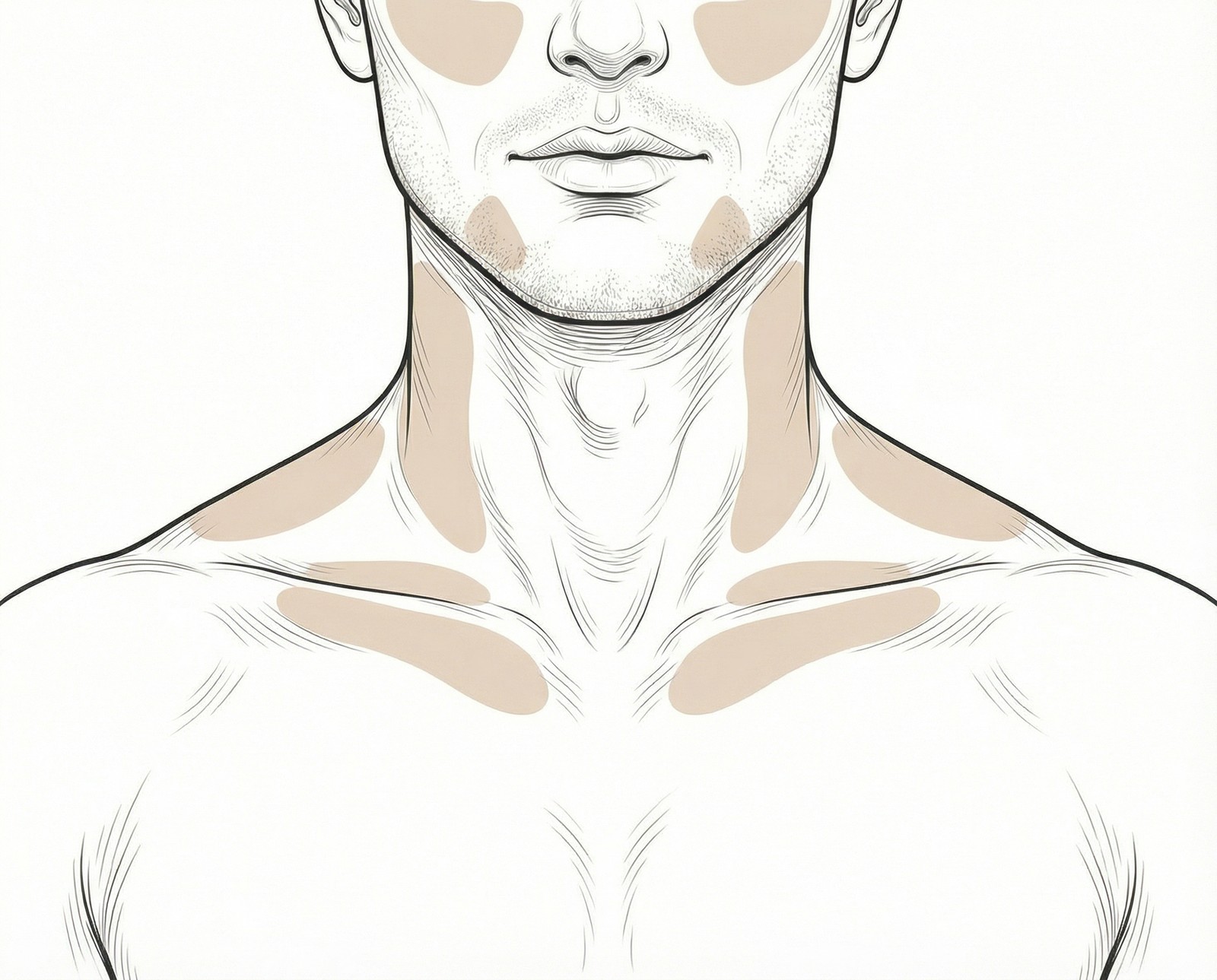
  1. sun spots — forehead, temples, neck (the result of years without SPF);
  2. post-inflammatory hyperpigmentation from shaving and ingrown hairs;
  3. uneven, grey tone of a "tired-looking" face;
  4. minimal downtime — thicker skin usually responds quickly to acids, and stages are planned around your schedule.
Rysunek stref zabiegowych — twarz i szyja, sylwetka męskaForehead and templesPoliczkiJawlineSzyja
Indicative map of the areas

Hyperpigmentation in men has specific causes

Men's skin accumulates hyperpigmentation differently from women's — and for different reasons. Years of outdoor work, often without the habit of wearing SPF, build up UV exposure into patches on the forehead, temples and neck. Shaving with a razor leaves micro-damage that, combined with a tendency toward ingrown hairs, turns into dark post-inflammatory marks along the beard line. After forty, hormonal hyperpigmentation can also appear — melasma, which is wrongly assumed to affect only women.
Each of these causes needs a different protocol. A brightening treatment at J'adore Instytut starts with an assessment of the type, depth and extent of the hyperpigmentation. Only then do we choose the active ingredients and the pace of treatment. There's no single recipe for everyone.

Thicker skin, a different pace — and a real advantage

Men's skin is thicker and produces more sebum than women's. This means two things at once: higher concentrations of active ingredients, or deeper exfoliation, are needed for a visible effect — but the skin is also usually more resistant to irritation and regenerates faster. In men, the results of a brightening treatment often appear earlier, and are more noticeable after just the first few sessions.
Salicylic acid penetrates pores more deeply than fruit acids, making it particularly effective for post-inflammatory hyperpigmentation along the beard line. Azelaic acid has antibacterial properties while also inhibiting melanin synthesis — a good choice when hyperpigmentation coexists with a tendency towards breakouts. Dosage and concentration are matched to your individual anatomy and treatment goal, not applied by a fixed template.

Shaving scars — a treatable problem

Dark marks along the beard line are the most common reason men turn to a brightening treatment — and one of the types of hyperpigmentation that responds best. Post-inflammatory hyperpigmentation is a build-up of melanin after mechanical damage to the skin: an ingrown hair, a breakout, razor irritation. Salicylic acid penetrates deeper into hair follicles and effectively clears excess melanin from around the pore. Improvement is usually visible after 3–4 sessions.
A practical point: for 48 hours after a peel session, it's best to avoid close razor shaving — the epidermis is more sensitive during that time. An electric trimmer or shaving at a distance from the skin is safe straight after the treatment. Your specialist will plan your session schedule to fit your grooming routine.

A visible effect, not a "done" look

The goal of a brightening treatment isn't to lighten the skin overall or change its shade. It's about making the face look even — without the focal hyperpigmentation that gives an impression of tiredness or neglect. An even skin tone makes a clear difference to how the face is perceived — without altering your features, without an "obviously treated" look. Anyone paying attention will notice the change. Anyone who doesn't know will simply see a well-groomed, healthy appearance.

Frequently asked questions

Can I shave normally throughout the whole treatment cycle?
Yes — with one caveat. For 48 hours after a session with an acid peel, skin is more reactive, and close razor shaving can irritate it further. An electric trimmer or shaving at a distance from the skin is safe immediately after the treatment. Your specialist will schedule sessions around your shaving routine to minimise discomfort.
Do I need to skip strength training or the sauna between sessions?
For the first 48–72 hours after a peel session, it's best to avoid heavy sweating — sauna, hot baths and intense training can heighten the skin's reaction and slow recovery. After that, there are no restrictions. SPF 50 applies regardless of activity — if you train outdoors, sun protection is essential.
Will anyone notice I'm having a brightening treatment?
Right after some sessions, skin may be slightly red for 1–2 days, and deeper peels can cause light flaking for 3–5 days. These effects are discreet and usually don't interfere with work. We schedule sessions so the first days after a more intensive treatment fall on less socially demanding days — let us know at consultation if you have important meetings or events coming up.
I have a dark skin tone — is a brightening treatment safe for me?
Phototypes IV–VI need a modified protocol: different active ingredients, dosages adjusted to your anatomy and individual sensitivity. This isn't a disqualification — it's a matter of choosing the method with precision. The standard programme is designed for phototypes I–III, but a consultation lets us adapt it so it's safe and effective for darker skin tones too.
Will shaving-related hyperpigmentation and sun spots disappear at the same time, or do I have to choose?
Both types can be treated as part of one course of treatment — the protocol often combines salicylic acid (for post-inflammatory hyperpigmentation along the beard line) with niacinamide and vitamin C (for evening out skin tone and reducing sun spots). Sequencing and priorities depend on severity — your specialist will set the plan at your first diagnostic consultation.

Where we offer it

Brightening programme for men — we perform it in three J'ADORE INSTYTUT salons: two in Warsaw and one in Krakow.

  • WarszawaŻelazna 59 · Wola · Mirów
  • WarszawaMińska 29A · Praga-Południe · Kamionek
  • KrakówKarmelicka 45 · Stare Miasto · Piasek

Price list

    Book a visit

    Prices come from the salon price lists. The choice of cocktail and the number of sessions is decided by your specialist at the consultation.