
WarszawaŻelazna 59WarszawaMińska 29AKrakówKarmelicka 45Warszawa · Kraków

Careers

ENPL

Full perspective

Sports / therapeutic massage (deep tissue) for men

Muscles don't forget — your body remembers every training session
Sports massage for men follows the most common pattern: strength training, greater muscle mass and desk work create heavily bound, overloaded areas. The work can be more intense simply because the tension is greater — but always with communication, never "full force without asking".
Czas
a shorter targeted session or a longer full-body one
Efekt
relief straight after the session; for training, it works best as a series
Regeneracja
none — you may feel brief muscle tenderness the next day
Seria
as a one-off or regularly, in line with your training rhythm
Wykonuje
massage therapist / physiotherapist
ListenSports / therapeutic massage (deep tissue) — this whole page read aloud

When it's worth it — indications

  • After training and competition — recovery, faster release of tension and soreness, lighter muscles.
  • Overload and stiffness — a bound-up neck, tight back, tight calves, stiff hips from sitting and the gym.
  • Trigger points — painful "knots" in the muscle that limit movement or refer pain.
  • Restricted range of motion — when muscles are so tense they shorten and restrict movement at a joint.
  • Injury prevention — regular work with overload for active people (running, gym, sport).
  • Before competition — a shorter, activating session that prepares muscles for exertion.
  • Desk work + sport — a typical combination: a sedentary day and intense evening training.

The areas we work on

  1. neck, traps and back — overload from work and the gym;
  2. chest, shoulders and arms — after pressing and pull-ups;
  3. thighs, calves and hips — running, squats, sport;
  4. injury prevention for regular, heavy training.
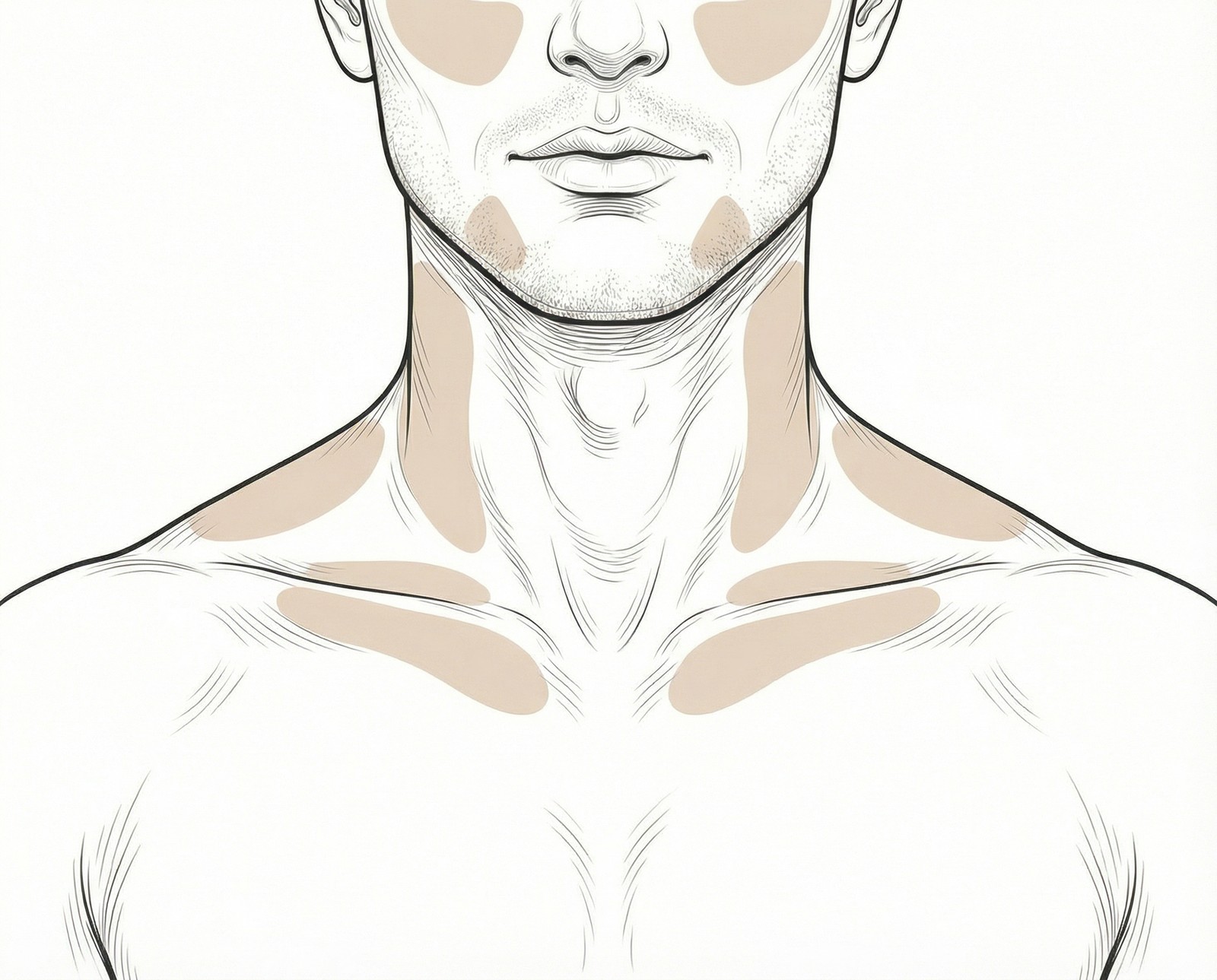
Rysunek stref zabiegowych — twarz i szyja, sylwetka męskaForehead and templesPoliczkiJawlineSzyja
Indicative map of the areas

Muscles don't forget — your body remembers every training session

Male muscle tissue is denser, has higher resting tension and is less well perfused in the deeper layers than in women. This means fascial adhesions and trigger points build up faster in men — and need firmer, more precisely targeted manual work to release. If you train strength or cardio several times a week and skip recovery, you're not saving time — you're deferring the cost to the future in the form of chronic tension, restricted mobility and, eventually, an injury that forces a break of anywhere from a few weeks to a few months.
The physiotherapist at J'adore works with men training at every level — from amateurs training three times a week to competitors preparing for events. Session parameters — pressure depth, techniques, focus areas — are chosen individually to match your training plan and the current state of your tissue.

Where tension builds fastest in men

With strength training: traps and lower trapezius (a hanger for desk-job stress plus overhead pressing), shoulder rotators (pressing without balancing the rear shoulder), biceps and the anterior-lateral chest wall (a result of push-dominant training), and the lower back and iliopsoas, shortened by hours of sitting.
With running and cardio: calves and plantar fascia, the IT band, the piriformis (especially on asphalt and slopes), and hip flexors shortened by sedentary work.
With combat sports and CrossFit: the whole neck-and-shoulder complex, the quadratus lumborum, and rotated pelvises from asymmetric techniques.

Sports massage and your training plan

Sports massage doesn't require a break from exercise — you can go back to training the next day. With intensive trigger point work, you might feel 24-hour tenderness to pressure (similar to mild DOMS after a new exercise) — this is a normal tissue response to releasing chronic tension, not a cause for concern. Light activity on the same day is advisable and speeds up recovery. We recommend postponing maximal-effort training by a day after a particularly intense session.
The optimal window for a recovery massage is 12–24 hours after training. A pre-competition massage works best 48 hours before the event, using lighter, activating techniques. During a training block, a massage every 7–14 days suits a volume of 4+ training sessions a week.

Frequently asked questions

Isn't sports massage too gentle — I want something firm to actually feel it?
Sports massage is one of the more intense forms of manual work available without medical indications. Cross-fibre friction, trigger point pressure and deep fascial work are demanding — not to be confused with relaxation massage based on light stroking. The physiotherapist calibrates pressure to your tolerance and the current state of your tissue: the first sessions on very tight areas can feel intense even at moderate pressure. Intensity increases with each visit as deeper layers release. Will anyone notice I'm getting massages? I worry it's not very "masculine". Sports massage is standard practice in athletic preparation at every level — from Premier League to UFC. Men make up over half of our clients for this treatment. Besides, no one asks how you handle your post-training recovery. Your muscles, your results.
I do strength training — won't a massage weaken me before my next session?
Quite the opposite. Released muscles have a better range of motion and are ready for full activation at your next session. A massage right before a heavy strength session isn't advisable (the tissue is more relaxed immediately afterwards), but 24+ hours beforehand it improves technique and reduces the risk of strains. With regular use, strength sets go up, not down.
I have a specific issue: knee pain for the past six months. Can massage help?
It depends on the source of the pain. If it's patellofemoral overload, IT band tension, or biceps femoris tension referring to the knee, manual work gives very good results, often within 2–3 sessions. If it's a structural injury (meniscus, ligaments), massage supports rehabilitation but doesn't replace an orthopaedic diagnosis. At your first visit, the physiotherapist will assess what's going on.
Can I combine sports massage with kinesiotaping or cupping therapy?
Yes — and it's often exactly what we recommend. Kinesiotaping after a massage stabilises and supports the muscles worked on between sessions, extending the effect by several days. Cupping therapy intensifies fascial work and is especially effective for chronic tension in the lower back and shoulder girdle. We choose the combination for you during the consultation.

Where we offer it

Sports / therapeutic massage (deep tissue) for men — we perform it in three J'ADORE INSTYTUT salons: two in Warsaw and one in Krakow.

  • WarszawaŻelazna 59 · Wola · Mirów
  • WarszawaMińska 29A · Praga-Południe · Kamionek
  • KrakówKarmelicka 45 · Stare Miasto · Piasek

Price list

    Book a visit

    Prices come from the salon price lists. The choice of cocktail and the number of sessions is decided by your specialist at the consultation.