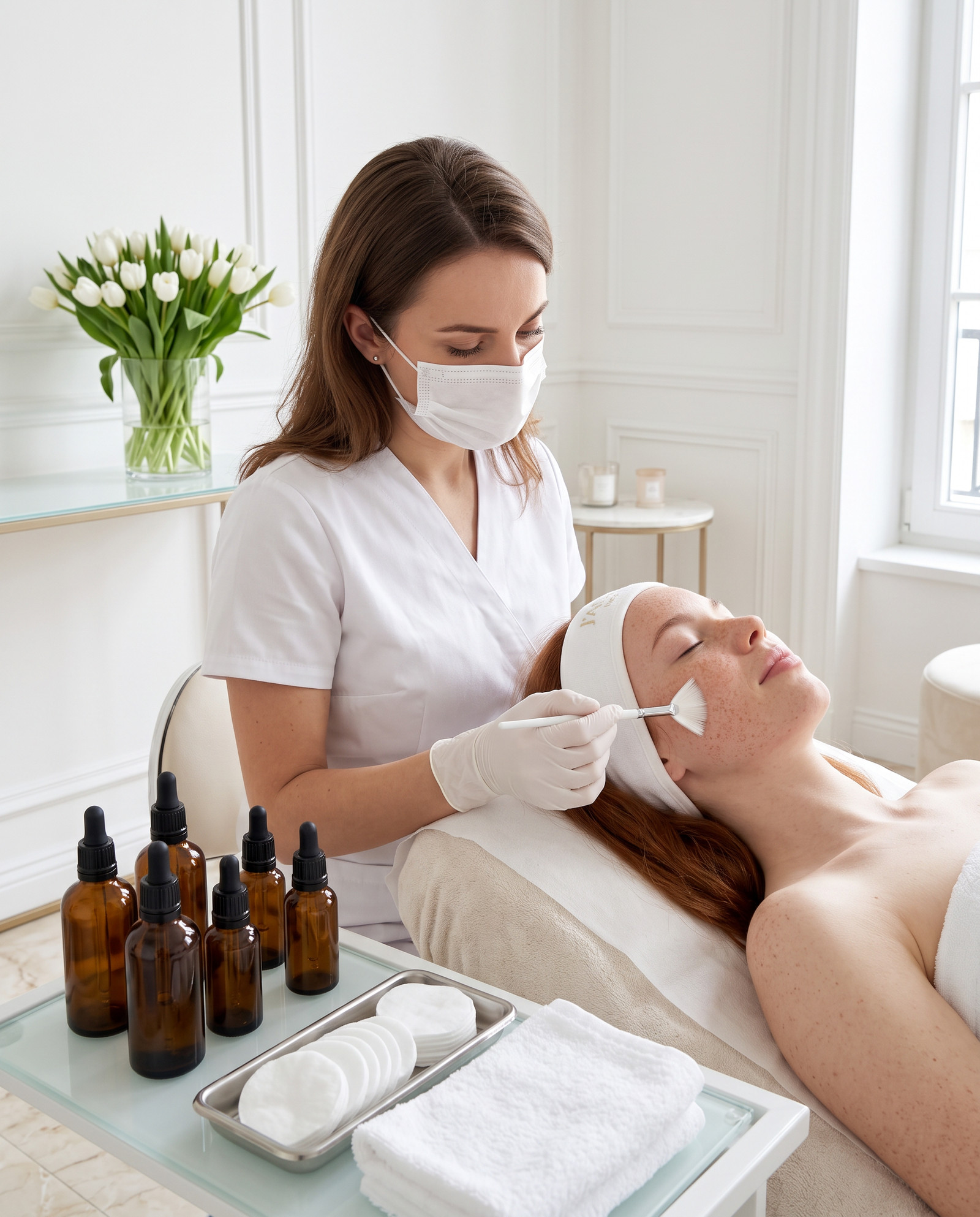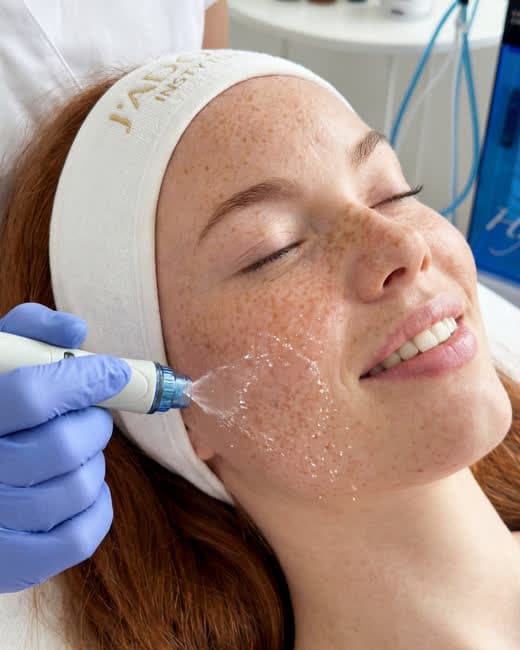
The cosmetologist qualifies the skin, not the name from the booking
The booking says C Peel, but under the lamp, we see something more important: fine cracks by the nostrils, uneven redness on the chin, peeling on the temples, and a freshly scratched lesion. The cosmetologist asks if your face stings when washing, if you have recently changed your cream, if you have been tanning, and how ordinary scratches heal. These observations lead to the decision to perform, modify, or postpone the procedure. The mere absence of a diagnosed disease is not enough for a green light.
In practice, the extent of the problem also matters. A small abrasion far from the planned area may require bypassing, but a weeping lesion in the middle of your cheek changes the whole situation. This cannot be resolved with a filtered photo or the answer "it’s just dry skin". Your face should be examined without make-up, and any doubt addressed before the preparation is opened.
Stinging when using water is a bad time for a resistance test
You have been combining a retinoid, an acid toner, and a cleansing brush for several evenings. On the day of your visit, you cover the redness with foundation because the peel was meant to improve roughness. After removing your make-up, your skin shines in the most irritated areas, and a simple cleansing product causes stinging. Performing another exfoliation would make it difficult to distinguish the reaction to the treatment from the damage that was already present. First, we must restore comfort and determine what led to the irritation.
Warning signals also include tightness lasting all day, itching after using many cosmetics, fresh peeling around the mouth, and redness that does not return to its baseline. Do not try to "prepare" your face with an additional home peel just before your visit. The clearer the initial picture, the easier it is to choose the right approach and notice a contraindication that make-up or a temporarily greasy cream should not hide.
Tingling under the lip can be more important than the absence of a blister
A cold sore does not always start with a visible lesion. If you know its recurrences, you may first feel a characteristic tingling, burning, or tenderness in one spot. You must report this before the treatment, even if your skin looked normal in the morning. An active cold sore and the suspicion of a starting recurrence are reasons to stop the plan and determine further steps with the appropriate specialist.
The mistake looks trivial: you cover the spot with a cosmetic, do not mention the symptom, and hope that since the preparation will not be applied exactly on your lips, the problem does not concern you. However, the boundary of the treatment area, make-up removal, and touch during the procedure all matter. A history of recurring cold sores should be included in your medical history even when no lesions are visible.
Wounds after squeezing, hair removal, and shaving are not a cosmetic detail
Do not aggressively disinfect a damaged area just before the consultation and do not cover it with a thick layer of concealer. Tell us when the injury occurred, whether it bled, whether there was any discharge, and what you used. If the lesion is hot, painful, or growing rapidly, the priority is to assess the problem, not to keep the peel appointment.
A fresh tan changes the decision even after a cloudy weekend
A tan does not have to mean lying on the beach. A long walk, gardening, or a day on the slopes can leave your skin warmer, darker, and more reactive. Sunburn, even without blisters, is a clear reason to postpone the procedure. It is equally important whether you can realistically limit exposure after the treatment, rather than just promising to apply SPF once in the morning.
A person with a tendency to dark marks after breakouts requires special caution. Excessive trauma and light can increase the risk of uneven skin tone after an inflammatory reaction. This is not an automatic ban for a specific skin phototype. It is an argument for assessing your phototype, previous discolouration, tolerance to skincare, and the possibility of protection after leaving the salon.
The list of medications must also include skin preparations
Isotretinoin in current or past therapy requires open discussion. Do not use a universal interval found in an online discussion and do not stop treatment on your own to keep the appointment. The decision depends on the procedure, the state of your skin, and the recommendations of your doctor. The cosmetologist should be able to refer you for a consultation if their scope of competence does not allow them to resolve the situation safely.
Allergy requires the name of the ingredient, not a general "I have sensitive skin"
In your history, provide known allergies to cosmetic ingredients, medications, latex, and substances used during procedures. Describe the reaction: was it redness at the application site, hives, swelling, shortness of breath, or just temporary stinging? These events are not equivalent. If you have a discharge summary after an allergy consultation or the name of the product that caused the problem, bring it instead of trying to reconstruct the composition from memory.
C Peel is the name of the treatment, not a single vitamin C molecule. The formula may contain other active and auxiliary substances, which is why a known hypersensitivity is compared with the full composition of the preparation used. A test performed on your own with a home serum does not confirm tolerance to a professional product. When the composition cannot be verified, this gap should not be filled with the assurance that "vitamin C doesn't cause allergies".
Pregnancy and breastfeeding require checking the specific protocol
The mere phrase "vitamin C" is not enough to qualify for a treatment during pregnancy or while breastfeeding. The complete list of ingredients, concentrations, area, method of use, and the rules adopted for the product all matter. Report your pregnancy, its suspicion, and breastfeeding before starting the procedure. If the safety of a specific formula is not clear, the right decision is to postpone or choose skincare approved after consultation, not to experiment.
Do not treat consent for one gentle home cosmetic as consent for every peel with a similar marketing description. Not all preparations in the same category are interchangeable. The salon should be able to provide the product name and explain the basis for its decision. If an opinion from your doctor is needed, it is worth obtaining it before the appointment instead of arguing while already in the chair.
A skin disease cannot disappear from the conversation just because it is currently calm
Atopic dermatitis, psoriasis, rosacea, a tendency to keloids, healing disorders, and other diagnosed diseases must be reported. Not every one of them always excludes every procedure, but it may change the threshold of caution or indicate the need for a medical consultation. Remission is also part of your history. The statement "nothing is visible now" does not say how your skin reacted to trauma and exfoliation in the past.
The cosmetologist examines the location of redness, the boundaries of lesions, blood vessels, scabs, and the way of peeling. If the picture is not clear, they should not guess the diagnosis or cover the problem with a milder treatment name. Postponing the C Peel until the lesion is clarified is more sensible than performing the procedure and later wondering which process is responsible for the deterioration.
General infection and feeling unwell also belong to the qualification
Fever, a fresh infection, intensified allergic symptoms, or an antibiotic started the day before are not side information. Call before you arrive and describe the situation. Weakness makes it difficult to go through the treatment comfortably, and the cause of the symptoms may require priority. Do not mask a temperature with medication just to use the appointment. Postponing the visit is easier than interpreting an unusual reaction in a person who already felt bad before the procedure.
It is also worth reporting a recent dental procedure, vaccination, or a new medication. This does not mean an automatic refusal; however, it allows us to assess whether there is a transient state that complicates observation. A good consultation card is not for ticking off answers. It is meant to capture changes since your last visit.
Previous good tolerance is not an indefinite pass
A person coming for the first time usually talks about cosmetics in detail because they do not know what to expect. At the fifth visit, they may shorten the interview to "everything is the same", even though they have started a retinoid, returned from a trip, and had a cold sore episode since the previous session. Knowing your feelings during a peel is helpful, but it does not protect you from a new contraindication. Every appointment requires a short update of your data.
During a follow-up after a series, the cosmetologist may see that redness lasts longer than before or that dry patches appear in a new place. This does not have to mean permanent intolerance. However, it may justify a break, a change in protocol, limiting the area, or a referral to a dermatologist. The repeatability of the treatment name does not guarantee the repeatability of the skin.
Fresh procedures and home experiments create an invisible interval
Microneedling, laser, waxing, intensive cleansing, another peel, and surface-disrupting treatments should not be hidden, even if performed elsewhere. Provide the date, area, and healing progress. The required interval depends on the type of intervention and the current picture, so it makes no sense to replace the qualification with one number of days for all combinations.
A home experiment can be equally important: a high concentration of acid bought online, a microneedle device, or an exfoliating patch left on longer than recommended by the manufacturer. If your skin looks calm, still tell us about the event. The cosmetologist must know why your tolerance may differ from that observed during an earlier visit.
The calendar after the treatment can be a practical contraindication
The day after the peel, you plan an all-day outdoor tournament, then the swimming pool, and two days later a photo shoot requiring heavy make-up. Even with healthy skin, such a plan may not leave room for protection and observation. Safety is not just the absence of disease on the day of the visit. It is also the ability to follow recommendations, react calmly, and make contact if the course turns out to be different than expected.
Postponing a C Peel is not a failure of your skincare plan. Sometimes it is better to choose a treatment that does not involve exfoliation or stick to your home routine. The alternative should correspond to what the cosmetologist really sees on your face, not the need to sell something in the reserved time.
Three similar bookings can end in three decisions
The first client comes with an even skin tone, no wounds, and no active irritation, but shows a photo of a retinoid recently introduced by a dermatologist. She does not know if she should have taken a break. The cosmetologist does not determine this on their own based on a forum and does not suggest hiding the treatment from the doctor. They stop the procedure until the plan is agreed upon. In this situation, the problem is not the appearance of the face, but the lack of information needed for a safe decision.
The second person has had a C Peel before and tolerated it well. This time, while removing her make-up, she mentions an itchy spot by her lip, although there is no blister yet, and she knows this feeling from previous cold sore recurrences. The practitioner does not cover the spot with a plaster and does not work "around" it, but postpones the treatment and indicates where to get further advice. A good history of previous sessions does not invalidate a new symptom.
Do not prepare answers for the expected result of the consultation
Before your visit, do not take a several-day break from every cosmetic solely so that your face looks calmer, if no one has recommended such preparation. The cosmetologist needs the true history: what you usually use, what has been discontinued, when, and for what reason. Your skin may temporarily stop stinging, but the lack of information about a previous reaction still leads to an incorrect assessment of tolerance.
Do not minimise symptoms with words like "it's nothing" when you care about an appointment before a celebration. Say whether the redness is new, whether it itches, whether it is spreading, and what preceded it. The salon should not punish you for honesty or exert pressure for the treatment to take place at all costs. A full answer protects not only your skin but also the possibility of later determining why a specific reaction occurred.
Warsaw: two locations, the same need for a full interview
You can find the service description and booking data on the page C Peel in Warsaw. J’ADORE INSTYTUT at ul. Żelazna 59 is open from Monday to Saturday from 8:00 to 21:00 and on Sunday from 11:00 to 19:00. The salon at ul. Mińska 29A/46 is open from Monday to Saturday from 9:00 to 21:00. The address does not change the rules: for the consultation, bring a list of your treatments and show your skin without hiding any active lesions.
If a symptom appeared just before your appointment, call the chosen location and describe it before travelling across the city. A short piece of information can save you unnecessary make-up removal and a visit that ends in a postponement. However, the final decision may require seeing your skin in person, because a photo does not show temperature, tenderness, or the way of peeling.
A safe refusal should end with a clear next step
A simple "it's not possible" leaves the client with the temptation to book the same treatment elsewhere the next day. A good qualification explains exactly what raises the objection, what information is still needed, and how to recognise that you can return for an assessment. Sometimes it will be the healing of a wound, sometimes the end of sun exposure, and sometimes an opinion from a dermatologist or your doctor. Not every situation should end with a new date immediately.
If sudden, severe stinging, pain, rapid swelling, or any other unusual sensation occurs during application, tell us about it immediately. Do not wait in silence to "endure until the effect". The cosmetologist observes the colour and reaction, but they do not feel what is happening on your face. After the treatment, increasing pain, blisters, weeping, signs of infection, or a severe general reaction require contact in accordance with the instructions received, and in an emergency — urgent medical help.
Ask for the reason for the deferral and the conditions for re-evaluation to be recorded. This ensures the next practitioner does not start the conversation with guesswork. It also prevents you from accidentally testing whether the issue has already passed. Documentation is meant to organise the decision. It does not serve as a promise that the treatment will certainly be performed after the indicated date.