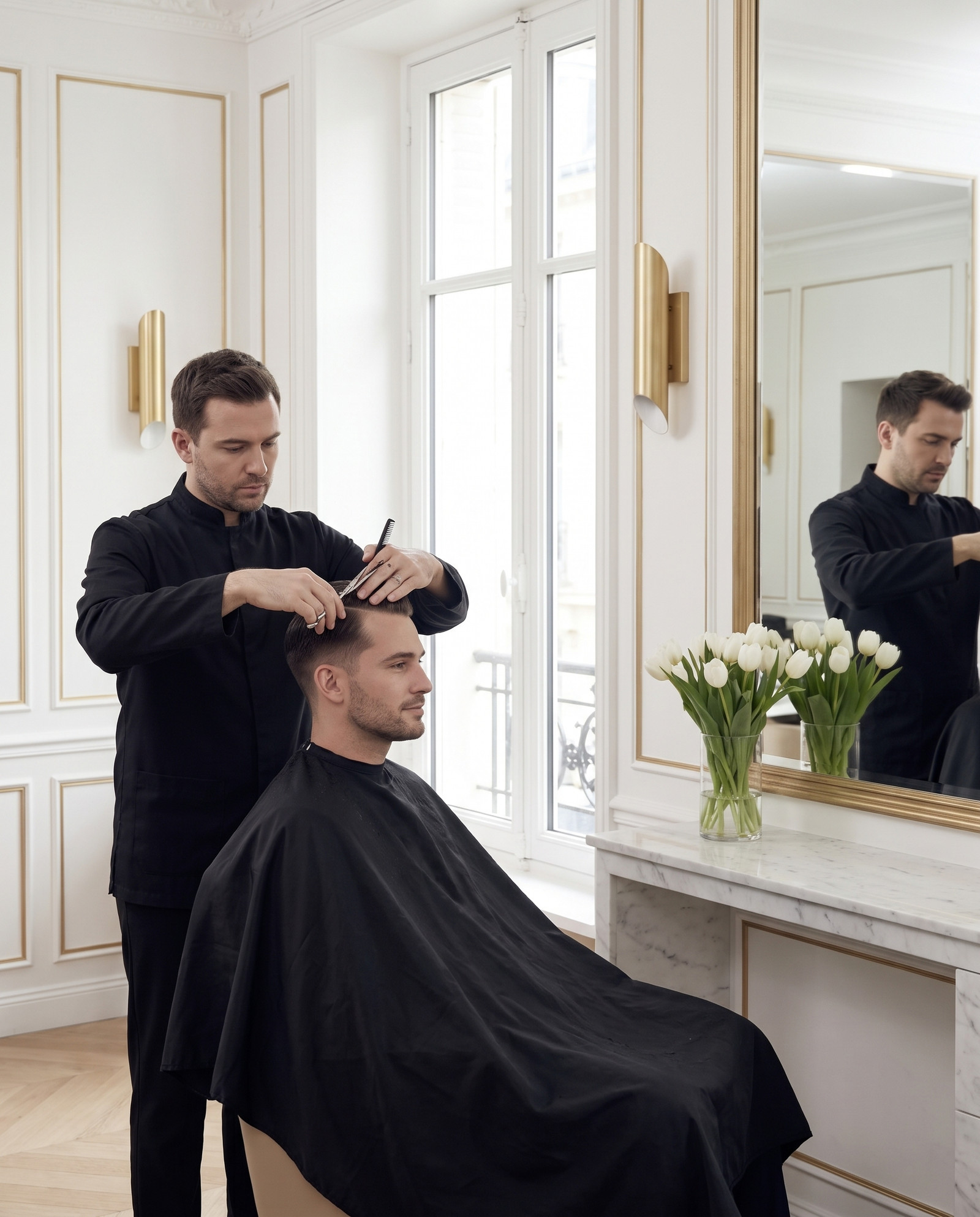
Before you open your mouth — do your homework
Your barber will ask "what are we doing?" and the clock starts ticking. There's no time for philosophising. That's why you prepare before you walk in — it takes three minutes the night before and saves you weeks of regret (regrowth takes about six weeks).
The most effective method: a reference photo. One good image, showing the haircut clearly from the front and the side. Not a gallery of ten different styles — that only causes confusion. One clear photo says more than five minutes of description. Your barber immediately sees the proportions, texture, gradient and the line above the ears. No guessing what you mean by "short" or "classic".
If you don't have a photo, remember three parameters: length on top, length on the sides and back, and the transition between them. These are your three coordinates. Everything else is detail.
The language your barber understands
There's a gap between what you mean and what your barber hears. "Short" means 3 cm to one client and 1 cm to another. "A bit" means everything and nothing. Below is a vocabulary that works:
- Clipper number — from 0 (bald) to 8 (about 25 mm). If you don't know your number, ask your barber at your last visit and remember it. "Same as last time, sides at 2, top at 4" is a perfect instruction.
- Transition — three types: hard part — a sharp line with no gradient; skin fade — fading down to the skin; fade/gradient — a smooth blend between lengths. If you say nothing, your barber will pick whatever they prefer — not what you want.
- Line above the ears and at the nape — sharp (shaved in a clean line) or natural (left as is). A sharp line looks tidier but grows out faster. A natural line is less invasive and holds up longer between visits.
- Texture — left "lived-in" (some movement, some chaos) or smooth and styled. The first works better on thick hair, the second on fine, straight hair.
- Temples and beard — say upfront whether you want them tidied up. "While you're at it, could you tidy my brows and sideburns" is a sentence worth adding — or skipping, if you'd rather leave them alone.
Common traps — and how to avoid them
Even with a good description, misunderstandings happen. Usually when you use words that sound specific but stretch like elastic:
What you say
what it means to you
- "Take a bit off the top"
- "A classic haircut"
- "Same as last time, just a bit shorter"
- "A light fade"
What your barber hears
how they interpret it
- Could be 1 cm or 4 cm
- 1950s? undercut? ivy league?
- "A bit" is a wild card again
- High fade or low? Down to skin or not?
There's one remedy: add numbers or show a photo. If your barber starts asking questions, take it as a good sign. It means they want to get it right, not take a guess.
During the cut — speak up, don't stay silent
There are two moments worth speaking up: right at the start (before anything is cut) and after the first pass, while there's still room to adjust. The middle of the cut is the worst time — the result is unpredictable because the haircut is half-finished. Once it's done, that's when you can judge it properly.
If something feels off once it's finished — say so before you get up. Most barbers will fix it without a fuss. If you're wondering whether you're "allowed" to say something — yes, you are. You're sitting there, looking in the mirror; this is exactly the moment. Just don't save the feedback for after you've walked out the door: your hair will grow back, and the feedback won't reach anyone but your phone.
Building a relationship — not every visit is a blank page
Men who've had the same barber for years don't need to explain anything. Two words and it's done. That's not magic — it's the result of accumulated information. Your barber remembers your hair, knows how it grows, knows what you like. You get there through 3–4 visits of good communication, not by hoping someone will "figure you out".
On your first visit somewhere new: explain more than you think you need to. Say what you liked about your previous barber, what didn't work for you, and how you want your haircut to grow out between visits — whether you prefer it neat for four weeks or one that holds up for six without a trim. This information works in your favour at every visit that follows.
A good barber isn't one who "tries hard" from scratch every visit. It's one who builds up knowledge of your hair and suggests refinements. If you're still explaining everything from zero on your third visit, that's a sign it's worth finding someone who listens.
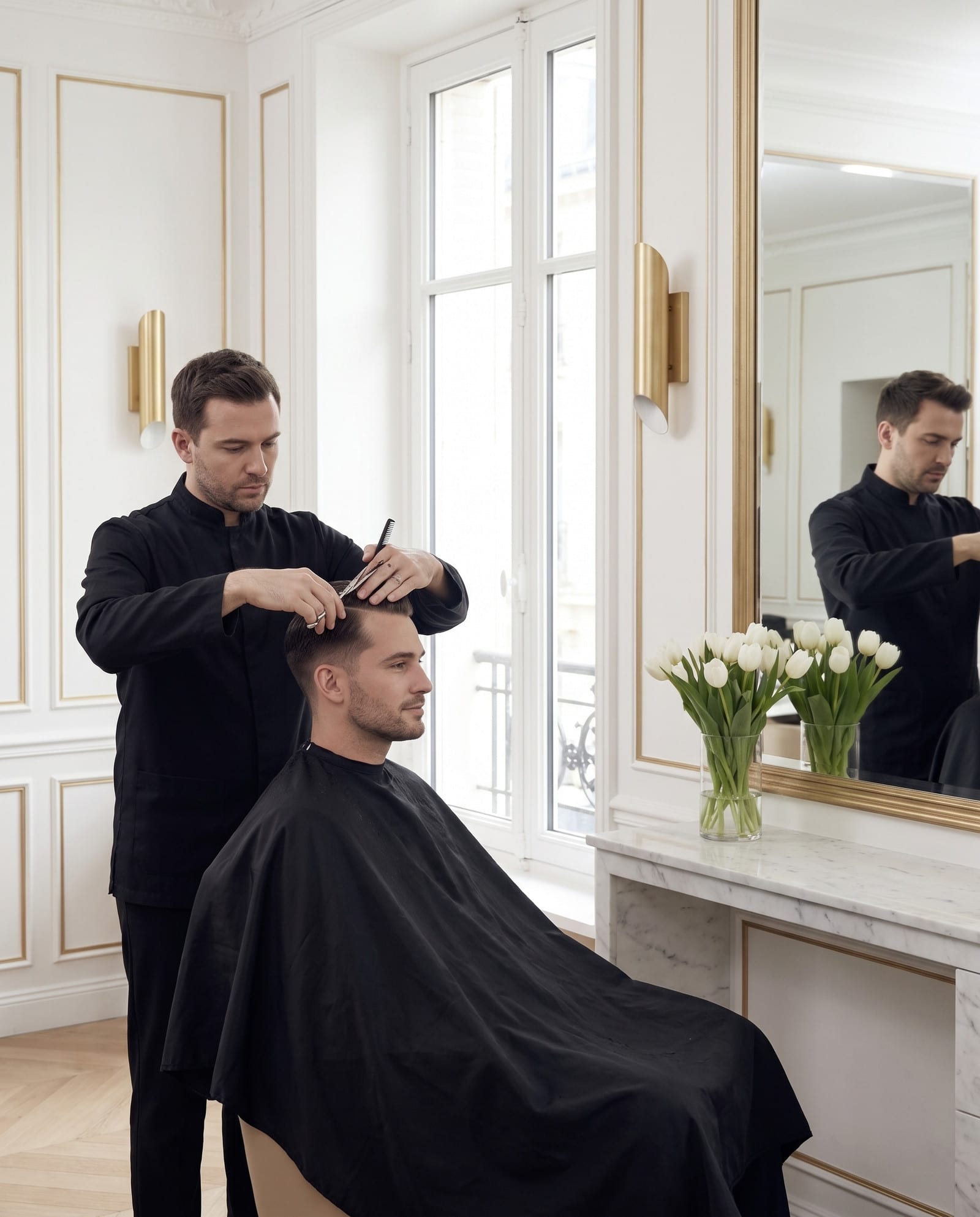
Special situations — when communication gets harder
Some cases need more than a verbal description:
- Hair loss and thinning. Say it plainly — "I have thinning at the hairline / on top, and I want the cut to work around it." Your barber has techniques to conceal it (cutting direction, texture, the right length), but only if they know it's a priority.
- Uneven growth and "whorls". If you have a whorl or one side grows differently from the other, mention it up front. Your barber can factor this into the cutting direction or proportions.
- Changing your style after years of the same cut. Bring two photos: the old one (what you want to keep) and the new one (the direction you're heading). Say what wasn't working for you. A drastic change all at once can be risky — a good barber will suggest doing it in stages.
- A special occasion. A wedding, a job interview, a photo shoot — always mention the date. Your barber will be more conservative if they know there's no room for a touch-up.
After the cut — the aftercare that keeps it looking good
Your haircut looks great leaving the salon, then looks completely different two days later. Often it's not down to the barber — it's down to what you do afterwards. A few rules that make a difference:
- Styling starts with a dry towel, not a hairdryer. Rubbing your hair hard with a towel roughens the hair's outer layer and leads to frizz. Pat, don't rub.
- A good product is one that matches your haircut. Deep shine with strong hold (wax pomade) — for classic, styled cuts. Matte finish with natural hold (clay, paste) — for textured, undone styles. The mistake is using a heavy pomade on a light, movable cut.
- Less is more. Most men use too much product. Slicked-back, clumped strands aren't a style — they're the result of overdoing it. Start with a small amount and add more if you need it.
- Dry styling versus wet. Always style your hair when it's dry or slightly damp — never soaking wet. Wet hair won't hold its shape once dry; you lose the effect your barber spent half an hour creating.