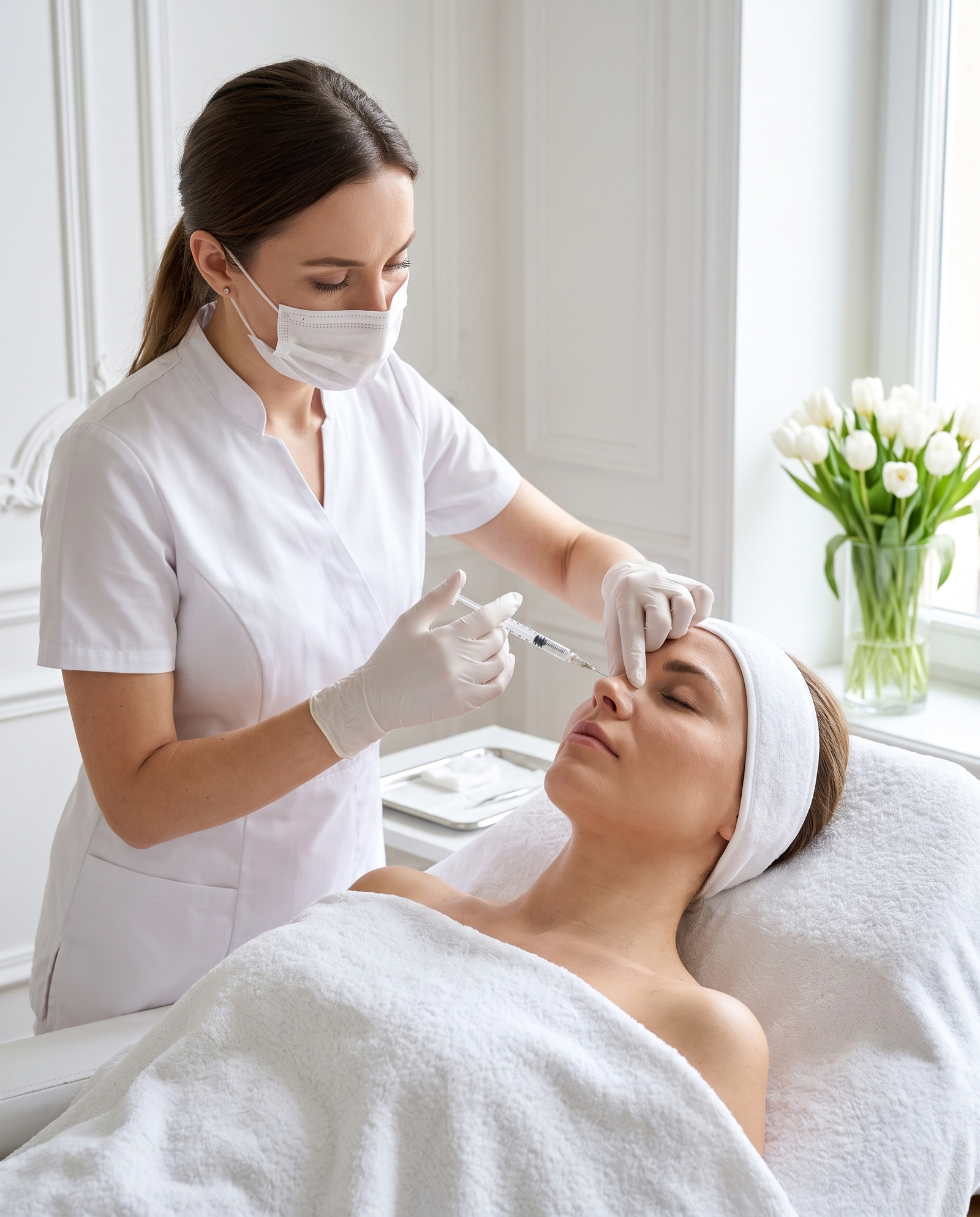
A filler masks an irregularity by adding volume
With the right anatomy, a small amount of product can even out a depression on the bridge, change the perception of a hump, or subtly correct profile proportions. The result comes from light and line contouring, not from tissue reduction. From the front, the nose may still have the same width, and sometimes the additional volume will be noticeable.
This method will not fix a deviated septum, improve breathing, or remove a large hump. If the goal is a real reduction of the nose or functional correction, adding product may only take you further from your goal.
Surgery can remove and rearrange structures, but it requires recovery
Rhinoplasty allows for the modification of bone and cartilage elements, width, projection, the tip, and — in a properly planned procedure — functional problems. The scope is greater, but the consequences are also greater: a surgical procedure, swelling, healing, post-operative limitations, and the permanence of the decision.
Surgery is better when the problem cannot be masked by positive volume, when the nose needs to be smaller, or when there are breathing difficulties. A filler is sometimes better for minor profile correction, a realistic goal, and anatomy qualified by an experienced doctor.
The reversibility of a filler does not mean there is no serious risk
Hyaluronic acid-based products can be dissolved with hyaluronidase in certain situations. This does not mean, however, that every problem disappears immediately or that the treatment is trivial. The nose is an area with complex vascularisation; intravascular injection can lead to tissue ischaemia and, in extreme cases, visual impairment. This requires medical qualification, knowledge of anatomy, and the readiness to recognise complications.
- Ask who is performing the treatment and what their experience is in this specific area.
- Check whether the clinic has a procedure for suspected ischaemia.
- Ask for the name of the product and the medical documentation of the treatment.
- Establish which symptoms after leaving require urgent contact.
The duration of action and the permanence of the decision are fundamentally different
A filler provides a temporary effect, although the actual duration depends on the product, tissues, metabolism, and previous treatments. You should not plan automatic top-ups without assessing whether the previous material is still present. Repeating it "because a year has passed" can lead to volume accumulation.
The result of surgery is assessed after a long healing period; swelling can change the appearance for many months. This is a much more permanent decision, but the word "immediate" does not describe it either. In both methods, a photo taken right after the procedure is not the final result.
The comparison must also include what is not visible on the profile
Filler correction
optical contouring
- adds volume at selected points
- does not improve breathing
- temporary effect, hyaluronidase possible
- no surgical healing, but there is a vascular risk
Rhinoplasty
structural change
- can reduce and rearrange tissues
- can include the functional aspect
- permanent result
- surgery and longer recovery
A profile photo may hide asymmetry visible en face, the width of the nose base, or the influence of facial expressions. A consultation should include an examination from several angles and a conversation about breathing, previous injuries, surgeries, and injections.
When neither method is a good answer for today
A treatment is not planned during an active infection, skin lesions at the injection site, or without a full medical and medication history. After a recent surgery, injury, or previous filler, an assessment of the tissue condition is needed. Dysmorphophobia and the expectation that changing the nose will solve a broad self-esteem problem also require stopping the process, not accelerating the booking.
Non-surgical correction is not worth it for someone who wants a smaller nose and does not accept adding even a small amount of volume. Surgery is not a reasonable "permanent alternative" for someone who is not ready for the risks and healing. Sometimes the right decision is no treatment at all.
A Krakow consultation should end with qualification, not a sale
J’ADORE INSTYTUT in Krakow is located at Karmelicka 45/2B. You can check the scope of services on the city nose correction page. At the consultation, show photos of your goal, but ask the doctor to assess your face in motion and from several perspectives.
If the goal requires tissue removal, functional improvement, or a major change, the answer is a surgical consultation. If it concerns a minor profile alignment by adding volume, a filler can be considered — provided the anatomy is suitable and you accept its limitations. This distinction protects against choosing a convenient procedure for the wrong goal.
First, name the problem: hump, tip, width, or breathing
The phrase "I don't like my nose" is too broad to choose a method. A small depression above a hump is planned differently than a drooping tip, a wide base, clear asymmetry after an injury, or difficulty breathing. A filler only works where adding volume can improve proportion. Surgery offers the possibility of working with structures, but the scope is determined by the surgeon after an examination, not by an internet photograph.
With a hump, a filler can build a straighter line above and sometimes below the prominence. The hump still exists; the surroundings stop reading it so clearly from a chosen angle. When the hump is large, masking would require adding more volume and could enlarge the profile. Then, the advantage of the method turns into its limitation. Surgery may be more accurate if the goal is to remove the prominence, not to camouflage it.
The tip of the nose also requires precise language. A subtle change in support or perception of the angle is not the same as reduction, narrowing, or permanent cartilage reconstruction. In selected cases, a filler can change the line, but it will not replace surgery for a large, heavy, or clearly asymmetrical tip. The promise of any "lift" with a product ignores the boundaries of anatomy.
Width visible en face is particularly important. Adding material to the bridge can improve light and shadow, but it does not narrow the bone or the wings. If the primary goal is a narrower nose from the front, analysing only a profile photo leads to the wrong choice. In turn, a problem with airflow requires a functional assessment. An aesthetic filler treatment does not clear the nose and does not treat the cause of breathing difficulties.

A temporary effect is not always a good "test before surgery"
It is often said that a filler allows you to check a new shape before rhinoplasty. This is true only in a limited sense. You can see how the face perceives a straighter profile line created by adding volume. You cannot simulate a smaller nose, a narrowed base, a removed hump, or the healing result after cartilage reconstruction in this way. These are different geometries.
A filler before surgery can also complicate the assessment. The surgeon should know which product was administered, when, and at which points. The material may still be present, even if the patient thinks the effect has already disappeared. Sometimes, before planning a procedure, waiting, an additional assessment, or considering dissolving the product is necessary. Decisions are not made independently according to a calendar date.
If you know from the start that you want to remove a hump and reduce projection, performing a series of temporary camouflages may mean additional procedures without getting closer to the goal. A surgical consultation does not oblige you to have surgery; it allows you to learn about the possibilities and limitations. A filler makes sense as a separate method for a properly qualified, small goal, not as a mandatory gate before surgery.
On the other hand, an undecided person who expects only a subtle alignment and accepts slightly more volume can consciously choose a temporary effect. However, they must accept the entire package of this decision: the risk of injection, the possibility of unevenness, the need for follow-up, and the fact that repeating the treatment should not happen automatically. The word "test" cannot be used to downplay the seriousness of the procedure.
Recovery differs not only in length but also in unpredictability
After a filler, you can expect local swelling, tenderness, redness, or bruising. The final perception should not be assessed at the moment you get out of the chair, because the punctured tissues change shape. A normal post-treatment reaction is different from increasing pain, blanching, skin mottling, or visual impairment. These symptoms require immediate assessment and are not part of the normal waiting for the result.
After surgery, you must count on more extensive healing. Visible swelling and bruising are only part of it; the nose can change gradually, and individual areas do not lose swelling at the same rate. Early asymmetry does not have to be the final result. The date of an important event should take into account not only the moment the dressing is removed but a longer period of uncertainty regarding the appearance.
A filler wins with shorter time off from daily life, but loses with its temporary nature and the vascular risk specific to injections. Surgery loses with the length of healing and surgical burden, but it can solve a structural problem that a product will not touch. You cannot honestly compare the methods solely by asking "which one will get me back to work faster?". First, you must check whether both lead to the desired result at all.
Planning before a wedding, a session, or a long trip should be conservative. A treatment right before an event leaves little time to assess swelling, bruising, or the need for a check-up. Surgery, even more so, is not planned according to a photo calendar without a margin for healing. If the date is more important than the possibility of safe management, it is sometimes more reasonable to resign from the procedure for the moment.
Risks have a different nature, so they cannot be placed on one scale
A filler is a minimally invasive treatment compared to surgery, but this term does not mean the stakes of every complication are low. Vessels connected to the circulation of the eye area run through the nose. Skin ischaemia, necrosis, and visual impairment are risks that the doctor should talk about before consent. The clinic must be able to recognise symptoms and start the appropriate management without delay.
Hyaluronidase is a tool used for HA products, but it is not a magic button that turns back time. Its use also requires a medical decision, can cause reactions and does not replace a prompt diagnosis of the problem. Not every unwanted effect is solely a matter of excess material. Swelling, infection, lumps, unevenness or an inflammatory reaction may occur, and the course of action depends on the cause.
Rhinoplasty carries surgical and anaesthetic risks, bleeding, infection, healing disorders, scarring, persistent asymmetry, an unsatisfactory result and the possibility of needing further correction. An aesthetic change can affect respiratory function, so qualification should cover both aspects. The surgeon discusses specific risks based on your health, anatomy and surgical plan.
The comparison of "safe injection versus risky surgery" is therefore false. A more accurate question is: which risk is justified by the scope of the possible benefit? For a small unevenness, surgery may be disproportionate. If you want to reduce the nose, a filler is inadequate because it exposes you to risk without performing the task. The right method minimises not only invasiveness but also the gap between the procedure and the goal.
Before and after photos easily overstate both methods
A profile photographed from a slightly different camera height can look straighter, shorter or more upturned. The focal length affects the proportions of the central part of the face, and the light affects the visibility of a bump. Make-up, lip tension and chin position also change the perception. Compare photographs taken from the same distance, in similar light and without filters.
With a filler, a photo taken immediately after may include swelling. With surgery, a photograph taken after a few weeks does not necessarily show a mature result. Ask when the "after" shot was taken and whether it represents a long-term follow-up, not just a first impression. One good pair of photos says less than repeatable results shown from the profile, three-quarter view and front.
Look for cases with a similar problem, not a similar hairstyle or beauty type. If the width of your nose en face bothers you, a portfolio full of straight profiles does not answer the question. If you are considering correction after an injury, results on symmetrical primary noses also have limited value. The doctor should explain the differences instead of promising to repeat someone else's result.
Computer simulation can help discuss the direction of surgery, but it is not a guarantee. The model does not fully account for the biology of healing and tissue response. With a filler, marking points on a photograph also describes the intent, not a certain result. Visual materials are the language of consultation; they should not replace a conversation about limits.
Questions that separate a good qualification from a quick booking
- Which element of my nose can be changed with this method, and which will remain unchanged?
- Will the effect be created by adding, removing or rearranging tissues?
- How might the nose look from the front if the profile is filled?
- Do my breathing difficulties require separate diagnostics?
- How does a previous filler, injury or surgery change the plan?
- Which symptoms after the procedure are normal, and which require immediate contact?
- Who provides care in the event of a complication and what is the route for urgent contact?
- When can the result be honestly assessed and what is subject to control then?
- What does the doctor recommend if neither method provides a proportional benefit?
A good answer does not have to lead to a treatment. It may indicate that a small feature is a normal part of anatomy, that camouflage would enlarge the nose or that surgery would be too great an intervention for the goal. It may also refer you to an ENT specialist or surgeon if the problem has a functional aspect. Refusal and referral to the appropriate specialist are elements of qualification.
Be wary of an answer focused solely on the number of units of the product, a promotion or an available slot. Quantity is the result of the plan, not its beginning. In surgery, an equally poor signal is the promise of an identical nose to an inspiration without discussing your own proportions and function. In both cases, the doctor should examine, ask and name limitations before pricing the final procedure.
The most useful verdict is often simple. Choose a filler only when a small correction by adding volume achieves the goal, and the qualifying doctor considers the anatomy suitable. Choose a surgical consultation when you expect reduction, structural changes or functional improvement. Do not choose either method if the benefit is unclear, expectations are unrealistic or you do not accept the full risk profile.
The history of previous corrections is part of today's anatomy
Every previous treatment changes the starting point. Tell us about all injections into the nose and surrounding areas, even if they were performed a long time ago, the effect seems invisible or you do not remember the name of the product. Provide an approximate date, place of administration, reactions after the treatment and information about any dissolving. Do not assume that the material is no longer there just because the period stated in the advertisement has passed.
After surgery, scars, altered tissue pathways, grafts and the healing process matter. Injectable nose correction after rhinoplasty is not a simple "trifle for unevenness"; it may require a different risk assessment. Reoperation is also a separate category, usually more difficult than the first procedure. The qualifying doctor should know the documentation, and a lack of data may be a reason to expand diagnostics or postpone the decision.
Do not try to prepare your nose for consultation by massaging it yourself or pressing on unevenness. Do not book one procedure just to "fix" the effect of another without determining the cause. Excess product, swelling, a scar and natural asymmetry may look similar in a photo, but they require different management. First, identify the current state, then choose the tool.
This rule organises the entire comparison: you are not choosing between an abstract injection and an abstract surgery. You are choosing an answer to a specific anatomy, with its history and function. The more previous interventions there are, the less room there is for a decision based solely on convenience or speed.