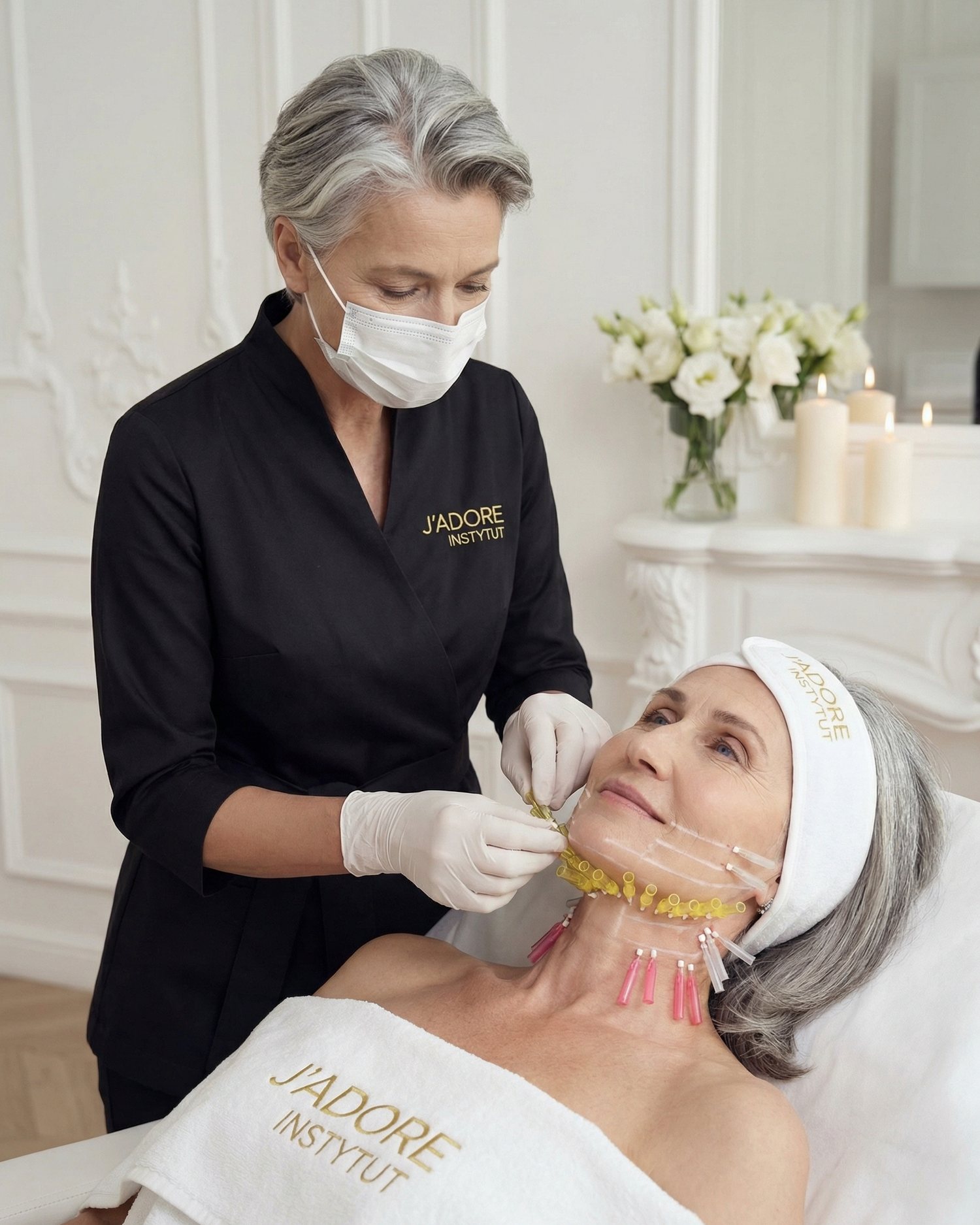

First, understand what's actually sagging
The facial contour isn't a single structure — it's several layers that age at different rates. On top sits the skin — thinner with age, less springy, with weaker collagen. Beneath it lies fat tissue, arranged in "pads" that a young face has full and high, and a mature face has flattened and dropped. Deeper still are the ligaments and the muscle-fascia "frame" of the face, and beneath everything, bone that resorbs over time. The contour sags when one of these layers — or several at once — stops holding.
This distinction matters, because each of the three methods addresses a different level of the problem. Filler works on volume and support. Threads work on lifting and densifying. A surgical lift physically removes the excess and tightens deep structures. The question "threads, filler, or surgery" is really the question "which layer is my problem playing out on".
Three paths, three different jobs
The simplest way to remember it: filler rebuilds support, threads lift and densify, a lift removes the excess and tightens the frame. The first two are aesthetic medicine — no cuts, short recovery. The third is a surgical procedure, with an actual operation and real recovery time. Here's how they differ in practice:
Filler / volumetry
rebuilds lost volume and support
- cheeks, cheekbones, jawline, chin, temples
- reduces "jowls" and hollows by supporting the contour from within
- results are visible immediately and are largely reversible (HA)
- when the face looks "emptied out" rather than sagging
Lifting threads
lift tissue and densify the skin
- gentle lift to the cheek, contour, jawline, neck, brows
- alongside lifting, they stimulate your own collagen along their path
- result is partly immediate, partly builds over time; temporary
- when the contour has sagged mildly to moderately, but the skin still has elasticity
Surgical lift
removes excess skin and tightens deep structures
- genuine sagging of skin and tissue, advanced contour drop
- the surgeon repositions the SMAS layer and removes the excess — permanently
- the deepest and longest-lasting result, but this is surgery with recovery
- when non-surgical methods no longer "reach" the scale of the problem
The mirror test — where to start the conversation
Before anyone suggests a treatment, you can run a quick self-check in front of the mirror. It won't replace a consultation, but it will steer the conversation the right way — and help you notice if someone is selling a solution that doesn't match your problem:
- The finger-lift test. Place your fingers on your cheek and gently lift the tissue towards the temple. If the contour "comes back" and visibly improves from that small lift — that points towards threads.
- The hollowness test. Look at whether your cheek and cheekbone area look "emptied out", flattened, as if something has gone from them. If it's more a lack of volume than sagging — the direction is filler / volumetry.
- The resting-fold test. Relax your face and look at the jawline and neck. If the skin visibly hangs, forming folds and excess that no gentle lift will hide — that's a sign the problem may go beyond aesthetic medicine, and it's worth discussing surgery.
- The elasticity test. Gently pinch the skin on your cheek and release it. If it bounces back quickly and springily — non-surgical methods have plenty of scope. If it returns slowly and "sluggishly" — the skin has lost firmness, which changes the calculation.
The most common result of this test isn't "one of the three" — it's a bit of each, because a mature face usually loses volume and firmness at the same time, and the contour sags on several levels at once. That's entirely normal, and it's exactly why a good plan is rarely "one treatment". But simply naming what bothers you most means the consultation starts with something concrete, not with "I'd like to do something about this".
When to combine — and why the best results are rarely "one treatment"
Since the contour sags across several layers at once, the most natural results usually come from a sensible combination of methods, matched to what's happening at different levels of the face — with the order and intervals decided by your doctor. The logic stays the same: rebuild the foundation first, then lift, and finally address the quality of the skin covering it all:
Filler + threads
first restore volume and support where the face has emptied out, then lift with threads what already has something to "sit" on. The reverse order tends to disappoint.
Threads + biostimulator / collagen
lifting plus gradual rebuilding of skin quality and density, so the result isn't just "lifted" but better supported from within.
Filler + skin-tightening treatment
volume plus work on surface firmness, when the skin starts losing elasticity but surgery is still far off.
A plan spread over time
for a mature face, it's more common to sequence several treatments at intervals than to do "everything at once". The face should look rested, not "done".
- 01
Consultation & diagnosis
Your doctor assesses which layer has failed — volume, firmness, or structure. This is where the decision "aesthetic medicine or already surgery" is made.
- 02
Foundation
If volume is missing — support is rebuilt first (volumetry / filler), so there's something to lift.
- 03
Lifting
When sagging tissue needs lifting — threads, either alone or alongside volume work.
- 04
Skin quality
Biostimulation and surface care — so the contour not only "holds", but also looks good.
- 05
Maintenance
Results from non-surgical methods are temporary; the plan builds in repeat sessions at intervals agreed with your doctor.
Where aesthetic medicine ends and surgery begins
This is the question most missing from conversations about the facial contour — because it's easier to sell another non-surgical treatment than to admit the problem has outgrown the method's scale. Yet there is a limit, beyond which threads and filler start "chasing" the sagging, adding work without a satisfying result. Signs you're at that limit: clear excess skin that doesn't disappear with a gentle lift, significantly loosened neck tissue, advanced sagging that non-surgical methods can no longer "reach".
A surgical lift does something aesthetic medicine, by definition, cannot: it removes excess skin and tightens deep structures (including the SMAS layer), giving the deepest and longest-lasting result. The price for this is real, though — it's surgery, with a general or local anaesthetic, real recovery, and risks your surgeon will discuss with you. Importantly, a lift on its own often doesn't rebuild volume — which is why it's sometimes combined with a fat transfer, so the tightened face doesn't look "empty".
The good news is that for most people with early to moderate contour sagging, aesthetic medicine has a great deal to offer — and can push back the thought of surgery for years. The less good news, in the sense that it calls for honesty with yourself, is that with advanced sagging, further injections won't just fail to help — they can actually weigh the face down. A sound plan is one that names where you are on this scale, and doesn't pretend the limit doesn't exist. The best first investment is almost always a consultation, where someone will honestly help you locate that limit.