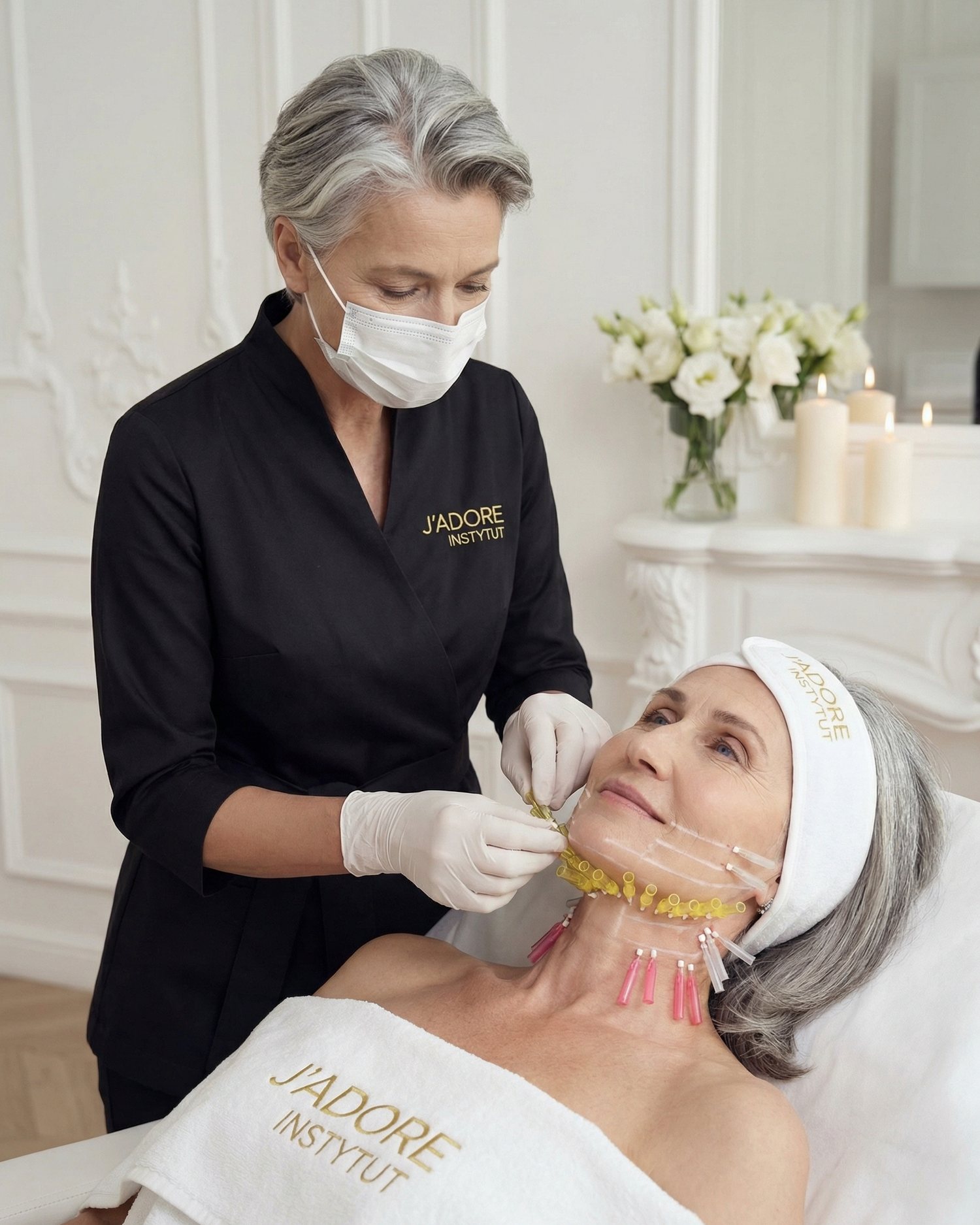

Four tools, four levels of action
Before we compare them: each tool addresses a different ageing mechanism. The face doesn't age uniformly. It loses fat volume, tissue softens and sags, skin loses density, and the jaw and eye-socket bones slowly change shape. That's why one solution is rarely enough — good treatment starts by identifying which mechanism dominates in a particular case.
Volumetry
restores facial proportions and contour
- loss of fullness in the cheeks and temples
- the face becomes narrower, the "triangle of youth" inverts
- sagging features caused by volume loss
- immediate result — the doctor sculpts the face like an artist
Filler (hyaluronic acid)
precisely fills specific areas
- nasolabial folds visible at rest
- tear trough, lip contour, eye area
- targeted corrections — one area, one specific result
- immediate result, precise and reversible
Lifting threads
mechanically lifts and tightens tissue
- sagging facial contour, cheeks, neck
- brows or mouth corners pulling downward
- visible soft-tissue ptosis
- immediate result plus collagen stimulation
Stimulator / biostimulator
rebuilds skin quality from within
- thin, grey skin, lacking firmness and radiance
- fine network of lines, lack of density
- works with your own collagen and elastin
- results build up over weeks and last a long time

How to identify what you need — the mirror test
Before you book a consultation, sit for a moment in front of a well-lit mirror. These four questions won't replace a medical diagnosis — but they'll help you describe the problem accurately and choose the right specialist:
- Look at your whole face, not just one part. If you feel that "everything has dropped" or your face is narrower than it used to be, that signals volume loss. Direction: volumetry.
- Look for a specific fold or hollow. A line from the nose to the corner of the mouth, shadows under the eyes, thin lips — these are localised deficits. Direction: filler.
- Lift your cheek or neck skin with a finger. If your face "lifts" and looks several years younger, you have sagging tissue. Direction: lifting threads.
- Examine your skin texture. Fine lines everywhere, no radiance, skin that looks papery or dull — that's a skin-quality issue, not a volume one. Direction: stimulator or biostimulator.
A simple rule is worth remembering: filler or volumetry solves a volume problem, threads solve a gravity problem, and a stimulator solves a skin-quality problem. If you're unsure which category applies to you, that's a good reason to start with a consultation with an aesthetic medicine doctor, rather than deciding on a specific treatment in advance.
One important note: in most people over forty, all four mechanisms are at work at the same time, just to varying degrees. The mirror test helps you identify which one is dominant — and that's enough to start the conversation with your doctor from the right place. There's a big difference between "I want to do something about this" and "I can see my cheek has lost volume — I want to understand it". The second version lets the specialist get straight to the point, instead of spending half the consultation diagnosing a problem you could have identified beforehand.
Volumetry and filler — how they differ in practice
This is the most common misunderstanding: "volumetry and filler are probably the same thing, just under a different name". Both methods use hyaluronic acid, but they differ in purpose and scale:
- Filler works like a retouch — it targets one specific area: that fold, that corner, that contour. Precision and an immediate result in a chosen spot.
- Volumetry works like a facial architecture plan — the doctor looks at overall proportions: where the face has lost fullness, what's "pulling" it downward, how to restore harmony without an artificial look. It often covers the cheeks, temples, jawline and eye area all at once.
- The difference shows in the result: filler corrects, volumetry rejuvenates without changing your features — your face still looks like yours, just a few years earlier.
When it's best to combine methods
A single method rarely produces a natural, lasting result. A mature face loses volume, skin loses density, and tissue sags — all at once, at different rates. A treatment plan often looks like a multi-layered strategy, and the doctor decides the order and the gaps between sessions:
Volumetry + biostimulator
volume and proportions are restored, while the skin catches up in quality. A natural result that doesn't look "done".
Threads + filler
threads lift sagging tissue, while filler precisely fills the folds and contours threads can't reach.
Volumetry + threads
for more significant ptosis combined with volume loss: one plan, two mechanisms of action.
Stimulator + volumetry
first improve skin quality to prepare the ground, then shape the proportions.
A full, multi-stage plan
a mature face often needs all four levels, spread out over time — not all at once, but in a carefully considered order.
A good salon doesn't sell a "treatment for folds" — it builds a plan for the whole face. If someone recommends a specific product straight away, without analysing proportions or facial history, it's worth asking: exactly what will this treatment solve, and why this and not something else?
There's no single right combination for everyone. The choice depends on age, skin condition, facial structure and what a particular person wants to achieve. Someone aged 38 might have pronounced tissue ptosis and benefit mainly from threads, while someone aged 52 might need volumetry and stimulator work above all. A face doesn't come with an age label — it has a history. A good doctor listens to that history during the consultation, before reaching for any tool at all.