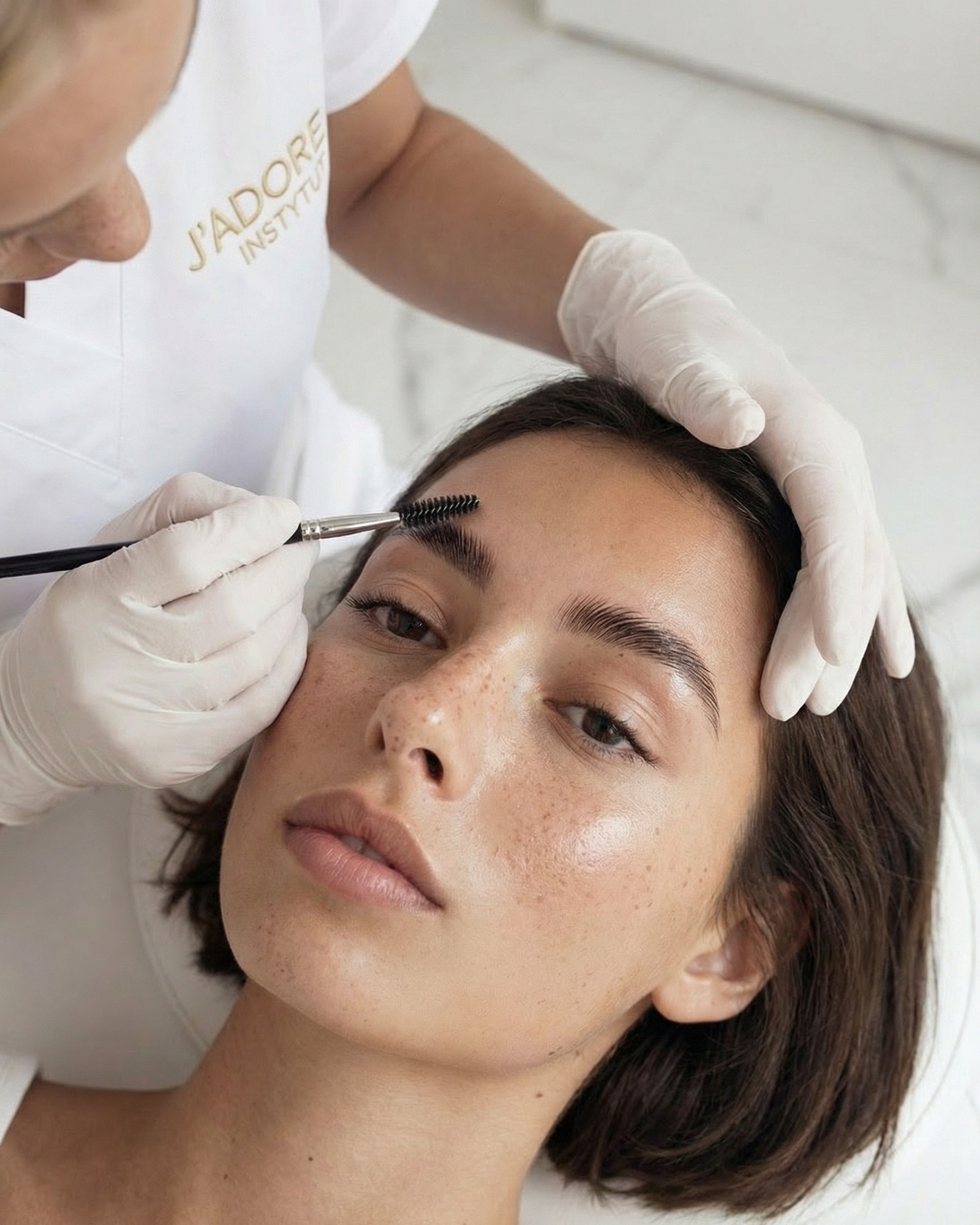
First criterion: the consultation concerns your hairs, not an inspiration photo
Lamination changes the way natural brow hairs can be arranged. It does not add new ones and does not fill in areas where they are missing with pigment. Therefore, the stylist should first see what material they are working with: whether the hairs are thick or delicate, flexible or dry, dense or uneven, natural or recently subjected to another chemical styling. Without this assessment, it is impossible to responsibly select the course of the service.
Show your inspiration, but expect a conversation about the differences. The same brushing direction does not look identical on a low arch, a dense male brow, thin hairs or visible gaps. A good stylist will tell you what can be achieved with the layout, where additional shaping or colour would be needed, and what lamination will not change.
Establish exactly what you are booking: layout, colour or shape
Package names can be misleading. Lamination arranges the hairs, tinting or henna changes their colour, and shaping tidies the contour. These elements may appear in a single visit, but they are not the same thing. If you are booking a "full brow styling", ask for a breakdown of what is included and in what order the stylist plans to work.
Lamination
changes the susceptibility and direction of the hair
- tidies hairs growing in different directions
- can give an optical impression of a fuller brow
- allows you to choose a direction from subtle to defined
- does not create hairs in an empty space
Colour
dye or henna is responsible for the shade
- darkens light hairs
- can increase the visibility of the contour
- requires a separate conversation about previous reactions
- does not change the natural direction of growth
Shaping
tidies the arch line
- removes hairs outside the agreed shape
- helps to even out the contour of both brows
- should take into account the natural asymmetry of the face
- does not replace lamination or colour
This separation is also important for expectations. A person with large gaps may see better-distributed hairs after lamination alone, but they will not receive a line identical to that after makeup. Conversely, a very dense brow may mainly need tidying, without additional darkening. A good salon does not add elements automatically just because they exist in a package.
Read a portfolio by its diversity, not by one trendy effect
A portfolio can help if it shows different types of brows and different intensities of layout. Pay attention to whether every person does not leave with identically vertical hairs, regardless of their length, density and arch shape. A repeatable style may be an aesthetic choice, but a repeatable protocol for all hairs does not testify to an individual approach.
- Look for photos of thin, dense, light and stiff brows — not just one easy model.
- Check if the layout differs depending on anatomy and the natural direction of growth.
- Assess both brows, not just a tight frame of one arch from the best angle.
- Pay attention to the skin around: strong redness should not be retouched or presented as proof of quality.
- Do not treat the fresh shine of the product as a lasting effect of lamination; ask how the brows look after the first wash and in the following weeks.
Safety near the eyes cannot be an addition to the service
Lamination does not pierce the skin with a needle, but it uses products that change the susceptibility of the hair and is performed in a delicate area. The stylist should ask about irritation, eye infections, skin damage, previous allergies and reactions to tinting. If the eyelid is red, a stye has appeared, the skin is peeling or the hairs are clearly weakened, the right decision may be to postpone the visit.
For the variant with henna or dye, ask how the salon approaches a patch test and when it should be performed. A test does not provide an absolute guarantee of no reaction, but talking about it shows whether the place treats the colouring product as a real chemical contact with the skin, or as an innocent addition to a photo. Do not hide a previous reaction just to keep your appointment.
Ask about the method of selecting the product and the working time
You do not need to know the composition of every product or learn the technology of lamination before your visit. However, you have the right to ask what influences the choice of product and the moment of its removal. A sensible answer refers to the thickness, porosity, condition and previous history of the hair. The answer "we always do it the same way" is less reassuring than admitting that the stylist observes the hairs during the process.
A "stronger" preparation is not automatically better, just as a maximum vertical lift is not proof of effectiveness. The goal is a supple, aesthetically placed hair that remains in good condition after styling. Over-intensive work can result in stiffness, dryness, or uncontrolled curling. Therefore, the quality of the procedure is also visible in moderation.
How to recognise a well-performed styling
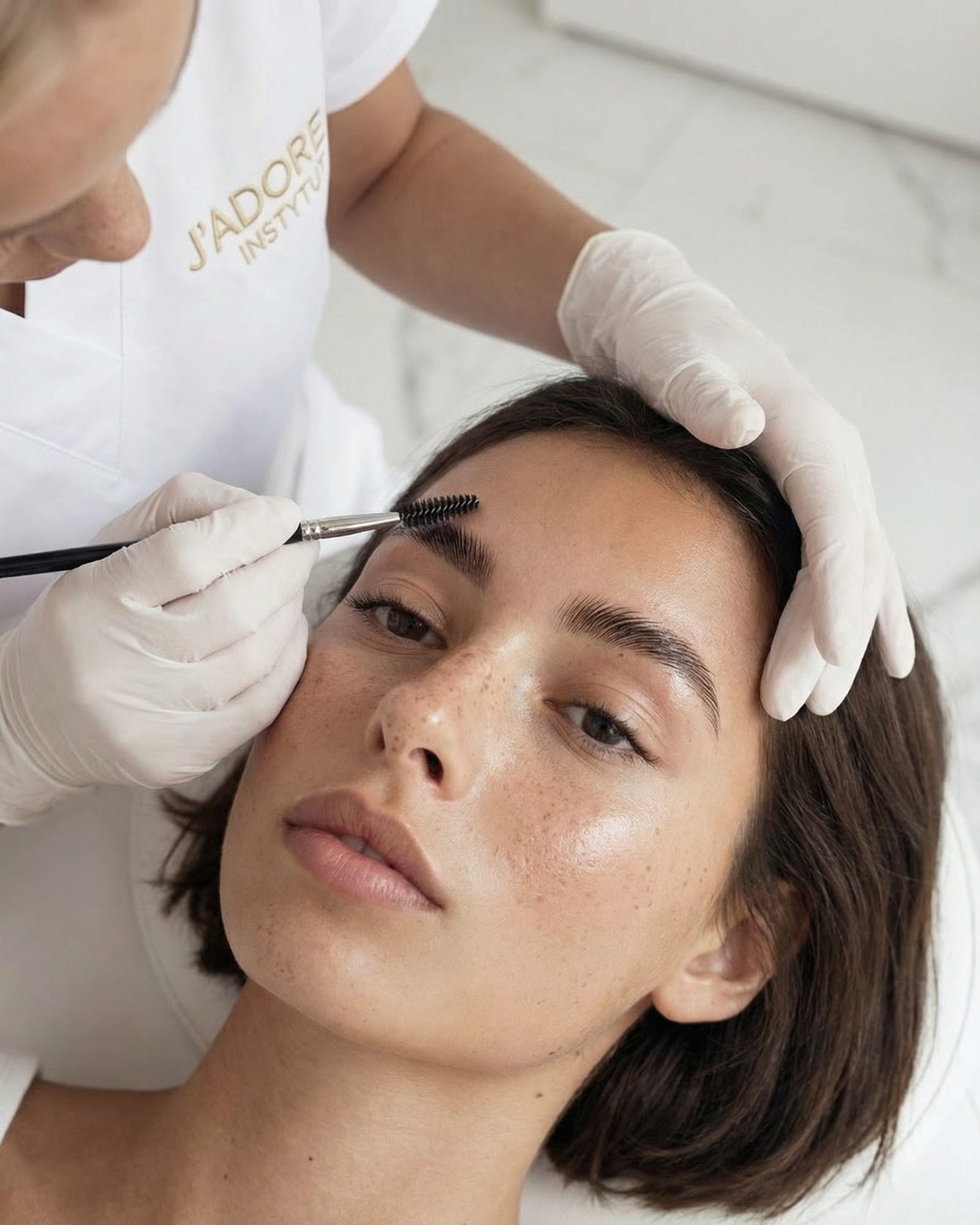
A well-performed lamination does not have to mean hairs set vertically. It should match the agreed direction, allow for gentle combing, and respect the natural difference between the right and left sides. Brows may be optically fuller, but they should still look like your own hairs — not like a uniform, glued-down surface.
- The direction of the placement matches your face and was agreed upon before starting.
- The hairs are not visibly curled, burnt, broken, or stuck together in random strands.
- The contour after shaping is not mechanically cut according to a single template.
- The colour, if added, harmonises with the hairs and does not replace an assessment of their condition.
- The stylist explains how to proceed after the visit and when to consider the next styling at the earliest.
- If the result is intense immediately after the treatment, you receive information on how it may change after stabilising and the first wash.
Red flags before booking and during the visit
A single lack of response to a message does not determine the quality of work, but several ambiguities at once should prompt a pause. This is especially true when a salon sells lamination as a solution for every type of brow and does not show situations in which they will not perform the treatment.
Signs of a good place
a decision made before the preparation
- an interview about condition, previous stylings, and reactions
- an explanation of the difference between lamination, colour, and shaping
- a portfolio with different types of brows and effects
- a readiness to postpone and clear recommendations
Red flags
the result is meant to be more important than the qualification
- no questions about hairs, skin, and the eye area
- one identical direction of placement for every person
- downplaying a previous reaction to a preparation
- encouraging a quick repeat despite dryness
Also, be wary of assurances that lamination will "rebuild" missing hairs. It can distribute them better and optically reduce gaps, but it does not trigger the growth of new ones. If the main problem is a significant loss, it is worth determining the cause first and choosing a solution for it, instead of masking it with increasingly stronger brushing.
Organisation also says a lot about the standard
Before booking, check who performs the service, how much time the salon allocates for the consultation and work, and how they handle lateness. Lamination requires a controlled sequence of preparations; shortening a visit to fit in another appointment should not mean skipping the assessment of the hair or the recommendations.
The response does not have to be long. However, it should show that the place understands the difference between a first visit and a repeat, between lamination alone and a package, and between an aesthetic preference and a limitation resulting from the condition of the hairs.
Brow lamination in Warsaw — two J'ADORE locations
In Warsaw, we perform brow lamination at J'ADORE INSTYTUT at Żelazna 59, 00-848 Warsaw — from Monday to Saturday 8–21, on Sunday 11–19 — and at Mińska 29A/46, 03-808 Warsaw — from Monday to Saturday 9–21. When booking, choose a convenient location and check the stylist's availability.
The range of options, the current price list, and the link to booking can be found on the page brow lamination in Warsaw — locations and dates. If you are planning a variant with tinting or henna and have reactive skin or a previous history of allergies, report this before the appointment to determine the correct method of qualification.
A one-minute checklist for choosing a salon
- 01
Check the consultation
Does the stylist ask about the condition of the hairs, previous treatments, skin, and reactions in the eye area?
- 02
Separate the scope
Determine whether you are booking only lamination, colour, shaping, or a set of several elements.
- 03
Read the portfolio
Look for different types of brows and directions of placement, not one repeated photograph of an effect.
- 04
Ask about safety
Find out how the place handles irritation, weakened hairs, and the colour variant.
- 05
Assess the readiness to refuse
A professional stylist knows how to postpone a service when the current state of the brows does not allow it to be performed reasonably.
The best place does not promise one trendy brow to every person. It helps choose a direction that matches the natural hairs and the face, and when necessary — it stops the procedure. This quality can be noticed even before the first preparation is applied.