

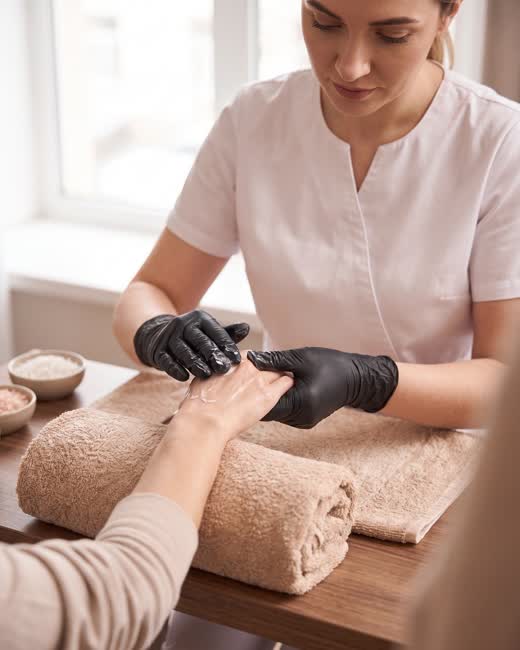
540 years of tradition, in your hands (literally)
Kobido — literally "the ancient path to beauty" (ko = ancient, bi = beauty, do = path) — was born in 15th-century Japan, during the age of the samurai. Legend has it that two master masseurs, Wahei Inoue and Hidetoshi Kubo, competed for the title of best therapist at the imperial court. Out of that rivalry came a technique so effective it was reserved exclusively for the Japanese aristocracy and imperial family for centuries.
For centuries, kobido passed from master to student within a closed system — much like martial arts. There were no textbooks. There were no weekend courses. There was years of training under a single teacher, hundreds of hours of practice on living tissue, and a deep understanding of facial anatomy.
Only in the 21st century did kobido move beyond Japan. And that's where the problem starts — because what Instagram calls "kobido" often has nothing to do with the real technique.
47 techniques, zero stroking
A genuine kobido massage isn't a relaxing face-stroking session with oil to the sound of Tibetan singing bowls. It's 47 distinct manual techniques, including:
- Deep kneading of the facial muscles — the therapist works on the muscles, not the skin. That's the key difference. The frontalis, orbicularis oculi, zygomaticus major and minor, masseter — each needs different pressure and a different technique.
- Fast percussive movements (tapotement) — the vibrating fingertip tapping characteristic of kobido. It stimulates microcirculation and boosts collagen production. The speed can reach several hundred taps per minute.
- Lifting techniques — precise lifting of tissue against the pull of gravity. The therapist literally "sculpts" the facial contour, working against the force that has been pulling the tissue downward for years.
- Lymphatic drainage — gentle but precise guiding of lymph towards the lymph nodes. Result: reduced swelling, especially around the eyes and jawline.
- Work on acupressure points (tsubo) — kobido draws on traditional Chinese and Japanese medicine. Stimulating specific points on the face affects muscle tension, circulation and — according to tradition — the flow of qi energy.
- Releasing the masseter muscle — this powerful muscle (the strongest in the human body relative to its size!) is chronically tense in many people, from stress, teeth clenching or bruxism. Releasing it can change the shape of the lower half of the face.
The full session usually lasts 60–90 minutes and is an intense experience. It doesn't hurt — but you definitely feel someone working. It's not a moment for a nap (though the neck and décolletage massage at the end can send even the most resistant clients drifting off).
What does the science say?
A study published in the Journal of Clinical and Aesthetic Dermatology (2023) found that regular manual stimulation of facial muscles leads to:
- Increased thickness of the facial muscles — like any other muscle, facial muscles respond to stimulation by growing in volume
- Improved microcirculation — by 30–40% immediately after the treatment (measured by laser Doppler)
- Increased synthesis of type I and III collagen — mechanostimulation of fibroblasts is one of the most effective ways to boost collagen production without needles or lasers
- Reduced salivary cortisol — facial massage lowers the stress hormone, which has a direct effect on skin quality (cortisol breaks down collagen)
A Japanese study from the University of Tokyo (Murad et al., 2024) adds that regular manual facial stimulation improves skin elasticity by 15–20% after a series of 6 sessions, with the effect lasting up to 8 weeks after the series ends.
One session — a visible difference
This isn't a marketing promise. It's physiology.
After one kobido session, you can expect:
- A more defined facial contour — the lifting effect is immediate and visible to the naked eye
- Reduced swelling — especially in the morning, particularly around the eyes and jawline
- Skin "radiance" — better circulation means better oxygenation, which means a healthier skin tone
- Released tension — if you clench your jaw, you'll feel the difference straight away
- Smoother fine expression lines — relaxed muscles mean less visible lines
The effect of a single session lasts 3–7 days, depending on the starting condition of your skin and tissue. But the real magic starts with a series.
A series of 6 sessions — "the needle-free facelift"
The term "needle-free facelift" is bold, but in the context of kobido — justified. A series of 6 sessions carried out every 7–10 days produces a cumulative effect:
- Sessions 1–2: The skin "wakes up". Circulation improves, swelling starts to reduce, and the muscles begin responding to stimulation.
- Sessions 3–4: The facial contour becomes more defined. Clients notice that marionette lines and nasolabial folds are shallower. The skin feels firmer to the touch.
- Sessions 5–6: The lifting effect is lasting. The muscles have gained volume (just like after a workout!), the skin is firm, elastic and radiant. The face looks 3–5 years younger.
After the series, we recommend maintenance sessions every 3–4 weeks — just as you'd keep going to the gym to maintain your fitness.
Kobido vs gua sha — no, they're not the same thing
Instagram loves gua sha. Those beautiful jade or rose quartz stones, those hypnotic movements across the face. And gua sha is great — genuinely. It helps with drainage, it's relaxing, it feels good.
But comparing gua sha to kobido is like comparing stretching on a mat to a two-hour session with a personal trainer. Both are good. But the scale of the effect isn't comparable.
- Technique — 3–5 movements — 47 techniques
- Depth — Superficial (skin, fascia) — Deep (muscles, tissue)
- Duration — 5–10 min — 60–90 min
- Who performs it — You, at home — A qualified therapist
- Lifting effect — Mild, temporary — Marked, cumulative
- Risk of error — Low — Minimal (professional)
Gua sha is a great home ritual to use BETWEEN kobido sessions. But it's not a replacement.
Kobido and a skin biostimulator — when can they be combined?
This is where things get really interesting. Skin biostimulator — a next-generation injectable hyaluronic acid that doesn't fill but biostimulates — combined with kobido produces an effect neither method could achieve alone.
Skin biostimulator works from within: it stimulates collagen and elastin production, hydrates the deep layers of the skin, and improves tissue quality.
Kobido works from without: it improves circulation (and so the distribution of hyaluronic acid!), stimulates the muscles, drains, and lifts.
Combining a skin biostimulator with massage requires an individual plan. Session numbers, intervals and the time to resume massage depend on the product, injection area and healing. There is no single protocol or guaranteed result for the entire category.
Who kobido is NOT for — contraindications
Honestly — not everyone can benefit from kobido at every moment. Contraindications include:
- Active inflammatory acne — massage can spread bacteria and worsen the inflammation. Wait until the acne settles down.
- Rosacea in the acute phase — reddened, reactive skin with dilated capillaries needs calm, not stimulation. In remission, gentle kobido may even help — but a specialist decides.
- Botox — less than 14 days after treatment — botulinum toxin needs time to "settle" into the muscle. Intensive massage within two weeks of injection can cause the product to migrate to unwanted areas. After 14 days — green light.
- Filler — less than 3–4 weeks after treatment — hyaluronic acid needs time to integrate with the tissue. Massaging too soon can displace it.
- Active skin infections — cold sores, fungal infections, bacterial inflammation
- Fresh wounds, sunburn
The dirty truth about "kobido courses"
What to look for when choosing a therapist:
- A certificate from a recognised school (not an "online course")
- Experience — how many sessions have they performed?
- Duration — genuine kobido takes a minimum of 45–60 minutes. A 20-minute "mini massage" isn't kobido.
- Result — after a good kobido session, you see the difference straight away
Ancient wisdom in a modern salon
540 years ago, Japanese masters had no lasers, no hyaluronic acid, no ultrasound. They had hands — and knowledge of how the human body responds to touch. That knowledge has proven timeless.
At J'ADORE INSTYTUT, kobido massage is performed by therapists trained in Japanese lifting massage techniques, combining a traditional approach with knowledge of modern anatomy and physiology. You can book the treatment as a stand-alone ritual or as part of a comprehensive anti-ageing protocol, combined with skin biostimulator or other biostimulating treatments. Because a genuine lift doesn't have to hurt, doesn't have to cost a fortune, and doesn't have to turn your face into someone else's. Sometimes the best technology is the one that's 540 years old.


