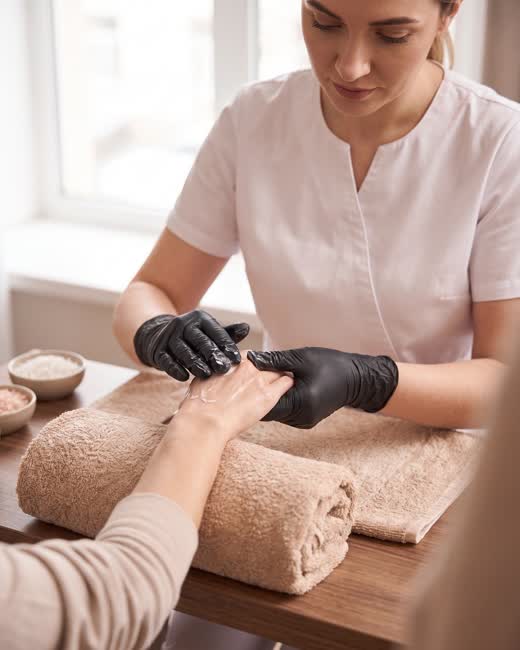
What is Kobido — before we start busting myths
To understand why “cheap Kobido” is often an oxymoron, it is worth starting with what Kobido really is. It is a structurally complex manual technique. It combines acupressure point massage, work on the facial muscles, lymphatic drainage and rhythmic movement sequences with a strictly defined order and pressure. Each layer requires separate training over many months and ongoing practice. This is not a set of movements you can “memorise” during a weekend course.
In practice, this means that performing Kobido at a level that delivers measurable results requires an advanced knowledge of facial anatomy. This is not just surface-level knowledge of skin and tissue. It includes the precise course of facial muscles, lymph nodes and lymphatic drainage pathways, as well as fascial tension points. Without this knowledge, the practitioner is working by feel — and strokes rather than lifts. Stroking feels pleasant. But it is not Kobido.
The Kobido myths we hear most often
Myth 1: “Kobido is Kobido — it is the same everywhere.” This belief is one of the most costly myths in cosmetology. Unlike a pedicure, for example — where the difference between salons comes down to polish quality and chair ergonomics — Kobido is a technique in which the result depends almost entirely on the practitioner’s competence. There is no device that does the work instead of the hands. There is no protocol that can make up for gaps in training. There is only knowledge and practice — or their absence.
Myth 2: “Cheap Kobido delivers 80% of the result for 30% of the price.” This is a popular belief with no basis in anatomy. Kobido works on several levels at once: stimulation of collagen fibres, stimulation of skin and lymphatic circulation, and release of muscle tension. Each effect requires a different type of touch — different pressure, location and sequence. Shortened training usually provides only the relaxation layer: pleasant stroking. Drainage, lifting and muscle work disappear along with the reduced training time.
Myth 3: “You only see the result of Kobido after a series.” This is untrue — and it is one warning sign that the treatment was not performed thoroughly. After genuine Kobido, the change is visible after the first session: the face looks less swollen and more sculpted, while the features may appear more defined. The result is not permanent after one appointment, but it is tangible. If you leave Kobido with the same face you arrived with, either your lymphatic drainage was exceptionally congested and swollen — or you simply had stroking.
Myth 4: “Kobido is always safe because it is only a massage.” Precisely because Kobido works on muscles, acupressure points and lymphatic pathways, it can be performed incorrectly — with results you did not want. Excessive pressure in the wrong area may worsen inflammation in someone with vascular skin. Incorrect lymphatic drainage can paradoxically increase swelling rather than reduce it. Working on muscles without anatomical knowledge can overload a muscle rather than release it. There is no such thing as “just a massage” — there is good massage and bad massage.
Myth 5: “Every beautician who has completed a Kobido course can perform Kobido.” A weekend course provides theoretical knowledge and an outline of the technique. Genuine proficiency in Kobido is a matter of thousands of hours of practice — exactly as in any other field requiring manual precision. Mastery of Kobido requires regular supervision, training under an experienced instructor and ongoing work with clients in different circumstances. This is not a criticism of courses — it is simply the reality of every manual technique.
What distinguishes genuine Kobido — 5 things worth checking
Before booking Kobido somewhere new, it is worth asking a few specific questions. A good specialist will answer them without hesitation — and their answers will tell you more than any online review.
- 01
Training and certification
Ask directly: where and with whom did the practitioner train, was it theory alone or extended practice, and do they attend supervision regularly? Genuine Kobido requires ongoing professional development — a masseur who completed one course three years ago and has been “performing hundreds of treatments” ever since is a red flag.
- 02
Assessment before the treatment
Genuine Kobido starts with an assessment of the face: muscle tension, skin quality and drainage condition. If someone immediately places you on the treatment bed and starts massaging without any assessment, they are skipping the first, crucial layer of the protocol.
- 03
Duration and treatment structure
Full Kobido is not 30 minutes of “facial massage”. A proper session includes preparation, the massage itself in several layers and completion. A very short session simply does not allow enough time to work through every element of the protocol.
- 04
How it feels during the treatment
Kobido is not purely a relaxing treatment — it works on the muscles. During the session, you may feel differences between the sides of your face, tension at specific points or even slight sensitivity in areas where drainage is blocked. Pure stroking feels pleasant, but it is ineffective.
- 05
The immediate result
Leave the treatment and look in the mirror. After good Kobido, many people’s faces look different — more defined, less swollen and with a visible lifting effect. If there is no difference at all, you were probably pampered rather than massaged.
Comparison: genuine Kobido vs “Kobido for relaxation”
Genuine Kobido
Advanced manual technique
- Work on facial acupressure points
- A sequence of movements with a defined order and pressure
- Active lymphatic drainage
- Work on facial muscles
- Facial assessment before the treatment
- A visible result after the first session for many people
Facial massage branded as Kobido
A relaxing treatment with a label
- Pleasant stroking and kneading
- A relaxing effect and temporary release of tension
- May improve wellbeing
- Available in many places at a low price
There is nothing wrong with facial massage as a relaxing treatment — the problem begins when it is sold as “kobido” and promises results it cannot deliver without the genuine technique. Transparency here is a matter of basic honesty towards the client — and the lack of it is one reason why Kobido has an ambiguous reputation in Poland.
Kobido and gender — do men use it too?
For a long time, Kobido was seen as a treatment exclusively for women. Its image in Poland was shaped by wellness salons aimed at women. Yet male and female facial anatomy differs in several important ways: thicker skin, stronger facial muscles and a different distribution of tension. This is why Kobido for men looks and feels different than for women, although it is based on the same technique.
Men who use Kobido regularly most often report reduced tension around the jaw and temples — often linked to bruxism or long hours in front of a screen — improved skin tone and a less tired-looking face. None of these results are “feminine”. They result from working on tissues that function in the same way in both sexes. Kobido for men is simply Kobido with a protocol adapted to anatomy.
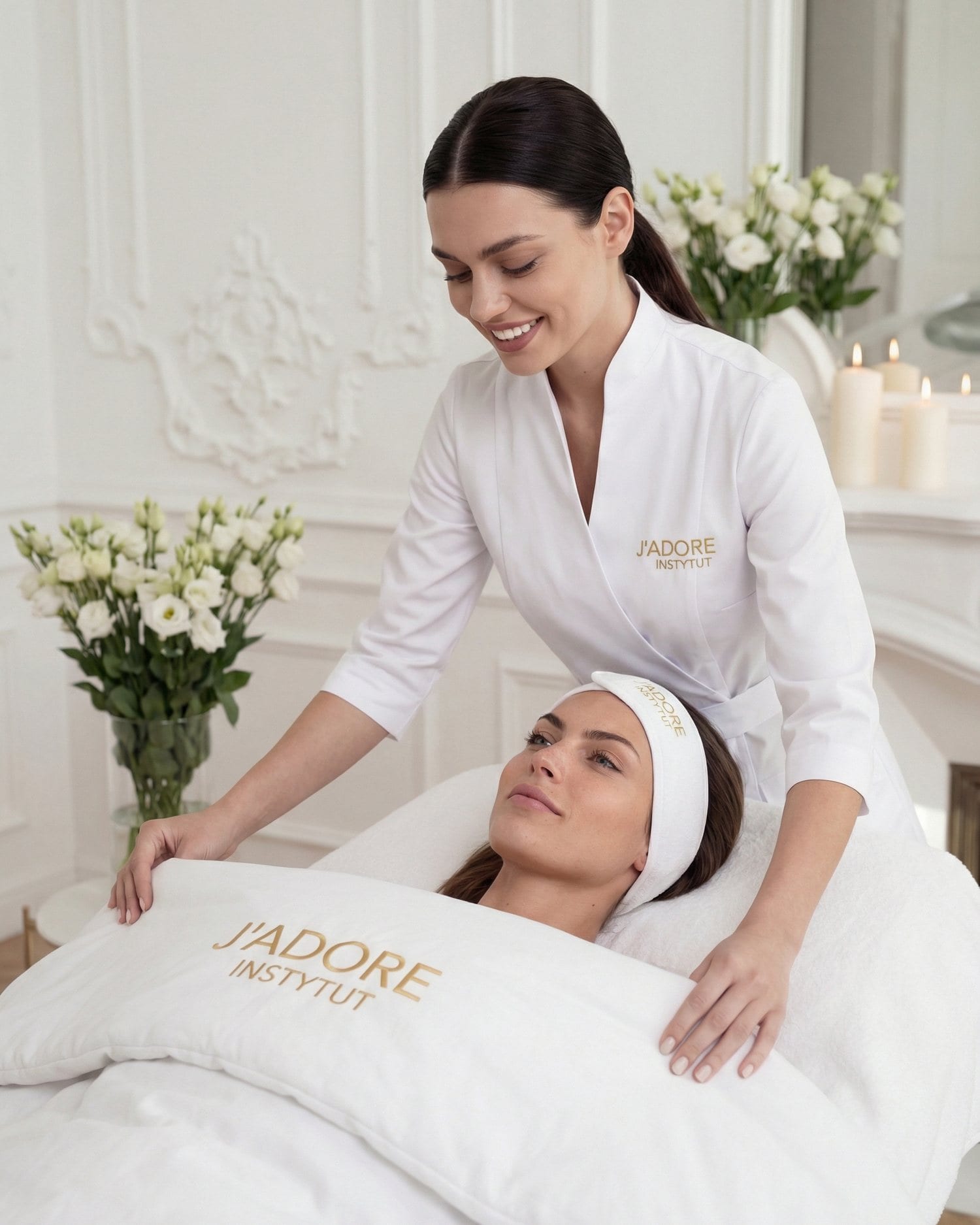
How to choose a good place for kobido — questions worth asking
A good salon will have no problem answering any of the questions below. Quite the opposite — a professional place will often address them during consultation before you ask. It treats thoroughness as a standard, not an exception.
It is also worth noting how the treatment is described in the salon’s materials. Phrases such as “looking 10 years younger in one session” or “natural Botox” are marketing simplifications. They suggest that sales matter more than accuracy. Kobido can deliver noticeable results — but an honest description is: “for many people, the face looks more defined and rested after the treatment”, not “we guarantee reversal of the ageing process”.
True kobido and other treatments — what is worth combining
Kobido works most effectively as part of regular care, rather than a one-off experiment. Its results can also be enhanced and complemented with other treatments. This depends on what matters most to you.
Kobido + biostimulators
Biostimulators build skin structure from within. Kobido improves muscle tone and lymphatic circulation. Together, they support both skin quality and how it sits on the face.
Kobido + mesotherapy
Mesotherapy delivers active ingredients directly into the skin. Kobido improves circulation and may support their absorption. Leave a few days between treatments.
Kobido + facial cleansing
A classic combination: cleansing prepares the skin, while kobido stimulates microcirculation and drainage. It works particularly well for skin prone to puffiness and water retention.
Kobido as a regular programme
Even without other treatments, a regular kobido programme brings cumulative results for many people — gradually improved facial muscle tone, better skin quality and more lasting definition of facial contours.
Summary: what to take away from this article
Kobido is one of the most effective manual techniques for the face — but only when performed by someone who has truly mastered it. The problem is not the treatment itself. Its name has become a generic term for “facial massage”, and the market has allowed this without warning.
- The results of true kobido — lifting, drainage and improved muscle tone — are tangible. For many people, they are visible after the first session.
- Cheap kobido performed by someone without thorough training is usually a pleasant relaxation massage — without a lifting effect.
- Training duration, assessment before the treatment and the immediate result are three signs that help distinguish the true technique from its simplified version.
- Kobido works for both women and men — the protocol is adapted to anatomy, not gender.
- Before booking, it is worth asking specific questions — a good salon will answer them without hesitation.