
What muscle tension really is
Before we understand why it returns, we need to know where it comes from. Muscle tension (tonic resting tension) is a state in which a muscle is not fully relaxed, even when it is not working. We feel it as hardness, pressure and limited movement. We often misinterpret it as a “blockage” that only needs to be “released” once and for all.
Muscle tension is not passive — it is actively controlled by the nervous system. The spinal cord and brain decide how much tension a muscle maintains at any given moment. They do so based on external signals: posture, stress, pain, movement patterns and even mood. The muscle follows instructions. It contracts as much as the control centre tells it to.
This leads to a conclusion that is rarely said aloud: the tension you feel in your neck, shoulders or buttocks rarely resides in the muscle itself. It is controlled from elsewhere — by a posture pattern you have had for years, desk work, the way you walk or chronic stress. The muscle is only the carrier. The control centre is higher up.
What happens during a massage — and why “once is enough” is not true
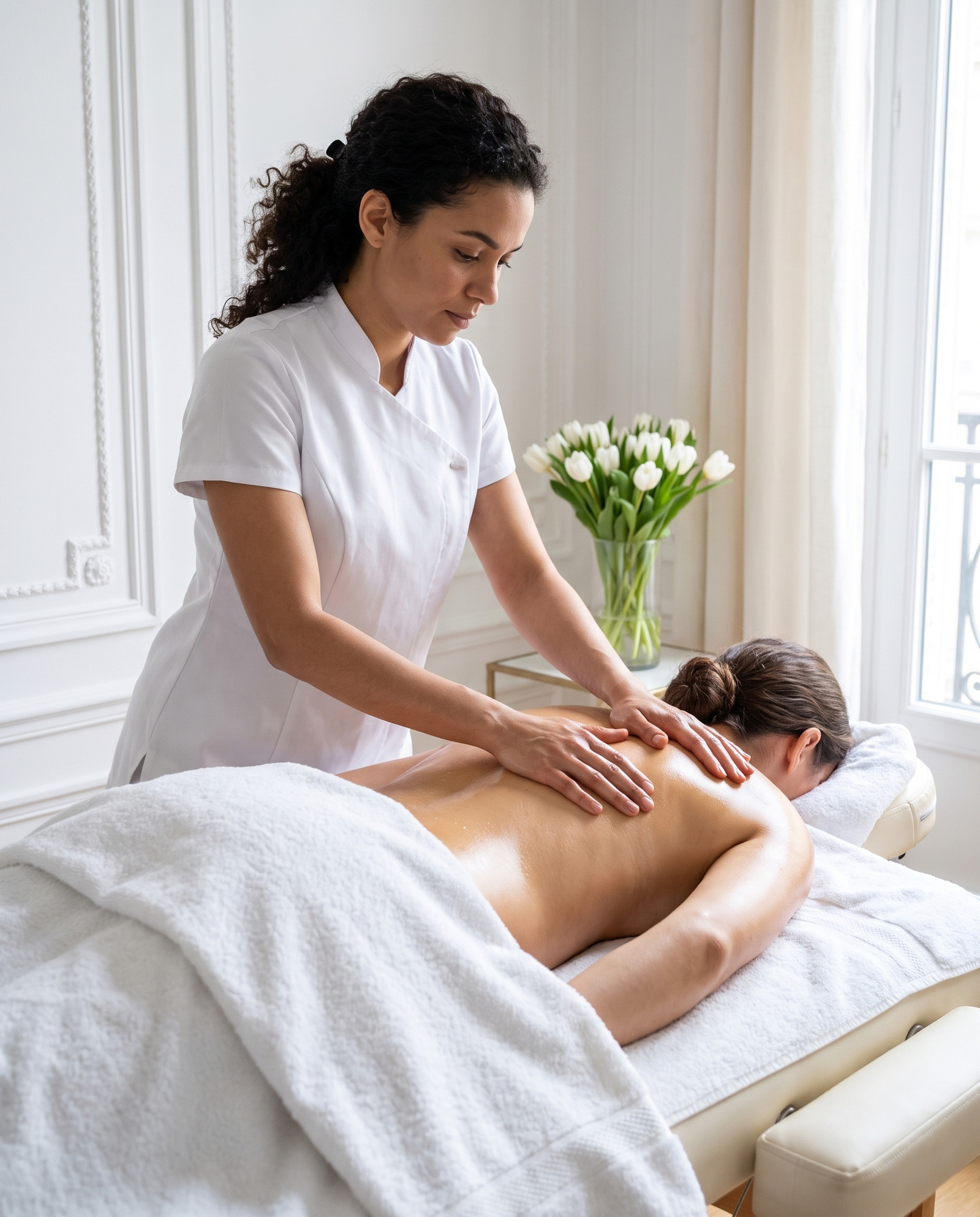
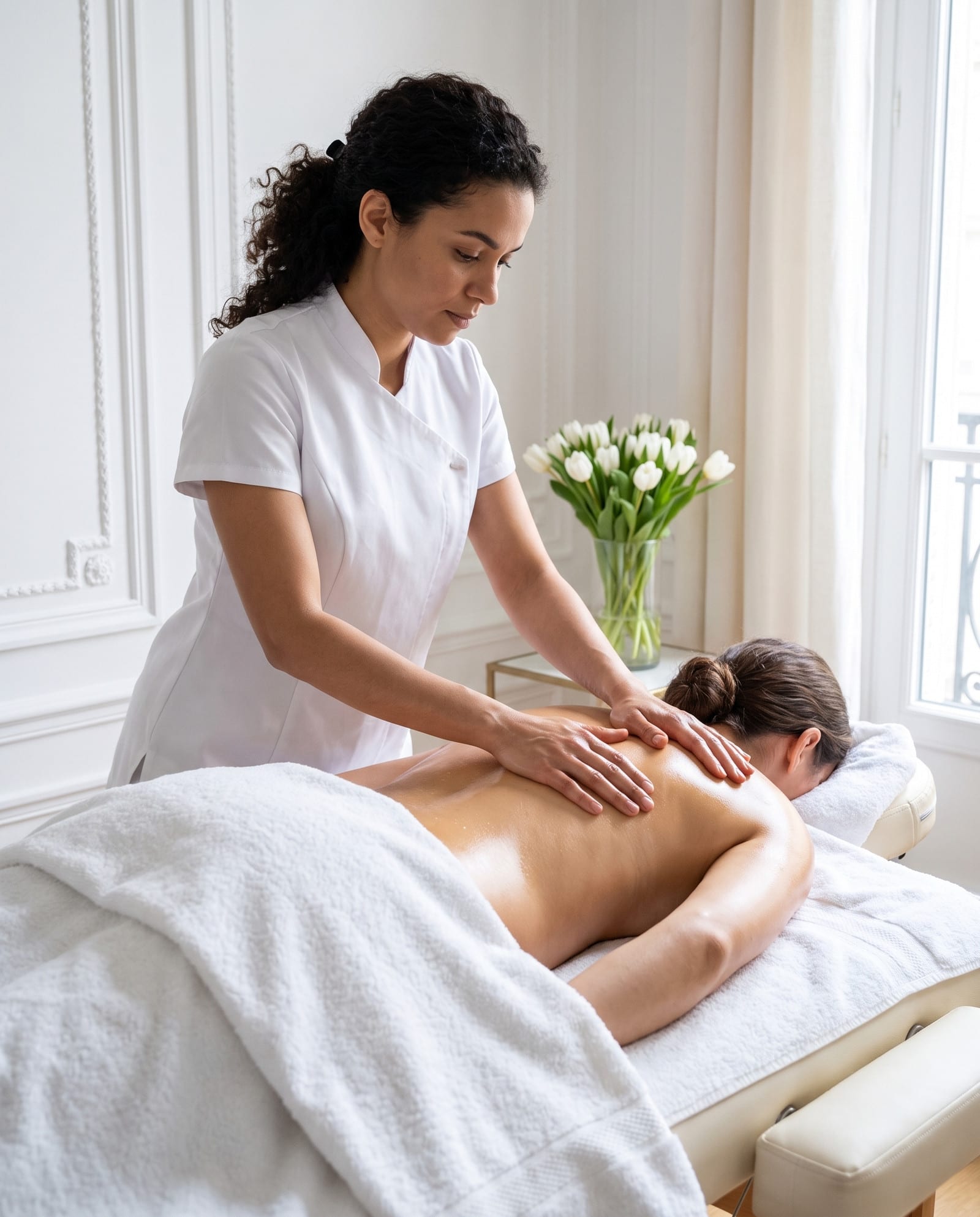
A good massage works in several ways at once. Mechanical pressure and tissue stretching can improve blood and lymph flow, reduce local fascial stiffness and release trigger points — areas where muscle fibres have become caught in a pattern of chronic contraction. These are real, measurable changes. But something more important also happens: massage affects the nervous system.
During touch, receptors in the skin and deeper tissue activate. They send signals to the spinal cord and brain. The nervous system receives the message: “you are safe, you can reduce tension”. Parasympathetic activation — the part of the nervous system responsible for regeneration — calms the stress response. This is why, after a good massage, we often fall asleep or feel a heavy, pleasant drowsiness — it is not a side effect, but the aim.
This is the key point. After a massage, the body returns to its environment: the chair, keyboard, stress, posture and movement patterns that reshape tension for hours each week. One massage cannot compete with thousands of hours of bodily habits. This is not a treatment failure — it is mathematics.
Muscle memory: why the body returns to what it knows
There is another mechanism that is rarely discussed outside therapeutic settings. Muscles, fascia and the nervous system create what we commonly call “muscle memory” — although it is more neural than tissue memory. Tension patterns repeated over years become the system’s default settings.
Changing this baseline norm requires repetition — just as learning to ride a bicycle requires repetition, not one lesson. One massage gives the nervous system a new experience: “this can feel different too”. But if this experience happens once every few months, while the body lives in its old pattern for the rest of the time, the old pattern wins. Always.
- 01
One massage
The nervous system receives the signal: “you can reduce tension”. Tension drops. You feel significantly better. The effect is real but short-lived — the body returns to its environment and old patterns.
- 02
Three to four sessions
The body begins to “recognise” a relaxed state as something familiar. The time before tension returns after a massage may become longer. Deep-tissue receptors learn a new range.
- 03
A regular series
The nervous system updates its “baseline norm”. For many people, resting tension decreases on a lasting basis. Changes in the fascia and soft tissue may become established. Breaks between massages become less noticeable.
Fascia — the tissue that holds us in shape, sometimes too tightly
There is another key part of this story, just as important as muscles and the nervous system: fascia. It is a network of connective-tissue membranes that surrounds and permeates everything — muscles, organs, bones and vessels. Imagine a bodysuit worn from the inside. It holds everything in place and transmits movement throughout the body at once.
Fascia responds to tension and immobility differently from muscle. When it remains compressed or immobilised for a long time — for example, through hours of work in one position — it thickens and loses its ability to glide. Its fibres can adhere to neighbouring layers. This is where it differs from muscle: fascia changes more slowly. It needs sustained, gentle pressure, not brief and intense pressure.
This is why therapists working with fascia, for example through deep-tissue techniques or myofascial massage, often recommend a series of shorter sessions at regular intervals rather than infrequent, long sessions. Fascia learns change gradually, session by session.
What a series does that one massage does not
A series of massages is not “more of the same” — it is a different type of intervention. Each following session reaches a body that already remembers the previous one. The tissues are more responsive, the nervous system is less vigilant, and the fascia gradually changes its properties. With every session, the therapist can work more deeply, precisely and effectively — because the body simply “opens up” at a different pace than it does the first time.
One massage
change of state
- Temporary reduction in tension
- Relief and improved wellbeing for several days
- Parasympathetic activation (regeneration)
- Local improvement in tissue blood flow
A series of massages
change of pattern
- Gradual update of the tension “baseline norm”
- Lasting changes in fascia and soft tissue
- A longer-lasting effect between sessions
- Teaching the body a new resting state
The specific rhythm of a series depends on what you come in with. With acute tension and discomfort, more frequent sessions at the beginning, for example every week or fortnight, provide a faster cumulative effect. For prevention and maintenance, a regular interval every few weeks may be enough to prevent the body from returning to old patterns. A therapist who knows your body after several sessions can adjust the rhythm better than any online template.
Why tension returns so quickly — and what it tells you
If tension returns within a few days after a massage, this is valuable information — not a reason for frustration. Tension returning quickly often means that its source is still actively at work: stress that does not ease, a sitting pattern unchanged for years, or constant arm tension at the keyboard. Massage reduces the load, but it does not switch off the source.
This is the point where many therapists speak about “treating the cause, not the symptom” — but this phrase can place an unfair burden on you. Changing your working routine, movement habits or way of managing stress takes time. Massage does not replace these changes, but it can be a bridge — regularly reducing the level of load gives the body more space, making other changes easier to introduce.
How many sessions and how often — questions worth asking
There is no single answer. But these questions help assess what your body needs at a given time:
- How long has the problem been present? Tension lasting a week responds differently to tension lasting five years. Chronic patterns need more time.
- What drives the tension? Physical work, a sedentary lifestyle, chronic stress or sports overload — each source suggests a different treatment rhythm.
- How quickly does tension return after a session? If the effects of massage last several weeks, less frequent sessions may be enough. If they last several days, your body is signalling that it needs more frequent “resets”.
- What is the goal — relief or change? One massage is enough for one-off relief. A series is needed to create a lasting change in the tension pattern.
Relaxation massage
A starting point — if you are just beginning and want to see how your body responds to regular work on tension.
Deep / therapeutic massage
When tension is chronic and deeply embedded in the tissue — working in layers over several sessions gives the most lasting effect.
Fascial massage
When tension is “held” throughout the body, not only in one area — fascial work over a series helps reprogramme the pattern globally.
Lymphatic drainage
A good complement to a series of therapeutic massages — it supports tissue regeneration between sessions and reduces swelling.