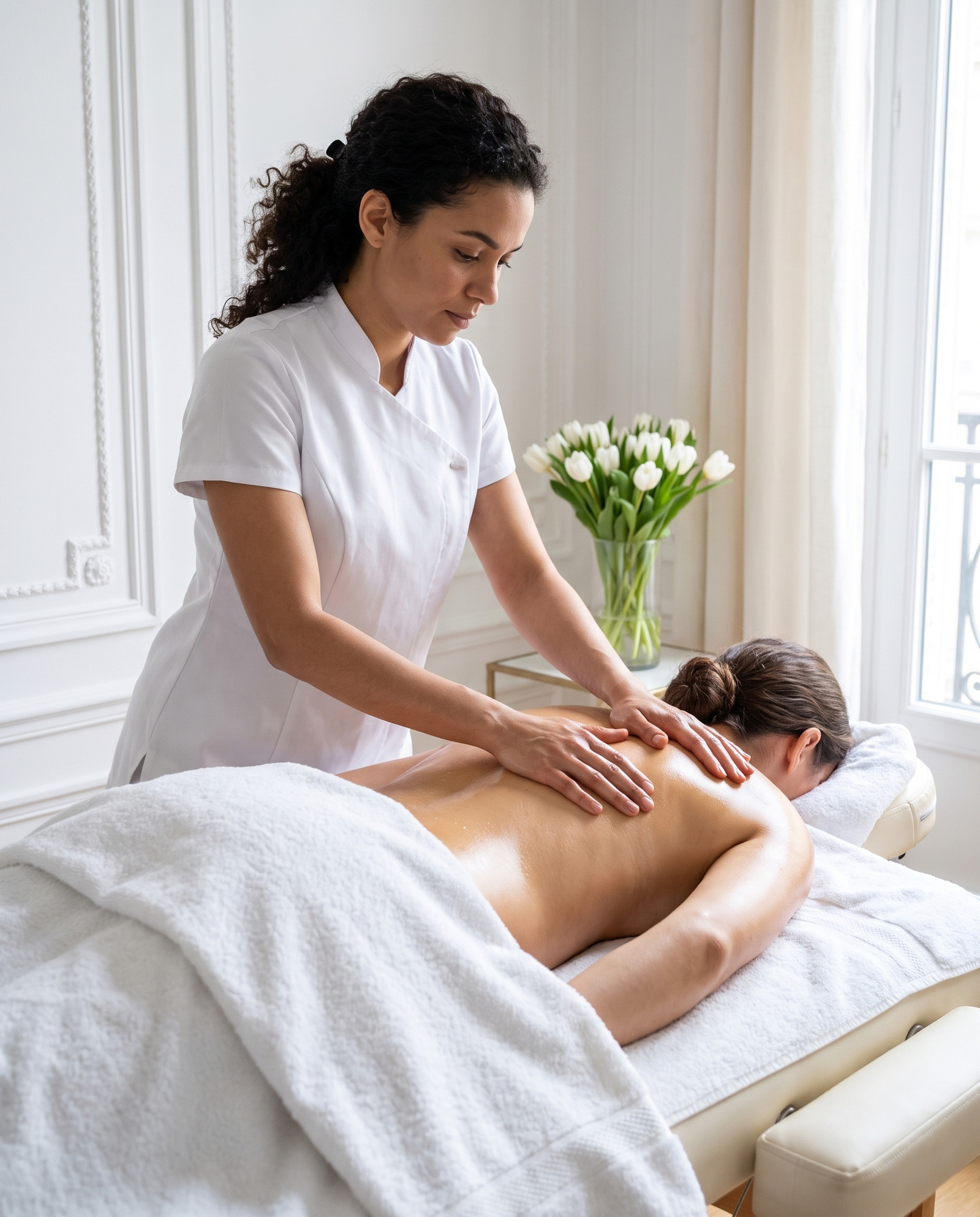

The skin as the first gateway — what happens at the moment of contact
The skin is not just a covering. It is the body’s largest sensory organ — densely equipped with receptors that constantly report to the nervous system: what is happening outside and whether you are safe. These include heat-sensitive thermoreceptors, which respond to changes in temperature. Their activation by warm oil begins the entire cascade of changes.
When warmth reaches the skin, receptors send a signal to the hypothalamus — the area of the brain responsible, among other things, for regulating temperature and autonomic nervous system activity. This is where a quiet decision is made: switch into calm mode. Activity in the sympathetic nervous system, responsible for alertness and stress, decreases slightly. The parasympathetic system — responsible for rest and regeneration — takes over. Your heart rate slows, breathing deepens and muscles lose some of their baseline tension. All this happens before the massage has properly begun.
It is important to distinguish warmth from heat. The brain differentiates between them very precisely. Moderate, pleasant warmth activates relaxation centres. Excessive heat does the opposite — it triggers a pain alarm and tension. This is why the temperature of massage oil matters. It should feel warm in a way the body perceives as an invitation, not an attack.
Muscles, fascia and why tension does not release on its own
Many muscular tensions we experience as “stiffness” or “a stone in the back” share one source: the tissue simply cannot relax without external help. A muscle tensed by prolonged sitting, stress or compensation after injury enters a kind of vicious circle. Contraction impairs circulation. Poor circulation impairs regeneration. Reduced regeneration sustains the contraction.
Warmth interrupts this cycle at a specific point. Under the influence of warm oil, blood vessels in the skin and subcutaneous tissue dilate — a response known as vasodilation. More blood reaches the muscles, together with more oxygen and nutrients. Tissue mechanics also change. Warmed muscle fibres and fascia, the dense “mesh” surrounding muscles, become more responsive to stretching and pressure. It is literally easier for the therapist to work deeper. It is also less painful when they do.
- Cold fascia — dense and less elastic, it resists kneading; deep pressure on cold tissue can be painful and trigger a protective response.
- Warmed fascia — more pliable and more receptive to movement; the massage therapist can work deeper with less resistance and discomfort.
- Cold muscle — higher resting tension and a slower response to stretching.
- Warmed muscle — lower tension, faster reflex relaxation during stretching and better neuromuscular coordination.
Oil as a medium — how the properties of fat change the experience
Massage oil is not only about comfort or fragrance. Fat as a medium changes the physics of contact — on several levels at once. First, it eliminates friction. Dry hands on the skin can cause micro-damage to the epidermis and trigger a protective response. Oil allows the hands to glide rather than pull. This enables longer, calmer, rhythmic movements — and rhythm itself matters to the nervous system.
Second, plant oils have their own properties. More importantly, as fats, they retain warmth on the skin longer than water. Warmed oil acts as a thermal insulator: once it reaches the body, heat escapes more slowly and the therapeutic effect of temperature lasts longer. The skin remains warm and pliable throughout the session, not only during the first few minutes.
Third, contact between the skin and a warm, oily substance activates touch receptors differently from dry contact. Oil “extends” the sensation — pressure feels more diffuse and less localised. The intensity of the stimulus reaches the brain as soothing rather than alarming. This is one reason why an oil massage can feel deeper and less painful than one without oil.
The nervous system — what “letting go” really means
When we say that massage “relieves stress”, we use a common shorthand for something far more specific. Stress is not only an emotional state — it is a physiological state in which the body maintains increased readiness for action. The heart beats faster, muscles are more tense, breathing is shallower and the digestive system works more slowly. This mode is useful in sudden danger. It can be harmful when it continues for weeks.
Massage with warm oil activates a specific mechanism for leaving this mode. It activates the vagus nerve — the main pathway of the parasympathetic nervous system, running from the brain through the neck to the internal organs. Its stimulation slows the heart, lowers blood pressure, deepens breathing and shifts metabolism into regenerative mode. This is not a metaphor — the changes are measurable. For many people, cortisol levels in saliva and blood decrease after a massage session.
- 01
The first warmth
Skin thermoreceptors send a signal to the hypothalamus. The nervous system begins to shift from alert mode into rest mode.
- 02
Vasodilation
Blood vessels in the skin and muscles dilate. Circulation increases locally, and tissues receive more oxygen and nutrients.
- 03
Tissue pliability
Warmed muscles and fascia become more responsive to pressure and stretching. Therapeutic techniques can work deeper with less resistance.
- 04
Rhythmic touch
Repetitive, steady movements activate touch receptors and calm the nervous system. Endorphins and oxytocin are released.
- 05
Vagus nerve activation
Signals from the massaged tissue reach the vagus nerve. The heart slows, breathing deepens and the body enters a state of deep regeneration.
- 06
Result after the session
Muscles remain more relaxed and blood vessels dilated. Cortisol levels decrease for many people. The body “remembers” this new baseline for several hours or days.
Warmth and pain — why “warmer” often means “less painful”
There is another mechanism worth knowing about — especially if you associate massage with discomfort during deep tissue work. Warmth and pain are two signals that “compete” for access to the nervous system according to a principle known as gate control theory of pain.
Put simply, the spinal cord processes sensory signals — and cannot transmit all of them at once. A strong, distinct signal from one type of receptor can block or suppress signals from others. Warmth activates thick, fast nerve fibres that can “close the gate” to slower pain fibres. In practice, the same depth of pressure after warming the tissue may feel far less painful than it does when the tissue is cold.
For massage practice, this means that warm oil not only helps relax the tissue — it also allows the therapist to work deeper without triggering protective responses. Instead of tensing in response to pressure, the body can accept it and respond with relaxation. This is the key difference between deep tissue massage “cold” and the same massage preceded by warming.

When regularity matters — cumulative effects
One massage session with warm oil can bring noticeable relief. However, the body responds most clearly to regularity. The nervous system is plastic: the more often it enters a state of deep relaxation, the more easily it returns to it. Muscles that are regularly relaxed and oxygenated maintain lower resting tension between sessions. Fascia that is regularly mobilised retains its elasticity for longer.
It is also worth knowing that the effects of massage — like the effects of exercise — are partly adaptive. Your body does not only respond to a stimulus. It also adapts to it. Regular sessions may gradually reduce baseline muscle tension, improve joint mobility and change how your body manages daily stress — not only for a few hours after a session.
What to choose — an overview of warm oil massage techniques
Not every warm oil massage is the same. Temperature, movement types and depth of work distinguish these techniques from one another. Each draws on a slightly different aspect of the physiology described above. Below is a short guide to what may be suitable and when.
Relaxation massage (classic)
for everyone — an introduction to calm
- Long, gliding movements (effleurage) — activate the vagus nerve and soothe
- Warm oil from the start — pain gating and tissue relaxation
- Ideal for stress, overwork and general tension
Deep tissue / sports massage
when tension runs deep
- Work on specific muscle groups and fascia
- Heat warms the tissue — deep pressure is less painful
- Effective for chronic tension and back pain
Massage + warm stone ritual
Basalt stones retain heat longer than a therapist’s hands — warming the tissue more intensely and deeply. Combined with oil, they enhance fascial relaxation and improve circulation.
Massage + dry brushing before the session
Dry body brushing before a massage stimulates lymphatic circulation and removes dead epidermal cells. This allows the oil to absorb more effectively and heat to penetrate deeper into the tissue.
A series of massages every 2–3 weeks
Cumulative effects — a regular rhythm helps maintain lower resting muscle tension and the nervous system’s sensitivity to relaxation signals between sessions.