

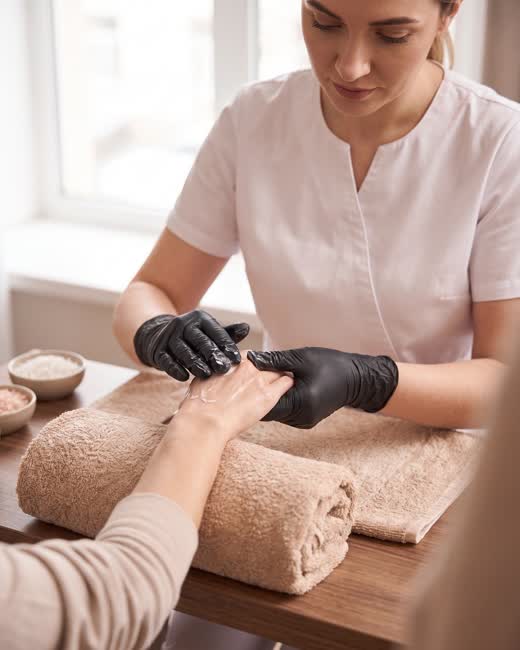
What you feel when the therapist reaches tense tissue
The start of the session should serve to warm up superficial layers and assess reactions. Only then does the pressure increase. In a tense muscle band, a broad feeling of pressure, expansion or dull burning usually appears. At a trigger point, the sensation may be local or travel to a characteristic area, but it remains predictable and subsides when pressure is reduced.
Sensations also change within a single session. A calf after a run may react differently than a neck overloaded by computer work. Superficial tissue often gives a broad burning sensation, while a trigger point may reproduce a familiar, dull pain. The mere fact that the therapist has "found exactly that spot" does not give permission for arbitrary pressure. The nervous system's reaction always counts, as does whether the sensation truly fades after the technique is released.
- Dull, even pressure that weakens after a few breaths usually falls within safe work.
- A short feeling of pulling during fascial work can be intense, but it should not force you to escape.
- Sharp pain like a sting, electric shock, numbness or sudden loss of sensation requires immediate cessation of the technique.
- Pain that intensifies with every movement, rather than gradually decreasing, is not the goal of the session.
The pain scale only makes sense if you can speak on it
A practical scale is not for breaking records. Zero means no discomfort, ten — unbearable pain. Work usually stays in the middle of the scale, but the number is not universal. The quality of the reaction is more important: calm breathing, no reflexive tensing and the ability to speak a full sentence. The therapist should ask not only "does it hurt", but also where and what kind of pain it is.
The same number can mean something different for someone who uses massage regularly and for someone after their first session. Therefore, good communication describes the change: "it was dull, now it stings", "the pain has moved towards the knee", "it still throbs after release". Such a description allows the therapist to change direction, work on an adjacent structure or avoid the spot entirely. Heroism deprives the therapist of the data needed to work.
Different training moments require different intensity
Before a start, the goal is not to induce deep tenderness. Work should prepare the body for movement, not leave muscles heavy and sore. After heavy exertion, the body also does not always need an immediate, aggressive session. Fresh micro-injuries, dehydration, cramps and general fatigue change tolerance. Information about the date of the competition, the type of training and the load of the last few days is part of the interview, not small talk.
A session for someone returning to training after a break is planned differently than for a runner in the middle of a competition plan, and differently again for someone with chronic tension from sitting. The term "sports" does not automatically mean maximum force. It means subordinating techniques to a specific movement goal and current regenerative capacity.
Anaesthesia would take away information needed during massage
Sports massage is not performed under anaesthesia. Sensory information is part of safety: it allows you to catch excessive pressure, nerve irritation or work on a fresh injury. Painkillers taken before the visit can suppress this information; you must tell the therapist about them. Alcohol is also not a way to relax before a massage.
Discomfort is reduced by preparation: a calm meal beforehand, hydration, no heavy training right before the session and precise indication of overloaded areas. A long exhale at the moment of pressure also helps. Silence for fear that asking for lighter work will "spoil" the treatment does not help.
It also makes no sense to apply an anaesthetic preparation to a painful area without agreement. The therapist needs true feedback, and altered sensation makes assessment difficult. If the pain is so strong that the area cannot be touched without medication, the first step should not be deep massage, but determining the cause of the ailment.
Technique can reduce discomfort without abandoning the goal
Less pressure is not the only possible change. The therapist can extend the warm-up, change the position of the limb, work more slowly, start from adjacent tissues or divide the area into shorter stages. Sometimes supporting the knee or shoulder makes a bigger difference than another attempt to "break down" tension. A body that does not have to stabilise an uncomfortable position allows for manual work more easily.
Tempo matters. Fast, surprising pressure can trigger a defensive reaction even with moderate force. Slow entry into the tissue gives time for adaptation and communication. This is why two sessions of similar intensity can be perceived completely differently. Skill does not lie in using the greatest force, but in matching the stimulus to the response.
Muscle, nerve and injury pain do not sound the same
Dull, diffuse pain within a tense muscle usually changes with pressure and position. Nerve symptoms can be sharp, burning, electric or combined with tingling and numbness. Injury pain can appear with a specific movement, accompany swelling, loss of strength or instability. A massage therapist should not pretend to be an imaging diagnostician, but must recognise a situation where manual work is not the first choice.
Pain without a clear cause, intensifying at night, combined with fever or general deterioration of well-being, requires special caution. Such information must be reported before the session. When symptoms go beyond the typical picture of soft tissue overload, postponing the massage is more reasonable than checking if it "can be massaged away".
What sports massage will not fix
Deep tissue does not set joints, does not heal a torn muscle and does not replace diagnostics for acute pain after an injury. Fever, active infection, open wounds, acute inflammation, suspected thrombosis and unexplained numbness are reasons to postpone the session and consult on your health status. Working "through the pain" can be harmful in such cases.
Massage will also not improve running technique, workstation ergonomics or a training plan if everything remains unchanged after the session. It can reduce tension and facilitate movement, but the source of the overload is still active. When pain returns after every identical stimulus, an analysis of load, recovery and movement patterns is needed, sometimes with the involvement of a physiotherapist or doctor.
Tenderness the next day is not mandatory proof of good work
Some people feel local sensitivity after a session, others only lightness or a greater range of motion. Lack of pain the next day does not mean the massage was too weak. Likewise, strong muscle soreness does not confirm that the therapist reached the "deep cause". The reaction is assessed together with function: whether it is easier to turn your head, do a squat, place your foot and rest at night.
If you are planning an important training session, the first high-intensity massage should not fall right before it. You do not yet know your body's reaction or the time it takes for tenderness to subside. It is safer to learn your body's response in a quieter week, and later match session dates to your training calendar.
What may hurt after a session and when to react
After deep work, tenderness similar to the feeling after training is possible. It should gradually weaken. On that day, it is better to forgo maximum loads, give the tissues low-intensity movement and observe the reaction. Increasing swelling, a large bruise, numbness, limb weakness or pain hindering normal movement are not the price of effectiveness — they require contact with the salon, and in the case of an acute course, medical consultation.
A simple record helps with observation: what hurts, with what movement, whether the sensation is decreasing and whether symptoms have appeared that were not there before the visit. A photo of extensive bruising in neutral light and information about medications taken can facilitate the conversation. Do not try to immediately "fix" tenderness with another very strong rolling session, because you are adding a stimulus to an already irritated area.
The first session should leave data for the next one
After a massage, it is good to note which techniques were tolerated, where radiating pain appeared and how the body behaved over the next two days. At the next visit, the therapist can use this as a basis to change the tempo, pressure and order of areas. Repeating an identical protocol despite a different reaction is not consistency, but ignoring information.
It is also worth defining a simple functional test before and after: a bend, neck turn, lifting an arm or a squat without extra weight. It is not for making a diagnosis, but for checking whether the session brought you closer to the goal. The level of pain on the table itself is much less useful than the movement that became freer after the treatment.
Where to book a sports massage in Warsaw
You can check the scope of the treatment and booking on the sports massage in Warsaw page. Before the visit, describe your training, fresh injuries, painkillers and the exact nature of the ailments. The best session is not the one that is hardest to endure, but the one after which the body regains freer movement without alarm symptoms.
For your first visit, do not come with the assumption that a specific pressure force is a condition of quality. Book a goal: improvement of a specific movement, reduction of overload after training or preparation for the next stage of activity. If the therapist can explain the choice of techniques, reacts to changes in sensation and does not work through nerve signals, intensity ceases to be a competition. It becomes one of the parameters of a well-conducted session.
Before starting, also mention easy bruising, medications affecting clotting, recent treatments and chronic diseases. Not every piece of information automatically excludes massage, but it may change the scope or force of the work. Concealing it so that the session takes place shifts the risk onto the body. A reliable interview is sometimes less spectacular than a deep grip, but it is what determines whether such a grip makes sense.
If the goal is a return after an injury, bring the recommendations of the person conducting the rehabilitation and do not expect the massage therapist to change the diagnosis. Manual work can be part of a larger plan, but it should not compete with exercises, load control and diagnostics. Honestly setting a boundary is especially important when pain limits daily movement, and not just appears after demanding training.
In Warsaw, it is easy to find places advertising massage as very strong. This is a poor comparative parameter, because it says nothing about qualifications, communication and adjustment to the training day. Ask how the therapist reacts to radiating pain, when they refuse to work and how they plan intensity before a start. The answers will say more than a declaration that they can use an elbow with great force.
The final rule is simple: during the session, you have the right to change your mind. Pressure that was acceptable a minute earlier may become too much after changing position or entering a different layer. Say so immediately. A good therapist does not treat feedback as criticism, but as a current measurement. Sports massage is meant to support movement and recovery. If it requires ignoring warning signals, it ceases to fulfil its purpose.
After the visit, do not evaluate quality solely at the moment of getting off the table. Check in the evening and the next morning whether the range of motion has been maintained, whether tenderness allows you to function normally and whether no new symptoms have appeared. This observation closes the information loop. At the next session, say not only that it was good or strong, but how long the improvement lasted and what happened after training. Thanks to this, the next work can be more precise, not just stronger. If there is no improvement in function despite repeating a similar massage, do not automatically increase the pressure. Change the plan and look for the cause beyond muscle tension itself.
A well-conducted session therefore ends not with praise for endurance, but with clear information: what was worked on, what reaction can be expected and when not to wait to make contact. This allows you to distinguish controlled discomfort from harm. In this sense, pain is one of the readings, never a goal or a bill that must be paid for an effective massage.


