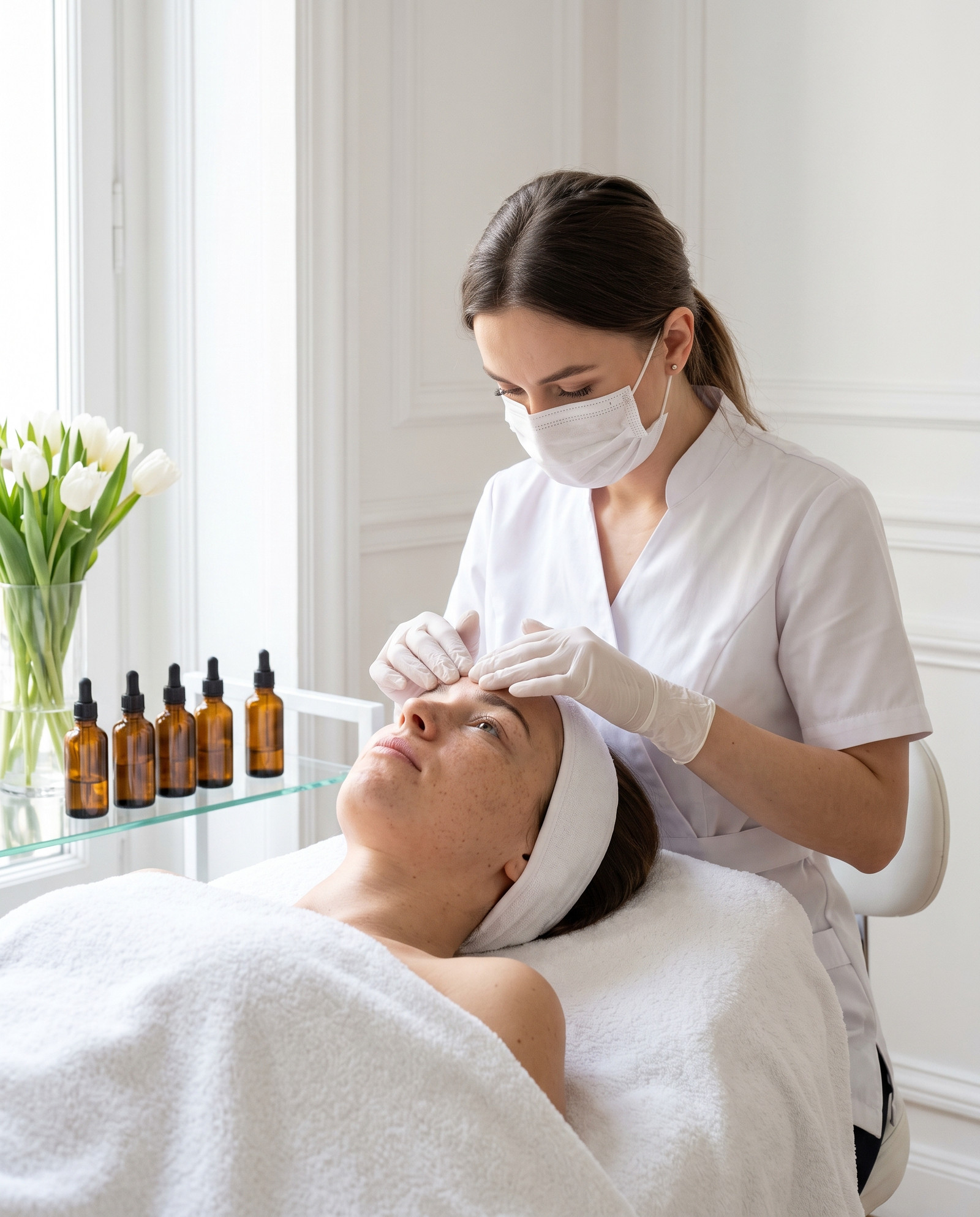
After make-up removal, the cosmetologist creates a map of the lesions, not a list to be squeezed.
An open blackhead has a visible opening and a dark surface. A closed one may form a small, light-coloured bump. A painful nodule located deeper, a blister, a scaly patch, or a dark lesion with an irregular shape requires a different approach. The mere fact that something protrudes above the skin surface does not make it content for extraction.
The specialist examines the colour, borders, opening, swelling, and reaction to gentle touch. They also check for any wounds from at-home squeezing nearby. Only then do they mark the areas suitable for treatment. If the diagnosis of a lesion is uncertain, the sensible decision is to leave it alone and refer you to a doctor, rather than attempting to resolve it with pressure.
On the same chin, three different conditions can lie side by side. The first point has a clear opening and empties under controlled pressure. The second is a hard, light-coloured bump near the vermilion border and requires a different technique and assessment. The third is painful even before being touched and has no exit path to the surface. Treating all three identically would be convenient, but it dangerously simplifies the skin. The treatment map may therefore contain areas for extraction, areas for observation, and places completely excluded from work. This division should be explained before starting.
Cold sores, weeping, and hot skin mean a change of plan
- A cluster of blisters near the lips. Fresh scabs and purulent discharge are a signal to postpone work in the affected area.
- Inflammation and warmth. Extensive warmth or rapidly spreading redness requires a change in the treatment plan.
- Risk of spreading. Mechanically disturbing the surface can increase irritation and transfer infectious material to adjacent skin, so skipping a blister by a few millimetres does not always solve the problem.
If the lesions are accompanied by a fever, chills, or a clear deterioration in your well-being, a beauty treatment is not the priority. Call before you arrive, describe the onset of symptoms, and do not try to mask them with concealer. The cosmetologist needs to see the actual picture, and if an infection is suspected, they may recommend a proper medical consultation.
A person with recurrent cold sores sometimes already knows the first warning sign: tingling at the lip appears before a blister is visible. If such a sensation started in the morning, it must be reported, even if the skin still looks almost normal. Warming and mechanical work in the vicinity are not a good experiment. For a lesion known from previous episodes, further action is determined according to a doctor's recommendations. The cosmetologist should not cover the area with a mask and perform the rest of the procedure without re-evaluating the scope. Sometimes it is safer to postpone the entire visit.
A deep, painful bump does not open with more force
During proper treatment, you may feel pinpoint pressure, especially around the nose and chin. Sharp, throbbing, or increasing pain requires stopping. The cosmetologist re-examines the lesion and decides whether to try a different setting or leave it entirely. The goal is not an empty bump at any cost, but the smallest possible trauma for the available content.
At the nasal ala, even proper pressure can be intense because the area is small and sensitive. The difference appears in how the specialist reacts to your feedback. When a client says the pain is becoming sharp, the specialist lifts their hands, dries the area, and checks if the skin has broken and if the opening is truly accessible. They do not reply "everyone has it like that" and do not ask you to endure further attempts. If the lesion does not empty with the correct setting, they leave it. Giving up on one point protects the tissue better than later explaining a bruise by the depth of the blackhead.
Stinging after a retinoid can look like skin needing exfoliation
The first visit after starting active skincare may end with just make-up removal and assessment. A cotton pad moved over the cheek causes stinging, and the skin quickly turns red. At the fifth meeting, after organising your routine and in accordance with the manager's recommendations, the same area may be calm, but still not require extraction. Data from subsequent visits is not meant to prove that the skin has "gotten used to" pressure. It is meant to show whether a mechanical procedure is even suitable for the current problem. Sometimes, improving the barrier reduces the number of places that previously looked clogged.
A wound from at-home squeezing changes the qualification the next day
The evening before the visit, the client checks if the blackhead on the chin is ready. In the morning, instead of an opening, there is swelling, a scab, and a red ring. The cosmetologist cannot assess the original lesion, and a fresh wound precludes further pricking in that area. An at-home attempt did not speed up the treatment. It took away the possibility of a calm extraction.
A patch applied overnight creates a similar problem. In the morning, the lesion is white and softened, and the adhesive has irritated the skin around it. This does not necessarily mean the blackhead has become easier to remove. The cosmetologist should ask what was under the patch, how long it remained, and whether it contained an active substance. Without this information, redness can be wrongly attributed to the lesion itself. With fresh irritation, it is better to skip pressure and observe the surface than to add a puncture to the reaction from the adhesive or preparation.
Medications and chronic illnesses must be reported, although they do not always mean a ban
Anticoagulant or dermatological medications should not be stopped on your own at the salon's request. If minor cuts usually take a long time to heal, form dark spots, or hypertrophic scars, talk about it regardless of the diagnosis. The history of skin reactions is sometimes more important for the scope of work than the number of blackheads visible on a given day.
A client might say: "recently, a wound on my nose was small, but the mark remained for many weeks." This is a specific detail that changes the plan. The specialist limits pricking, chooses only easily accessible openings, and documents the skin colour before the treatment. If similar marks appear after minimal trauma, further extraction should not be performed in a series without reflection. The value of the interview is not collecting disease names for a form, but linking a previous reaction to the decision made today. When the salon ignores this history and proposes a stronger session, the risk of repeated trauma increases.
Hygiene is a whole sequence of actions, not a one-time needle shown in packaging
- Disinfection of hands and work area. Pay attention to whether the person performing the treatment takes care to prepare a clean field and regularly disinfects their hands.
- Changing gloves. Gloves should always be changed after touching a phone, lamp, hair, or drawer, because a disposable tool does not protect the process if the hand returns to the skin after contact with a door handle.
- Questioning about sterilisation. Asking about the sterilisation of reusable tools is a normal question about a service that breaks the continuity of the skin surface.
After extraction, one should not return to the same point several times just to show the content on a gauze pad. Every additional pressure increases micro-trauma. A photo of "what came out" is not a measure of quality. It is more important whether the skin remains continuous and whether the places that were not to be treated were indeed skipped.
The scene of a hygiene check is very ordinary. With gloves on, the cosmetologist moves the lamp, then reaches into a drawer for a gauze pad and returns to the chin. Each of these surfaces could have transferred contaminants to the gloves that were clean a moment ago. The correct reaction is to change gloves or use a prepared barrier, not to assure you that the salon disinfects the room daily. The cleanliness of the interior does not replace a clean sequence of touch. The client can calmly ask about this moment, and the person performing the treatment should answer without making them feel embarrassed.
The first visit checks the reaction, the next should use the history
During the first extraction, more time is taken for the interview and a tolerance test of the skin preparation. The specialist does not yet know if the redness will calm down the same evening or if the spots on the chin will remain tender for longer. Treating fewer lesions is not an incomplete service. It provides the information needed for the next plan.
At the fifth visit, the client says that the nose remains calm, but painful bumps appear after shaving the neck. Repeating extraction on the entire face would ignore this feedback. The cosmetologist compares the distribution of lesions, asks about the razor and aftershave product, and may leave the neck without pressure if they see active folliculitis. History is used to reduce trauma, not to increase intensity.
Immediately after extraction, the normal reaction should fade
Ask for clear aftercare: what to wash your face with, what cream to use, when to return to active cosmetics, and who to contact in case of deterioration. The salon should know which preparations were used and which places were pricked. Without a treatment card, it is harder to reconstruct the possible cause of an unusual reaction later.
Increasing pain, heat, and discharge are not the skin "cleansing itself"
Stronger pain with every hour, increasing swelling, a hot area, purulent discharge, red streaks, fever, or a cluster of new blisters require contact. Do not explain them with the slogan "the skin is purging impurities". Mechanical extraction does not trigger a mandatory breakout that must be patiently waited out.
Take a photo in natural light and note when the symptom appeared. Do not apply several acids, rubbing alcohol, or a random antibiotic from your home medicine cabinet. Contact the salon, and in case of rapid deterioration, general symptoms, involvement of the eye area, or difficulty breathing, seek urgent medical help.
On the third day, the most common mistake is trying to finish the treatment yourself
When the redness disappears, it is easier to see a blackhead left next to the nose. The client decides that the cosmetologist missed it and squeezes it with their fingernails. The next morning, a painful scab appears, even though the rest of the face looks calm. This is not a late complication of the entire procedure, but a new injury made at home.
Good extraction does not mean empty pores forever. Some lesions are left intentionally because they are not ready or do not qualify for extraction. Instead of fixing them, write down the location and show them at the follow-up. This will allow you to assess whether the lesion has matured, disappeared after changing your skincare, or still requires being left without pressure.
Another third-day mistake involves scrubbing a peeling point with a towel. A small scab catches on the fibres and is torn off, after which the place bleeds again. This is a signal of a new injury. Do not fix it with rubbing alcohol or acid. Wash your skin according to the recommendations, do not touch it, and contact the salon if pain, swelling, or discharge increases. The information that the scab was mechanically torn off is important; do not hide it for fear of being judged. It allows separating the post-treatment course from an event that occurred later at home.
A dark, bleeding or constantly recurring lesion requires a diagnosis.
A black spot may be a blackhead, but a pigmented lesion with an irregular shape should not be pricked during cleansing. The same applies to an area that is growing, changing colour, bleeding without injury or failing to heal despite being left alone. A cosmetologist does not need to name the problem. They should recognise the limits of their competence.
A dated photograph helps show a doctor how a lesion changes over time, but a smoothing filter and different lighting can distort it. Do not try to "cleanse" the surface before a consultation. A scab or a fresh injury makes assessment difficult. Doubt is safer than the certainty that every bump is acne.
In Warsaw, a qualification precedes the choice of the extraction scope.
The service description is available on the manual cleansing page in Warsaw. The salon at Żelazna 59, 00-848 Warsaw is open Mon–Sat 8–21 and Sun 11–19. The location at Mińska 29A/46, 03-808 Warsaw operates Mon–Sat 9–21. When booking, disclose any active cold sores, dermatological treatment, recent peels and unusual healing after previous visits.
Choosing a location does not confirm that the treatment will take place as planned. The final decision is made after make-up removal, an interview and a skin examination. If some lesions are inflammatory, the procedure may be limited, changed or postponed, regardless of the waiting time for an appointment.
Four questions organise the decision before any pressure is applied.
- Does the lesion have a visible opening and is it not painful on its own?
- Is the skin surface intact, without a blister, oozing or a fresh wound?
- Has the interview revealed no therapy or healing issues that require a change of plan?
- Can the practitioner stop without pressure if the content does not come out with a gentle technique?
If even one answer is uncertain, the lesion may be skipped. This is the most important boundary of manual cleansing. The treatment is not meant to prove thoroughness by addressing every single point. It is meant to safely remove only those blackheads that are truly suitable for extraction and to provide a clear contact path in case of an abnormal reaction.
After your visit, note which areas were intentionally left without pressure. If one of these points starts to grow quickly, ache or ooze, do not try to perform the extraction at home. Inform your cosmetologist that it was a lesion previously excluded from the treatment.