What permanent freckles are — and why "permanent" doesn't mean "forever"
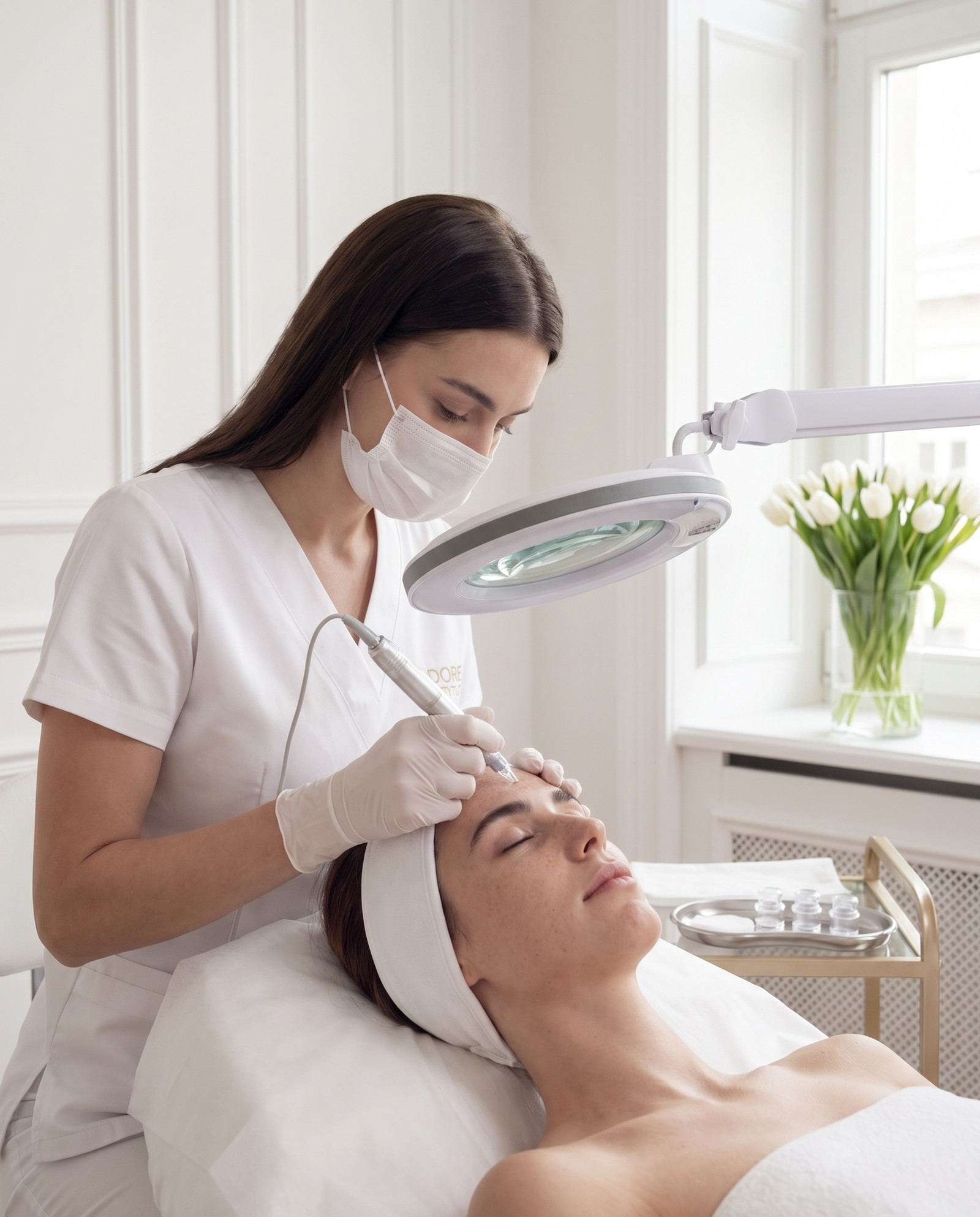
Permanent freckles are a permanent makeup technique that deposits pigment into the epidermis and the shallow layers of the dermis — unlike traditional tattoos, which sit much deeper. This isn't accidental. Shallower pigment placement gives a subtler, more skin-like result and — crucially — it fades gradually, instead of staying on the skin for life.
In this context, "permanent" means the pigment won't wash off with water or any cosmetic product — it doesn't disappear like eyeliner. But skin is a living, dynamic organ: it sheds, regenerates, and works constantly. That's exactly why pigment placed in its shallow layers fades over time. This is a deliberately designed effect, not a flaw in the technique.
Permanent freckles mimic natural sun-induced pigmentation — the same kind that appears on your nose and cheeks in summer. A specialist creates them by hand, one by one, matching shape, distribution and intensity to your facial features. The result can be barely noticeable or clearly defined — it all depends on what you agree together before the treatment.
What happens to your skin right after the treatment
Right after the session, freckles look more intense than the final result — darker, more defined, sometimes slightly swollen. This is your skin's reaction to the micro-injuries caused during the treatment, not the finished effect. Many people feel uneasy at this stage — it's one of the most common reasons for questions to specialists.
- 01
First 24–48 hours
Your skin reacts to the treatment: mild swelling, redness around the freckles, more intense colour. The pigment sits close to the surface.
- 02
Days 3–7
Your skin starts to regenerate. Micro-scabs form — a thin, barely visible layer over the freckles. The colour may look dark and matte.
- 03
Weeks 2–3
The scabs shed naturally, taking some of the pigment from the upper layers with them. The freckles look noticeably lighter — often 40–50% lighter than right after the treatment. This is a normal stage, not a cause for concern.
- 04
Weeks 4–6
Your skin fully regenerates, and the pigment "settles" into its final layer. Only now can you see the actual result of the first session — this lighter shade is the starting point for the touch-up.
Why freckles fade — the mechanism
Skin constantly renews itself from within. Epidermal cells on the surface today will be replaced by new ones within a few weeks — and the old ones shed and disappear. This process, called cell turnover, is what causes PMU pigment to fade gradually. The pigment doesn't disappear suddenly — it's slowly carried upward by migrating cells until it reaches the surface, where it sheds along with the epidermis.
At the same time, immune cells in the skin — macrophages, whose job is to clear away foreign particles — are also at work. Some of the pigment is absorbed and broken down by them. This process is stronger when pigment is placed shallowly and in high concentration — the skin "works" on it more intensively.
The rate of fading is individual and depends on many variables — both skin-related and lifestyle-related. Two people who had the same session with the same specialist can have completely different results a year later: for one, the freckles will still be visible; for the other, barely noticeable. This isn't about quality of work — it's biology.
What affects longevity — and what you can control
The longevity of permanent freckles depends on a dozen or so factors. Some relate to your skin and are hard to change. Others depend directly on your everyday choices — and this is where you can really influence how long the result lasts.
Biological factors
hard to control
- Skin type — oily and combination skin pushes pigment out faster than dry skin
- Rate of epidermal renewal — younger skin usually has faster cell turnover
- Activity of the skin's immune system
- Skin thickness and density (for example, nose area vs cheek)
Environmental factors
largely controllable
- Unprotected sun exposure — UV degrades the pigment and speeds up fading
- Retinoids and acids in your skincare — they speed up epidermal turnover, shortening how long the pigment lasts
- Exfoliating treatments around the face (peels, microdermabrasion)
- Aftercare — proper hydration in the first few weeks has a real impact on the final result
On average, permanent freckles remain visible for one to three years — but that's a genuinely wide range, and results vary a lot from person to person. The key isn't hitting the "middle" of that range. It's understanding which factors apply to you, and how to manage them.
What a touch-up really is
A touch-up is one of the most commonly misunderstood terms in permanent makeup. Many people treat it as a "fix for a mistake", or as an optional, emergency option for when something has gone wrong. In reality, a touch-up is a standard, planned part of the process — not an exception.
The reason is simple: no two skins take pigment the same way. After the first session, your specialist can't yet see how much pigment will "stay" in the skin once healed, how intense the freckles will look once the scabs shed, or where any unevenness might appear. Only once the result has fully settled — usually after 4–6 weeks — is there a real basis for assessment and adjustment.
Don't confuse a touch-up with a refresh — a separate visit that makes sense after a year or longer, once freckles have faded and you want to revive them. A touch-up closes the original result; a refresh is a decision to extend its life. Both are new treatment sessions — not a "final top-up" of something already done.
What the life cycle of permanent freckles looks like
When thinking about permanent freckles, it helps to see them not as a "one-off result" but as a multi-stage cycle with several points of contact with your specialist. This shifts your perspective — instead of expecting perfection after the first session, you understand that the result is built up and maintained gradually.
- 01
Consultation and first session
Deciding on intensity, distribution and character of the freckles. Choosing a pigment shade to match your skin tone. Performing the treatment — the result is initially darker than the final look.
- 02
Healing (4–6 weeks)
Natural shedding, pigment settling. A crucial stage where aftercare has a real impact on the final result.
- 03
Touch-up
Assessing the result after healing, filling in any gaps, achieving final saturation. Closing the result of the first session into its final version.
- 04
Stable stage (several months to over a year)
Freckles look their final way. They gradually fade — the pace depends on your skin and lifestyle. Sun protection and skincare extend this stage.
- 05
Refresh (optional)
Once freckles have faded to a level you're not happy with — a new session restores intensity. The cycle starts again.
Many people ask whether they can "opt out" of freckles if they change their mind. The answer is fairly reassuring: because PMU pigment sits more shallowly than in a classic tattoo and fades gradually, for many people the freckles simply disappear over time without any further intervention. This isn't guaranteed, though — the pace and extent of fading are individual. Laser removal techniques for PMU pigment also exist, and it's worth discussing these with your specialist if natural fading isn't enough.
Are permanent freckles for everyone?
There's no single answer, because everyone's skin reacts differently. The treatment works very well on most skin types and skin tones — from fair, through olive, to darker tones. Matching pigment to skin tone is one of the most important parts of the consultation, because what gives a natural, summer-freckle look on fair skin may need different shades and intensity on darker skin.
- Oily and combination skin — pigment fades faster, but the treatment is still possible. Worth factoring into your plan and any refresh sessions.
- Sensitive and reactive skin — possible more intense redness after the treatment, longer healing time. Consultation before the treatment is especially important.
- Active acne or inflammatory changes — in the treatment area, these may be a contraindication until healed.
- Pregnancy and breastfeeding — as standard, PMU treatments are postponed during this time.
- Using retinoids / acids — requires a break before the treatment (usually a few weeks); worth discussing with your specialist.
The result of permanent freckles is naturally subtle and skin-like — this isn't the same as artistic makeup or a decorative tattoo. That's exactly why the treatment works both as a complement to natural freckles (for people who have a few and want more), and as a standalone result on a face that has never had freckles at all. The key is a good consultation and honest conversations about expectations.
Brow Styling (PMU)
Freckles and permanent brow styling are a natural combination — a consistent, fresh look with no makeup needed. Both treatments use the same technique, so it's worth planning them together or close together in time.
Needle mesotherapy or PRP
Treatments that improve skin condition and hydration extend how long PMU pigment lasts. Good skin care "from within" helps the skin barrier work better and hold onto pigment for longer.
Dermatology consultation
For people with oily, acne-prone or reactive skin — talking to a dermatologist before a PMU treatment can help plan the sequence of treatments and avoid conflicts between them.