What a review of PMU says — and what it cannot confirm
Reviews are most useful when they repeat information about the process: whether the linergist explained the stages, whether the design could be discussed calmly, whether the aftercare instructions were clear, and whether you could get an answer to questions about healing after the visit. They show the standard of communication, although they do not prove the quality of the pigmentation.
A review is not a skin examination or a follow-up photo. You do not know what the skin type was, whether the brows had previous pigment, how the person followed the aftercare instructions, or at what stage they described the effect. Enthusiasm recorded on the day of the treatment concerns fresh, sharp brows. A critical assessment from the exfoliation period may concern a normal stage when the colour looks weaker. Without context, both statements can be sincere and yet insufficient.
Reviews help you assess
organisation and communication
- Whether the consultation was attentive
- Whether the design was discussed before pigmentation
- Whether the aftercare instructions were clear
- Whether the clinic responded during the healing process
- Whether the touch-up was a planned stage
Reviews do not confirm
suitability for your skin
- How the pigment will heal on you
- Whether the chosen technique is appropriate
- Whether the shape suits your features
- Whether you have a contraindication
- How a specific colour will age
Portfolio: the most important photo is taken after healing
Fresh PMU is more intense, has higher contrast, and is more sharply defined against the skin. This is a natural stage, but it is also the reason why a photo taken immediately after pigmentation cannot be the only proof of quality. In the following days, the skin heals, exfoliation occurs, the colour temporarily weakens, and only then does it stabilise. What looks beautiful in the chair must still go through this process well.
Ask for healed work, preferably shown before and after the touch-up, with the stage indicated. Look at the softness of the brow head, the evenness of the shading, the retention of individual strokes, and whether the colour creates a heavy, uniform patch. Also, assess variety. A portfolio with one shape copied onto every face may be aesthetically consistent, but it does not show individual design.
The technique is chosen for the skin, not for the popularity of a photo
The hair-stroke method, powder method, or ombre method, as well as the combination technique, are most often compared. In the hair-stroke method, the goal is to imitate natural hairs. The powder technique builds soft shading, and the combination technique uses both methods. None is the best by definition. What is important is which one allows you to achieve a predictable, aesthetic effect on a specific skin type and with a specific arrangement of natural hairs.
On dry or normal skin, delicate hair strokes may remain legible better. With oily, combination, or vascular skin, the lines have a greater tendency to lose sharpness, which is why the linergist may recommend powder shading, ombre, or a combination solution. This is not a degradation to a "less natural" version. A well-executed powder brow can be very soft, and naturalness also comes from the colour, gradient, and proportions, not just from drawn hairs.
- Ask how the lines or shading look after healing on skin similar to yours.
- Tell us about oiliness, reactivity, skincare with acids and retinoids, and previous treatments.
- Show how you paint your brows on a daily basis, but allow the design to also consider your face without makeup.
- Do not choose a technique based solely on its name — different executions under the same name can look different.
Design before the needle: the shape must work on your face
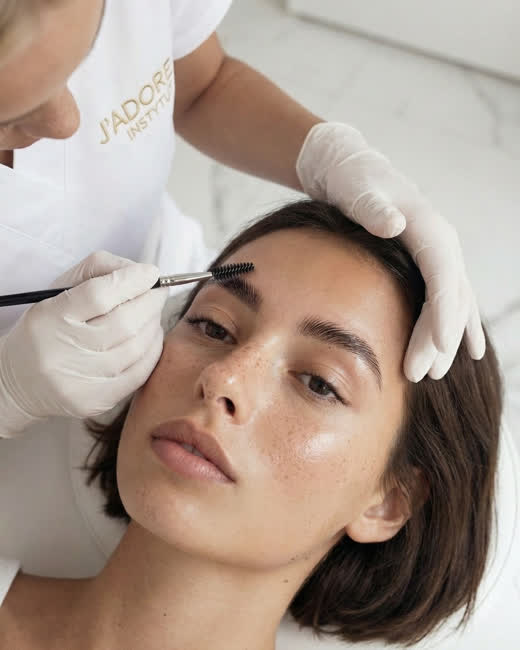
Before pigmentation, the linergist draws a brow design on the skin. This is not a quick visualisation to be accepted from the chair, but a stage where the head, arch, tail, width, and the relationship of both brows to the face are checked. The design should be viewed up close and from a distance, with calm facial expressions. It is worth sitting up, looking straight ahead, and seeing how the brows look together with your entire features.
A natural face is not perfectly symmetrical, so the goal does not have to be mathematical identity at all costs. The design organises asymmetry, but it should not fight against the arrangement of bones, muscles, and natural hairs. A brow that is too wide, too dark, or excessively lifted may look striking in a close-up, but dominate your entire face without makeup.
Hygiene is not an addition to a good review
PMU breaks the continuity of the skin, which is why a beautiful portfolio does not replace a hygienic way of working. You have the right to know which elements are disposable, how the workstation is prepared, and where the pigments come from. A qualified linergist should be able to answer factually, without dismissing the question with the argument that "this is how we always do it."
- Ask about disposable elements that come into contact with the skin and how they are opened before the treatment.
- Pay attention to a clean, prepared workstation, changing gloves, and protecting work surfaces.
- Ask for information about pigments from legal, certified sources and the possibility of recording the colour used.
- Check whether a health, medication, allergy, and previous PMU questionnaire takes place before the work.
- Establish what written aftercare instructions you will receive and the contact details in case of a worrying healing process.
Touch-ups and healing: do not judge the service at the wrong time
Immediately after pigmentation, brows are usually more intense than the intended effect. Later, gentle exfoliation occurs, and the colour may appear significantly lighter. Only after regeneration is it possible to calmly assess how much pigment remains and whether it has settled evenly. For this reason, at J'ADORE, the plan for your first PMU includes the treatment and a touch-up after 4–6 weeks. A touch-up is not automatically proof of an error — it is a planned completion of the effect following the skin's reaction.
Before booking, check how the salon defines a touch-up, when it takes place, what it may include, and how it is settled in the current offer. Do not assume terms based on reviews from a long time ago. Also, ask how a touch-up for your first PMU differs from a later refresh or working on old, existing pigment. These are three different situations.
- 01
Freshly after pigmentation
The colour is intense, and the skin may be red. This is documentation of the treatment, not the final result.
- 02
During exfoliation
Brows may look uneven or very light. Do not pick at the flaking skin and do not judge the durability at this stage.
- 03
After regeneration
The colour stabilises, and the linergist can assess pigment retention and the need for a top-up.
- 04
After the touch-up and its healing
This is the right moment to assess the complete first PMU process.
When PMU needs to be postponed or another issue solved first
Active inflammation, infection, or skin damage in the brow area are reasons to postpone pigmentation. The treatment is also not performed during pregnancy or while breastfeeding. Oral retinoids, blood-thinning medications, uncontrolled diseases that hinder healing, a tendency for keloids, and active skin diseases may be significant. A specialist decides on the appropriate interval and qualification based on a full medical history.
Old permanent makeup requires a separate assessment. If the pigment is dark, has changed shade, or lies outside the new design, it is not always possible to simply cover it with another layer. Sometimes lightening or removal is needed first, and only then a new design. A good linergist shows the limitations of a touch-up instead of promising that a fresh colour will cover every previous piece of work.
Brow PMU in Krakow — address, hours, and consultation
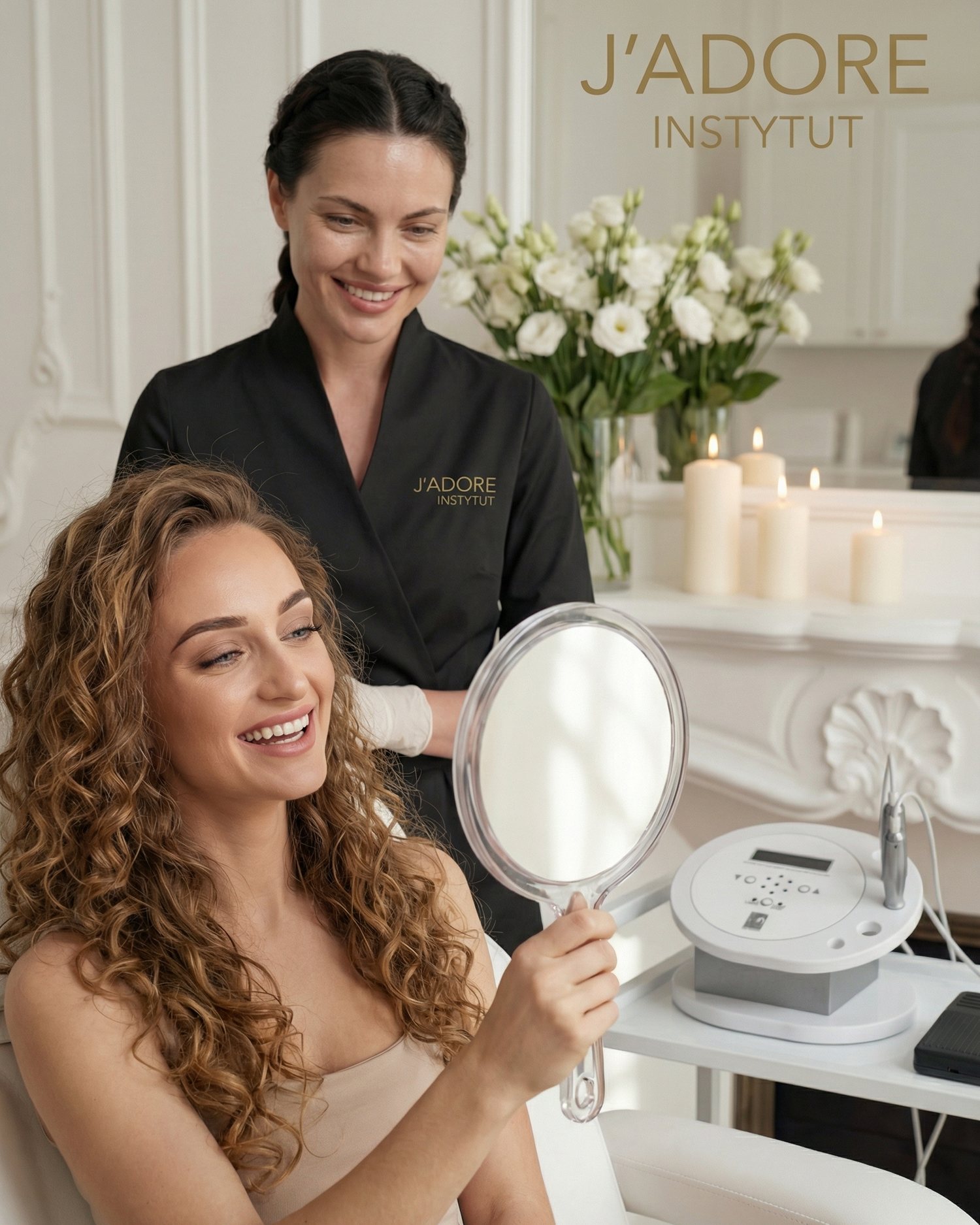
In Krakow, we perform permanent brow makeup at J'ADORE INSTYTUT at Karmelicka 45/2B, 31-128 Krakow. Opening hours: Mon–Sat 8–20. The PMU is performed by a qualified linergist, and before pigmentation, a consultation takes place involving skin assessment, technique selection, and the choice of shape and colour.
You will find the treatment description, current price list, local information, and a link to booking on the page Brow PMU in Krakow — treatment and location. Before choosing a date, it is worth preparing a photo of your brows without makeup and information about previous PMU, active skincare, and medications taken.
Summary: reviews open the conversation, they do not end the selection
A high rating for a salon can be a good sign, but for PMU, the consistency of several pieces of evidence is more important. A healed portfolio should confirm the ability to work on different faces, the consultation — the matching of technique and design, and the conversation about hygiene and touch-ups — responsible management of the entire process.
- Read reviews in terms of process and communication, not just enthusiasm.
- Look at healed results, not just fresh photos.
- Allow the technique to be matched to your skin and natural brows.
- Accept the shape, colour, and scope before pigmentation begins.
- Ask directly about hygiene, pigments, aftercare, and contact after the treatment.
- Treat the touch-up as part of the plan, and contraindications as a reason for a safe postponement.