What the needle actually does during PMU
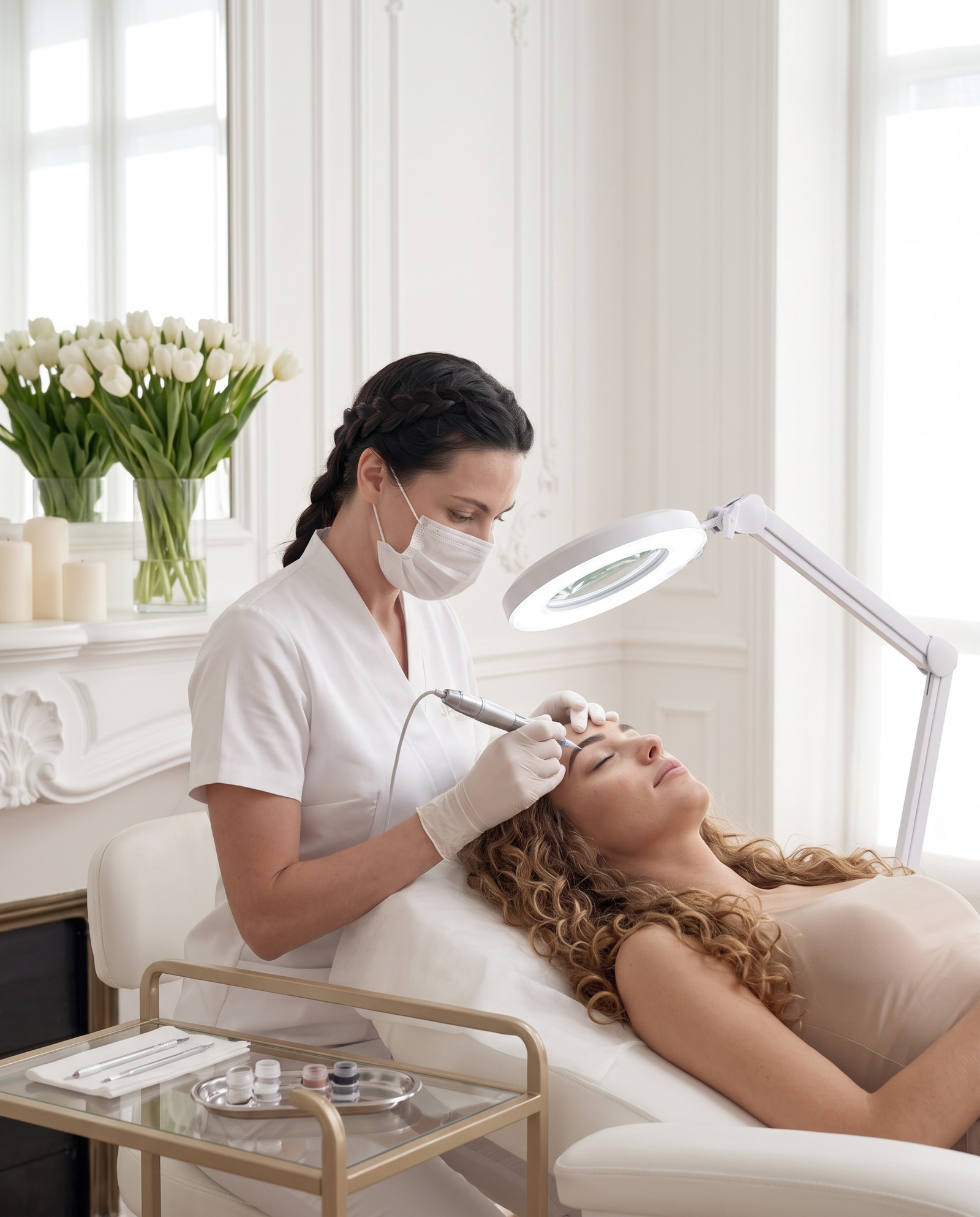
Permanent makeup isn't a body tattoo — and that distinction matters if you want to understand why healing unfolds the way it does. Pigment is placed more shallowly, into a skin layer called the dermis — but not as deep as a classic tattoo. Why does this matter? Because the dermis is a living layer that actively responds to any disruption. The needle doesn't just deposit pigment. Through millions of micro-punctures, it breaks tissue continuity, triggering a local inflammatory response.
This inflammatory response isn't an error or a complication — it's a built-in repair mechanism. Your skin doesn't distinguish between damage caused by a scratch, a burn, or a precise PMU device. It runs the same protocol: an influx of immune cells, phagocytosis of foreign particles, and the release of tissue-remodelling substances. And it's this protocol that actively affects how the pigment looks and how much of it remains during the first weeks.
Four healing phases — and why each one matters
Healing after PMU isn't a single event. It's a sequence of phases that follow and overlap one another. Each one changes how the result looks. Skipping a phase, or trying to "speed up" the process with early intervention, disrupts the whole sequence.
- 01
Inflammatory phase (days 1–3)
Your skin is red and irritated, and may be slightly swollen. The colour looks intense — darker than the final result. This is the peak of the immune response. The pigment is "surrounded" by immune cells trying to examine it and partly remove it.
- 02
Exfoliation phase (days 3–10)
The epidermis forms a thin scab — a natural protective layer. Under the scab, the colour may look darker or uneven. During this time, you must NOT peel, soak or scratch the scab. Pigment removed with it won't come back.
- 03
"Fading" phase (weeks 2–4)
Once the scab comes off, the result often looks as though the colour has faded or almost disappeared — especially with brows. This is the point where many people start to worry. In reality, the pigment is still in your skin, just covered by a new layer of epidermis. The colour is muted at this stage and doesn't reflect the final result.
- 04
Pigment stabilisation (weeks 4–6)
The dermis finishes remodelling. New collagen forms around the pigment particles, immune cells complete their work, and the colour "settles" at its final saturation level. Only now can you see how much pigment remains and how it's distributed — in other words, what actually needs a touch-up.
Why an early touch-up doesn't help — and can cause harm
Imagine a workshop undergoing active renovation. The walls are wet, the paint hasn't dried, and the building crew is still on site. You could go in and paint over it, but the outcome would be unpredictable — the paint might not stick, it might mix with the damp surface, or it might turn out quite differently from what you intended. This is exactly the situation your skin is in during the first weeks after PMU.
- Pigment takes less well. Skin in the active healing phase is more resistant to retaining new pigment — immune cells are still actively removing foreign particles, and new pigment gets treated the same way. So the touch-up result may be weaker, and harder to predict.
- You can't tell what's actually missing. In week two or three, the colour is in its "fading" phase — it looks weaker than it will end up being. Correcting something that isn't yet the final result is like painting a picture in poor light.
- Risk of pigment overload. If a touch-up is done before the previous pigment has stabilised, extra pigment can be layered "just in case" — which can lead to over-saturation or unevenness once both layers finally settle.
- Overloading your skin. Tissue needs time to complete healing. Disrupting the skin's continuity again before it's finished repairing extends the overall recovery time and can increase the risk of irritation.
Touch-up too early (< 4 weeks)
before the pigment has stabilised
- Poorer retention of new pigment
- Assessment based on a transitional-phase colour
- Risk of excess or uneven colour
- Extended overall skin healing
Touch-up after 4–6 weeks
once the pigment has stabilised
- Full picture of the first session's result
- Skin fully healed and receptive
- Precise top-up — only what's missing
- Predictable, controlled outcome
The colour has "vanished" — is that normal?
This is one of the most common and unsettling experiences after PMU — especially with brows. A week after the treatment, the colour looked intense. Two weeks later, it seems almost invisible. And the thought creeps in: did the treatment not "take"? Do I need to start over?
In the vast majority of cases, this is a completely normal stage of healing, not a sign of failure. The epidermis regenerating after the treatment is thicker and more opaque than usual at this stage — and it simply covers the pigment, which is still sitting deeper, in the dermis. As the new epidermis matures and becomes more transparent, the colour "comes back through". For many people, the result improves around week 4–5 — on its own, without any touch-up.
What to do while waiting for your touch-up
Waiting doesn't mean doing nothing. How you care for your skin in the first weeks after PMU has a real effect on how much pigment remains and how the touch-up result will look. Here are a few things worth paying attention to:
- Aftercare exactly as instructed. A nourishing balm (usually a neutral ointment or a dedicated product), applied regularly in the first few days, slows down exfoliation and gives the pigment time to stabilise. Skin that's too dry exfoliates faster, taking more pigment with it.
- Never pick or peel the scab. The scab is a natural form of protection. Removed mechanically, it can take pigment particles with it — exactly at the spots where gaps will appear.
- Avoid intense sun exposure. UV accelerates pigment breakdown — both during healing and long term. In the first few weeks, it's best to avoid long periods in the sun without covering your head.
- Avoid saunas, swimming pools and heavy sweating. Water and steam speed up epidermal exfoliation, which can flush pigment out faster during the healing phase.
- Don't use retinoid or acid creams around the PMU area — they speed up epidermal turnover and push the pigment out faster than it should go.
Touch-up — what can really be improved, and what to expect
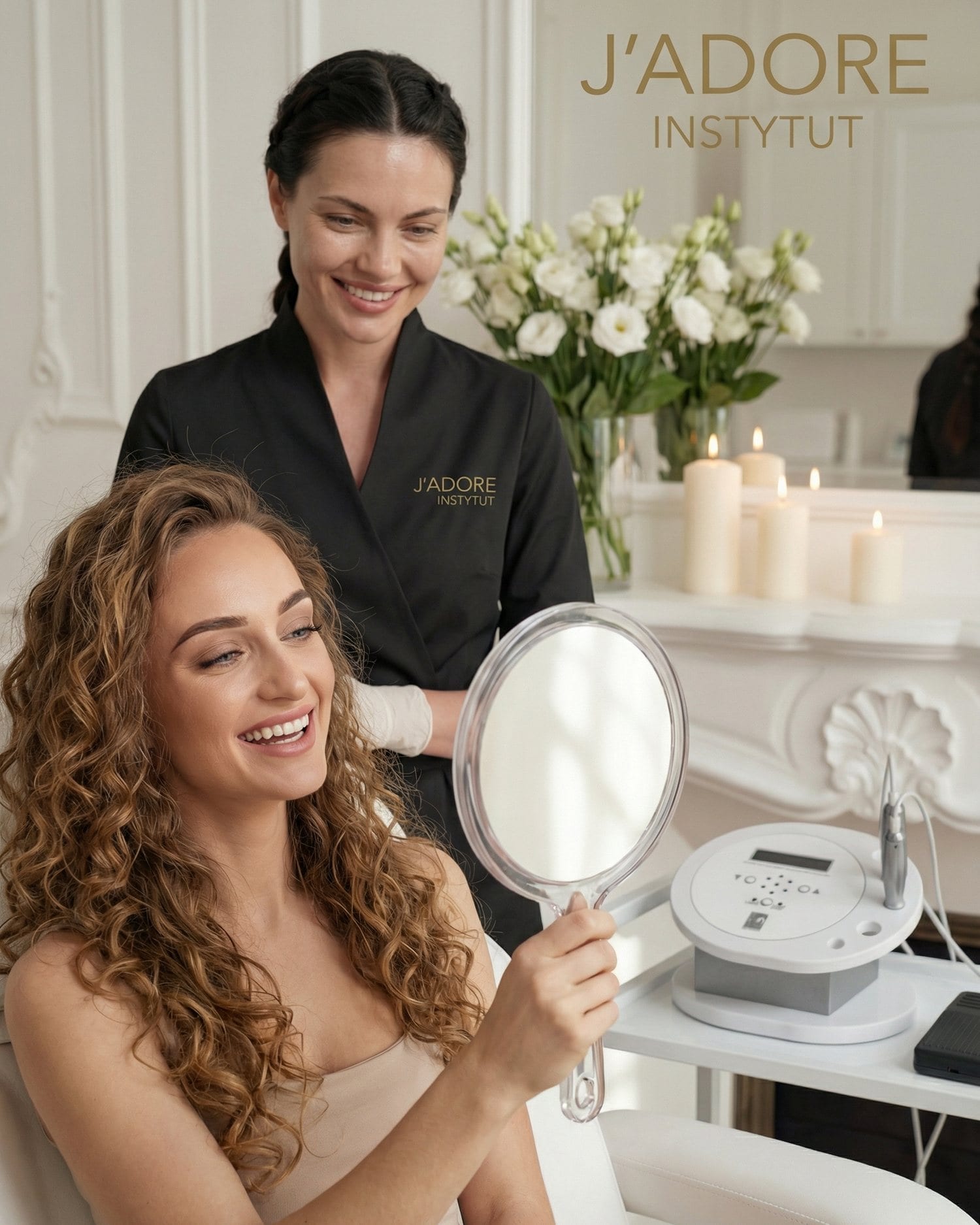
After 4–6 weeks, you have the full picture of your first session's result. Now your specialist can see the real state of the pigment: where it's too light, where the colour is uneven, where the shape needs a small adjustment. This is a completely different situation from trying to fix things mid-healing — your specialist is working on stable ground, with full knowledge of how your skin has taken the pigment.
- Filling in gaps. Spots where the pigment didn't take, or took less well, often appear in specific areas depending on skin thickness or oiliness in that spot.
- Colour correction. If the colour, once stabilised, is slightly different from what was intended (for example, if it shifted tone due to your skin's individual pH), the touch-up is the moment for precise adjustment.
- Refining the shape. Small asymmetries, or spots where the line needs subtle filling in — visible only once the result has fully healed.
- NOT a full redo. A touch-up is a finishing step, not a new treatment. If something needs a radical change (a complete change of shape or colour, for example), that's a separate conversation and a longer plan.
Different types of PMU — different healing timelines?
PMU isn't a single technique — it's a family of methods that differ in how pigment is applied and in the final look. And while the 4–6 week rule applies to all of them, it's worth knowing that each technique heals a little differently and can look different during the transitional phase.
Microblading / hair stroke
hair-stroke imitation
- Fine, precise strokes that mimic individual brow hairs
- During the exfoliation phase, strokes may look "blurred"
- Once healed, they sharpen and become clearer
- Oily skin may retain strokes less well — this only becomes clear after stabilisation
Powder brow / ombré
soft shading effect
- A filled-in effect — soft, like powder
- May look intense right after the treatment, then noticeably lightens after exfoliation
- Tolerated better by oily skin
- Once stabilised, gives a softer result than right after the treatment
Regardless of technique, the rule stays the same: what you see in the first days and weeks isn't the final result. The final result is what remains once the stabilisation phase is complete — and only then can you fairly assess what, if anything, needs a touch-up.