Why men choose PMU
The reasons are more practical than they may seem. It is rarely about “aesthetics” in the sense of beauty. More often, it is about functionality and confidence. A man with a scar beyond the hairline after scalp surgery does not want to think about it at every meeting. Someone with alopecia areata in the brows simply wants brows — symmetrical, natural and without daily pencil filling.
- Brows — filling sparse areas, correcting asymmetry, restoring brows after previous hair removal or hair loss caused by alopecia
- Lash line (eyeliner/lash line) — subtle definition for the eyes, especially when lashes are fair and barely visible
- SMP (Scalp Micropigmentation) — the illusion of shaved hair on a balding scalp or camouflage for scars after a transplant or surgery
- Correction and touch-up — improving an unsuccessful treatment performed elsewhere
Whatever the reason, the route to each of these results starts in the same way: with a consultation. Your specialist assesses your skin, history and expectations. This is not a formality. It is the most important part of the whole process.
Consultation — what actually happens
Consultation is not “selling a treatment”. It is a two-way technical conversation. Your specialist gathers information and you ask questions. The more you share, the more tailored the result can be. You do not need to arrive with a clear vision. You can come with a concern and let your specialist suggest a solution.
- 01
Skin and health assessment
Your specialist asks about your skin type (oily, dry, combination or sensitive), tendency towards keloids, medications, skin conditions and sun exposure. These are not bureaucratic questions. They affect the choice of technique and pigment.
- 02
Assessment of the treatment area
Natural hairs, if present, face shape, brow line, symmetry and tissue distribution — your specialist assesses all of this visually, often using a ruler or templates. They measure rather than assume.
- 03
Choosing the technique
For brows: microblading, ombre powder brows, a combination technique or nanobrows — each leaves a different result on the skin and changes differently over time. The choice depends on your skin type, lifestyle and preferred result.
- 04
Choosing the shape and colour
Your specialist sketches the shape — first on the skin with a dermographic pencil, then, if needed, using digital tools. You have every right to say “too dark”, “too arched” or “I want it straighter”. This is the stage for changes, not the finished result.
- 05
Discussing the process and healing
You will learn what the result looks like immediately after the treatment, when it is more intense. You will also learn how the skin heals over the following weeks and when you can assess the final result. A follow-up after a few weeks is standard.
Brows for men — why they require a different approach
Female and male brows follow different aesthetic principles. Female brows can be clearly shaped, with a visible arch and stronger colour. Male brows need to look like your own, only better — a “done” brow effect is not an option.
Female PMU brows
what female aesthetics allow
- a defined arch, sometimes dramatic
- higher colour contrast against the complexion
- a more defined outer line
- a “fresh from the brow salon” effect is acceptable
Male PMU brows
what defines the male result
- a flat or minimally arched line
- a colour close to the natural hair colour
- filling gaps, not drawing a new shape
- result: “as if you have always had brows like this”
This is why, when choosing a salon and specialist, it is worth checking a portfolio of work on men — not only women. The technique may be the same, but the aesthetic judgement and understanding of how a male face should look must suit your sex.
SMP — the specifics of scalp treatment
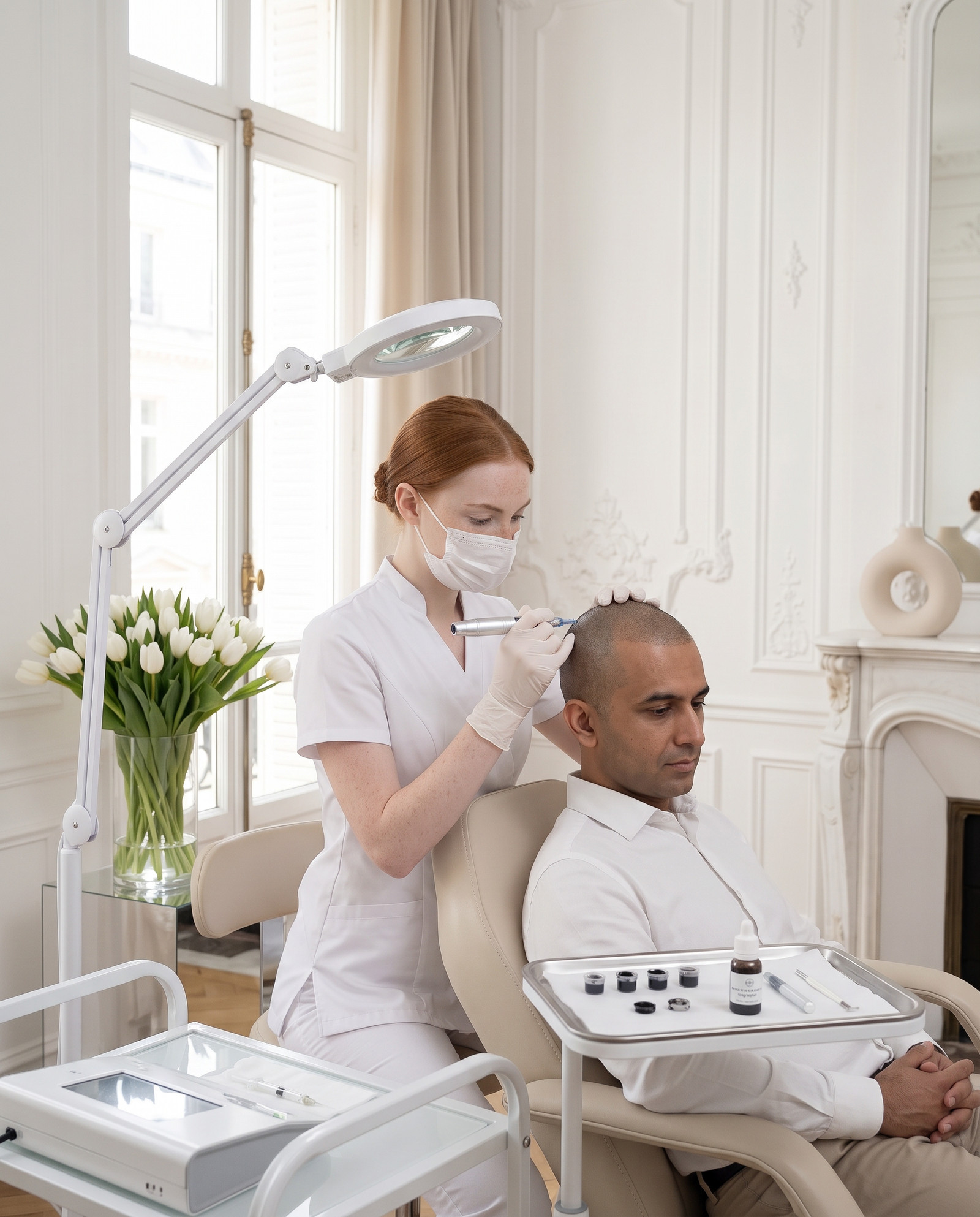
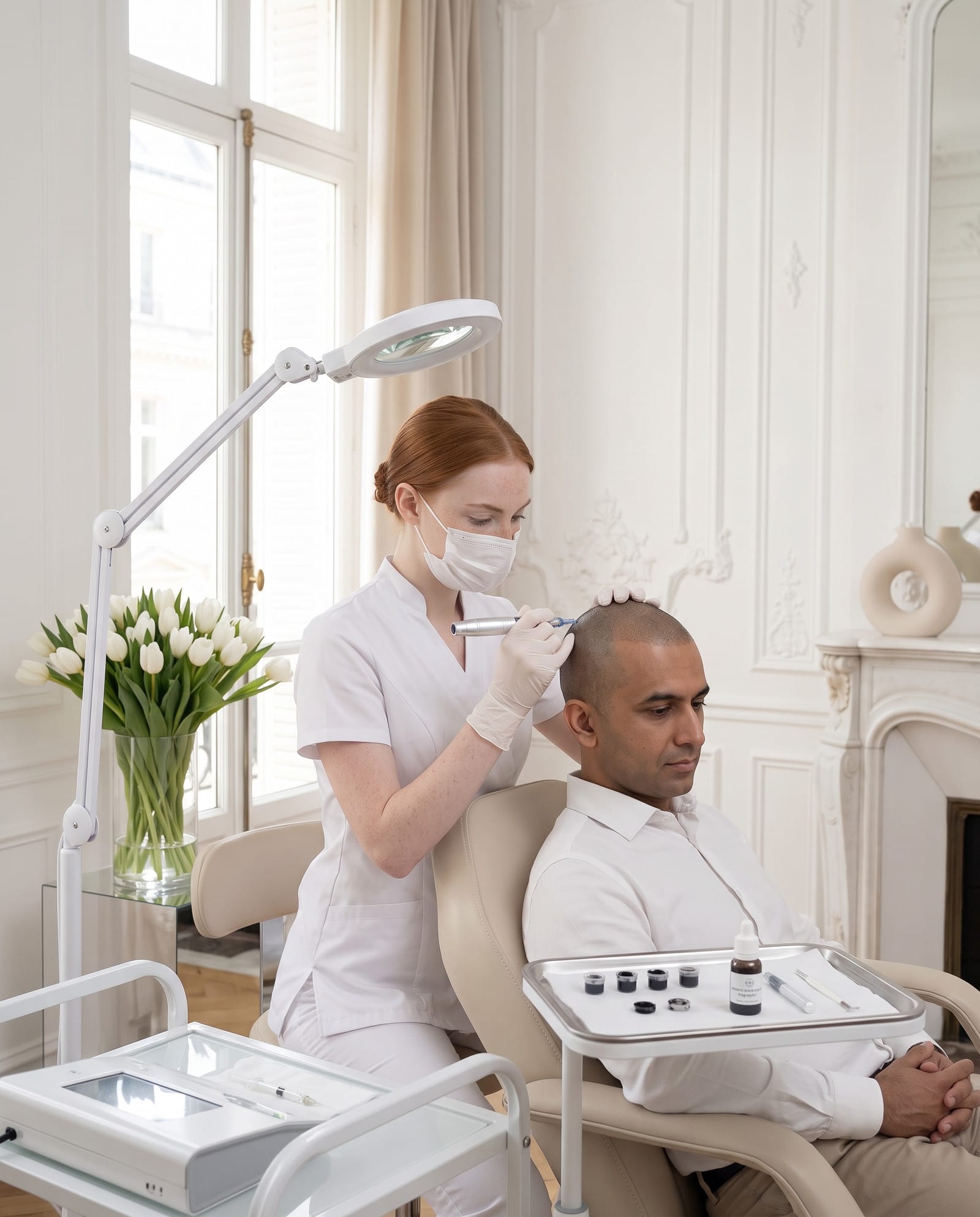
Scalp Micropigmentation is a separate category — technically closer to paramedical tattooing than classic PMU. It involves placing tiny pigment dots that imitate shaved hair follicles. The result is the illusion of density and stubble where hair no longer grows.
- Androgenetic alopecia (a receding hairline or thinning at the crown) — creating the illusion of density without surgery
- Scars after FUT/FUE transplantation — camouflaging linear or dot scars on the back of the head
- Alopecia areata — camouflaging patches of hair loss
- A fully shaved head — an even stubble effect across the scalp, often for a close shave
SMP usually requires several sessions — the result is built in layers. During consultation, the specialist assesses the colour of your skin and existing, or intended, stubble to match the pigment shade. This is crucial: the wrong colour may look natural for a year, then turn “grey” or “blue”. A good specialist knows how to prevent this.
Questions worth asking during consultation
Consultation is for you — do not be afraid to ask specific questions. This is not a visit where someone is “selling” you something. It is the time to establish all the terms before making a decision.
Pay attention to how the specialist answers your questions — whether the answers are precise and supported by examples, or vague and focused on booking you in quickly. A good specialist is your partner in making a decision, not someone selling a slot in the diary.
Preparing for your consultation — what to consider beforehand
The consultation is free and comes with no obligation. To make the most of it, it is worth considering a few things in advance.
- Reference photographs — photos of brows or hairlines you like, even from the internet. The specialist will see what you are looking for more quickly than from a verbal description.
- Skin history — if you have keloids, psoriasis, rosacea or seborrhoeic dermatitis, mention it in advance. This may affect the technique or appointment date.
- Medicines and supplements — retinoids, acids, anticoagulants and acne medication affect healing and pigment longevity.
- ‘Before’ photographs — if the treatment is intended to camouflage a scar or fill areas of hair loss, photographs from different angles and in different lighting will help the specialist plan the treatment.
Healing and results — realistic expectations
PMU does not look perfect when you leave the salon. It is important to understand this before the treatment, so you do not mistake the normal healing process for an error by the specialist.
- Days 1–3: more intense colour and slight swelling — the result may look too strong or too dark. This is normal.
- Days 4–7: the skin may peel and the colour may ‘disappear’ beneath the new epidermis. Do not apply products or scratch — this is a critical stage for the pigment to settle properly.
- Weeks 2–4: the colour returns and gradually reaches its final intensity. Only now can you assess the result.
- After 4–6 weeks: follow-up — the specialist checks how the pigment has settled and tops it up if needed.
PMU results may last differently in men than in women — oily skin, more frequent sweating and sun exposure, such as outdoor work or sport, may accelerate pigment fading. A good specialist will consider this when selecting the technique and pigment. They will tell you directly what to expect in one, two or three years.