Where "duck lips" came from in the first place
The fear of "duck lips" is fed by three things. First — selective imagery. The internet shows extremes, because only extremes are "worth" photographing; nobody recognises naturally contoured lips as the result of a treatment, so statistically they "don't exist". Second — confusing the word with the effect: "augmentation" sounds like "more at any cost", though in the clinic it's usually about contour, symmetry and hydration rather than sheer volume. Third — lack of conversation: it's easier to repeat someone else's fear than to ask a doctor what the result actually depends on.
Seven myths, one by one
Myth 1: "Lip filler always shows." This is the most common fear — and the most common misunderstanding. "Showing" almost always means overcorrection or poor technique: too much product, injection into the wrong layer, ignoring facial proportions. Well-chosen, conservative contouring defines the shape and hydrates the lip so that people notice "you look great", not "you've had something done". A good doctor's goal is the exact opposite of an overfilled lip — and it comes down to the golden rule of aesthetic medicine: less is more.
Myth 2: "Duck lips are caused by hyaluronic acid." No. Hyaluronic acid is just a tool — the same substance can create a subtle contour or, if overused, ruin it. "Duck lips" come from how much is injected and where, not from the product itself. It's a bit like blaming the paint for a badly painted room. The result depends on the doctor's hand, eye and restraint, not on the substance in the syringe.
Myth 3: "Go big the first time so I don't have to come back." This approach usually ends in disappointment. Lip contouring works the other way round: it's easier to add more later than to correct too much. That's why, on a first visit, a good doctor works conservatively — building the effect gradually, in line with your facial proportions. "Big from the start" doesn't save you visits — it's the quickest route to exactly what you're afraid of.
Myth 4: "Once you've had it done, your lips never go back to how they were." Hyaluronic acid isn't permanent — over time it breaks down naturally, and your lips return to their original state. What's more, if you're unhappy with the result for any reason, you don't have to wait: the filler can be dissolved with an enzyme (hyaluronidase). This is one of the most important — and least mentioned — facts about this treatment: it's reversible. Few aesthetic treatments offer this level of "undo".
Myth 5: "Lip augmentation always means more volume." This is where the biggest misunderstanding lies. "Augmentation" also covers contouring — and very often it has nothing to do with fullness. Sometimes the goal is simply a defined contour and a sharper Cupid's bow, sometimes it's correcting asymmetry, lifting drooping corners, or just hydrating dry, thinning lips. Not every pair of lips needs "more" — some just need "more even" or "fresher". That's why the first question at consultation isn't "how many millilitres", but "what exactly do we want to improve".
Myth 6: "You can see the result straight away, so I'll judge my lips the next day." Quite the opposite — and this is one of the main causes of post-treatment panic. Lips are a highly vascular, mobile area, so they swell significantly: for the first few days they can look larger, uneven, sometimes bruised. This is temporary swelling, not the final result. The real outcome only shows once the filler has settled — after around two weeks. Hence the golden rule: never book lip contouring right before an important event, and don't judge the result on the day of the treatment.
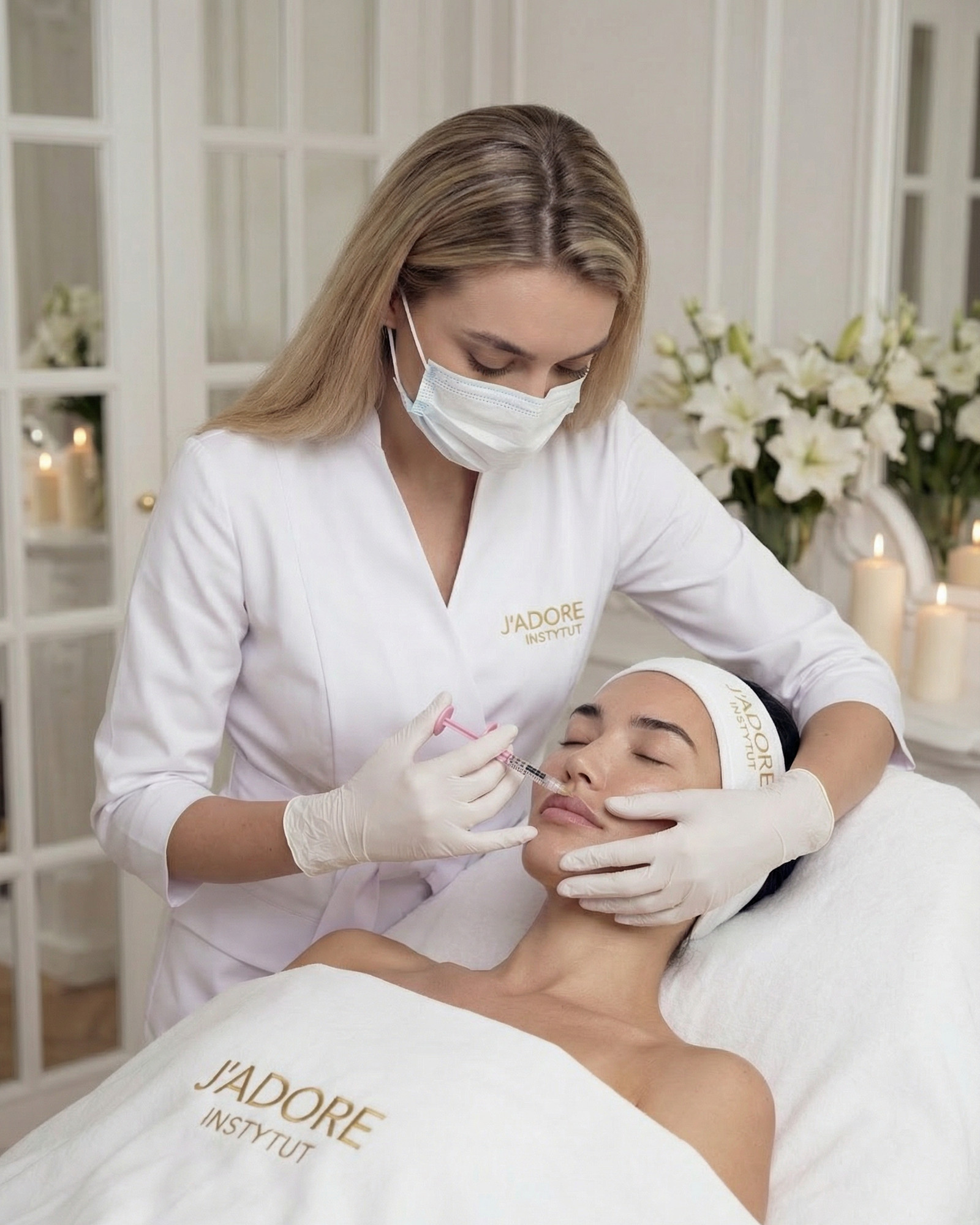
Myth 7: "Lips are a minor treatment, so it doesn't matter who does it." This myth can genuinely cause harm. Lip contouring is a medical treatment — the area is richly supplied with blood vessels, and the margin for error is small, so anatomical knowledge, technique, and how the doctor would handle a complication all matter. That's why at J'adore this treatment is performed only by an aesthetic medicine doctor, using an original, certified product, and always after consultation. "Cheap, fast, walk-in, with anyone" is the worst possible saving when it comes to lips.
What really determines a natural result
Since most myths come down to "who and how", it's worth knowing what actually makes lips look natural rather than "done". First — proportions, not volume. Lips don't exist in isolation; the doctor looks at the whole face: the relationship between the upper and lower lip, lip width relative to the nose and chin, symmetry. A natural result is harmony with the rest of your features, not maximum fullness. Second — contour before quantity. Often it's a clearer vermilion border and a preserved Cupid's bow that create the impression of "fresh, pretty lips" — not litres of product. Third — a staged approach. A natural result is more often built over two calm visits than one "bold" one. And fourth — choice of product. Lips need specially formulated, soft products; the doctor selects the right one for your goal, and you have every right to ask what they're using and whether the product is genuine.
What nobody tells you — cold sores, and a few simple rules
There's one topic almost always missing from conversations about "beautiful lips", yet it can determine how the whole treatment goes: cold sores. If you've ever had a cold sore — even rarely, and even not exactly at the injection site — always tell your doctor before the treatment. An injection near the lips can reactivate the virus, and instead of a nice result, you get a painful flare-up. This isn't a reason to skip the treatment — it's a reason to prepare for it: for recurrent cold sores, the doctor will recommend antiviral cover in advance and choose the right timing. Withholding this information only harms you.
The rest of the rules are mundane, but they determine how comfortable the first few days will be. Give yourself plenty of time — since lips swell and the result only settles after around two weeks, don't book the treatment the day before a wedding, photo shoot or important meeting. Expect temporary swelling, and possibly bruising — this is normal for such a vascular area, not a complication. Don't judge your lips in the first few days, and don't panic and try to "fix" anything — a follow-up visit is there for any touch-ups, once the filler has settled. And the simplest rule, most often ignored: go into your consultation asking "what do we want to improve", not "how many millilitres" — the first question leads to natural lips, the second to duck lips.
Before you decide — a quick cheat sheet
If you're considering lip contouring after all this, start with an honest answer to one question: what do I actually want to improve? Do I lack volume, or has my contour become blurred? Does asymmetry bother me, drooping corners, or just dry, thinning lips? This distinction is made at consultation, and it prevents most disappointments — not every "lip problem" is solved the same way, and sometimes hydration and contour are enough, without volume.
Second point: a natural result is a process, not a one-off shot. A calm first visit, assessment after two weeks, a possible subtle touch-up — this is how you build lips nobody will recognise as "done". And third, most importantly: it's a reversible choice. Genuine hyaluronic acid can be dissolved, and it's absorbed naturally over time anyway. Lip contouring isn't a decision for life — and knowing that lets you approach it calmly, without fear of "duck lips", which really begins and ends with restraint.