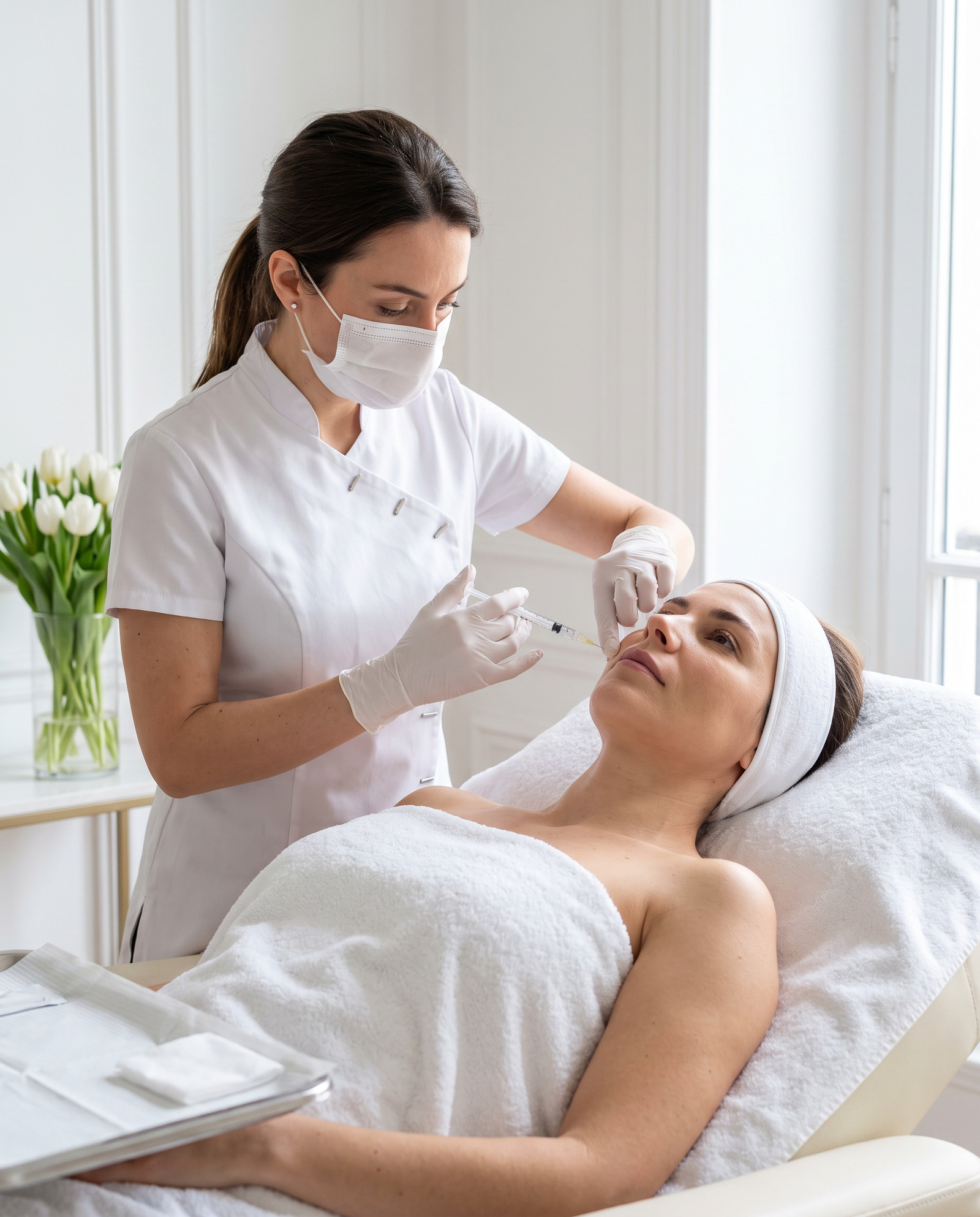

First, take a breath: is this even your thing
Before you say "yes" to lip augmentation, it's worth pausing on the question of purpose. Reasons vary widely — and each calls for a different approach. Some people come wanting more volume where it has always been lacking. Others want to hold on to what they have — because lips lose fullness with age, and the contour becomes less defined. Some simply want to correct asymmetry or refresh the shape without changing size.
And when is it worth thinking twice? If you want lips you saw in a specific social media photo — because those lips belong to someone else, set within a particular face, with particular cheekbones and proportions. A good result is always tailored to you, not to someone else's photo. One more thing: if the decision comes in the middle of major stress or after a difficult event, wait. Not because it's a bad idea, but because decisions about your appearance made calmly are always better.
Two approaches to lips — where the differences in results come from
You've probably seen both extremes. Lips that look naturally beautiful, and lips that shout about intervention. That's not down to chance — it's the result of two completely different philosophies for working with hyaluronic acid. Before you decide, it's worth knowing what's behind each one.
Conservative approach
Always for the first visit
- A small dose of filler, precise work with shape
- Enhances your own contour, rather than replacing it
- Result: "You look fresh — did you change something?"
- Minimal swelling, short recovery time
Volume approach
For experienced clients — built up in stages
- A larger amount of filler, a visible change in size
- Requires confidence and familiarity with your own reaction
- Higher risk of swelling and unevenness at a first visit
- Harder to correct if results don't meet expectations
Corrective approach
When the goal is symmetry or refreshment
- Focus on evening out, not increasing
- Can be a one-off treatment or repeated over time
- Often includes: contour restoration and correction of the corners
- For those 35+ who want to "turn back time", not "change their face"
Why is a conservative approach always the first step — even if your ultimate goal is more volume? Because your lips have their own shape, their own vascular pattern, their own specific tissue. The doctor needs to get to know your face and your reaction before going further. This isn't a limitation — it's professionalism. And that's exactly how every field of medicine works: start with a minimal dose, observe, adjust.
Your first visit, step by step
You already know a conservative approach is the right start. But what does that first visit actually involve? What happens from the moment you walk into the salon? Here's an honest, chronological account — no secrets and no drama.
- 01
Step 1 — Consultation and facial analysis
The visit starts with a conversation, not a syringe. The doctor looks at your whole face: proportions, symmetry, bone structure, skin age, how you move and speak. The questions are specific: what bothers you, what you want, what you're worried about. This stage takes as long as it needs to — this is where the whole plan is born. You can come for a consultation only, with no obligation to have the treatment. A good doctor will never pressure you into anything.
- 02
Step 2 — Discussing the plan and quantity
The doctor proposes a specific plan: how much filler, which zones, and what result to realistically expect. At a first visit, we usually work with a smaller amount — and we explain why. This is the moment to ask questions and voice any concerns. Nothing happens without your consent.
- 03
Step 3 — Anaesthetic and treatment
Before any needle appears, we apply a local anaesthetic (cream or nerve block) — lips are sensitive, and your comfort matters a great deal here. The treatment itself usually takes a dozen or so minutes to under an hour, depending on scope. The injection technique is precise: we work with the context of each zone individually — never "on the fly".
- 04
Step 4 — Immediately after: swelling and cooling
Right after the treatment, your lips will be swollen — that's completely normal and unavoidable. You can leave the salon without worrying about looks: the swelling is visible, but it noticeably reduces within 24–48 hours. You'll be given aftercare guidance: what to avoid (heat, physical activity, alcohol during the first few days) and how to care for your lips.
- 05
Step 5 — Assessing the result after 2 weeks
This is the most important moment. The filler settles, the swelling disappears completely, and only now do you see the actual result. Book a follow-up — this is standard, not the exception. If you want more added or anything adjusted, we do it then. Or you decide it's perfect — and come back in a few months for maintenance.
Pay close attention to Step 5 — it's just as important as the treatment itself. Many people think "this is too little" after their first visit precisely because they're judging the result through swelling, or too early. Two weeks is the minimum for a fair assessment — and only from that point is it worth deciding what's next.
What NOT to do — a list of costly mistakes
The internet is full of inspiration, advice and "obvious truths" about lip augmentation. Some of it is fine — but some of it can cost you dearly, literally and figuratively. Here's a list worth keeping in mind before you decide.
There's another trap rarely discussed openly: the compounding effect of visits at different clinics. Every doctor works with a different technique, different products behave differently, and results layer up unpredictably. If you're at the stage of building your result — stick with one trusted salon and one doctor. This isn't loyalty for its own sake — it simply gives you better aesthetics in the end.
When to see a specialist and how to choose one
When it comes to lips, the question isn't "whether to see a specialist" — it's a necessary condition. Hyaluronic acid in the lip area carries a real risk of complications (unevenness, inflammatory reactions, and, in rare and most serious cases, vascular complications). It should therefore be performed by a doctor experienced in aesthetic medicine, in a salon fully equipped to manage complications.
- Look for a doctor (not a cosmetologist, not a technician) with documented training in aesthetic medicine and specific experience with the lip area.
- Check their portfolio — real before-and-after photos, with a visible date or description (not stock photos). Look at naturalness, symmetry, and whether "the treatment shows".
- Make sure the salon has hyaluronidase — the enzyme used to dissolve filler if needed. A serious salon always has it on hand.
- The first meeting is a consultation, not a treatment. If you feel pressured or rushed during that first conversation — that's a bad sign.
- You can ask directly: "What technique do you use for a first visit?" and "What do you do if the result isn't symmetrical?" A good specialist will answer calmly and in detail.
And finally, one thing worth taking away from this text: don't be afraid of the first time, but let it be a small step. Lips built up in stages — a conservative first visit, assessment after two weeks, a possible top-up — look different from lips built all at once. They look like yours. And that's exactly the point.