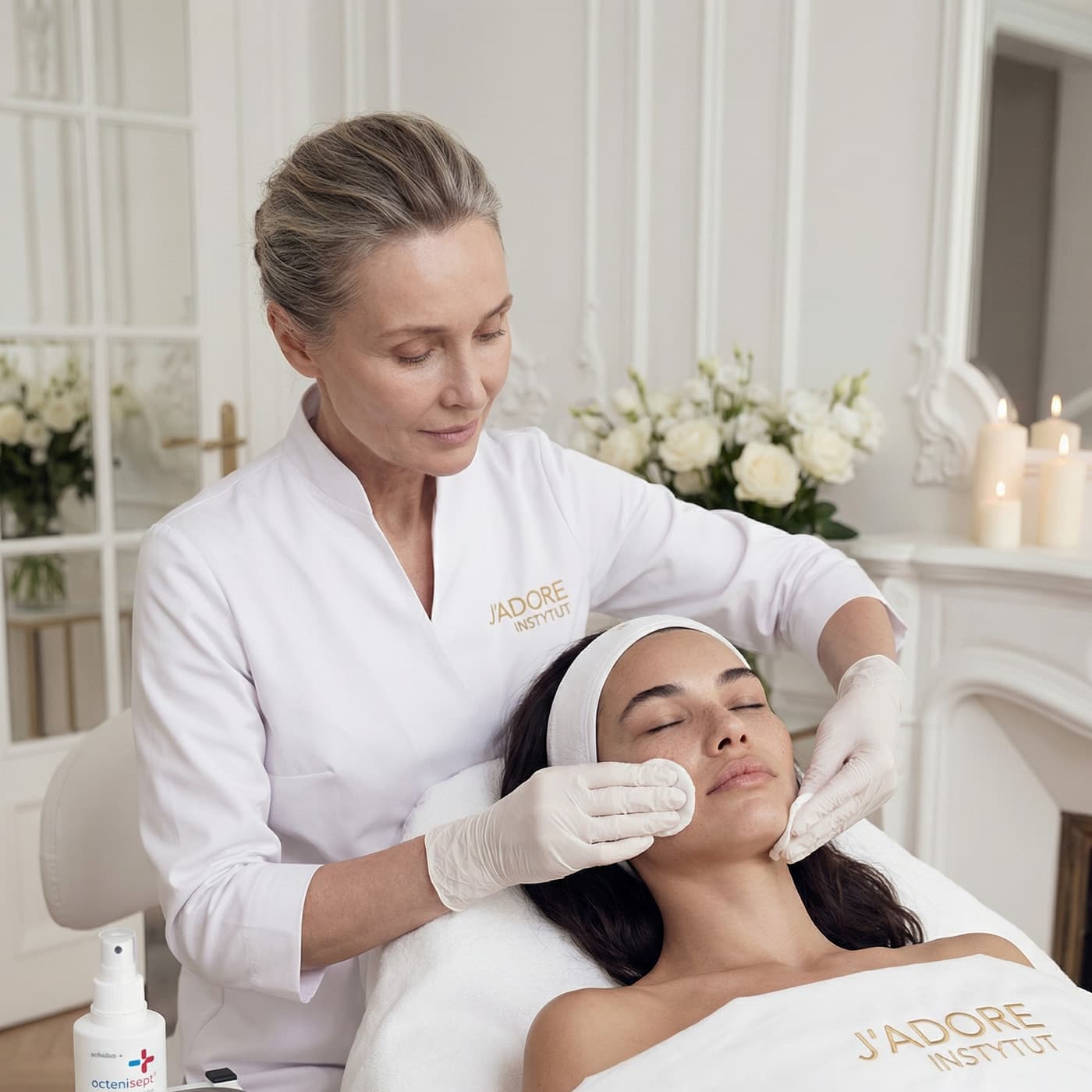
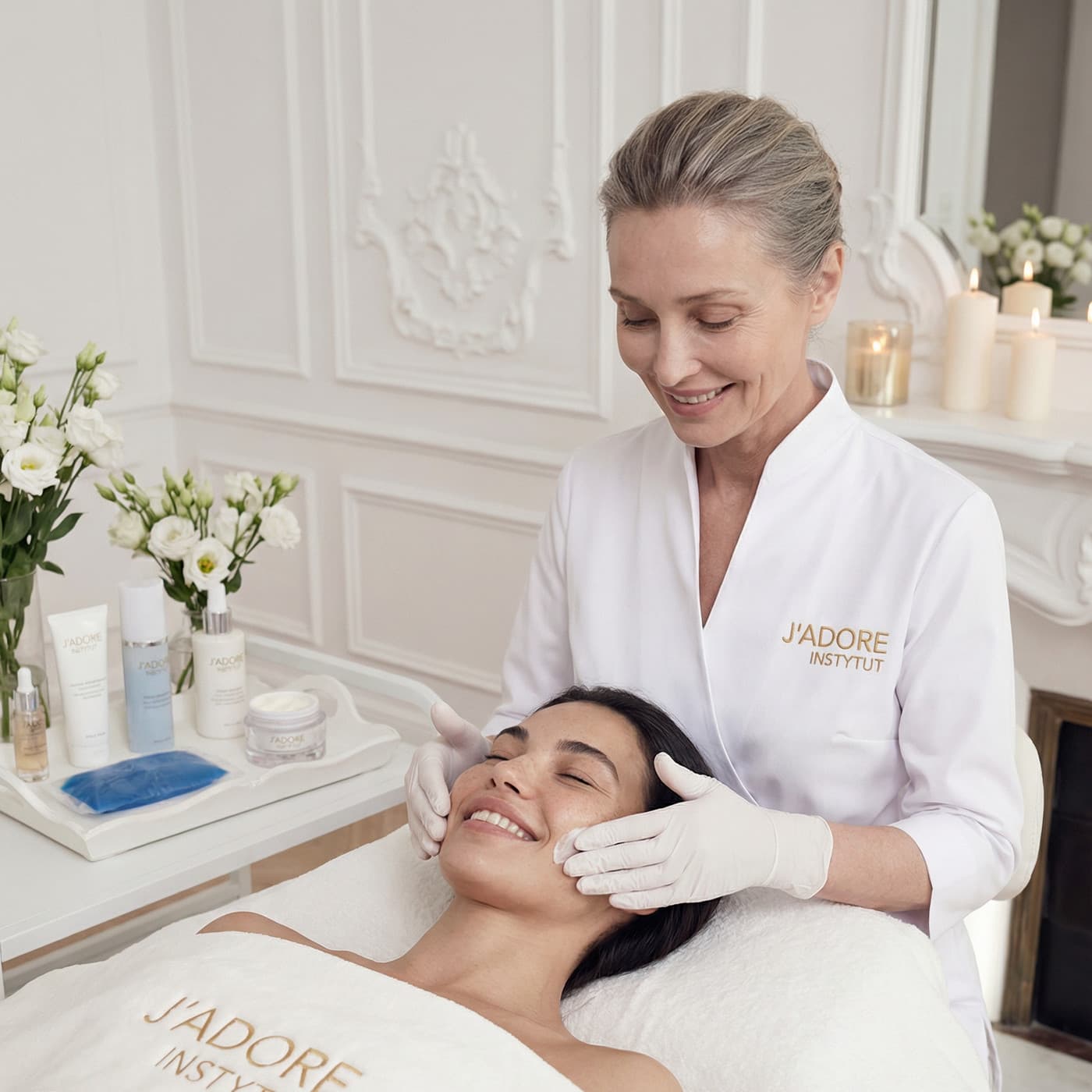
A treatment room at J'adoreAESTHETIC MEDICINE
Nasolabial folds, so-called "marionette lines" pulling the corners of your mouth down, dark circles and tear troughs that make you look permanently tired, sunken cheeks, a blurred facial contour — these aren't expression lines. They're loss of volume and support.
With age, your skin loses hyaluronic acid, and the face literally "drops". HA-based fillers replace this loss: they restore volume where it's missing, smooth folds, contour the face and — by binding water — hydrate the area from within. A well-chosen filler doesn't change your facial identity and isn't about "pumping up" — it rebuilds what was there before. At J'adore Instytut, this treatment is performed by an aesthetic medicine doctor. Below you'll find everything worth knowing before your first visit.
1 session; touch-up as needed
What HA fillers are
Fillers are gels based on hyaluronic acid (HA) — a substance that occurs naturally in your skin and is responsible for its hydration and volume. With age, levels drop and the face "sags": folds deepen, cheeks and tear troughs hollow, the contour blurs. A filler replaces this loss — it restores volume and support where they're missing — and, thanks to its water-binding capacity, also hydrates the area.
Importantly, a well-chosen filler doesn't change your facial identity and isn't meant to "pump up" your features. Its job is to restore what was there — smooth a fold, lift a corner, rebuild a cheek, subtly refine the lips. The "duck lips" effect or an overfilled face results from excess product and poor technique, not from the method itself.
Did you know: this isn't a "foreign" material — hyaluronic acid occurs naturally in your skin. A filler simply delivers it in a cross-linked, more durable form where your body has stopped producing enough of it. Over time it breaks down into the same simple molecules.
How it works
A filler works mechanically and immediately: injected into the right layer of skin, it lifts and fills, and by binding water it also hydrates. Depending on the density and degree of cross-linking of the gel, one product suits gentle smoothing of fine lines, another suits strong support (rebuilding a cheek, jawline contour), and another suits subtle lip hydration.
Injection depth also matters. Placed shallow, just beneath the skin, a delicate gel smooths fine lines and hydrates the area; placed deeper, near the bone, a denser product works as support — it lifts tissue from below and rebuilds lost contour. Hyaluronic acid binds water, so freshly injected gel absorbs it and swells slightly for the first few days — which is why the full result should only be assessed once it has settled. Over time, the product undergoes natural absorption, and volume gradually returns to baseline; the effect is therefore temporary by design and, for most people, needs topping up after a while.
That's why choosing the right product and injection depth is an individual decision — one gel works in the lips, another in the tear trough, another in deep cheekbone support. This decision is made by the doctor after assessing your facial anatomy; it's not about "one universal filler" but the right tool for each area.

Did you know: a hyaluronic acid molecule is a long, unbranched chain of repeating sugars — and it's chemically identical in humans and other mammals. That's why HA fillers don't require the patch tests that older animal-derived products once needed. The same compound fills the vitreous body of the eye and lubricates joint fluid — skin is just one of the places it works.
Ideal for
The final plan — which areas, which product, and how much — is set by the doctor at consultation, looking at the whole face rather than a single "problem".
Women's zone and men's zone
The aim is usually harmony across the whole face and freshness: smoothing folds, restoring the "triangle of youth" in the cheeks, brightening the tear trough, gentle lip and contour shaping. These are natural proportions, not changed features — classic fillers for women.
The areas we support
Male skin is thicker, and the focus is different — it's about strengthening structure: a more defined, angular jawline, a stronger chin, "de-tiring" the face without softening it. These are the so-called fillers for men, usually using denser products (stronger support is needed).
The areas we support
Safety
With fillers, results and safety depend on three things worth asking about at any salon:
The face is densely vascularised, and the most serious (though rare) complications are vascular — injecting product into a vessel can impair tissue blood supply, and in high-risk areas (nose, eye area, glabella), in exceptional cases, threaten vision. At J'adore, this is administered exclusively by an aesthetic medicine doctor, who knows the anatomy and is ready to respond immediately.
We work only with branded gels from authorised distributors. A filler of unknown origin behaves unpredictably in tissue and carries real risk.
Original HA can be dissolved with an enzyme (hyaluronidase) — if the result isn't right or in case of a complication. A doctor who keeps it on hand is the standard. Permanent, irreversible materials don't offer this safety net.
Red flag: a suspiciously cheap "years-lasting" filler · A bargain price and the promise of a filler that "lasts for years" are the most common warning signs. Permanent, irreversible materials in such a heavily vascularised area are a risk not worth taking. You have the right to ask for the product name, its origin, and whether the doctor has hyaluronidase available. A good salon will answer without hesitation.
Contraindications
Some contraindications are permanent, others temporary — in the latter case, we simply postpone the treatment until the situation passes.
From our doctor
The most serious, though rare, risk is vascular complications — which is why an experienced doctor and an original, reversible product with hyaluronidase on hand matter so much. This isn't an abstraction — it's the real reason this treatment is done in a medical setting, not as an afterthought.
This isn't a complete list — we'll review your medication, health conditions and previous treatments individually at consultation.

The visit

Medical consultation
the doctor assesses the proportions of the whole face, decides on areas, selects the product, discusses realistic results, and rules out contraindications.

Preparation and anaesthesia
the skin is cleansed; comfort is provided by numbing cream, and the products themselves usually contain an anaesthetic agent (lidocaine). For lips, additional anaesthesia (a nerve block) may be used.

Injection
with a fine needle or a cannula (fewer bruises, greater safety in high-risk areas), shaping the result as we go and checking symmetry.

After the treatment
the result is visible right away (allowing for swelling). You'll receive aftercare guidance and can return to your daily activities. The whole visit takes anywhere from around fifteen minutes to about an hour, depending on the number of areas treated.
What to expect
Most importantly: the result is visible right away, but the first few days are when the product "settles" in the tissue. The full, final look is assessed after around two weeks — which is why treatments before an important event should be planned with a time margin.
The most common question two days after a lip treatment: "is this how it stays?" No — that's swelling. That's why we assess the full result only after around two weeks, not before. Patience pays off.
Portfolio
A record of the work in our salons — the place where we publish treatment frames and, after photo sessions, results.
A record of results — in preparation. We publish photographs of our clients only with their consent.
Filler and your lifestyle
The most common questions aren't about the treatment itself, but about what happens afterwards: training, sauna, holidays, facial massage. There's one rule — for the first hours and days, we protect the freshly injected product so it can "settle" where it should, and to limit bruising.
For the first day or two, don't massage or press on the treated area (unless your doctor advises otherwise) — the fresh product needs to settle.
Intense exercise speeds up circulation and encourages swelling and bruising — skip it for around a day.
High temperatures increase swelling. Save the sauna, hammam, pool and hot baths for a few days later.
Hold off on intensive sun exposure, sunbeds and extreme cold at first. Wear daily SPF 50+.
This is important: schedule any contouring massage or Kobido treatment after around two weeks, once the product has stabilised.
Alcohol dilates blood vessels and increases the risk of bruising — best avoided on the day of the treatment and the day after. It's worth stopping blood-thinning agents earlier, in agreement with your doctor.
You can return to your daily activities right away. Makeup — usually from the next day, once the skin has settled and healed.
HA fillers — wrinkles and folds
Price list

Face + neck
1 h · Teosyal Redensity I
Area and salon — we'll show the price straight away.
Warsaw, Żelazna 59 · 1000 zł
Prefer to call? Żelazna 573 569 431 · Mińska 732 228 806 · Karmelicka 732 228 846
See also
AESTHETIC MEDICINEBotox — expression linesSee treatment: Botox — expression lines
AESTHETIC MEDICINEVolumetrySee treatment: Volumetry
AESTHETIC MEDICINELip contouringSee treatment: Lip contouring
AESTHETIC MEDICINENon-surgical rhinoplastySee treatment: Non-surgical rhinoplasty
AESTHETIC MEDICINEBiostimulators / skin boostersSee treatment: Biostimulators / skin boosters
AESTHETIC MEDICINEProfhiloSee treatment: ProfhiloThe result lastsusually from six months to around 1.5 yearsJ’adore Instytut
Medical information. Hyaluronic acid filler treatment is medical in nature and is performed exclusively by a doctor. The text above is for informational purposes only and does not constitute advertising of a medicinal product or medical advice. Indications, product and area selection, and contraindications are determined by the doctor during an individual consultation.