Where do broken capillaries in men come from?
Broken capillaries — medically known as telangiectasia — are permanently dilated small blood vessels just beneath the skin's surface. They don't disappear on their own. Once dilated, they stay visible as red, pink or purple threads, thread veins, or diffuse redness. In men, they're most commonly found on the nose, cheeks and chin — exactly where the razor works every day.
The mechanism is simple: the vessel loses elasticity and doesn't return to its normal diameter after dilating — for example, from heat, exercise, alcohol or cold. Repeated micro-trauma from shaving makes the vessels more visible. The skin is abraded, pores open up, and the capillaries look even more congested. That's why the problem doesn't fade with age — it tends to intensify.
- Broken capillaries on the nose and cheeks — the most common form, often mistakenly called "rosy cheeks". It can accompany a mild form of rosacea.
- Thread veins on the temples and cheeks — thin red or purple networks, clearly visible up close or in photographs.
- Redness after shaving — diffuse flushing that lasts for hours after every shave; often the result of broken capillaries on the chin and neck.
- Redness of the nose — a cluster of broken capillaries on the nostrils and tip of the nose, which intensifies with temperature changes and after exercise.
Vascular laser — what actually happens
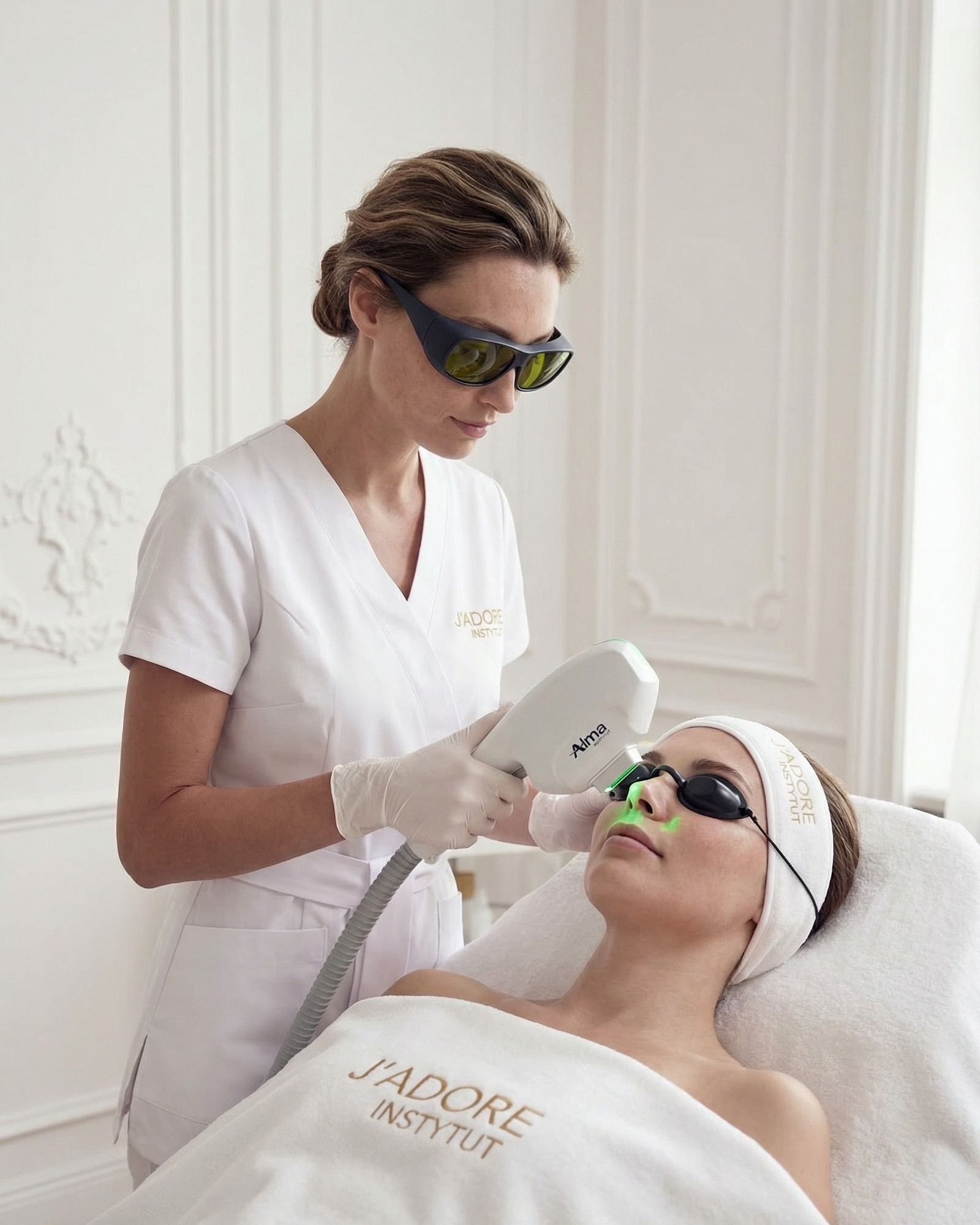
The technology is based on selective photothermolysis — it sounds technical, but the concept is simple. The laser emits a wavelength of light absorbed precisely by haemoglobin, the pigment in red blood cells. The vessel absorbs the energy, heats up and collapses from within — without damaging the surrounding skin. The body treats the closed vessel as redundant tissue and gradually reabsorbs it over several weeks.
This isn't a peel, an acid, or mechanical abrasion. There's no broken skin, no wound — just precise action reaching into the epidermis. That's why most men return to work the same day, or the next.
Vascular laser
permanent vessel closure
- closes the vessel at the source — not just masking it
- precise: targets the vessel, doesn't irritate the surrounding area
- results visible after a few days to around two weeks
- no downtime for small vessels
Vitamin K creams / creams for dilated vessels
maintenance care
- soothe irritation after shaving
- may reduce skin reactivity
- available without a visit
Before and after: what to expect in practice
The question we hear most often: "How much does it hurt, and will anyone notice afterwards?" The answer to both: less than you think. Laser pulses feel like a light stinging or warmth — nothing close to strong pain. Straight after the treatment, the area may be slightly red and mildly swollen, but this usually settles within a few hours.
- 01
Consultation
The doctor assesses the type and extent of the vascular changes, skin tone, and any contraindications. They decide on the protocol and number of sessions.
- 02
Treatment
The laser passes precisely over the targeted vessels. Skin may be slightly red immediately afterwards. No anaesthesia is needed for small facial vessels.
- 03
First days
Darkening or browning of the vessels is a normal sign that the vessel has closed. Skin may be slightly more sensitive; avoid shaving for 1–2 days.
- 04
A few weeks later
The body reabsorbs the closed vessels — the red networks gradually fade. The final result is assessed a few weeks after the session.
- 05
Follow-up session (if needed)
For extensive changes or deeper vessels, a follow-up visit may be recommended — the doctor sets the interval after assessing the result.
For a week after the treatment, skip the sauna, the gym and alcohol — heated vessels work harder and can slow down reabsorption. SPF cream is essential — skin is more sensitive to sunlight after treatment. You can shave again after a few days, once the skin has settled.
Redness, broken capillaries, rosacea — is it all the same thing?
No — and this distinction matters for choosing the right protocol. Broken capillaries and redness after shaving are mechanically dilated vessels without active inflammation. A vascular laser is the first choice here. Rosacea is a chronic inflammatory skin condition — laser can be part of its treatment, but it needs to be combined with other methods and a consistent protocol.
In men, rosacea often goes ignored for years, or gets mistaken for "vascular skin". Yet early diagnosis and treatment help prevent thickening of the nasal skin (rhinophyma), which can be difficult to reverse once established. A vascular laser combined with a skincare protocol can effectively halt the progression of the condition before permanent changes set in.
When is it actually worth doing?
A vascular laser isn't a treatment for the brave — it's a response to a specific anatomical problem. Broken capillaries don't disappear on their own, and more appear with age. One to several sessions can significantly reduce their visibility, so shaving becomes just a morning routine again, rather than something that takes you out of action for half a day.
- Redness lasting hours after shaving — if you always need to "wait it out" before leaving the house.
- Visible thread veins on the cheeks and nose — noticeable in photos, on video calls, and in face-to-face meetings.
- A problem that grows with age — more every year, not less.
- Reactive skin — flushing strongly with exercise, alcohol or the sauna; a sign that vessels have lost their elasticity.
IPL (intense pulsed light)
For men with widespread background redness — IPL treats a larger surface area at once, while a vascular laser targets precise spots. The two are often combined in a single protocol after dermatological assessment.
Medical peel
Once the laser results have settled: evening out skin tone, reducing thickened skin on the nose. Order matters — the peel comes after the laser, not the other way round.
Dermatological consultation for rosacea
If the redness is diffuse and accompanied by pustules — diagnosis comes first, then the protocol is chosen. Laser can be part of the treatment, but on its own it doesn't address the underlying cause.