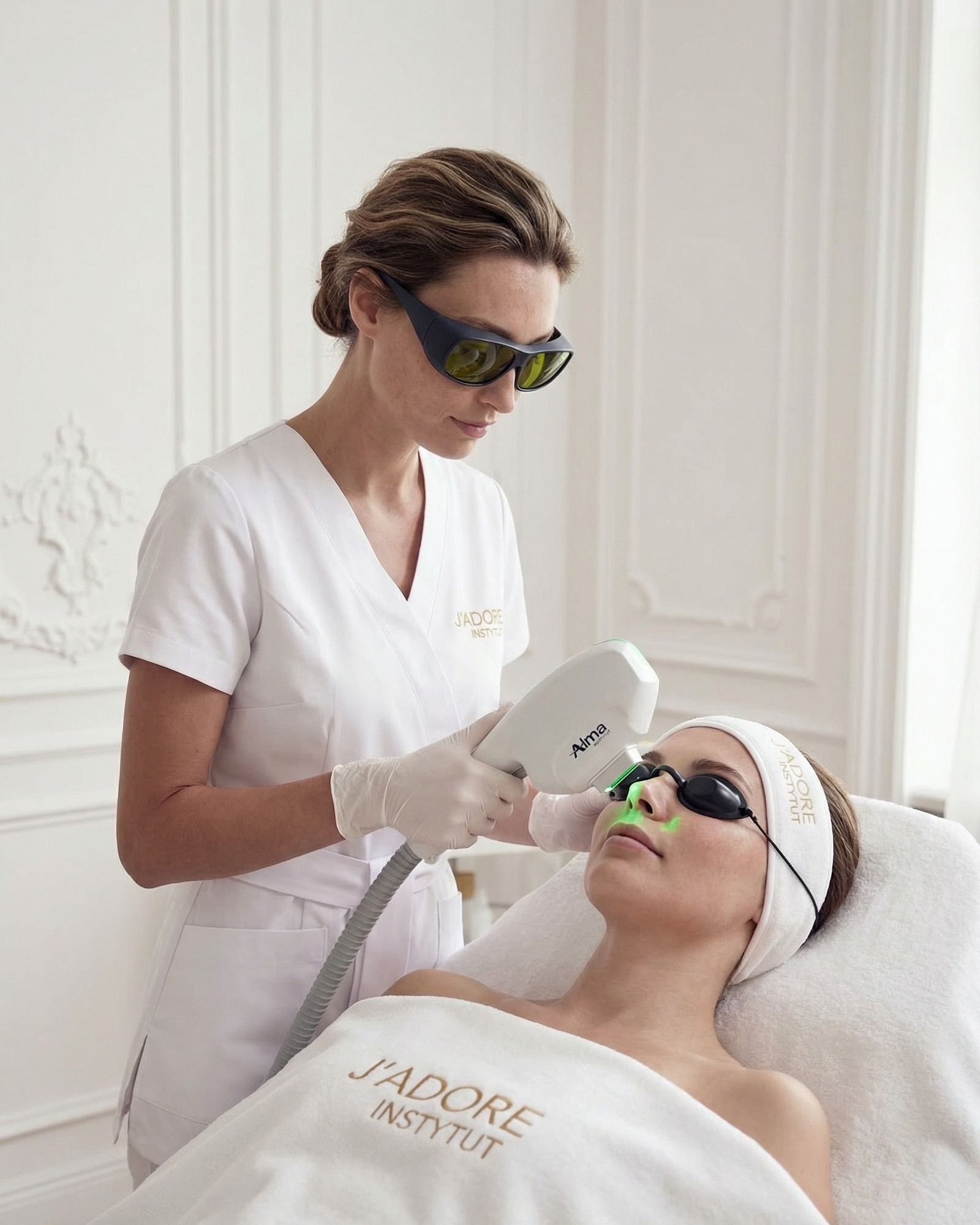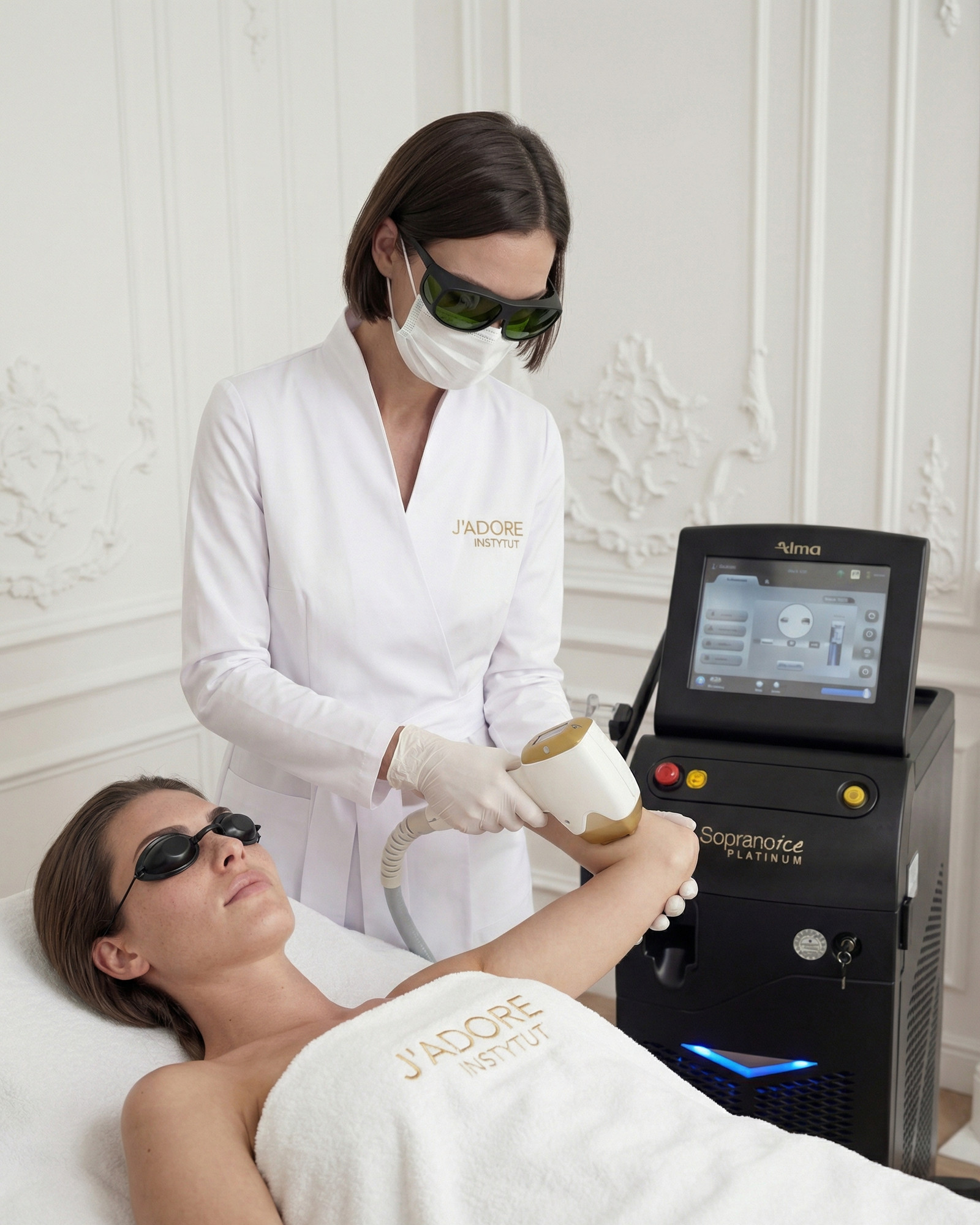
Three technologies, three goals
Before we go into detail, it helps to understand one rule: each of these technologies "sees" a different target. Light or laser energy is absorbed by a specific chromophore — melanin (pigment), oxyhaemoglobin (blood in vessels) or water in the tissue. Matching the technology to the concern comes down to one question: what do we want to destroy or stimulate?
IPL
broad spectrum — multiple targets at once
- sun-induced and hormonal pigmentation
- shallow vessels and diffuse redness
- hair removal on light skin with dark hair
- general skin tone evening ("photo-rejuvenation")
Dye-VL
precision for vessels and redness
- telangiectasia (spider veins)
- diffuse redness and rosacea
- shallow vessels on the face and décolletage
- vascular post-acne marks (red marks)
Nd:YAG
depth and safety for every skin tone
- deep vessels and varicose veins on the limbs
- hair removal for every skin tone, including dark and tanned skin
- deeper-seated pigmentation
- acne treatment and easing of acne scars
How to work out which technology suits you
Before your consultation, ask yourself a few simple questions. The answers won't give you certainty — that's your specialist's role — but they'll steer the conversation:
- Want to remove hair? Light skin, dark hair → IPL. Darker, tanning-prone or olive skin → Nd:YAG.
- Do you have spider veins or visible vessels on your face? Shallow, fine, red → Dye-VL. Thicker, bluish, on the legs → Nd:YAG.
- Do you have sun spots or patchy pigmentation? Shallow, light skin → IPL works well. Deeper or darker skin → Nd:YAG, under specialist supervision.
- Want to even out facial tone, reduce redness, stimulate skin renewal? → IPL (photo-rejuvenation) or Dye-VL where there's a vascular component.
- Do you have rosacea or diffuse redness? → Dye-VL as first choice; Nd:YAG for accompanying thicker vessels.
It's also worth remembering that the same concern can sit at different depths. Facial vessels can be very fine and shallow (Dye-VL is enough here) or thicker and deeper-seated (this needs Nd:YAG). Your specialist assesses this during the consultation, often using a dermatoscope or Wood's lamp.
A series, not a one-off session
One common misunderstanding is expecting a single laser session to solve the problem completely. In reality — regardless of the technology — results build up over a series of sessions, and the number needed depends on the concern, its depth and your skin's individual response.
- 01
Consultation and phototype assessment
Your specialist identifies the concern, its depth and your skin phototype, and selects the technology. She may carry out a test on a small patch of skin.
- 02
First session — testing your skin's response
Settings are kept conservative while we observe how your skin responds to the technology. Full assessment of the result takes place after 2–4 weeks.
- 03
Series of treatments
For hair removal, this typically means several to a dozen or so sessions at regular intervals, set by the hair growth cycle. For vessels and pigmentation, fewer sessions are needed, but the skin needs time to recover between them.
- 04
Maintaining the result
Pigmentation can return with unprotected sun exposure. Vessels can reappear. A single maintenance session once a year is often enough to keep the result.
When it's worth combining technologies
It's rare for one technology to cover the whole concern on its own — especially with facial tone evening, where redness, pigmentation and fine vessels can all be present together. In such cases, a salon may suggest a sequence of different technologies, or a combination:
IPL + Dye-VL
IPL works on pigmentation and general tone evening, while Dye-VL refines vascular redness. Often used together for facial photo-rejuvenation with a vascular component.
Dye-VL + Nd:YAG
Dye-VL for shallow facial vessels, Nd:YAG for deeper or thicker ones. Typical for rosacea with a pronounced vascular component.
Nd:YAG hair removal + care between sessions
The laser removes hair, but skin after hair removal often needs hydration and soothing. Regenerating treatments between sessions shorten the skin's recovery time and improve comfort throughout the series.
IPL + acid-based tone evening
Acid-based treatments (chemical peels, acids in your home care) prepare the skin for IPL — dead epidermis is removed, and the technology reaches deeper and more precisely.
The sequence and intervals between treatments are decisions for your specialist — treatments shouldn't be combined without a consultation, since some combinations require a recovery period between them. One key rule: every technology needs healthy, uninflamed skin — if your skin is still reacting to the previous treatment, it's not time for the next one.
Frequently asked questions before your first visit
- Does it hurt? Sensation varies — from warmth and mild tingling (IPL, Dye-VL) to a sharper pinch (Nd:YAG on deeper structures). Modern handpieces include cooling, which significantly improves comfort.
- When will I see results? With hair removal, the full result becomes visible after the whole series. With pigmentation, initial changes (darkening, flaking) can appear after the first session, with the final result visible after a few weeks.
- Can I go back to work after the treatment? Usually yes — redness lasts from a few hours to a day. With more intensive vascular treatments (Nd:YAG on the leg), it may last longer.
- Is there a season for laser treatments? Autumn and winter are more convenient — less sun, easier photoprotection. Summer sessions are possible with strict protection and no sun tanning.