A treatment room at J'adore
LASER THERAPY / HIGH-TECH / REMOVAL
Sun spots on your cheeks and hands left over from summer. Freckles and lentigines that no cream can "cover up" any more.
Uneven, grey skin tone that makes skin look tired even when it isn't. Broken capillaries and redness that comes in waves. Photorejuvenation doesn't "strip" the top layer of skin like a peel does — it sends pulses of light into the skin that are absorbed selectively by melanin (hyperpigmentation) and haemoglobin (blood vessels), heating and breaking them down, while also stimulating the skin to produce collagen. One light source, several problems at once. At J'adore Instytut, the treatment is performed by a doctor or experienced cosmetologist using the Alma Harmony XL Pro laser platform (DYE-VL / IPL / AFT handpiece). Below you'll find everything worth knowing before your first visit.
usually a series of several sessions every 3–4 weeks
How it works
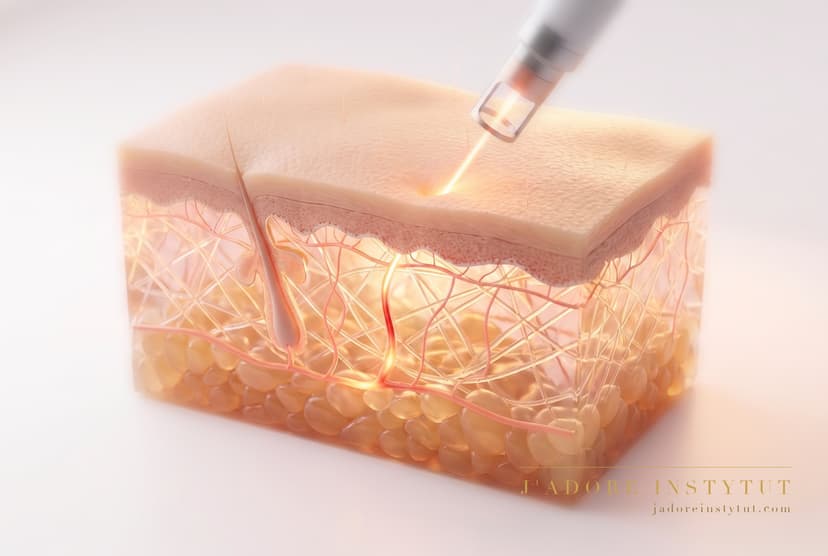
Photorejuvenation is a light-based treatment — at J'adore we use DYE-VL (AFT — Advanced Fluorescence Technology), an advanced, filtered form of pulsed light from the IPL family. In short: the device sends a short, intense flash of broad-spectrum light into the skin.
This mechanism is called selective photothermolysis. Light is absorbed selectively by two "targets" in the skin: melanin (the pigment in hyperpigmentation) and haemoglobin (the pigment in blood vessels). Energy converts into heat exactly where the problem is — breaking down clusters of melanin and closing off broken capillaries — while the surrounding, healthy skin remains largely untouched. At the same time, this heat stimulates the skin to rebuild collagen, which is where "rejuvenation" comes into the name.
This is why a single light source can work on several fronts at once: hyperpigmentation, broken capillaries and overall radiance. This is what sets IPL/DYE-VL apart from a laser, which emits one wavelength and works precisely on a single target.
Ideal for
Photorejuvenation works best on light and medium skin phototypes (I–III). For darker skin tones (phototype IV and above), we take a much more cautious approach, and for very dark skin (V–VI) we avoid this type of light altogether — this is decided during the consultation, not by your preference alone.
Women's needs and men's needs
The most common reason women come in for photorejuvenation for women is hyperpigmentation: sun-induced, pregnancy-related (melasma), post-inflammatory — plus uneven tone on the face, décolletage and hands. The goal is a clean, even tone and radiance "like after a good holiday" — minus the sun that caused the spots in the first place.
What we work with
Men most often come in for photorejuvenation for men after years without SPF protection: sun spots on the face and hands, dark marks from shaving irritation, grey skin tone and broken capillaries on the cheeks and nose. The goal: a rested, even tone — without a "done" look and without downtime.
What we work with
Fun fact: the same light that "collects" sun-induced spots can, with a different filter, close off broken capillaries and calm redness — because in both cases it does exactly the same thing: it targets a specific pigment (melanin or haemoglobin) and heats it selectively. That's how one treatment can work on both hyperpigmentation and broken capillaries at the same time.
Safety
With pulsed light, the result and safety depend on several factors — worth asking about at any salon:
The most important assessment is your phototype and whether your skin is currently tanned. IPL/DYE-VL is safe for light and medium skin tones (I–III), requires caution for darker skin (IV), and we avoid it altogether for very dark skin (V–VI) — otherwise the risk of burns and reverse pigmentation increases.
At your first treatment, we perform a test on a small area of skin to check the reaction and choose safe parameters. This is standard practice, not an unnecessary formality.
There's no single "dose" of light. The practitioner chooses the filter (wavelength) and energy level based on the concern, skin colour and treatment zone. That's why consultation is mandatory.
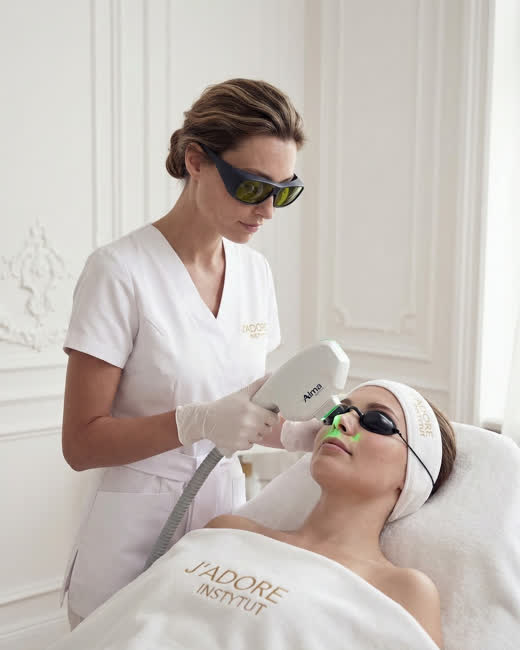
Protective goggles for you and the operator are an absolute standard with IPL/VPL; skin is actively cooled throughout the treatment.
A red flag: "photorejuvenation on tanned skin" or "no patch test needed" · If someone offers you a light-based treatment on freshly tanned skin, "on the spot", without asking about phototype, medication or performing a patch test — that's a warning sign. Light doesn't distinguish between a tan and pigmentation: on tanned skin, the risk of burns and discolouration rises. You have the right to ask about phototype, filter and patch testing — a good salon will answer without hesitation, and sometimes… will advise against booking.
Contraindications
Some contraindications are permanent, others temporary — in which case we simply postpone the treatment until the situation passes. With pulsed light, we're especially careful about sun exposure and phototype.
From the cosmetologist's chair
Appointments most often fall through over tanning and melasma. "I was by the sea for a week, but I stayed in the shade" — that's still a tan as far as skin is concerned. And with hormonal melasma, IPL can be a double-edged sword: sometimes it helps, sometimes it makes things worse. That's why we don't cut corners — I'd rather postpone a treatment by a month than risk discolouration.
This isn't a complete list — we'll discuss your medication, health conditions, phototype and previous treatments individually during consultation (with a medical consultation where necessary).

The visit

Consultation and qualification
the cosmetologist assesses the type of pigmentation, broken capillaries, phototype and history (tanning, medication, pregnancy, cold sores), rules out contraindications and sets out a plan for the series. If in doubt, we refer you to a medical consultation.

Patch test
a test on a small area of skin at the first session, to choose safe parameters.

Goggles and gel
we put on protective goggles and apply a cool contact gel to the skin, which distributes energy evenly.

Light pulses
the handpiece is applied to each zone in turn; you'll feel brief, warm pulses, often compared to a "rubber band snap". More sensitive areas (cheekbones, nose) can feel slightly more noticeable.

Cooling, SPF and finishing
we cool the skin and apply protection. No bandages; often no visible marks apart from temporary redness.
What to expect
The most important thing: right after the treatment, pigmentation looks darker — and that's how it should be. It's a sign that melanin has absorbed the energy. Over the following days, dark spots come away as fine "micro-crusts" or flaking. Don't rub or scratch them off — they'll come away on their own.
I most often hear after two days: "the spots are darker than before the treatment, something's gone wrong." Nothing has — this is exactly the moment when you can see the light has worked. The spot has to "surface" before it can flake off. Patience and SPF — the rest takes care of itself.
Duration depends on the size of the zone — the face alone is one relaxed session, while décolletage or hands are added separately. We confirm exact timing and the number of sessions in the series during consultation.
Portfolio
A record of the work in our salons — the place where we publish treatment frames and, after photo sessions, results.
A record of results — in preparation. We publish photographs of our clients only with their consent.
The result builds up over a series — one treatment addresses some of the pigmentation, and following sessions clear the rest while improving tone and radiance. Results last depending on one factor more than any other combined: sun protection. Without SPF, pigmentation returns over time.
Photorejuvenation and your lifestyle
The most common questions aren't about the treatment itself, but about what happens before and after: sun, sauna, swimming pool, make-up, shaving. Two rules govern everything — skin must not be tanned before the treatment, and after the treatment we protect it from the sun and avoid irritating freshly treated skin.
This is crucial with pulsed light. A fresh tan (including from self-tanner) means we postpone the treatment. After the treatment, avoid the sun and use SPF 50+ for about 4 weeks — this is essential both for results and for safety.
A high-factor cream isn't an "extra" — it's part of the treatment. Without it, pigmentation returns and the results of the series unravel. It's best to make it a permanent habit.
High temperatures increase redness and swelling. Skip the sauna, hammam and hot baths for the first 1–2 days.
Chlorinated water irritates freshly treated skin. Skip the pool for a few days, until redness and any crusting have gone.
On the day of the treatment, let your skin breathe. From the following day, light mineral make-up is fine — as long as you do not rub off the flaking patches.
Shaving — ideally from the next day, gently. Peels, acids and retinol should be paused during the flaking period, until skin has settled (resume after checking in with your cosmetologist).
IPL photorejuvenation / DYE-VL
These methods do different things and often complement rather than replace each other. The simplest way to think about them:
evens out tone broadly
doesn't target one deep scar or laxity specifically; handles tanned skin less well than an Nd:YAG laser
works precisely on a single target
one wavelength = narrower action; doesn't "collect" widespread spots as broadly as pulsed light
improve skin quality and density
don't remove pigmentation or broken capillaries — that's a different concern from pigment in the skin

What to combine it with
Photorejuvenation fits well into combined protocols — the cosmetologist decides on the order and intervals during consultation, but the general logic stays the same: tone and broken capillaries first, then (or in parallel) skin quality and density.
The most common misunderstanding: "I want IPL for this one deep scar / for sagging skin." Pulsed light isn't the best tool for that — it excels at collecting tone over a larger area. For scars or texture, we reach for a fractional laser; for firmness, biostimulators or tightening treatments. Simple rule: widespread colour and radiance → photorejuvenation; a specific structural defect → laser; skin quality and density → biostimulators.
Technology
At J'adore, photorejuvenation is based on the Alma Harmony XL Pro laser platform — one device with interchangeable handpieces (technologies). You don't "pick a handpiece off the shelf" — the practitioner chooses it based on your concern, phototype and treatment zone.
Filtered, intense pulsed light (AFT technology). Targets melanin and haemoglobin selectively — a broad spectrum in a single flash.
Dla kogoClassic photorejuvenation: hyperpigmentation, tone, radiance, broken capillaries and redness on the face, décolletage and hands.
A non-ablative "lunchtime laser" — stimulates collagen without disrupting the epidermis, with zero downtime.
Dla kogoAdding a rejuvenating/tightening effect to already-evened skin tone; subtle pigmentation.
An alternative vascular technology with deeper penetration than pulsed light.
Dla kogoSupport for deeper-lying vascular concerns, when DYE-VL isn't sufficient (chosen during consultation).
Fact: Why do prices vary? It's mainly determined by surface area (face alone vs face + décolletage + hands), the number of sessions in the series needed for results, and the technology/handpiece chosen for the concern. That's why we don't quote a "price per flash" — pricing and the series plan are set during consultation, after assessing your skin.
Price list
Checking free hours…
Gift voucher
Buy a voucher for this treatment in the J'ADORE online boutique — an elegant gift, redeemable at the salon of your choice.
Voucher pricePLN 210
Buy the voucher (opens in a new tab)Purchase and payment take place in the J'ADORE online store. The voucher is valid for 12 months from purchase and covers the selected treatment variant.
From the magazine
Editorial pieces on how this treatment works in practice — what happens during the session, how to prepare, where the limits are and what the first days after look like.
See also
The result lastsmonths — with consistent use of SPF 50+J’adore Instytut
Treatment information. Photorejuvenation is a treatment using a device that emits intense pulsed light (IPL/DYE-VL/AFT) on the Alma Harmony XL Pro platform. The text above is provided for information only and does not constitute medical advice. Qualification for the treatment, choice of filters and parameters, and contraindications are determined by the practitioner during an individual consultation (with a medical consultation where necessary). Results vary and depend, among other things, on the type of hyperpigmentation and skin phototype.
Home care
Cosmetics matched to what your skin needs after a treatment — so the clinic effect lasts longer.
 hyperpigmentationSesdermaMANDELAC Liposomal SerumView in the shop(opens in a new tab)
 capillaries and rednessMedidermaRedness Control A&A Sensitive Cream 50mlView in the shop(opens in a new tab)
 sun protectionCell Fusion CAquatica Sunscreen 100 SPF 50+/PA++++View in the shop(opens in a new tab)
 hyperpigmentationPeel MissionMelasma & PIH Cream 50 mlView in the shop(opens in a new tab)
 capillaries and rednessMedik8Calmwise™ SerumView in the shop(opens in a new tab)
 sun protectionDermaQuestSunArmor SPF50 30 mlView in the shop(opens in a new tab)
 hyperpigmentationDermoMedicaTRX C Foam Cleanser 150 mlView in the shop(opens in a new tab)
 capillaries and rednessVagheggiEmozioni Plus Soothing Mist 100ml — Soothing concentrated mist/tonerView in the shop(opens in a new tab)