Before the list — why piercing healing takes so long
Piercing healing isn't a one-week matter. It depends on the location — an earlobe may heal in a few weeks, cartilage can take up to a year. Nose, navel, septum, eyebrow — each has a different healing timeline, because each type of tissue works differently. Skin heals from the outside in: even when the channel looks closed, the inside may need months of quiet maturing. This matters, because most mistakes happen at exactly this stage — when it seems "already healed".
10 things that genuinely speed up healing
1. Isotonic saline solution — the only product you need. Proper cleaning is the foundation — but the cleaning agent itself matters enormously. The only substance that's effective, safe and non-irritating at the same time is sterile saline solution (NaCl 0.9%), as a spray or in ampoules. It doesn't damage the developing epithelium, removes discharge and cleans mechanically. You can buy it at the pharmacy labelled "inhalation saline" or "nasal rinse" — the formula is identical. Use it once or twice daily — no rubbing, no cotton wool.
2. Don't touch it — rule number one. Hands carry not just dirt but bacteria, and a fresh channel is the perfect environment for them. Every "just checking if it moves" is a potential inflammation trigger. Only touch the piercing when cleaning it, with clean hands. This single habit shortens healing faster than any supporting product.
3. Implant-grade jewellery throughout healing. Material matters fundamentally. Titanium G23 (ASTM F136), surgical steel 316L (implant grade), niobium, gold 14K or higher, borosilicate glass — these are metals the body tolerates without allergic reaction. Silver, brass, acrylic, and steel closer to costume jewellery than surgical grade can cause irritation, allergic reactions or micro-corrosion cracks. Throughout the entire healing period, don't swap in a "prettier" piece from a market stall.
4. Correctly sized starter jewellery. A piece that's too short or too tight compresses tissue and disrupts blood flow. One that's too long moves around and causes mechanical irritation. A good piercer matches the length and gauge of the jewellery to tissue thickness and expected swelling. Once swelling has subsided — usually after a few weeks — the jewellery can be shortened. Don't do this yourself; come back to the studio.
5. Sleep without pressure. This is a detail that's often overlooked. Sleeping on an ear or nose piercing for hours, night after night, causes chronic pressure and incomplete healing. A piercing pillow (with a cut-out for the ear) or sleeping on the opposite side can shorten cartilage healing time by weeks. A surprisingly simple intervention with a real impact.
6. Nutrition and hydration. A body healing a wound needs resources — above all vitamin C (essential for collagen synthesis), zinc (supports immune response) and adequate hydration. This doesn't mean megadose supplements — a balanced diet and drinking water are enough. Dehydrated, undernourished tissue heals more slowly, as confirmed by wound-healing research generally.
7. Avoiding dirty and chemical environments. Swimming pools (chlorine), the sea (salt water with bacteria), saunas (heat plus sweat), gyms (many hands have touched those handles) — these are places where the risk of contaminating the channel is higher than usual. During the first weeks of healing, avoid submerging the piercing or protect it with a waterproof plaster. This isn't a myth — it's simple infection physics.
8. No rotating the jewellery. "Turn the jewellery a few times a day so it doesn't grow into the skin" is one of the longest-running piercing aftercare legends. It's wrong, and it's harmful. Rotating pushes discharge — dried lymph — into the fresh channel and mechanically disrupts the forming layers of epithelium. Jewellery doesn't fuse with tissue; there's no need to move it. Leave it alone.
9. Patience when it looks healed but isn't. A channel can look closed and show no symptoms after a few weeks — and still be immature inside. Switching to "decorative" metal jewellery, or something shorter, before healing is actually complete is one of the main reasons delayed inflammation appears. If you're not sure — go back to the studio and let a piercer assess it.
10. One check-up when something worries you. Not every redness is an infection — often it's simply irritation. Not every bump is a keloid scar — it might be a "piercing bump," a localised swelling from accumulated discharge, which resolves once aftercare is optimised. But both should be assessed by someone experienced. Go back to the studio or see a medical specialist — before buying antibiotic cream on your own.
Myths that ruin healing — one by one
Myth — what does NOT work
Popular but wrong aftercare advice
- Surgical spirit or hydrogen peroxide disinfect most effectively
- Antibiotic cream prevents infection
- Turn the jewellery so it doesn't grow into the skin
- The more often you clean it, the better
- Silver jewellery is safe because silver has antibacterial properties
- Table salt instead of saline solution — it's the same thing
Fact — what works
Confirmed aftercare rules
- Sterile saline solution NaCl 0.9% — once or twice daily
- Dry, clean skin around the channel — no cosmetics, no creams
- No rotation — jewellery stays still
- Minimal cleaning frequency — no overdoing it
- Implant-grade jewellery throughout healing
- Salt concentration must be physiological — a home-made solution may be too strong or too weak
Why surgical spirit is a bad idea. Ethanol destroys epithelium-building cells just as effectively as bacteria. Applying it to a piercing channel disinfects it while simultaneously slowing healing. Hydrogen peroxide works in a similar way — its mechanism is powerful but indiscriminate: it attacks not just pathogens but tissue too. Saline solution is boring and unspectacular — that's precisely why it works.
Why antibiotic cream does harm. The greasy base of the cream seals the channel, limits oxygen access and creates ideal conditions for anaerobic bacteria. On top of that, many over-the-counter antibiotic creams contain substances that can cause contact allergies. Use one only when a doctor has recommended it after examining a specific infection.
Aftercare for women and men — is there a difference
The basic healing rules are universal. Differences appear in day-to-day details. For women, makeup is often the challenge — concealer, foundation and powder near a nose or brow piercing are a straightforward route to irritating the channel. The same goes for long hair catching on ear or nape jewellery. It's worth planning how to protect the piercing during your morning skincare routine — especially in the first few months.
For men, shaving is a common problem: a razor near a nose, chin or neck piercing risks knocking the jewellery and irritating the channel. In the first few weeks, it's worth avoiding the piercing area when shaving, and making sure the jewellery doesn't catch on foam tape or headphone bands. With chest or navel piercings — watch out for tight t-shirts and belts rubbing against them.

When to come back to the studio — and why
- 01
After a few weeks — a healing check
A good piercer will assess whether the channel is healing correctly and whether the jewellery length still fits once swelling has gone down. Shortening the jewellery reduces the risk of mechanical irritation.
- 02
When a bump, pain or a change in discharge appears
Don't search for a diagnosis online. A piercing bump, a granuloma and an infection can look similar, but need completely different treatment. A specialist can assess this in a minute.
- 03
When you want to change the jewellery
Switching to decorative jewellery before healing is complete is one of the most common causes of recurring problems. Come in for an assessment — and change the jewellery in the studio, not at home.
- 04
When you're not sure — just ask
No appointment needed, no charge. A good piercing studio treats aftercare questions as standard practice, not a client's whim.
Aftercare and other treatments near the piercing
If you're having other treatments near your piercing — especially ones that break the skin barrier — timing matters. Permanent eyebrow makeup and an eyebrow piercing sit in adjacent structures; the healing of one affects tissue condition for the other. Laser, peels or mesotherapy near an unhealed piercing can trigger unpredictable reactions.
Permanent eyebrow makeup
If you're planning both an eyebrow piercing and eyebrow PMU — schedule them in the right order, with a gap of several months minimum. A healing piercing and fresh pigment in the same area are two separate regeneration processes that affect each other.
Brow styling and lamination
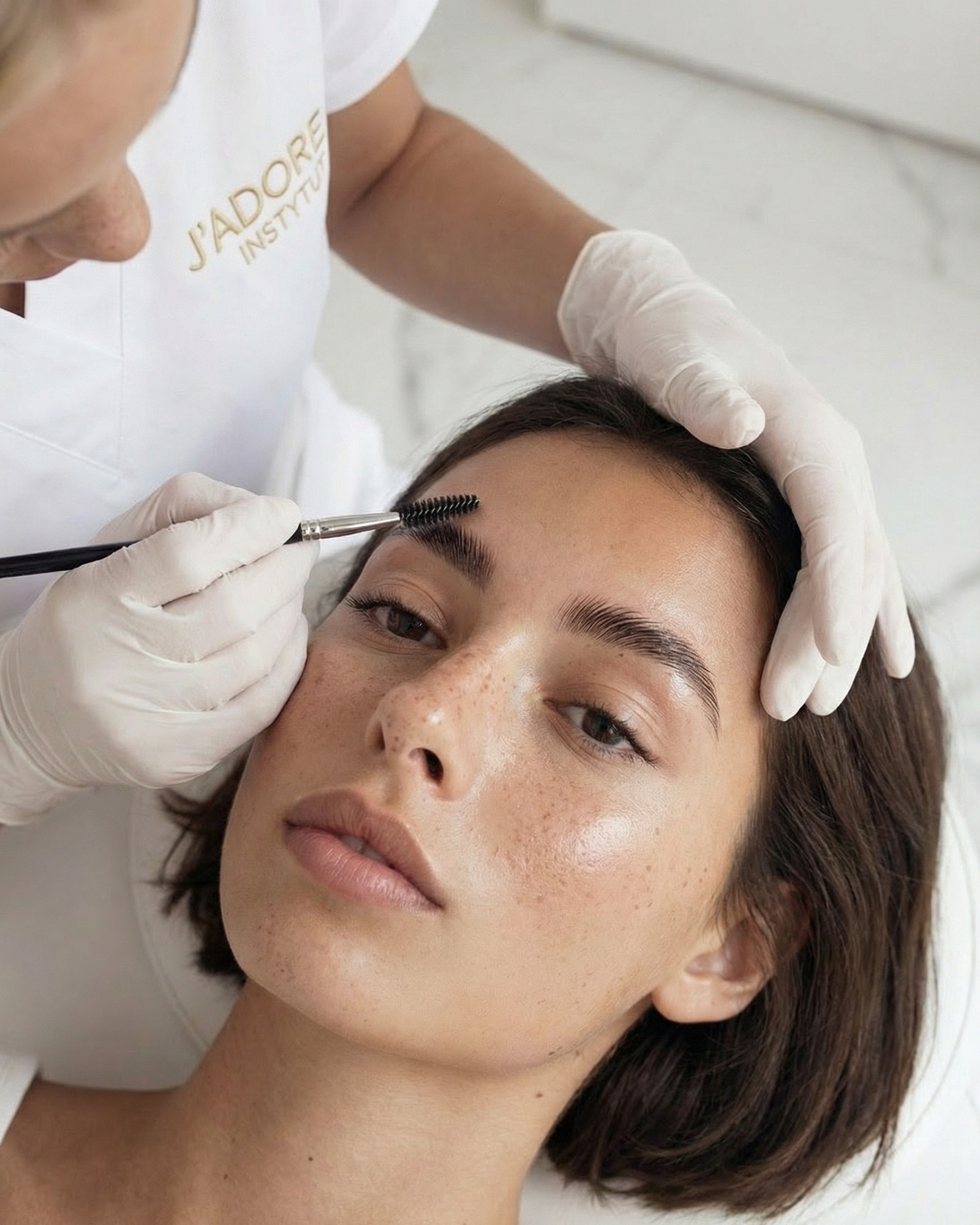
Safe and compatible with an eyebrow piercing — provided the channel has fully healed. During active healing, avoid applying chemical products directly next to the jewellery.
Facial needle mesotherapy
With an active nose or brow piercing, treatments that puncture the same zone require a consultation and an appropriate time gap. Don't combine them in the same week.