A scar isn't an aesthetic problem — it's a colour problem
Most scars aren't raised or noticeably different to the touch — the tissue often feels fine. The problem is colour: it's white, pink or reddish, while the skin around it is a different shade. The eye catches that contrast instantly. A laparotomy scar on the abdomen, a mastectomy scar on the chest, a long incision line on the leg — none of these stand out because of shape. They stand out because of pigment difference.
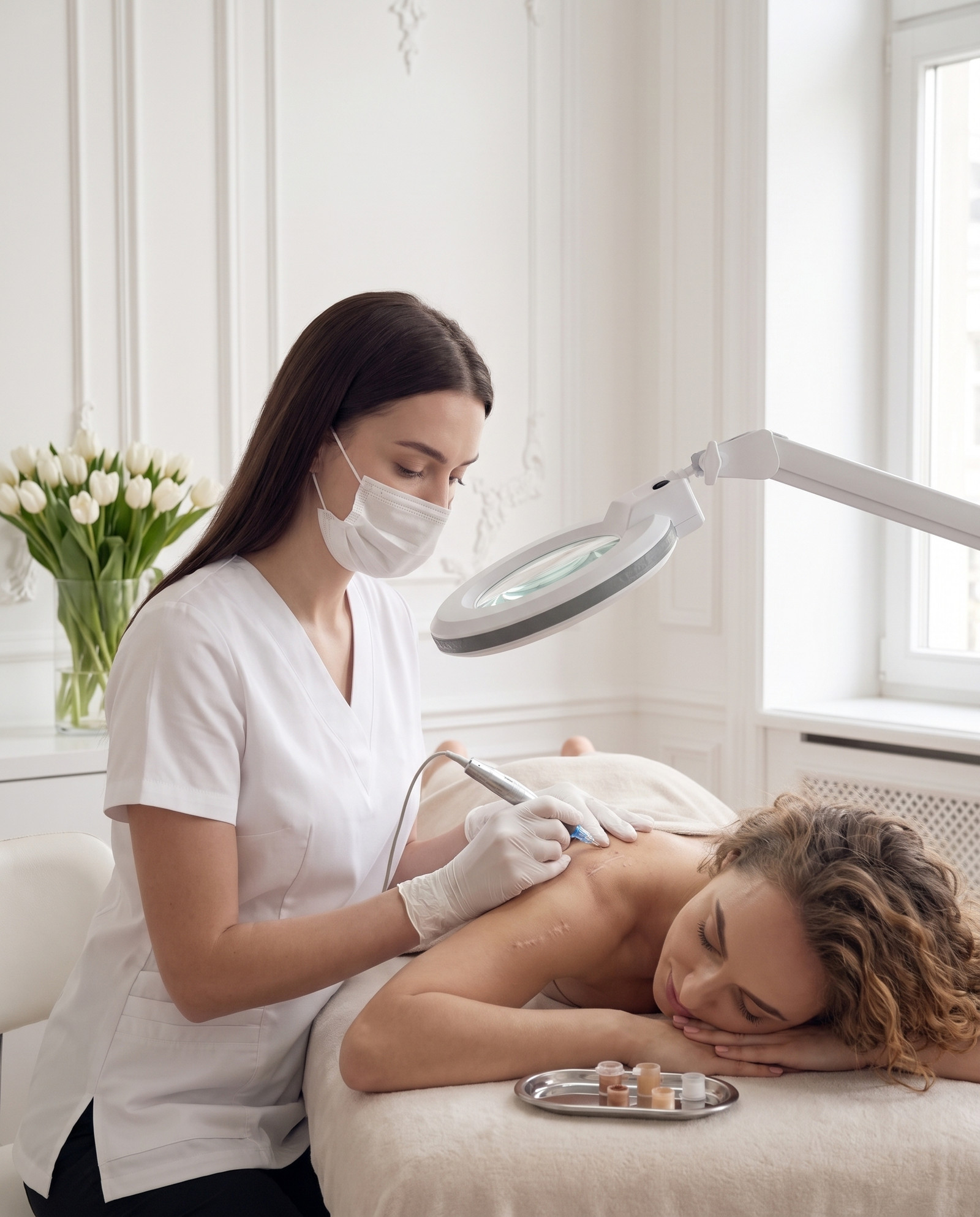
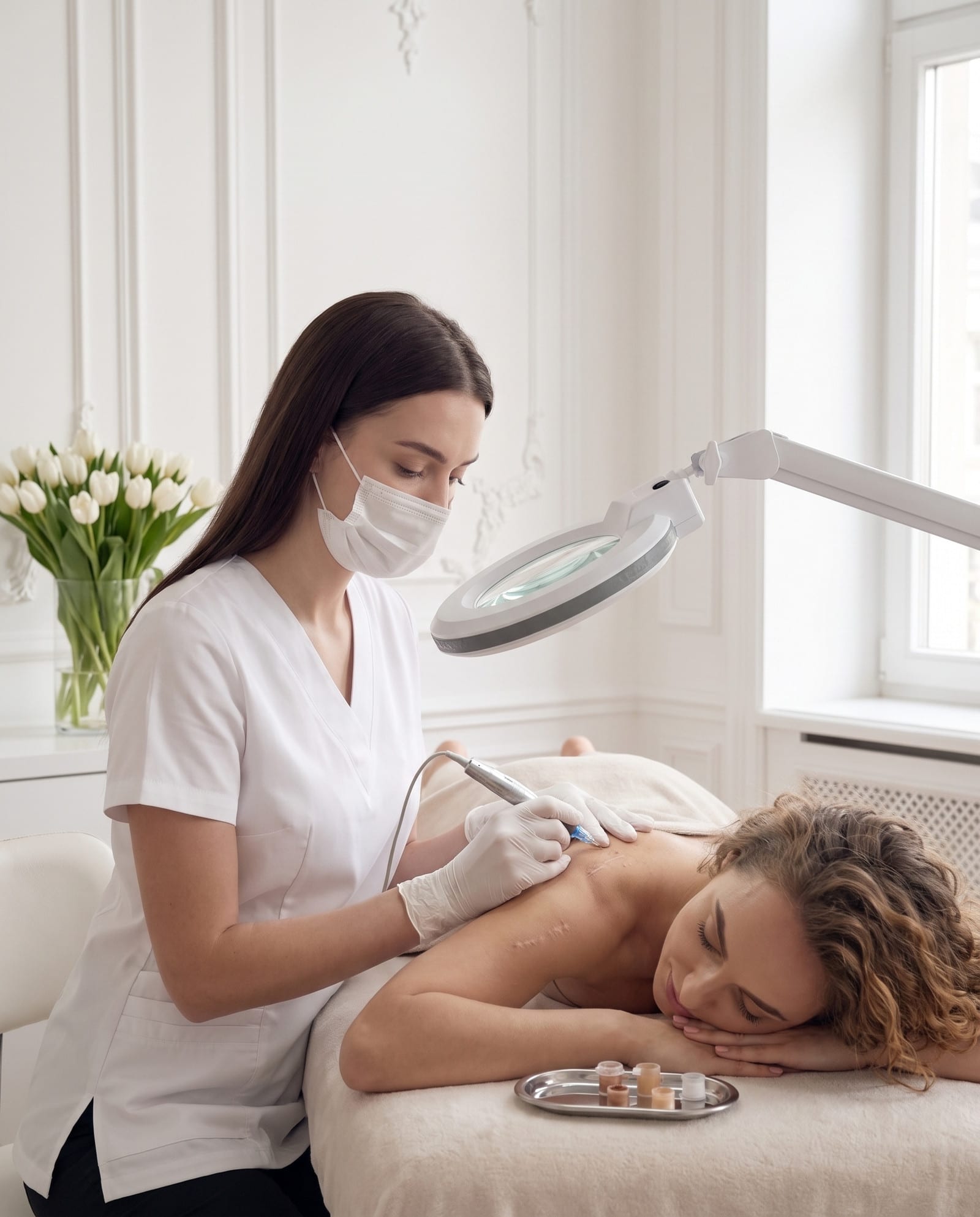
That's exactly what camouflage does. A technician deposits pigment matched to your skin tone directly into the scar tissue, which usually has no melanin of its own — that's why it's white. This is colour correction, not concealment or painting over. A well-matched pigment blend removes the contrast, and the scar blends into the surrounding skin.
When camouflage makes sense — and when it doesn't
Not every scar is ready for camouflage straight away. The basic condition: the scar needs to be mature. Fresh scars — up to a year old, often longer — are still "active". They change colour, texture and thickness. Depositing pigment into immature tissue defeats the purpose, because the result will be unpredictable. Before you come in for a consultation, the scar should be flat, pale and stable for at least a few months.
Good indications
when camouflage works best
- flat or slightly indented scars, mature (pale, stable)
- post-surgical scars — laparotomy, bypass, lesion removal
- scars from injuries and accidents without major texture irregularities
- scars from tattoo removal (correcting residual marks)
- pigment deficiencies — vitiligo in a limited area
Difficult cases
when a surgeon's consultation comes first
- hypertrophic scars (keloids) — raised, firm, active
- fresh scars (under 6–12 months old)
- significant texture irregularities within the scar
- areas with impaired microcirculation and poor healing
What the consultation and colour matching involve
Your first visit isn't a treatment — it's assessment and planning. The technician evaluates the scar's maturity, the tissue texture and — most importantly — your current skin tone. Skin colour changes with the seasons, with a tan, with age. Pigment is matched to your skin in a neutral, untanned state, so the scar doesn't end up darker than the surrounding skin once a summer tan fades.
The consultation also covers expectations versus realistic results. Camouflage can make a scar practically invisible — or reduce the contrast enough that it stops drawing the eye. Complete invisibility after a single session is rare. Usually, it takes two to three visits, spaced a few weeks apart to allow healing and assess how the pigment has settled.
- 01
Consultation
Scar assessment, colour matching, setting expectations and a schedule. Before-treatment photos.
- 02
First session
Pigment is deposited into the scar tissue. Skin stays slightly red for a few days; the pigment looks darker than the final result during the first week.
- 03
Healing & assessment
After 4–6 weeks, the pigment "settles" and reveals its true colour. That's when you assess the result and decide on a touch-up.
- 04
Touch-up (if needed)
Fine-tuning the colour, adding density or lightening selected areas. Usually 1–2 touch-up sessions.
- 05
Final result
A stable colour matched to your skin. Camouflage needs refreshing every few years, as pigment naturally fades.
The treatment itself — what it feels like and what to expect
Numbing cream is applied before the treatment and takes effect within ten to a few dozen minutes. Scar tissue is often less innervated than healthy skin, so many people find the treatment less unpleasant than expected. Any discomfort tends to be more noticeable at the border between the scar and healthy skin.
After the session, the area is red and the skin may swell slightly. This is a normal reaction to the pigment and settles within 24–48 hours. Apply a gentle moisturiser for a few days. Avoid sun exposure, the gym and wet environments (pool, sauna) for the first two weeks. Healing is quick and doesn't require time off work.
Scar camouflage vs other methods — what to choose
There are several approaches to scars on the market: camouflage creams (washable, applied daily), lasers (break down tissue and stimulate renewal), microneedling (stimulates collagen, improves texture), plastic surgery (excising and re-closing the scar), and pigment camouflage. No single method is always the best choice. Each one solves a different problem.
Pigment camouflage
permanent colour correction
- lasting result, no daily application needed
- works on flat scars with disrupted pigment
- can be combined with lasers and microneedling
- minimal healing time, no time off work
Laser / microneedling
texture improvement and skin stimulation
- improves scar texture and elasticity
- can lighten or even out colour in some cases
- good as a preparatory step before camouflage
In practice, a combination of methods often works best: laser or microneedling improves the scar's texture, and camouflage corrects the colour. A good technician will tell you whether your scar needs tissue work first — or whether you can start with pigment straight away.
Fractional microneedling RF
Before camouflage, it's worth improving the scar's texture. Microneedling stimulates collagen and "smooths" the tissue, which helps the pigment take evenly later on.
Mesotherapy
Hydrating and nourishing scar tissue before camouflage can improve its receptiveness to pigment and speed up healing afterwards.
One detail that changes a lot
Men talk less openly about scars — but that also means the topic reaches a specialist who could help less often. Pigment scar camouflage is available to anyone, and can be applied to the chest, abdomen, arms, neck or face. If you have a scar that draws attention — yours or someone else's — it's worth checking whether it's mature enough for a consultation.