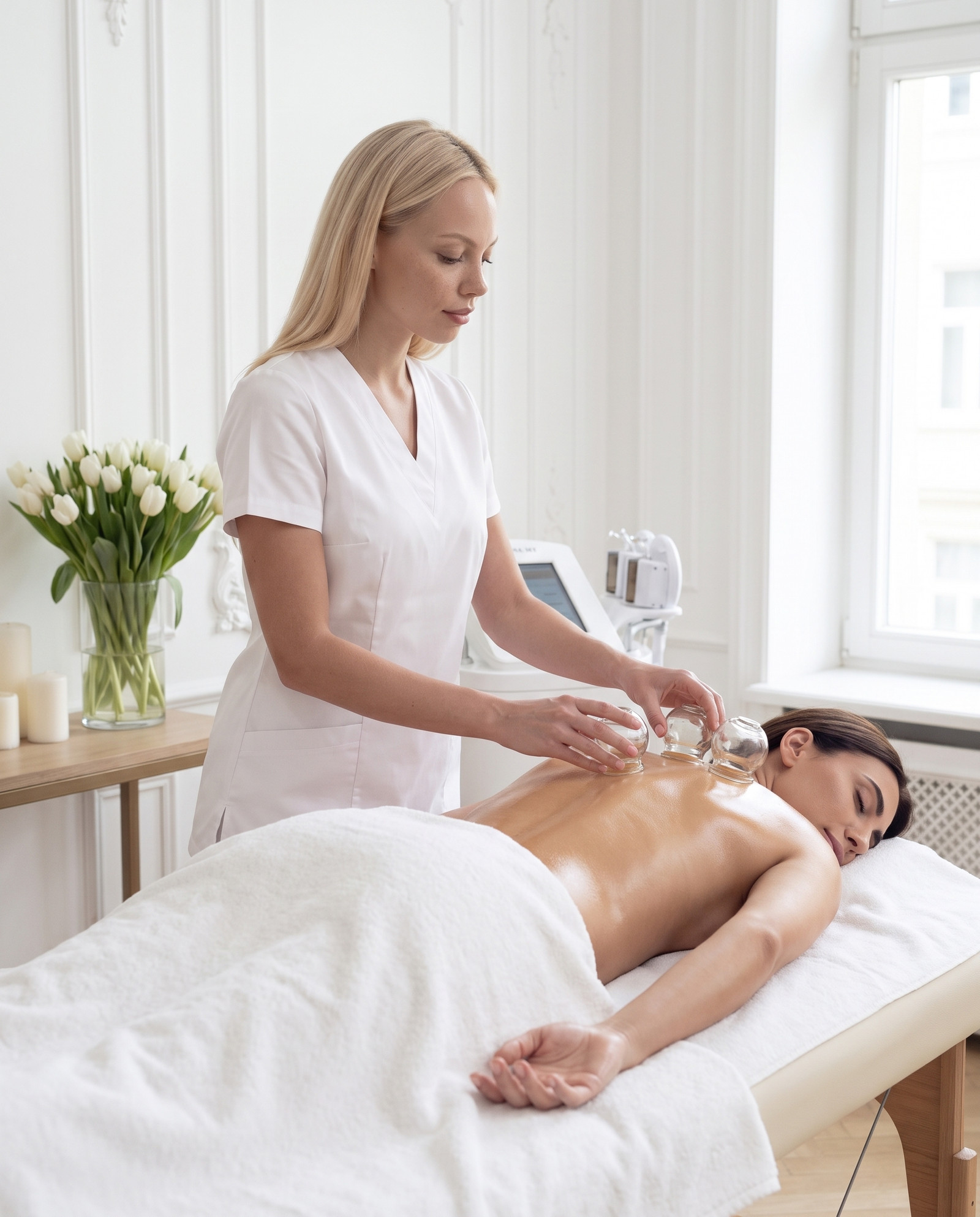
The first two hours: do not test your skin with another stimulus
After the massage, the therapist should remove excess product, examine the area, and tell you what reaction to expect. Before you get dressed, check for blisters, broken skin, or any point that is significantly more painful than the others. Mild tenderness and a feeling of warmth may occur, but you must report any increasing burning sensation while still in the salon. Ask whether a base oil or a scented blend was used; this information is important if a rash appears later.
On the way home, choose loose clothing that does not press on the marks with seams or elastic. Do not apply a very hot water bottle and do not scrub the area with a brush. If the skin is unpleasantly warm, a short cool compress through a cloth may provide relief, but do not apply ice directly. Drink according to your thirst; special "detoxes", fasting, and excessive amounts of water do not speed up the absorption of bruising. Cupping does not require flushing anything out of the body. It needs time for minor vessel damage to be naturally repaired.
The evening of the treatment: a short shower instead of a hot ritual
- Choose a lukewarm shower. Unless the salon has advised otherwise, a lukewarm shower is more sensible than a long, hot bath. Very warm water, saunas, and intense heating dilate vessels and can increase throbbing and redness.
- Wash your skin gently. Wash your skin with a mild cleanser or just water, without exfoliating particles, acids, retinoids, or heavily perfumed gels. Dry by patting with a towel.
- Do not rub the suction area. Friction from a rough cloth directly on the suction site adds mechanical trauma that is not immediately visible.
Do not massage the marks again, even if they feel hard. Do not use rollers, massage guns, or home vacuum cups. Alcohol can increase vessel dilation and make it harder to assess how you feel, so it is better to spend the evening after a strong session without it. If you are planning to take painkillers, do not choose a product at random: some agents affect clotting or are not suitable for your specific health conditions. If the pain is greater than simple tenderness, contact the salon or a pharmacist instead of masking the symptom and going to sleep.
The first night: position matters if the material rubs the area
After cupping on the back, sleeping on your front may be uncomfortable; after work on the thighs, tight pyjamas also create pressure. Choose a position where the skin is not constantly pressed and does not rub against a thick seam. Clean, soft bedding limits the contact of the irritated surface with sweat and cosmetic residues. Do not cover the marks with film and do not apply a thick layer of occlusive ointment without a recommendation. Healthy, unbroken skin usually does not need a dressing.
Before bed, take one photo in similar light if the reaction is strong. Not to publish the circles as proof of intensity, but to compare the direction of change the next day. Note in your memory or a note where the pain is greatest. If dizziness, nausea, or weakness occurs, sit down, rest, and assess whether the symptoms subside. Fainting, shortness of breath, chest pain, or a sudden allergic reaction require urgent help. These are not typical "post-cupping cleansing".
The next 24 hours: movement yes, record-breaking training no
Look at your skin in daylight. The expected mark may still be dark, but it should not quickly increase in diameter or turn into a hard, clearly tense lump. Pay attention to blisters, erosions, oozing, purulent content, strong warmth, and red streaks. Compare the symmetry of your limbs if the cupping was performed on your legs. New unilateral swelling, calf pain, and shortness of breath are not cosmetic issues. The NCCIH lists infections and burns among the possible side effects of cupping, so do not ignore a worsening appearance just because marks are common.
The second and third day: the colour may change, comfort should return
Daily care should still be sparing. A neutral, fragrance-free emollient can be considered for unbroken, dry skin, but there is no need to smear every mark with several active preparations. Do not combine arnica, heparin, essential oils, or cooling gels randomly, especially if you are taking anticoagulants, are pregnant, or have allergies. A product "for bruises" can also cause allergies. If you need to hide a mark, loose clothing is safer than heavy body makeup rubbed into an irritated surface.
The fourth and fifth day: do not speed up the next session because the skin looks better
This is a good moment for a short summary for yourself: which areas were most sensitive, how long the tenderness lasted, and whether any numbness, rash, or pain unrelated to the mark appeared. Such information is more useful to the therapist than a photo taken right after the visit. If the goal is to improve the appearance of subcutaneous tissue, a single bruise does not allow you to assess the result. Swelling and changed light can temporarily smooth out or highlight irregularities. Comparing photographs only makes sense under similar conditions, after the reaction has calmed down.
The sixth and seventh day: assess the progress, not the promise
A week is not a magic deadline after which every person must return to full normality. Age, medication, vessel fragility, the treatment area, and the strength of the negative pressure change the time. Systematic improvement is what counts. If the skin has not had time to calm down, do not plan another cupping session, waxing, intense peeling, or tanning on this area. Radiation can promote the fixation of post-inflammatory hyperpigmentation, so protect exposed areas from the sun with clothing and an appropriate filter tolerated by your skin.
Call the salon when the reaction goes beyond the established scenario
Good aftercare advice says not only "this is normal" but also where the norm ends. Contact the place where it was performed when a blister, abrasion, strong haematoma, rash, or increasing pain appears, or if a symptom lasts longer than predicted for your reaction. Say when the massage was performed, what area it covered, whether the cup was moved or left statically, and what medications you are taking. Do not minimise the fact that a new preparation was started or an injury occurred after the visit.
At J’ADORE INSTYTUT in Warsaw, recommendations should correspond to the actual reaction, so a photo and a precise description are better than just saying "it looks bad". The salon may recommend observation, care, or a medical consultation. However, if rapidly spreading redness with fever, symptoms of thrombosis, difficulty breathing, fainting, or sudden facial swelling occur, do not wait for a response from the reception. Use medical assistance appropriate to the urgency of the situation.
What cupping will not do after you leave the salon
Cupping does not locally burn fat tissue while the marks are fading. It does not remove "toxins" through bruises, it does not treat thrombosis, and it does not repair loose skin through irritation alone. It can be an element of working on the feeling of tension, tissue comfort, or the appearance of cellulite, but the result depends on the problem, technique, and repeatability, not on the darkness of the circles. If the only effect after a week is pain, the plan requires correction, not escalation.
Take three things with you. First: the mark should fade, not develop into a hot and increasingly painful area. Second: do not try to scrub it, heat it, or suction it again. Third: reporting a worrying reaction is not an exaggeration and does not take away from the sense of the treatment. It is feedback that allows you to change parameters or acknowledge that your tissues tolerate a different method better. Good aftercare for cupping is not about doing more. It is about not adding further problems to the skin.
What a reaction that is heading in the right direction looks like
On the first day, the area may be tender to the touch; on the second, the colour may seem darker, and then it should move to lighter shades. This in itself does not have to mean deterioration. Look for a set of features: the edges of the mark do not expand rapidly, the surface remains dry and closed, pain decreases, no fever occurs, and free movement returns. Slight differences between sides of the body are possible because tissues do not react identically. However, if one leg swells entirely, becomes warmer, or deep calf pain appears, do not explain this away as a stronger pass. Such a picture must be assessed independently of the treatment.
You can keep simple documentation: one photo a day from the same distance, without a flash, and a short note about pain during walking and touch. Do not photograph every hour, because lighting differences increase anxiety, not knowledge. If the mark is under clothing, note whether the pressure of elastic increases discomfort. When contacting the salon, also state whether you have been taking medications that affect clotting. Assessment is not about matching a circle to an online colour chart. The colour of the cup does not diagnose an organ, "stagnation", or the amount of toxins. The progress and the state of the whole person are what matter.
The sun can turn a temporary mark into a longer-term problem
Treat the area after intense negative pressure like skin after an injury: do not expose it intentionally to tanning. If the marks are on your arms, décolletage, or legs, cover them with breathable fabric. Sunscreen can be useful on unbroken skin, but choose a product you already know and tolerate. A fresh rash after a new cosmetic will make it difficult to distinguish a contact reaction from the aftermath of the massage. A tanning bed is not a way to even out the colour; it adds radiation to the inflammation and can promote the fixation of discolouration.
If the treatment was planned just before a holiday, a photoshoot, or an event with an exposed back, the visual effect might have been underestimated. Do not try to save the situation with a peel, self-tanner, or another treatment. Self-tanner can catch unevenly on the changed surface, and body concealer requires friction when applying and removing. For the future, include the possibility of marks in your calendar, even if they were almost non-existent previously. The reaction depends on the area, cycle, medication, hydration, state of the vessels, and the strength of the session. The lack of a "no circles" guarantee is more honest than a promise that the therapist will completely predict the skin's behaviour.
A blister or abrasion changes the care from cosmetic to wound care
If the epidermis has been broken, do not apply perfumed lotion, essential oils, or random ointment. Wash your hands, do not tear off loose skin, and contact the salon and — in the case of larger damage — a doctor or pharmacist. Do not puncture a blister at home. Observe for increasing redness, purulent discharge, fever, and red streaks. A photo taken before cleansing may help with assessment, but hygiene takes priority over documentation. If a dressing is needed, it should be chosen according to the type of wound, not what happens to be in your home cosmetic bag.
Ask the salon how the damage occurred: whether the cup stood for too long, the negative pressure was too high, the skin was sucked onto an uneven edge, or heat was used. The answer "that's how it sometimes has to be" is not sufficient. A blister is not a required stage of the massage. Before the next visit, the wound must be completely healed, and the cause discussed. If hypersensitivity, a scar, or a dark mark remains after the damage, you should not perform another cupping session on that area just to "break down the adhesion". First, an assessment of the tissue and a change of method are needed.
The plan for the next visit is created from the reaction of the first week
At your next booking, do not automatically answer "everything was fine" if it was difficult to sit for three days or if clothing hurt to the touch. Say how long the tenderness lasted, when the mark disappeared, and whether the skin itched. The therapist can reduce the negative pressure, shorten the time, use more glide, avoid the area, or propose a manual technique without cupping. Lower intensity does not mean a worse service. It means matching the dose of the stimulus to the tissue response. If the goal is relaxation, a session that leaves you with a fear of touch for a week misses that goal.
Do not book a series so densely that the marks overlap. The skin should regain its normal colour, continuity, and comfort before repeating work on the same area. If the reaction becomes stronger with each treatment despite milder settings, it is worth stopping and looking for the cause: medication, vascular disease, contact allergy, or skin that is too fragile. Cupping is a tool, not an obligation. You can give it up without losing the chance to care for your body. Sometimes the best result of the first week is clear information that a different method will be more predictable and better tolerated.
Before returning to cupping, check if your body has truly closed the previous reaction
When everything has healed calmly, still start the next session with a short skin check. A change in the date, medication, or health status can mean that a previously tolerated setting will not be the right starting point.
In Warsaw, reporting a reaction should indicate the specific salon
The service description can be found on the cupping massage page in Warsaw. J'adore Instytut operates at Żelazna 59, 00-848 Warsaw — Mon–Sat 8–21, Sun 11–19 — and at Mińska 29A/46, 03-808 Warsaw — Mon–Sat 9–21. If you are sending a photo of the reaction, include the location, the day and time of the visit, and the massaged area. The reception will then more easily find the correct service and the person who performed it.
A sudden general symptom requires medical help appropriate to its severity, regardless of reception opening hours.