
What cupping actually is, and why it differs from massage
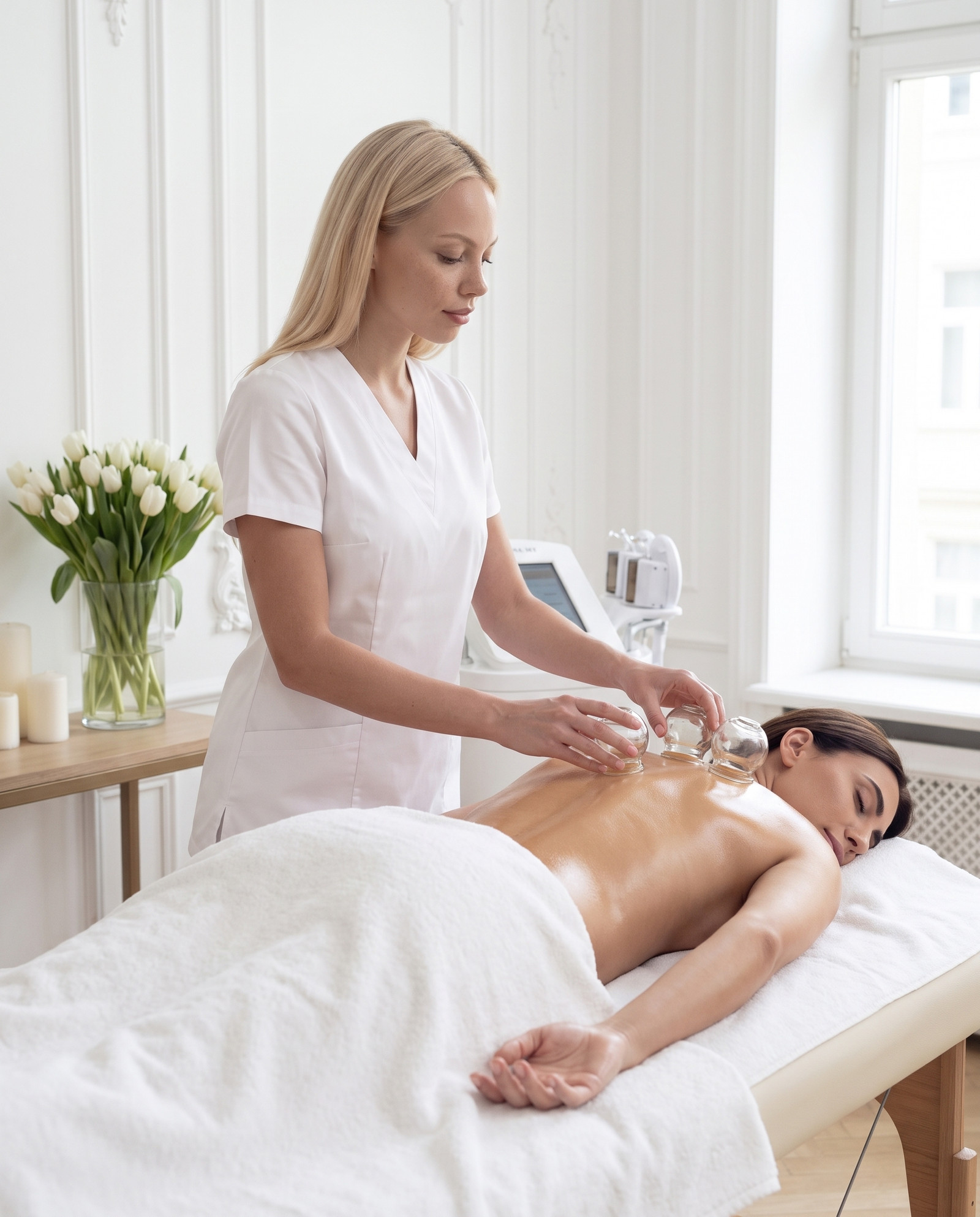
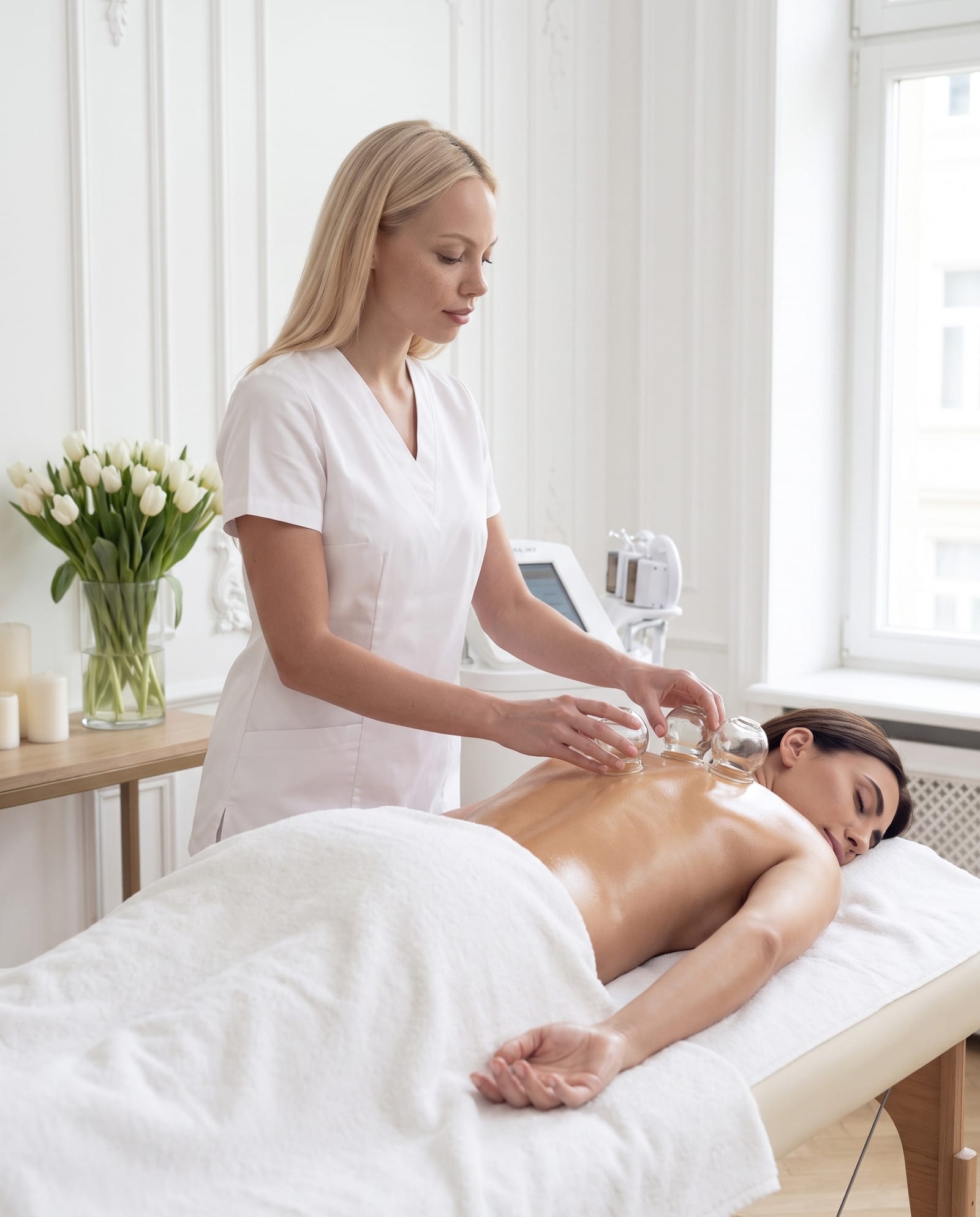
Classic massage works through pressure — the therapist presses into the muscles, breaking down tension. Cupping does the opposite: the cup creates suction that lifts the skin, fascia and muscle layer. This is decompression — tissue is literally pulled away from the bone and deeper structures, opening spaces for blood and lymph to flow through.
In practice, there are two variants: stationary cupping (cups left in place for a few minutes) and dynamic cupping — the therapist glides the cup across oiled skin, giving an effect similar to deep fascial massage, but without pressure. For the back and legs after training, dynamic cupping is used most often — or a combination of both.
Back pain after training — why cupping works especially well here
The lower back and lumbosacral area are among the most overworked spots for men doing strength training. Deadlifts, squats, rows — each of these movements engages the erector spinae, quadratus lumborum and IT band. Under heavy loads, the paraspinal fascia thickens and stiffens, hindering recovery and leading to that "locked-up back" feeling the day after a session.
Cupping along the paraspinal muscles often achieves what a foam roller can't: it lifts the entire fascial layer, releasing adhesions between tissue layers. For many people, range of motion in the lower back improves noticeably after just one session — the torso rotates more freely, bending forward doesn't trigger immediate tension. This has a direct effect on the quality of your next training session.
Legs after running and a day at the gym
Calves, hamstrings (biceps femoris), the IT band and quadriceps — these four areas account for most complaints among active men. The IT band is especially problematic: it's a dense fascial band running along the outside of the thigh, and no exercise will stretch it, because it isn't a muscle at all. Cupping is one of the few treatments that effectively improves how it glides against the layers beneath it.
Foam roller / self-massage
a daily tool of your own
- available any time
- good for maintaining results
- easy to use on your own
Cupping for legs
a recovery treatment at the salon
- decompresses the fascia of the IT band and calves
- better results for adhesions and chronic tension
- effects noticeable for several days after the treatment
Muscle soreness (DOMS) is micro-damage to muscle fibres accompanied by inflammation. Cupping can speed up its resolution by improving local blood and lymph flow — but it's worth understanding this precisely: it doesn't "cure" soreness by repairing micro-tears. It supports the environment in which the muscle recovers. Most people report that soreness feels less severe the very next day after cupping.
What the treatment involves — from start to finish
Before the treatment, the therapist asks briefly about your activity, any injuries and the areas you want to address. You don't need to know the technical terms — "back after deadlifts" or "calves after a run" is enough. Your skin is oiled to allow the cup to glide smoothly.
- 01
Consultation and preparation
The therapist learns about your training and overworked areas. No forms — just a normal, brief conversation.
- 02
Warming up the tissue
This often means a few minutes of classic pressure, so the tissue isn't "cold" before decompression. It makes the cup easier to glide and reduces discomfort.
- 03
Dynamic cupping
The cup glides over the muscle, along and across the fibres. You'll feel a distinct pulling sensation — not pain, but strong, intensive work. The therapist adjusts the suction strength to your tolerance.
- 04
Stationary cups (optional)
On the tightest spots, cups may be left in place for a few minutes. This is when the characteristic marks appear.
- 05
Finishing touches
A gentle massage settles the tissue. You leave with a feeling of lightness you often weren't expecting.
What you'll feel during and after — no sugar-coating
Cupping isn't a relaxation treatment in the classic sense. You'll feel a distinct pulling sensation, intense in places — especially over tight muscle bands. Most men describe it as "good pain": something clearly working, but never beyond your tolerance. If it's too strong, just say so — the suction can be adjusted on the spot.
After the treatment, your back and legs often feel lighter than before you walked in — the decompression effect is noticeable almost immediately. Over the following day, many people notice a kind of "warm fatigue" in the treated muscles, similar to the feeling after a good workout. This is normal: the tissue has responded to the stimulation, and recovery is under way.
When and what to combine cupping with
Cupping works best as part of a wider recovery plan, not a one-off treatment. If you train with weights or run regularly, book it every 2–4 weeks — this gives the tissue time to respond, recover and benefit again. A single session brings relief; a series builds a lasting change in muscle quality.
Sports massage
Combining cupping with sports massage gives you a complete recovery protocol: cupping decompresses the fascia, while sports massage works the deep muscle layers through pressure. We often perform both in a single session — cupping first, then massage.
Deep tissue massage
For chronic tension — a "knot" by the shoulder blade you've had for years, for example — cupping as preparation loosens the tissue and lets the therapist work deeper during the massage. The combined effect is stronger than either treatment alone.
Lomi lomi massage
For men who want to combine recovery with deep relaxation of the nervous system — lomi lomi uses long, flowing strokes across the whole body. After cupping on the back and legs, a lomi lomi session rounds off the effect and "integrates" the treated tissue.
When cupping isn't a good idea
Cupping is safe for healthy adults, but there are situations where it's worth waiting, or consulting a doctor first.
- Fresh injuries and inflammation — cupping can worsen swelling at the site of an acute injury. With a fresh strain or muscle tear, start with a few days of ice and rest.
- Broken skin, eczema, psoriasis in the treatment area — cupping over affected skin is a quick route to irritation.
- Clotting disorders or blood-thinning medication — strong decompression can increase bruising; a medical consultation is essential in this case.
- Right before an important competition — give your muscles at least 48 hours to adapt after the treatment before asking for maximum effort.