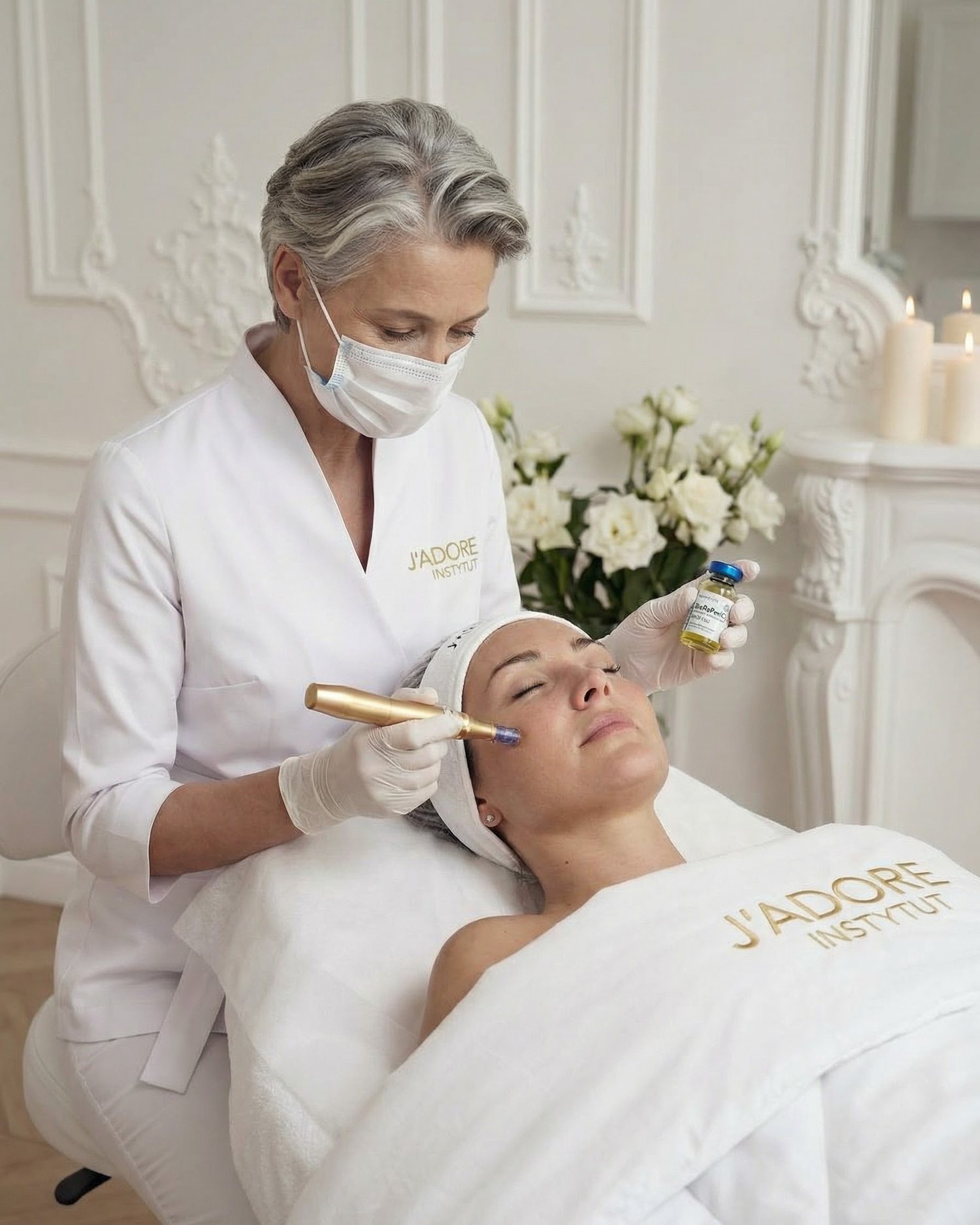
First result: you immediately see light reflecting off a smoother surface
After cleansing, product application and final skincare, the skin may look fresher, have a more even sheen and feel firmer. This is a valuable result if your goal is refreshment before an event. Let us not call it a full remodelling, however. Part of the change comes from the hydration of the stratum corneum and the way a smoother surface reflects light.
This quick result is best assessed without heavy make-up and without a filter. Take a photo in the same place, at the same time of day. If the "glow" disappears when you change the angle of the lamp, the photography was more effective than the peel. If your complexion looks fresher in normal light and your make-up sits more evenly, you have a concrete observation.
If you are planning a BioRePeel before a celebration, do not have your first session ever a few hours before applying make-up. The lack of visible peeling does not guarantee an absence of erythema, stinging or a minor reaction for every person. A trial session performed earlier tells you more about your tolerance than an assurance that the treatment is a "lunchtime" procedure.
Second result: in the following days, you assess texture, not just sheen
After the initial tightness subsides, you can check if the surface is smoother, the pores look cleaner and your make-up highlights dry areas less. BioRePeel contains ingredients that exfoliate and support oily skin, but pores do not open and close like doors. Their visibility depends on sebum, blackheads, wall elasticity and light.
For skin prone to blackheads, a single treatment may provide a sense of cleansing, but it will not replace a plan for the root cause of the breakouts. If your home routine still involves irritating products, pore-clogging cosmetics or a lack of regular cleansing, the pores will be visible again. A peel is an intervention, not a permanent change to skin physiology.
Minor, local peeling may occur despite the "no peeling" claim. Do not pick at the skin and do not add a mechanical peel to even out the surface. Gentle cleansing, moisturising and sun protection help you assess the proper reaction without adding damage.
- Compare your skin without oily serum on the surface.
- Do not assess pores in your phone's macro mode.
- Check how your complexion behaves throughout the day, not just in the morning.
- Note whether the number of new breakouts has decreased, instead of counting every point in a magnifying mirror.
Third result: remodelling needs weeks and a repeatable stimulus
The TCA in the formula is intended to be biostimulating, which is why the effect of tightness and skin quality may increase after the treatment. This is not a process visible from hour to hour. The treatment repository describes a series of several sessions at intervals determined by the cosmetologist. Each visit is another stimulus, not another layer of an instant lift.
Documentation after a series should only be created after the skin has had time to respond. Position your face straight, avoid tensing your muscles and take the photo without portrait blurring. Fine expression lines may look different depending on your facial expression. Comparing a smile with a resting face has no value.
- 01
The same day
Radiance, freshness and temporary tightness.
- 02
The following days
Assessment of surface, comfort and any minor peeling.
- 03
During the series
Gradual observation of texture, skin tone and pores.
- 04
After time for remodelling
Honest photos and a decision on whether to maintain or change the method.
If the problem remains unchanged after a full plan, do not assume that an infinite number of layers or sessions is the answer. Check if the indication was correct. Deep scars, persistent melasma or active skin disease may require a different method and diagnostics.
Skin tone improves differently for post-acne marks than for melasma
The word "hyperpigmentation" covers changes of different origins. A superficial post-inflammatory mark does not behave like melasma, which depends on hormones and light exposure. BioRePeel can support an even skin tone, but it is not automatically a full depigmentation protocol for every spot.
For recurring or rapidly changing lesions, a dermatological assessment is needed. A cosmetologist should not apply acid to a mole or attempt to "brighten" a lesion whose nature is not identified. The boundary of competence is part of a good result, as it prevents masking a problem that requires a doctor.
Sun protection determines whether your work on skin tone has the conditions to be maintained. A filter does not reverse existing pigment overnight, but it limits the addition of further stimulus. A lack of protection after a peel can lead to irritation and the deepening of hyperpigmentation, especially with intense exposure.
Pores and acne: an improved appearance is not a cure for every form of the disease
Salicylic acid and exfoliation can support oily skin, blackheads and an uneven surface. For a mild problem, a series can improve how the skin cleanses itself and looks. Active, extensive inflammatory acne, painful nodules or a sudden flare-up should not be covered up by the promise of a peel for everything.
If the lesions leave scars or do not respond to reasonable skincare, consult a dermatologist. BioRePeel does not replace pharmacological treatment when it is needed. Furthermore, isotretinoin therapy and the period following it are significant for qualification for a peel. Never hide your medication for fear that the cosmetologist will postpone the treatment.
After a series, count new lesions over a similar period and the same phase of your cycle, if it affects your complexion. A photo of one "good day" may overestimate the result, while a photograph at the peak of a flare-up may underestimate it. The trend is what counts: fewer inflammatory states, shorter healing time, a more stable surface.
BioRePeel will not permanently shrink pores to the size of a smoothed filter. It can improve their visibility by cleansing, smoothing and changing the quality of the surrounding skin. Such a result is less spectacular in advertising, but more honest and possible to assess.
Scars: shallow unevenness and deep loss of tissue do not respond in the same way
A peel can smooth the surface and support the remodelling of shallow marks, but a deep atrophic scar is a structural change. Light falling from the front can hide it, while side lighting can highlight it. Therefore, photographs of scars require a constant direction of lighting; otherwise, the "before" and "after" tell the story of the lamp.
For deeper scars, the cosmetologist may propose a plan with microneedling or a laser at appropriate intervals. More methods do not always mean faster results. The skin needs regeneration, and layering treatments without a schedule increases the risk of irritation and hyperpigmentation.
Before you buy a series exclusively for scars, ask for a classification of the problem and a realistic goal: softening the edges, improving texture or reducing contrast? "Removing scars" is too broad a promise. Even successful therapy usually improves their appearance, rather than restoring skin that was never damaged.
A series makes sense when every treatment answers the same thesis
Before the first session, name the main goal in one sentence: I want to reduce the number of blackheads, improve rough texture or even out superficial marks. Do not try to hold the peel accountable for the jawline, deep furrows, active acne and melasma all at once. One procedure cannot be honestly assessed on four unrelated scales.
During the series, the cosmetologist may change the number of layers and the frequency based on your reaction. Stronger stinging does not mean greater remodelling. If the skin remains irritated, the next stimulus may need to be postponed. The plan is meant to serve the skin, not the expiry date of the package.
Home care should be simple and stable. If you start a retinoid, a new acid and several supplements at the same time, you will not know what is responsible for the improvement or the irritation. The cosmetologist should indicate when to stop and when to safely reintroduce active ingredients.
After the series, take a break for assessment. If the radiance is good but the main problem has not budged, consider the quick effect a pleasant addition, not proof of the success of the entire plan. Sometimes the right decision is to change the method instead of indefinitely maintaining the glow.
Remember that the result may fluctuate with your cycle, sleep, stress and the weather. One bad day does not cancel the series, and one exceptionally good morning does not confirm it. Assess your skin at several repeatable points: in the morning after gentle cleansing, at the end of the day without adding highlighter, and in photographs taken under constant conditions. Also record your comfort — less tightness and easier skincare can be a significant improvement, even if they do not make for a strong advertising photo. The result should improve the daily functioning of the skin, not just a single frame.
If the gap between sessions is extended due to infection, holidays or irritation, do not rush to catch up with treatments. Contact your cosmetologist to recalculate your schedule. A safe break is a smaller problem than applying acid to skin that has not yet regained its balance. If your reaction to the previous application was unusual, show us photos and state how long it lasted. This allows us to adjust the number of layers or decide to skip the next stimulus entirely.
In Krakow, evaluate BioRePeel in natural light, not under a treatment lamp.
J’ADORE INSTYTUT in Krakow is located at Karmelicka 45. You can find the procedure description and availability on the Krakow BioRePeel page. Please bring a list of your active cosmetics, medications, recent treatments and planned sun exposure to your consultation.
Ask for a photo before the first application, not after the preparations have been applied. Establish when the "after" photo will be taken. Early comparison helps assess erythema and glow, while later comparison helps assess skin quality. Do not mix these points, as they lead to different conclusions.
The most reliable result is one you can describe without the word "spectacular": fewer blackheads, more even make-up application, reduced roughness, and a calmer skin tone. If the only change is a shine on your forehead in salon lighting, that is not enough to claim a remodelling effect.
BioRePeel is worthwhile for someone whose concerns fall within the scope of a peel and who accepts the need for a series of sessions and sun protection. It is not worthwhile for someone expecting immediate filling, the removal of deep scars or the treatment of an active disease. This boundary is more important than the most photogenic glow upon leaving.