Why fine, oily hair is its own category
Fine hair and oily hair are two separate issues that often go together — but not always. Fine hair simply has a smaller shaft diameter. That means less surface area for anything to attach to, and a higher risk of mechanical overload. Oily hair, on the other hand, results from increased activity of the sebaceous glands at the scalp. That excess sebum is exactly the problem for methods that rely on a firm "grip" at the root.
If you have both issues at once, you're facing a real dilemma. Flat-tip tape extensions create a thin, flat bond at the scalp, which can slip on an oily base. Keratin tends to perform better here. Micro-rings work quite differently — but have their own requirements when it comes to hair thickness. Each method behaves differently on hair that's both fine and affected by active sebaceous glands.
Comparing methods — how each behaves on fine, oily hair
Before your stylist suggests a specific method, it helps to know how they differ for your hair type. Here are the three main approaches and how they behave in practice:
Flat-tip tape extensions
a thin, flat bond at the scalp
- Invisible at the root — the flat panel sits discreetly under the hair
- A good option from medium hair density upwards
- Relatively quick to fit and remove
- Can give a natural volume effect for many women
Keratin (hot fusion)
a heat-bonded point-by-point attachment
- Can hold more securely than tape on oily hair
- The bond is small and round — less point-loading on fine hair
- Your stylist can adjust the bond strength precisely
- Wide choice of colours and strand textures
Micro-rings / nano-rings
a mechanical clasp, no adhesive
- No glue and no heat — the gentlest method for fine hair
- Doesn't react to sebum at the root the way adhesives do
- Adjustment and correction possible without removing the whole set
- A growing choice for delicate hair
Oiliness and how long results last — what to expect
The most common question at consultations: "Will my tape hold, given that my hair is oily?" The honest answer is: it depends on the method, your hair care, and your lifestyle. But it's worth knowing how specific factors affect how long extensions last.
- Sebum at the root — the natural enemy of adhesion. Glue and tape lose grip faster when the scalp produces a lot of sebum. Nano-rings are unaffected by this.
- Conditioner near the root — any conditioner applied too close to the bond weakens it. With fine, oily hair it's tempting to apply conditioner from the roots down, but this speeds up tape slippage.
- High heat — saunas, hot baths — these loosen keratin bonds and soften tape adhesive. On oily hair, which already generates a warm "micro-climate" at the scalp, the effect compounds.
- Frequent washing — oily hair needs washing more often, and every wash means water contact with the bond. A good extension-friendly shampoo (free from silicones and sulfates) can significantly extend how long extensions last.
Test: is your hair suitable for tape extensions?
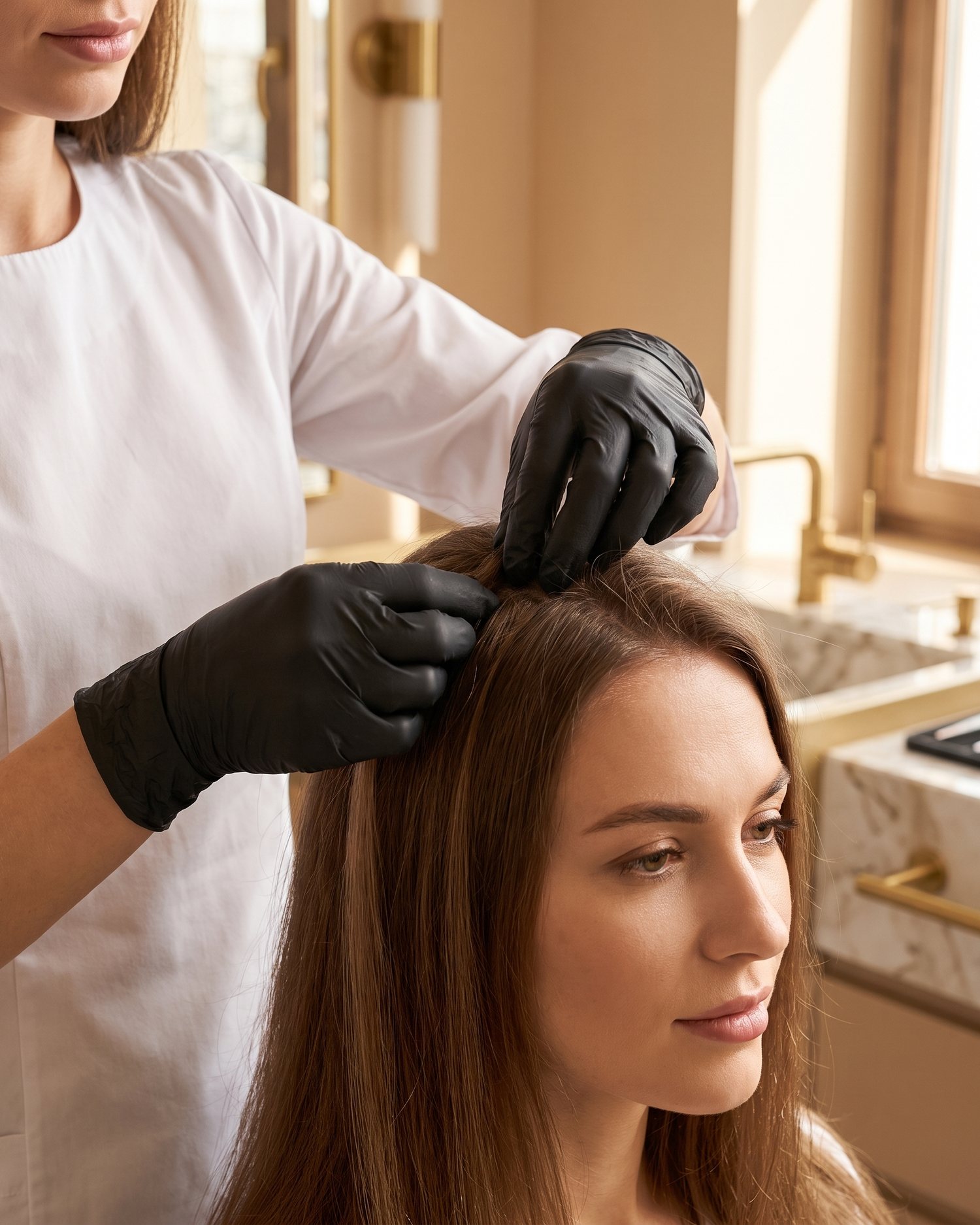
Instead of guessing, you can check a few signals that help you assess the situation before your consultation. This won't replace a specialist's assessment, but it sets the conversation off on the right track.
- 01
Check hair density and thickness
Take a single strand and roll it between your fingers. Hair that feels very fine — almost imperceptible — is a signal that load mechanics will matter. Your stylist will assess this more precisely under a magnifying glass or by touch, but you can get a first impression yourself: is it "fluff" or "rope"?
- 02
Assess how quickly your hair gets oily
How long does your hair look fresh after washing? If it's oily at the root within 24 hours, that's a strong signal for your stylist. If it takes 48–72 hours, you're in the moderate range, where tape extensions can work well with good aftercare.
- 03
Check your hair's condition
Does your hair break easily, have split ends, feel static or porous? Fine hair in poor condition doubles the risk. Your stylist may suggest a repair plan before extensions — that's a sensible approach, not a delay.
- 04
Assess your lifestyle
Physical activity with heavy sweating, regular sauna use, chlorinated pools — each of these weakens both the adhesive bonds and the condition of delicate hair. The more active your lifestyle, the more important it is to choose the right method.
When it's worth waiting — and what to do instead
There are situations where your stylist may suggest waiting before getting extensions. Not because anything is wrong, but because your hair and scalp need attention first. This honest approach gives better results in the long run.
- Active-phase hair loss — loading weakened roots with bonds can accelerate shedding. It's best to stabilise the condition first.
- Significant heat or chemical damage — hair after aggressive lightening or a perm may not withstand even a gentle method mechanically.
- Dandruff or scalp inflammation — no bonds should be applied over active inflammation. This is a firm rule.
- Hair too sparse at the root — below a certain density, tape or strands have nothing to "wrap around". Thickening can paradoxically reveal the problem rather than hide it.
Keratin straightening + micro-rings
If you have fine, curly or wavy hair, keratin straightening can first improve the shaft structure and make it easier to fit rings afterwards without excess strain.
Strengthening treatment course + tape
A series of nourishing treatments for the scalp and hair length, followed by extensions — this approach often gives longer-lasting results on fine hair than rushing straight in.
Sebum regulation + any method
If oiliness is significant, it's worth speaking to a trichologist or dermatologist before getting extensions. Reducing sebum production can meaningfully improve how long bonds last, regardless of the method chosen.