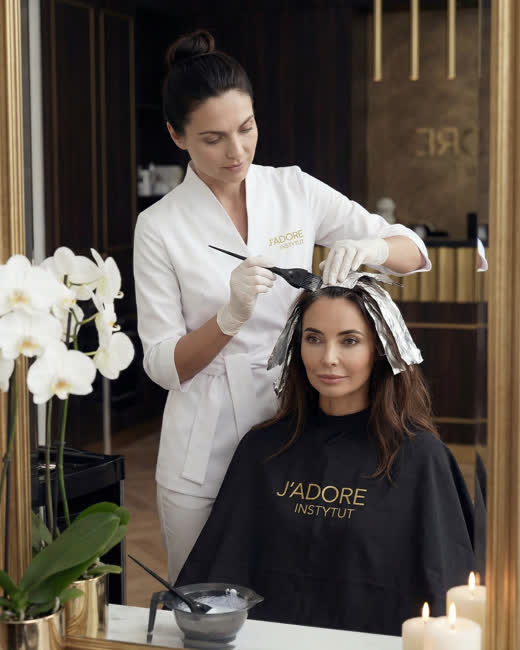
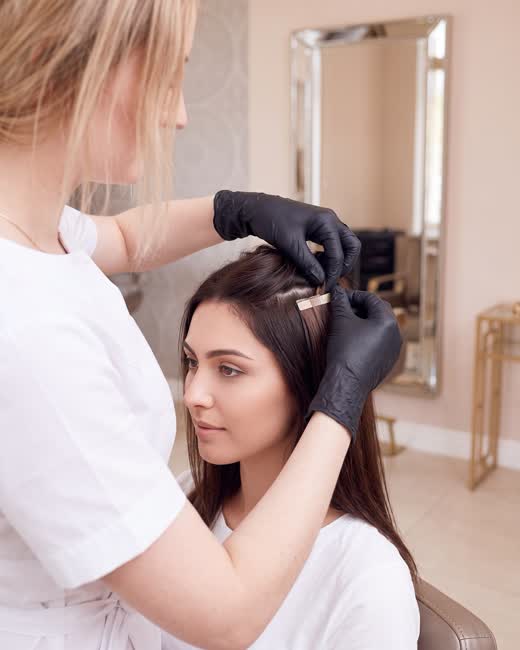
A treatment room at J'adore
HAIR EXTENSIONS & THICKENING
Thin ends, a see-through parting, a "skinny" ponytail, hair that has lost density after years of colouring and straightening — these are the most common reasons clients ask about hair thickening. Extension-based thickening is adding strands for volume and the appearance of denser hair, without significant length gain — unlike classic hair extensions, which are mainly about length.
Strands are placed strategically, where hair is thinner, keeping the natural distribution so the result looks like yours, not a "wig". One honest point to start with: this is a visual thickening of appearance — it does not stimulate the growth of your own hair. If the issue is hair loss or thinning, we first refer you to a trichology consultation (more on this below). At J'adore Instytut, this service is performed by a hair extension stylist. Below is everything worth knowing before your first visit.
1 fitting visit + touch-up every few weeks
HAIR EXTENSIONS & THICKENING
Thickening means adding extra strands so your hair looks denser and fuller — not to make it longer. The strands are usually shorter than in classic extensions and are woven in exactly where natural density is lacking: along the parting, at the crown, at the sides, or lower down to give a ponytail or wave some "body".
The skill lies in placing the strands so they can't be seen — keeping the natural direction of growth and matching your own shade. Well-done thickening doesn't give itself away, whether your hair is moving or pinned up: people see nice, dense hair, not "something attached".
Good to know: the effect doesn't come from the number of strands — it comes from where they're placed. A few strands positioned well, around the parting and at the base of the ponytail, can create a stronger impression of density than lots of extensions added without a plan. That's why the same number of strands looks completely different in the hands of a skilled stylist.
How it works
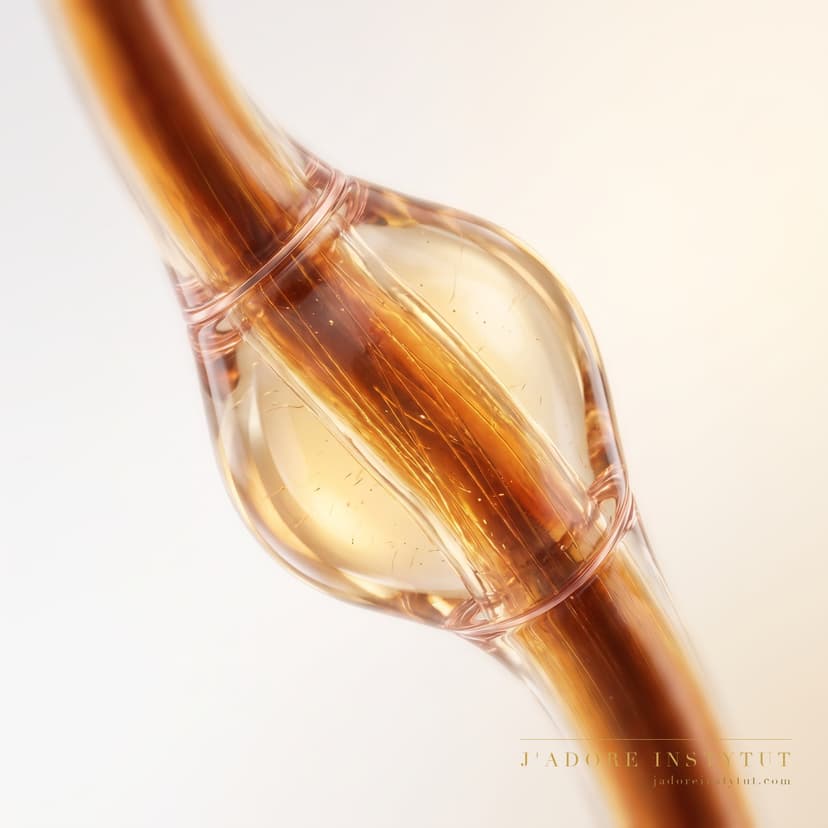
The impression of density doesn't come from the sheer number of hairs — it comes from how much scalp shows between them. Thickening works exactly on this principle: your stylist attaches extra strands close to the root, in the areas where the scalp shows through the most — along the parting, at the crown, at the base of the ponytail. The strands are shorter than in classic extensions, because their job is to fill the layer underneath, not extend the style. Your own hair sits on top and covers the attachment points, so the eye sees one dense, full mass of hair rather than individual strands.
The attachment itself — tape, a keratin bond or a micro-ring — relies on the strength of your own hair. Each attachment point grips a small section of your natural hair, and that hair carries the weight of the added strand. This is why your stylist spreads the attachment points across the whole area instead of concentrating them in one spot, and chooses their number based on hair thickness rather than the desired effect. As your hair grows, the attachment points move further down, and the lever arm acting on the root grows with them — this is exactly why a touch-up every few weeks is built into the service. For the same reason, extensions aren't fitted on weakened hair: an attachment is only as strong as the hair carrying it.
Good to know: the impression of density largely depends on the contrast between hair colour and scalp colour. That's why light, fine hair often looks denser than dark hair of similar density — the visible scalp simply stands out less against it. It's also why your stylist puts so much care into matching strand shade: a poorly matched tone shows before the attachment points do.
Ideal for
🚩 If your hair is falling out, thinning or visibly balding — extension-based thickening isn't the right first step. Extensions aren't fitted on weak or shedding hair: the extra weight at the root can overload it and make things worse. This is a trichological issue, not a styling one. What you need first is diagnosis and real strengthening — a trichology consultation, and if needed, scalp mesotherapy or scalp PRP. Only once your hair is healthy and strong is it time to talk about visual thickening.
Women's needs and men's needs
Thickening for women is the most common scenario for this service. The aim is aesthetic: adding volume and "body" where hair is naturally finer or weakened by styling — on healthy scalp and strong natural hair.
What we work with
In men, thinning hair is most often androgenic in origin (receding hairline, crown) — and this is rarely a situation for extensions. Strand thickening on men is harder to conceal and doesn't address the cause. That's why with male thinning we usually refer you to a trichologist first: a strengthening treatment, scalp mesotherapy or scalp PRP work on the actual condition of your hair, not just its appearance.
What we work with
The visit

Consultation and hair assessment
your stylist assesses density, the condition of your natural hair and your scalp, and listens to what you want. This is where we decide: thickening now, or a trichologist first.

Method and shade selection
tape-in, keratin or nano; matching colour and strand texture to your own hair.

Strategic strand placement
strands are fitted where volume is missing, keeping the natural distribution so the attachment points stay hidden.
Attachment
using the same method as with hair extensions (tape / keratin / nano), without affecting the scalp.
Cutting, blending and styling
we blend the strands into your style with cutting and styling, so the result looks cohesive.
Care instructions
how to wash, brush and sleep so the strands last as long as possible; we set a date for your touch-up.
Portfolio
A record of the work in our salons — the place where we publish treatment frames and, after photo sessions, results.
A record of results — in preparation. We publish photographs of our clients only with their consent.
Home care
Extensions last only as long as your care allows. There's one rule: look after the attachment points and the ends, but treat them more gently than your own hair — the strands aren't nourished by your own scalp, so they don't regenerate on their own.
This is the most important point: never apply oils or masks to the roots or attachment points — oil weakens tape and keratin, causing strands to slip. Condition only the ends.
Wet, tangled hair overnight is the fastest way to matting at the attachment points. Dry and gently brush before bed; a silk pillowcase and a loose plait help.
Brush from the ends upwards, holding the root, ideally with a brush designed for extensions. Gentle daily brushing prevents tangling at the attachment points.
Wash with a gentle, SLS-free shampoo, massaging the scalp with your fingers rather than scrubbing the attachment points. Leaning forward under the shower encourages tangling — wash upright instead.
Straighteners and curling irons — yes, but keep away from attachment points, especially with keratin bonds. In the sauna and pool, protect the strands (tie up, wear a cap) and rinse thoroughly after chlorine or salt water.
Don't wait until the attachment points slip too low. Regular repositioning as your hair grows is normal — it protects your hair and keeps the result looking fresh.
HAIR EXTENSIONS & THICKENING · Hair thickening
Thickening is a beauty/styling service, so "contraindications" here are natural — they usually mean "let's postpone" or "something else first", not "never".
In the stylist's words
The hardest conversations are the ones where someone really wants extensions right away, and I can see their hair can't take it. I'd rather decline and refer to a trichologist than add weight to hair that's already weakening. That's not making things difficult — it's looking after your own hair.
Hair thickening
This is the most important part of this page, because it's where misunderstandings happen most easily. Extension-based thickening gives a visual result — immediately, but on the outside of the hair. If you dream of your own hair being denser, that's a completely different path: trichology, which works on the condition of your scalp and hair follicles over time.
Visual effect — immediate
Doesn't stimulate the growth of your own hair, doesn't treat hair loss, doesn't replace diagnosis for thinning
Real regrowth — over time
No instant full result — it's a process, not a one-visit styling fix
Hair condition and quality
Doesn't add permanent volume or "extra" density — it improves the quality of what you have
Thickening works best as part of a broader hair care plan, not on its own. Depending on the condition of your hair, your stylist (and, when needed, a trichologist) will advise what to do before and after.
Order matters. If your hair needs regeneration or strengthening, we do that first. We fit thickening strands only on hair that's ready for it — that's when the result looks beautiful and stays safe.
The most common thing I hear is "I want denser hair." And I always ask — do you mean how it looks today, or your own hair long-term? If the scalp is healthy and the hair is strong, we thicken with strands and you get the result straight away. But if I see hair falling out or clearly thinning, I won't fit extensions — because I'd be adding weight exactly where it's already weak. In that case I refer you to a trichologist first. Extensions are about optics; trichology is about working on the real condition of your hair.
Attachment methods
Thickening can be done using different attachment methods — the same ones you know from extensions, here used to add volume. You don't pick a method off a menu — your stylist selects it based on the thickness and condition of your hair, how you wear it, and how long it needs to last.
Thin strands on tape, sandwiched at the root — flat, light, quick to fit and reposition.
Dla kogoFine hair and parting thickening; when comfort and easy touch-ups matter to you.
Strands bonded to hair point by point, securely and discreetly; very small, invisible attachment points.
Dla kogoStronger natural hair, and anyone wanting the most natural, long-lasting result.
Strands attached with a tiny ring, no glue and no heat — easy to reposition as hair grows.
Dla kogoAnyone preferring a method without bonding or glue, who values simple touch-ups.
Fact: Each method has its own way of holding, its own touch-up process and its own effect on hair. What we don't give here as numbers is how many strands and in what layout will give a natural result on your specific head — that's something your stylist assesses in person. "More is better" doesn't apply here.
Price list
Checking free hours…
From the magazine
Editorial pieces on how this treatment works in practice — what happens during the session, how to prepare, where the limits are and what the first days after look like.
See also
The result lastsA few months, with touch-ups as your hair growsJ’adore Instytut
Information. Hair thickening (extension-based) is a hairdressing and styling service; results and longevity depend on the method, the quality of the added strands, the condition of your natural hair, and home care, and require touch-ups as your hair grows. If you have hair loss or thinning, a trichology consultation is recommended first. The above is for informational purposes. Details and method selection are determined by the stylist during your visit.
Home care
Cosmetics matched to what your skin needs after a treatment — so the clinic effect lasts longer.
 hair regenerationOlaplexBROAD SPECTRUM CHELATING TREATMENT 370mlView in the shop(opens in a new tab)
 hair regenerationKevin MurphyYoung.Again Dry Conditioner Oil 100mlView in the shop(opens in a new tab)
 hair regenerationDSD de LuxeTravel PackView in the shop(opens in a new tab)
 hair regenerationSesdermaSESKAVEL Keratin Shampoo 200 mlView in the shop(opens in a new tab)