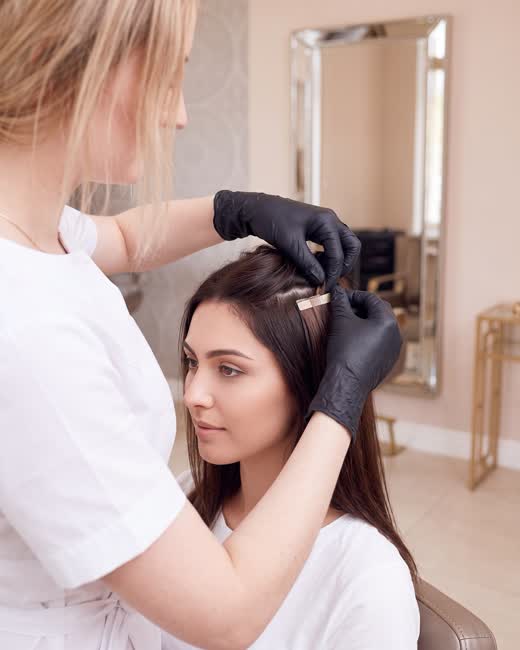
What exactly is a keratin bond?
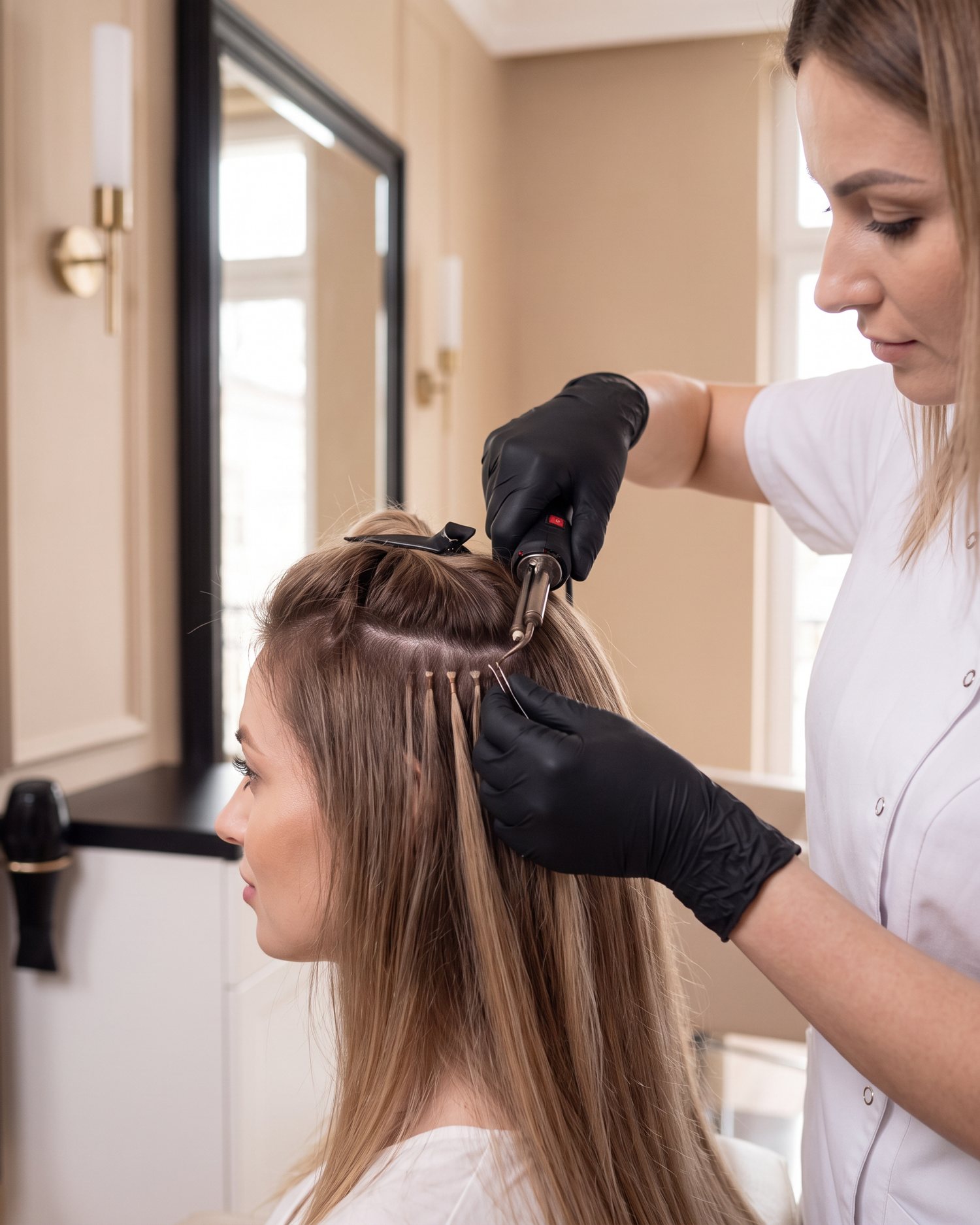
Keratin hair extensions involve attaching extension strands to your natural hair using a keratin-based bonding material — the protein that makes up every hair. The bonding material melts at a controlled temperature. It coats the join and hardens into a discreet, firm bond that is invisible in styled hair. This is one of the oldest extension techniques. It remains one of the most precise because it works strand by strand, rather than in sections.
The bonding material itself is not the problem. The problem is an application temperature that is too high, too little bonding material, placement too close to the scalp, or too many bonds on hair that is too fine. Each of these mistakes can lead to damage. Each is an application error, not a fault of the method.
Keratin bonds and other extension methods — a clear comparison
When choosing hair extensions, you choose more than length — you choose a lifestyle for the coming weeks and the level of commitment to aftercare. Every method has strengths and limitations. Here is how the three most popular options compare:
Keratin bonds
strand-by-strand precision
- Natural effect — each strand moves separately
- Long-lasting results — up to 4–6 months for many women
- Can be washed and styled like natural hair
- Precise application — as much volume can be added as needed
Tape-in extensions
quick application and removal
- Application is much faster than with keratin bonds
- Easy to reposition as hair grows out
- A good option for medium-thickness hair
- Discreet on dark hair
Clip-in extensions (temporary)
no commitment, a temporary effect
- No interference with natural hair
- Easy to apply and remove yourself
- Ideal for occasions and testing a longer length
- No visit to a hairdresser required
What really determines whether your hair stays healthy
Hairdressers' research and observations in salons indicate that damage after extensions rarely comes from the method itself. More often, it results from a combination of factors that can be assessed before the treatment.
- Your hair’s starting condition. Hair that has been repeatedly lightened, has level III porosity or is dried out by intensive styling may not be ready for the weight of extensions — this is information, not a sentence. A few weeks of repair are often enough.
- The thickness of the natural strand. The rule is simple: the bond should never be thicker than the natural strand to which it is attached. When the bonding material is too heavy for the hair, it pulls rather than protects.
- Distance from the scalp. A bond placed too close to the scalp restricts the hair’s natural movement. It also creates micro-pulling with every movement. Correct spacing is a matter of millimetres — and experience.
- The quality of the extension hair. Cheap extensions with synthetic fibres behave differently from pure Remy human hair. They have a different weight and structure, which affects the load on the join.
- Regular maintenance appointments. Bonds begin to pull at an angle as your hair grows out. Timely maintenance is not a luxury — it is a safety requirement.
What an honest consultation before hair extensions looks like
A good consultation takes longer than a minute. It does not begin with the question, “What length would you like?” It begins with an assessment of what you already have — and only then determines what is possible, when and how.
- 01
Hair assessment under magnification or in light
Strand thickness, porosity, breakage and the condition of the ends — this is the foundation. Without it, everything else is guesswork.
- 02
A discussion of your chemical treatment history
Lightening, colouring, keratin smoothing and oil treatments — each changes the hair structure and should influence the choice of method.
- 03
Choosing the bonding material and extension colour
Bonding materials differ in hardness, elasticity and application temperature. Colour is matched in daylight, not by eye — the difference between a precise match and one that is merely similar is significant.
- 04
Planning the placement map
How many bonds, in which layers, how far from the scalp and hairline — this is a plan, not improvisation.
- 05
Take-home aftercare instructions
Applying oil too close to the bond, using the wrong brush or rubbing vigorously with a towel — these are things you may unknowingly get wrong at home. A good hairdresser explains them in advance.
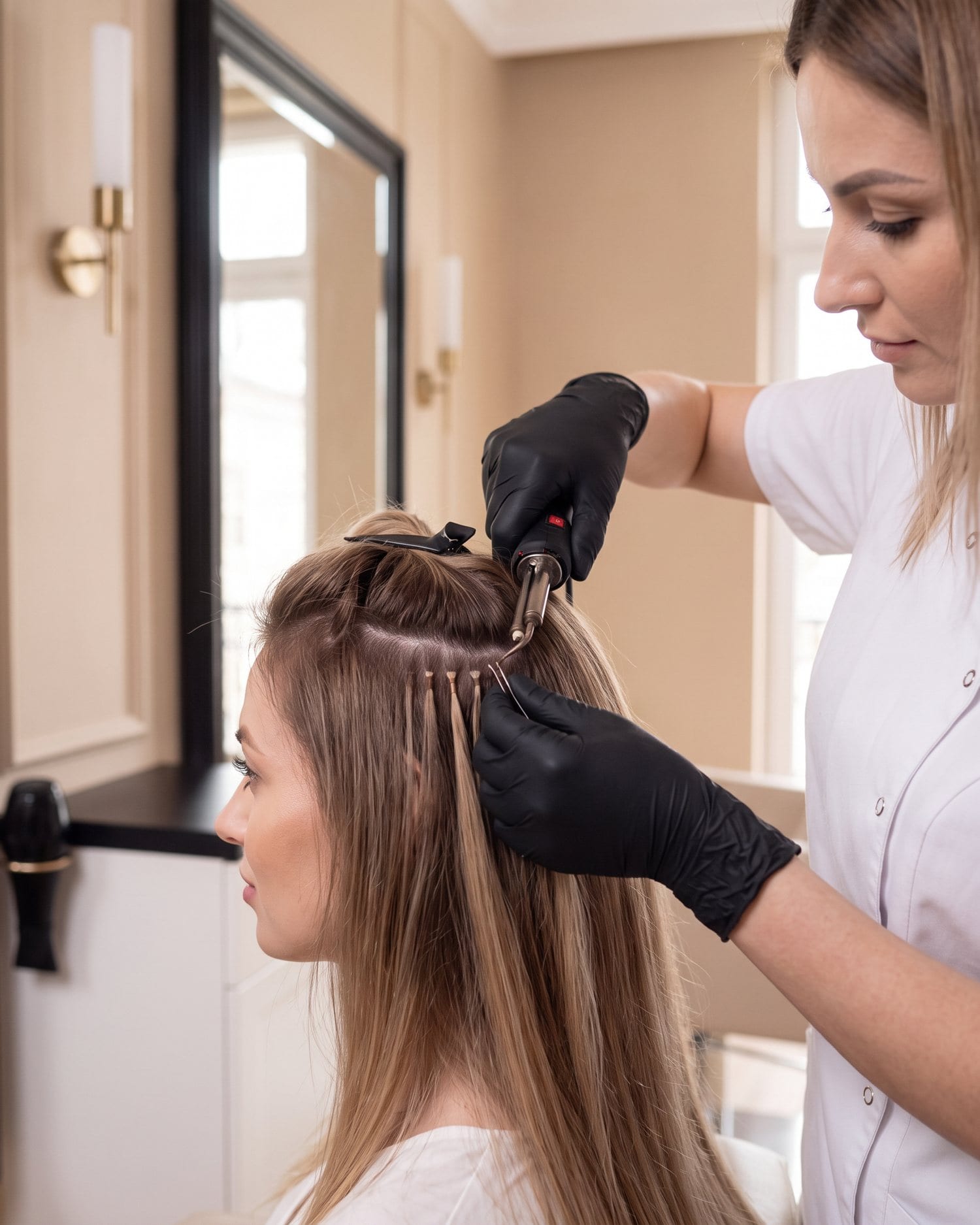
Hair care that truly matters
Most women focus on the treatment itself. Yet what happens at home over the following weeks often determines whether your hair will be in better or worse condition after the bonds are removed than it was at the start.
- A brush with soft natural bristles or a loop brush — never a standard brush that may pull out the bonds.
- Conditioners and masks without oils in the first few centimetres from the scalp — oils can soften the bond and reduce its durability.
- Gentle drying without rubbing — rubbing with a towel acts on the bond like a lever.
- Sleeping with a braid or a loose braided bun — tangling during sleep is one of the most common causes of problems between visits.
- Regular adjustments in line with your hair growth rate — the longer you wait for an adjustment, the greater the risk of tension at the regrowth.
Two questions worth asking before booking
Good selection begins before you enter the salon. These two questions often separate serious places from rushed ones:
- “Do you carry out a consultation before application, or do we apply them straight away?” — if the hairdresser offers an appointment immediately without assessing your hair, that is a sign.
- “What exact type of bonding agent do you use, and how do you handle removal?” — a professional studio has a specific answer, not simply “keratin”.
Removal is as important as application. The bonding agent should be removed with a specialist solution, not pulled out, overheated or left for you to deal with alone. Hair after well-performed extensions and properly carried out removal is often in better condition than before. For several months, it has had less contact with straighteners and the hairdryer, while the ends have been protected by the attached hair.