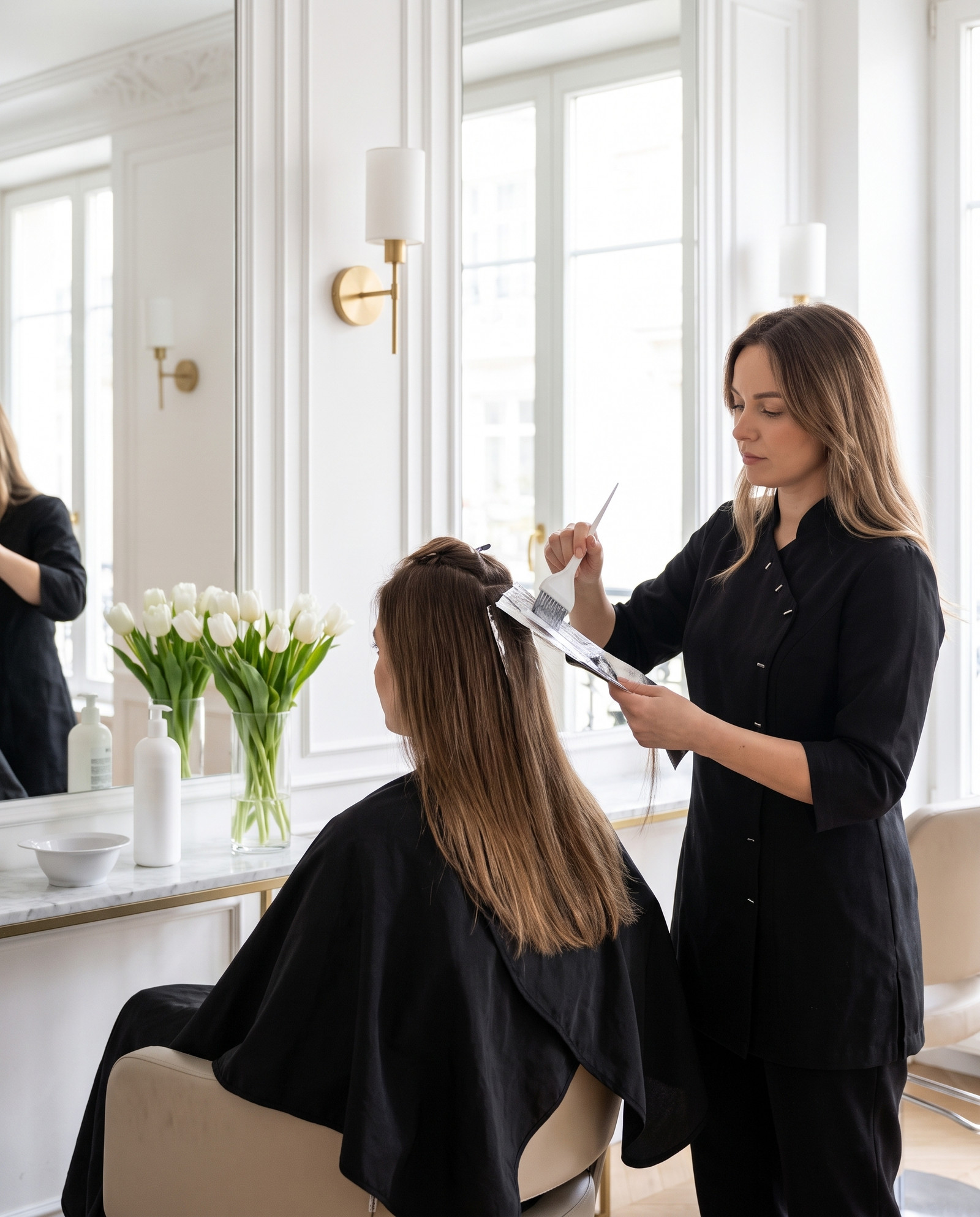
Three methods, three bonding philosophies
The simplest way to remember it: tape-in is a sheet, keratin is a point, nano is a ring. Each technology bonds with your natural hair differently. That difference determines how long the result lasts, how quickly you can make adjustments, and which hair type suits each method best.
Tape-in
layered tape bonds
- two tapes clamp a natural strand between them
- can be repositioned and reused multiple times as hair grows
- quick application — many strands at once
- a good choice for fine, delicate hair
Keratin (fusion)
heat-bonded point connections
- a strand of extensions bonded with keratin using heat
- a small, point-like bond, nearly invisible within the volume
- elegant on medium-to-thick hair
- natural fall and movement in longer styles
Nano rings
cold ring bonds
- a micro-ring clamped around the natural strand — no glue, no heat
- a particularly gentle technology — no chemicals or heat involved in bonding
- easy to adjust and reposition without chemical products
- often chosen for sensitive scalps
How to tell which method suits your hair
Before booking a specific method, it's worth asking yourself a few questions. The answers often point straight to the right direction:
- Do you have very fine, delicate hair? → tape-in can distribute weight better than keratin, but your stylist will assess strand thickness individually. Nano can also be a gentle option here.
- Do you want the least visible bond possible, especially when hair is pinned up? → keratin creates a small, point-like knot close to the root; tape-in can sometimes be felt in a tight bun.
- Do you want to avoid glue and heat during bonding itself? → nano rings are the only fully mechanical method, with no adhesives or heat involved in application.
- Do you plan to change length or colour every few months? → tape-in is the easiest to reposition; keratin and nano take a little longer to remove.
- Do you train intensively, or often swim or use a sauna? → ask your stylist about how each method holds up under high humidity and physical activity.
Every method can give a beautiful result — the question is with what hair structure, what lifestyle and what aftercare. That's why consultation isn't a formality — it's the real starting point. Your stylist assesses the thickness and density of your natural hair, the condition of your scalp and your daily habits.
Thickening and extending — not the same thing
Many people use these words interchangeably, but they describe two different goals — and sometimes two different strategies for choosing strands:
- Thickening — the priority is volume and quantity, not length. Shorter strands are often applied, colour-matched, in strategic zones (temples, crown, nape). The result can be more subtle, but very natural.
- Extending — the priority is length. Strands often reach a few to over a dozen centimetres below your natural ends.
- Both at once — the most common case. Thicker and longer — here the choice of method and number of strands matters more, because a greater mass of extensions needs a solid base.
Daily aftercare — what differs between methods
Aftercare after applying extensions is often what determines how long the result lasts and how good your hair looks between visits. Each method has slightly different rules:
- 01
Tape-in — watch out for oils
Products containing silicones and oils can weaken the adhesion of the tapes. It's worth using shampoos and conditioners designed for hair with extensions. Brush from the roots gradually, without pulling.
- 02
Keratin — go gently with heat
Keratin bonds prefer moderate temperatures. Styling with excessive heat right at the bonds can gradually weaken them. Straighteners and curling irons can be used freely along the strand, just not directly on the bond point.
- 03
Nano — no chemical restrictions in aftercare
Nano rings don't react badly to oils and silicones in products — a real comfort when using richer masks and serums. You do need to make sure the rings don't shift during vigorous brushing.
- 04
All methods — regular follow-up visits
Whatever the method, the strands move outward as your natural hair grows — book a repositioning or root touch-up every few weeks. This is key to durability and hair health.
When to pair thickening with aftercare
Extensions affect the structure of your hair, so it's worth keeping your natural hair in the best condition possible. A well-planned "package" combines a thickening method with strengthening treatments:
Thickening + hair Botox
Hair Botox (keratin reconstruction) smooths and repairs the hair structure. Used before or after applying strands, it improves the look and makes aftercare easier.
Thickening + keratin treatment
A dedicated keratin treatment rebuilds the hair core from within — reducing brittleness and improving elasticity, which leads to longer-lasting results.
Thickening + scalp treatments
Healthy scalp is the foundation for every method. If you tend towards oiliness or irritation, it's worth balancing sebum production and follicle condition before applying strands.