

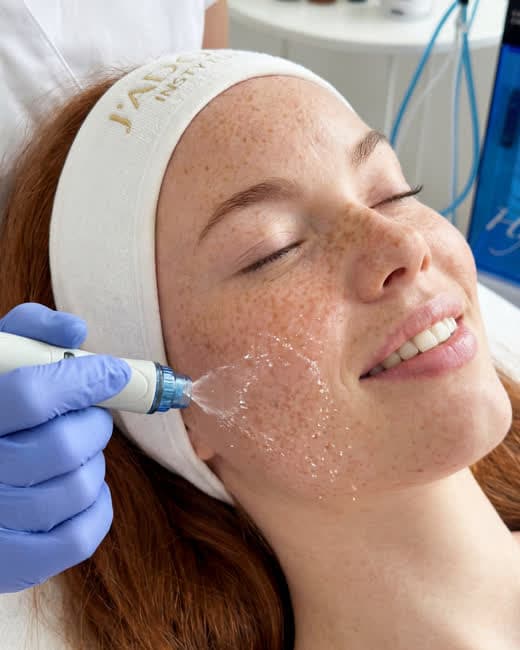
Why is winter half-term the ideal time for treatments?
This isn't about whims — it's about logistics. Most beauty treatments, even the gentlest ones, need a few days of recovery. Skin can look red after cleansing. Brows need 24 hours without water after lamination. After a peel, avoid makeup for 1–2 days.
During term time, that's a problem. Nobody wants to walk into school with a red face and answer "what happened to you?" During the half-term break? Zero pressure. You stay home, your skin heals, and you binge-watch a series. It's the perfect treatment window.
There's an added bonus: stress lowers skin resilience. Cortisol — the stress hormone — stimulates sebum production, worsens inflammation and slows healing. During the break, cortisol levels naturally drop. Your skin starts in better condition and recovers faster after treatment.
5 treatments a teenager CAN have
1. Facial cleansing — the foundation
What it is: A professional treatment that deep-cleanses pores of blackheads, excess sebum and dead skin. It usually includes make-up removal, an enzyme or cavitation peel, extraction (manual removal of blackheads), ozone therapy, a soothing mask and moisturiser.
Why it's worth it: Teenage skin produces more sebum — androgens, the hormones of puberty, are to blame. Sebum plus dead skin cells create open blackheads and closed whiteheads under the skin. Squeezing spots at home with dirty hands is a quick route to scarring and inflammation.
A professional cosmetologist works in sterile conditions, with the right tools and the knowledge to tell which blackheads can be removed and which are best left alone.
Recovery: 1–2 days of redness, sometimes minor irritation at extraction sites. After 3 days — clear, smooth skin.
How often: Every 4–6 weeks for problem skin. Once a quarter for normal skin.
2. Enzyme peel / light chemical peel
What it is: Gentle exfoliation of dead skin using enzymes — papain from papaya, bromelain from pineapple — or low concentrations of acids such as mandelic or lactic acid. The enzyme "digests" dead skin cells without disturbing the living layers underneath.
Why it's worth it: It evens out skin tone, brightens post-acne hyperpigmentation and smooths skin texture. Pores look smaller, and skin appears brighter and more radiant.
What matters: This is NOT a TCA or phenol peel. Enzyme and light acid peels are safe for teenage skin because they work superficially — on the epidermis, not the dermis.
Recovery: Minimal. Slight redness for a few hours, possibly light flaking for 1–2 days. No real downtime.
3. Brow lamination
What it is: A treatment that shapes your natural brows using products that soften the hairs and set them in the direction you want. The result: fuller, more "brushed-up" brows — like a good brow gel, but lasting 4–6 weeks.
Why it's worth it: Because brows frame the face. Well-shaped brows can change your expression more than makeup does. Lamination doesn't change your shape — it enhances what you already have. No needles, no permanent dye, no effect that can't be undone.
Recovery: 24 hours without wetting your brows — no swimming, sauna or heavy sweating. After that, life goes on as normal.
Note: If you'd like to combine this with henna brow tinting, mention it when booking — your cosmetologist can do both in a single visit.
4. Wax hair removal
What it is: Removal of unwanted hair — most often on the upper lip, brows, legs or underarms — using warm or hard wax.
Why it's worth doing over the break: Healing takes 1–2 days — redness, mild sensitivity. During the break, you can let your skin settle before heading back to school. The results are still visible after 2–3 weeks — hair grows back slower and finer than after shaving.
Recovery: 24–48 hours of redness. Avoid sun exposure and swimming pools for 24–48 hours.
5. LED therapy — light for acne
What it is: Exposing the skin to LED light at specific wavelengths. Blue light (415 nm) kills the Cutibacterium acnes bacteria responsible for inflammatory acne. Red light (633 nm) reduces inflammation and speeds up healing.
Why it's worth it: No pain, no downtime, no side effects. You can have the treatment and be back to normal 15 minutes later. Clinical studies, including one in the Journal of Clinical and Aesthetic Dermatology, confirm a 30–50% reduction in acne lesions after a series of 6–8 sessions.
Note: LED is not a laser. It doesn't penetrate the skin, doesn't cause burns and needs no healing period. It's completely safe for teenage skin.
Recovery: None. Genuinely — zero. You leave the salon and carry on as normal.
What a teenager should NOT do
Not everything you see on TikTok is right for you. It's not that you're "too young" — it's that your skin is different from a 35-year-old's.
Laser — too early
Laser treatments — fractional, IPL, pigmentation removal — need stable skin. Teenage skin is still developing. It produces melanin unpredictably and reacts to laser differently than adult skin does. The risk of paradoxical hyperpigmentation, where skin darkens instead of lightening, is higher. The only possible exception is laser for acne — and that's a decision for a dermatologist, not a TikTok influencer.
Botox — no
Botulinum toxin blocks muscle activity. In a teenager, the facial muscles work exactly as they should — there are no wrinkles to "smooth out". "Preventive Botox" for an 18-year-old is a marketing myth, not a medical necessity.
Aggressive chemical peels — no
A 25–30% TCA peel, a phenol peel, a deep retinol peel — these are treatments for mature skin with specific concerns such as sun damage, scarring or deep wrinkles. Teenage skin is thinner, more reactive and heals differently. An aggressive peel can damage the skin barrier and create problems that weren't there before.
Fillers and biostimulators — absolutely not
Hyaluronic acid, calcium hydroxyapatite, polynucleotides — these substances correct volume loss that comes with age. There's nothing to correct in a teenager. If anyone offers you lip filler at 15 — walk away. That's not a beauty salon. That's a red flag.
"Mum, I want to have some treatments" — how to talk about it at home
We know this conversation can be difficult. For many parents, "beauty treatments" bring to mind Botox, silicone and reality TV. In reality, facial cleansing for a teenager falls into the same category as a trip to the dentist — prevention and hygiene.
Arguments that actually work:
"This isn't about looking better — it's about skin health." Acne isn't a cosmetic issue — it's a dermatological condition that, left untreated, leaves scars for years. Professional cleansing is treatment, not vanity.
"I can't do this safely myself." Squeezing blackheads with dirty hands in the bathroom risks infection, scarring and worsening skin condition. A cosmetologist works in sterile conditions, with proper anatomical knowledge.
"The break is the perfect time." No school, no stress, time to recover. A logistical argument, not an emotional one.
A parent at the consultation — yes!
At J'ADORE INSTYTUT, we encourage a parent to join the first consultation. Not to "keep an eye on things" — but to:
- Hear directly from the specialist what the skin actually needs — and what it doesn't
- Ask questions about safety, ingredients and contraindications
- Make the decision together — no pressure, no manipulation
- Be part of the process, not an obstacle
A good cosmetologist will never suggest a treatment a teenager doesn't need. If you come in for a consultation and hear "your skin looks fine, home care is enough" — that's the best recommendation you could get.
A half-term plan: a realistic schedule
Week 1:
- Day 1–2: Consultation + facial cleansing
- Day 3–4: Recovery — home care as recommended by your cosmetologist
- Day 5: Brow lamination (optionally with henna)
- Day 6–7: Back to normal — your brows settle into shape
Week 2:
- Day 8: Enzyme peel — if recommended by your cosmetologist
- Day 9: LED therapy (session 1)
- Day 10–12: Back to normal, home care
- Day 13: LED therapy (session 2)
- Day 14: Ready for the new term!
Home care — what to do between treatments
Treatments are the foundation, but home routine keeps the results going. For teenage skin, 4 products are enough:
- Cleansing gel — gentle, pH 5.5, no SLS. Morning and evening.
- Toner or serum with niacinamide (vitamin B3) — regulates sebum, strengthens the skin barrier and reduces redness. An ideal ingredient for teenagers.
- Moisturiser — light, non-comedogenic. Even oily skin needs hydration — oily doesn't mean hydrated!
- SPF 30–50 — every day. Yes, in winter too. Yes, even when it's cloudy.
What not to buy: retinol (too early), high-concentration glycolic acid (too aggressive), or "anti-ageing" products (you don't need them). And please — skip the peel-off activated charcoal masks. They damage the skin barrier and cause micro-tears.
A final word
Looking after your skin as a teenager isn't a whim or vanity. It's an investment in yourself — in health, in confidence, in skin that will thank you in 10 years' time. The half-term break is the ideal time to start: you have time, you have calm, and you have a window to recover.
If you're not sure where to start, book a consultation at J'ADORE INSTYTUT. Our specialists work with teenage skin every day and know exactly what your skin needs — and what it absolutely doesn't. No judgement, no pressure, no unnecessary treatments. Just solid knowledge and a plan built around you.
Book your half-term appointment — before the calendar fills up.


