
Why the jawline disappears — and what to do about it
Between the skin and the bone sit several layers. One of them — the fascia, known as SMAS — is the one that sags with age and pulls the skin down with it. This creates the classic "heavy" face: blurred contours, sagging neck skin, a chin that fades into the neck. Surgical facelifts address this layer with a knife. HIFU addresses it with ultrasound — no incisions required.
A focused ultrasound beam targets a precisely chosen depth, heating tissue to a temperature at which collagen contracts immediately, and new collagen forms over the following months. The result? Skin lifts, contours return, the jawline becomes sharper. For many men, the difference is visible within a few weeks and continues to build over the following months.
HIFU in men: different starting conditions
Men's skin is thicker, better supplied with blood, and has more baseline collagen than women's skin. That's good news — but it also means the treatment parameters need to match your anatomy, not a "standard protocol". A clinic experienced with male patients knows this isn't simply the same treatment shifted slightly — it's a different treatment altogether.
Male skin and tissue
why the settings differ
- thicker skin — requires a different approach to depth
- stronger facial ligaments — a different starting point for lifting
- more baseline collagen — different thermal response thresholds
- facial hair may require protocol adjustments
The goal for men
what we're aiming for
- a defined, sharp jawline
- tighter skin on the neck and chin
- facial contour without "heaviness"
- a natural, not "done" result
What the treatment involves — zero downtime built into the plan
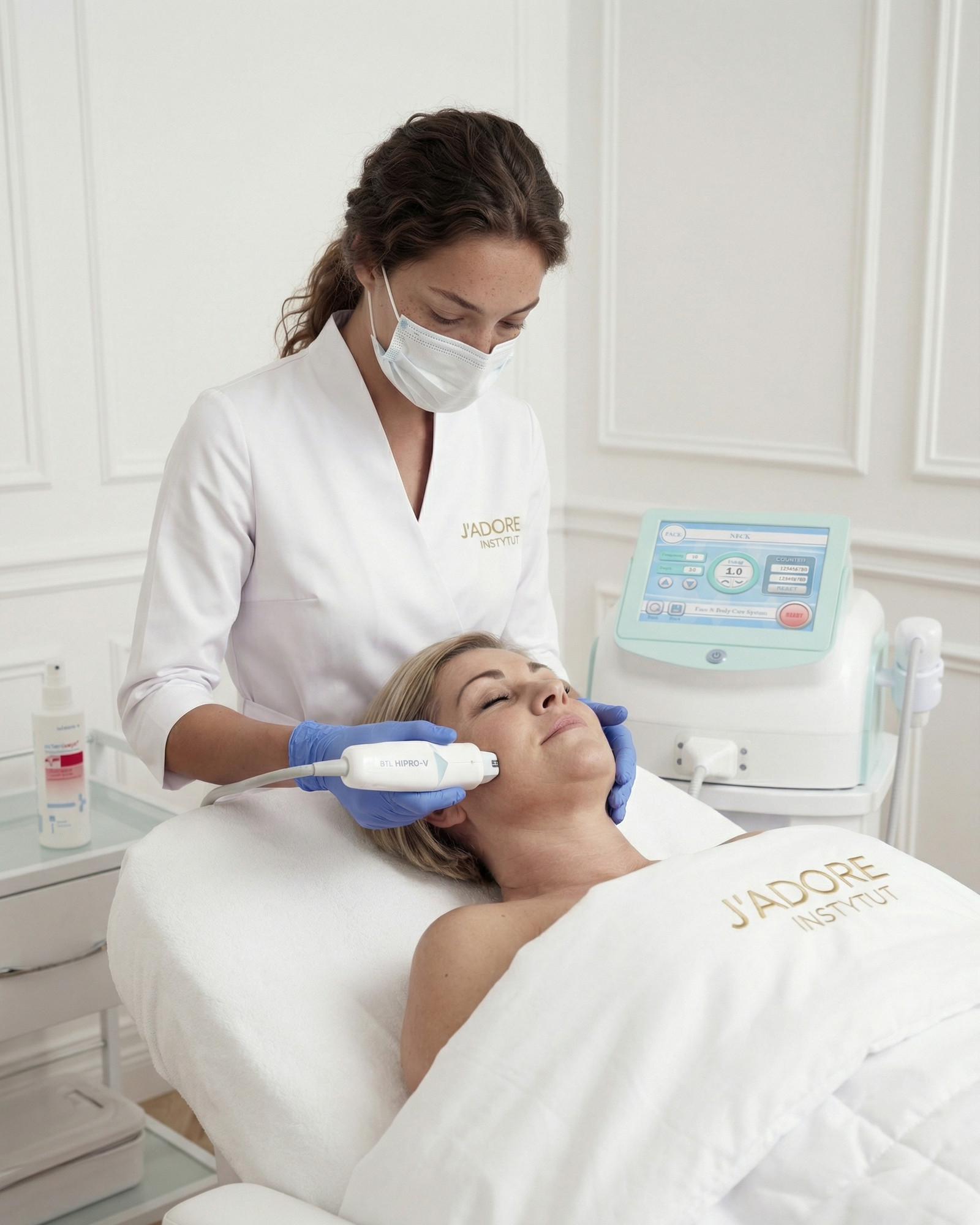
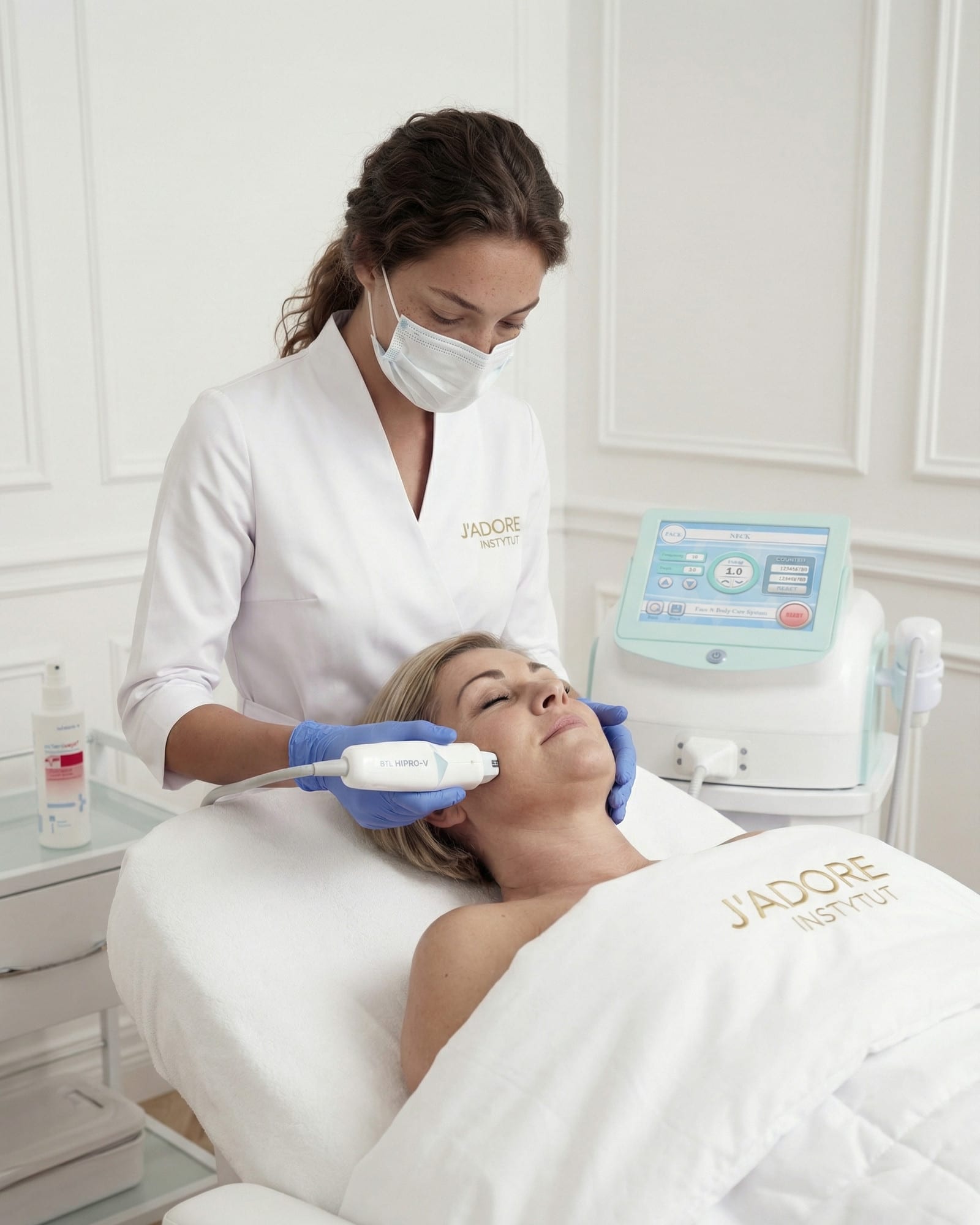
Gel is applied to the face, and the device head is moved along marked lines. You'll feel warmth and light tingling — a normal response to energy pulses working deep within the tissue. Discomfort levels vary from person to person; many find it acceptable without additional anaesthetic, while others prefer a topical numbing gel. Depending on the area covered, the treatment takes anywhere from several dozen minutes to over an hour.
- 01
Consultation
We assess your skin, tissue and goals. We confirm eligibility and agree the treatment area (face, neck, jawline).
- 02
Treatment
Gel is applied to the skin, and the device head moves along marked paths. You'll feel pulses of warmth — that's the ultrasound working within the tissue.
- 03
Immediately after
Mild redness or sensitivity may occur — this usually fades within a few hours. You can go about your day normally, with no visible signs.
- 04
Weeks 1–4
Skin starts to respond. Many men notice first results after 4–6 weeks — firmer skin, a sharper contour.
- 05
Months 2–6
Full results build as new collagen forms. Best results are visible after 3–6 months.
After the treatment, you can go straight back to a meeting, the office, or the gym — there's no recovery period. The only advice for the first 24 hours is to avoid very hot baths and intense exercise. Otherwise, it's a normal day.
What HIFU can and can't do — no sugar-coating
HIFU is effective for skin laxity and sagging contours — the jawline, neck, cheeks. That's its main strength. It isn't designed to remove deep static wrinkles or add volume (that's the role of fillers). Nor does it replace surgery in cases of very advanced tissue sagging.
- Yes: tighter skin on the neck and jawline — often a marked improvement
- Yes: facial contour — the outline becomes sharper for many people
- Yes: cheek skin — less "heavy", more lifted
- Yes: prevention — in younger men, it slows the rate of sagging
- No: filling wrinkles or folds (that's the role of hyaluronic acid)
- No: fat reduction — other technologies handle that
- No: replacing surgical facelifts in very advanced cases
HIFU versus other options — where it fits
Men often ask whether HIFU is a "lift without a scalpel" — and the answer is both yes and no. As a simplification of the goal, it's accurate. But the mechanism and scale of the effect differ. Here's how HIFU compares with other methods aiming for a similar result:
HIFU
ultrasound lift
- works at the depth of the fascia (SMAS)
- zero downtime — you go about your day normally
- effect builds over months
- natural result, no scars
Surgical facelift
facial and neck surgery
- mechanical repositioning of tissue
- the strongest, most lasting effect
- can address very advanced changes
For most men over 40 who don't want surgery or visible side effects, HIFU is a sensible middle ground — a clear result without the risk or the downtime. It's not a compromise for the sake of it. It's simply a different tool for a different scale of problem.
Combining with other treatments — when it's worth it
HIFU does its best work on tightening and contour. But the face ages in several ways at once — losing not just firmness, but also volume and skin quality. That's why many men combine HIFU with other treatments that address what HIFU doesn't.
Botulinum toxin (brotox)
HIFU tightens; Botox relaxes the expression muscles. Together, they give a calmer, more rested expression and a sharper outline — each doing a different job.
Facial mesotherapy
HIFU works deep; mesotherapy works at the skin's surface. Combining the two can speed up skin renewal and reinforce the tightening effect.
Laser therapy / radiofrequency
Technologies that strengthen the skin from the outside, complementing the lift from within. A specialist always sets the schedule — treatments can't always be done at the same time.