Why beard growth can be uneven
Before we get to the solution, it helps to understand where the problem comes from — it affects which technique suits you. Gaps in beard growth have several different causes, and not all of them are genetic:
- Genetics and skin type. In many men, hair follicles in specific areas of the face simply don't produce visible growth. This comes down to the distribution and activity of hair follicles — no diet or supplement changes that.
- Scars. Any scar — from surgery, an accident, or acne — destroys the follicles in the affected area. Hair won't grow back on scar tissue. It never has, and it never will. This is one of the most common causes of an asymmetrical moustache or beard line.
- Alopecia areata. This autoimmune condition can affect facial hair just as effectively as scalp hair. It causes characteristic round or oval hairless "islands" within the beard.
- Irregular growth lines. Hair grows, but its edge is uneven — thicker on one side, sparser on the other. This asymmetry makes it hard to shape a defined contour.
Each of these cases looks slightly different to a specialist, and each calls for a slightly different approach. The common thread: a transplant isn't the only option.
What is beard micropigmentation?
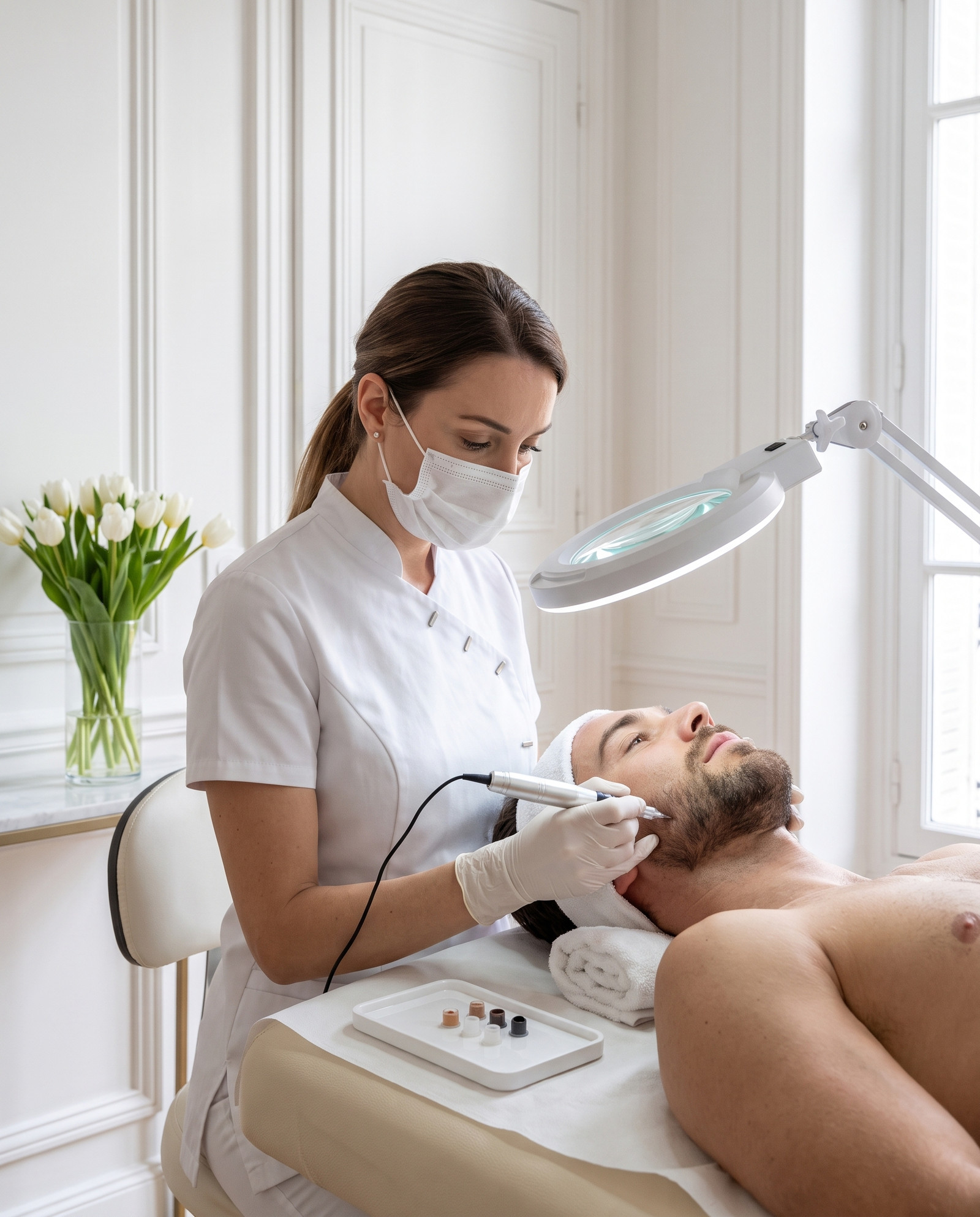
Beard PMU (permanent make-up) is a technique that deposits pigment into the dermis using a precise needle. Unlike a tattoo, the pigment is formulated differently, the depth is shallower, and the aesthetic goal is entirely different. The aim is to recreate the natural look of individual beard hairs — their colour, thickness, growth direction and distribution across a given area of the face.
The technique is sometimes called beard microblading (a term borrowed from brow treatments) or hair stroke PMU — because it works stroke by stroke, hair by hair. The specialist works literally one hair at a time, matching the direction of each stroke to your natural growth pattern. The result is a beard that looks fuller and more even. Your existing hair camouflages the strokes, so there's no visible line between natural and drawn.
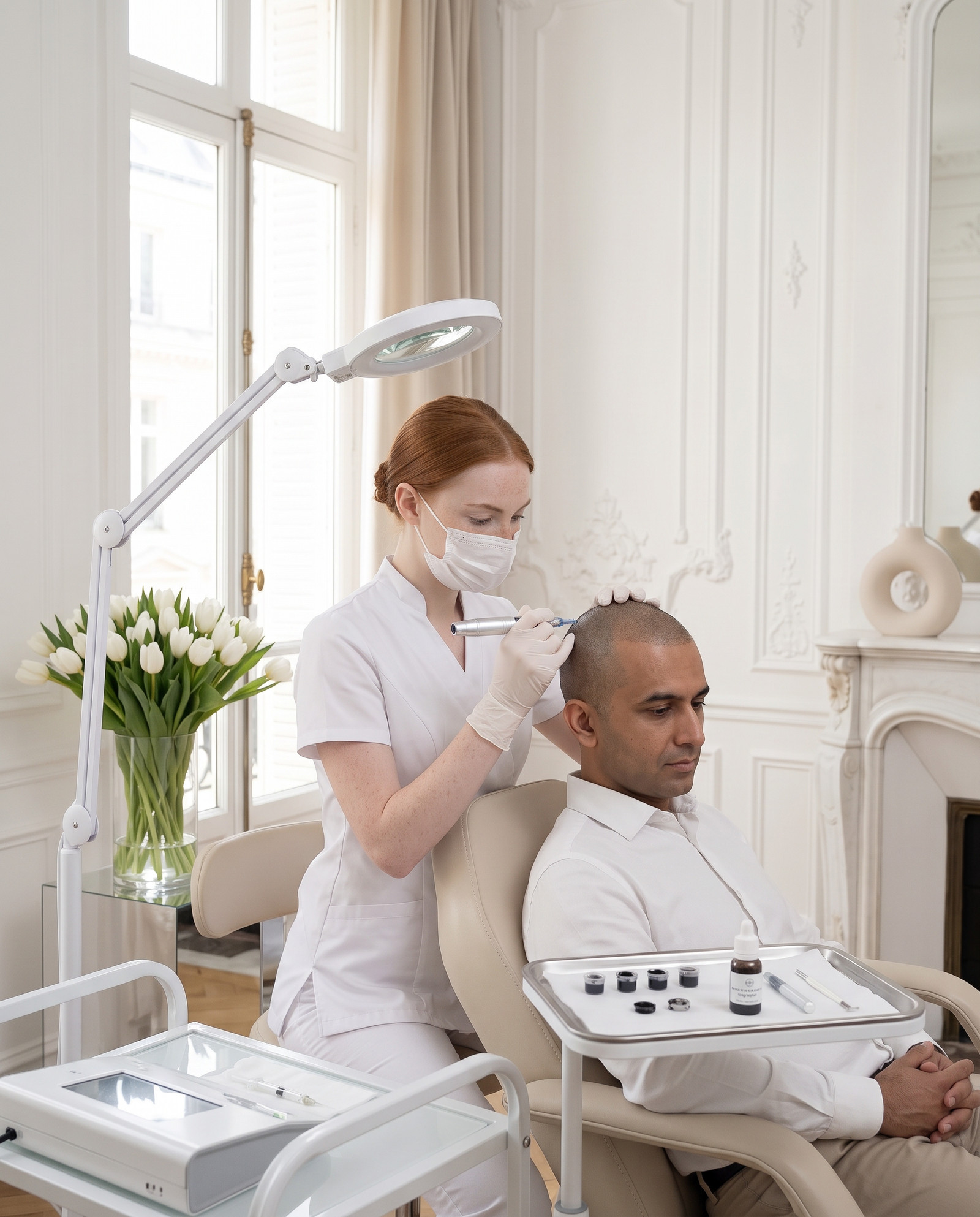
It's also worth knowing that beard micropigmentation and scalp micropigmentation (SMP) are related but distinct techniques. SMP mimics the cross-section of shaved hair follicles on the scalp — hence different pigment dots and depth. Beard PMU mimics individual hairs — hence strokes, not dots. The two techniques aren't interchangeable.
Beard PMU versus a transplant — what to choose, and when
This is the question most men ask straight away. The answer depends on several factors — there's no single right answer for everyone.
Beard PMU
Ideal for
- aesthetic gaps — evening out density, defining the contour line
- scars and areas without follicles (pigment works on scar tissue)
- no surgery, no healing period — virtually zero downtime
- visible results straight away, lasting several years
- correcting an irregular beard edge
Hair transplant (FUE/FUT)
Ideal for
- restoring growth completely — in areas with no facial hair at all
- a permanent biological result (follicles keep growing after transplant)
- a large area to cover (the whole chin, the sides)
In practice, many men combine both methods: PMU as a fast, immediate visual solution — and a transplant later, if they decide on a permanent biological change. The two aren't mutually exclusive.
What does the treatment involve? Step by step
For men who've never set foot in a beauty salon before, here's what actually happens — no sugar-coating.
- 01
Consultation and design
Our specialist assesses your natural growth, identifies the areas to fill and designs the contour of your beard or moustache. We choose a pigment colour to match your natural hair tone and skin colour. Nothing gets drawn without agreeing exactly where and how first.
- 02
Skin preparation
We cleanse the skin, then apply a numbing cream. The anaesthetic works locally on the skin — most men describe the sensation as mild discomfort or a light scratching, not pain.
- 03
Pigmentation — hair by hair
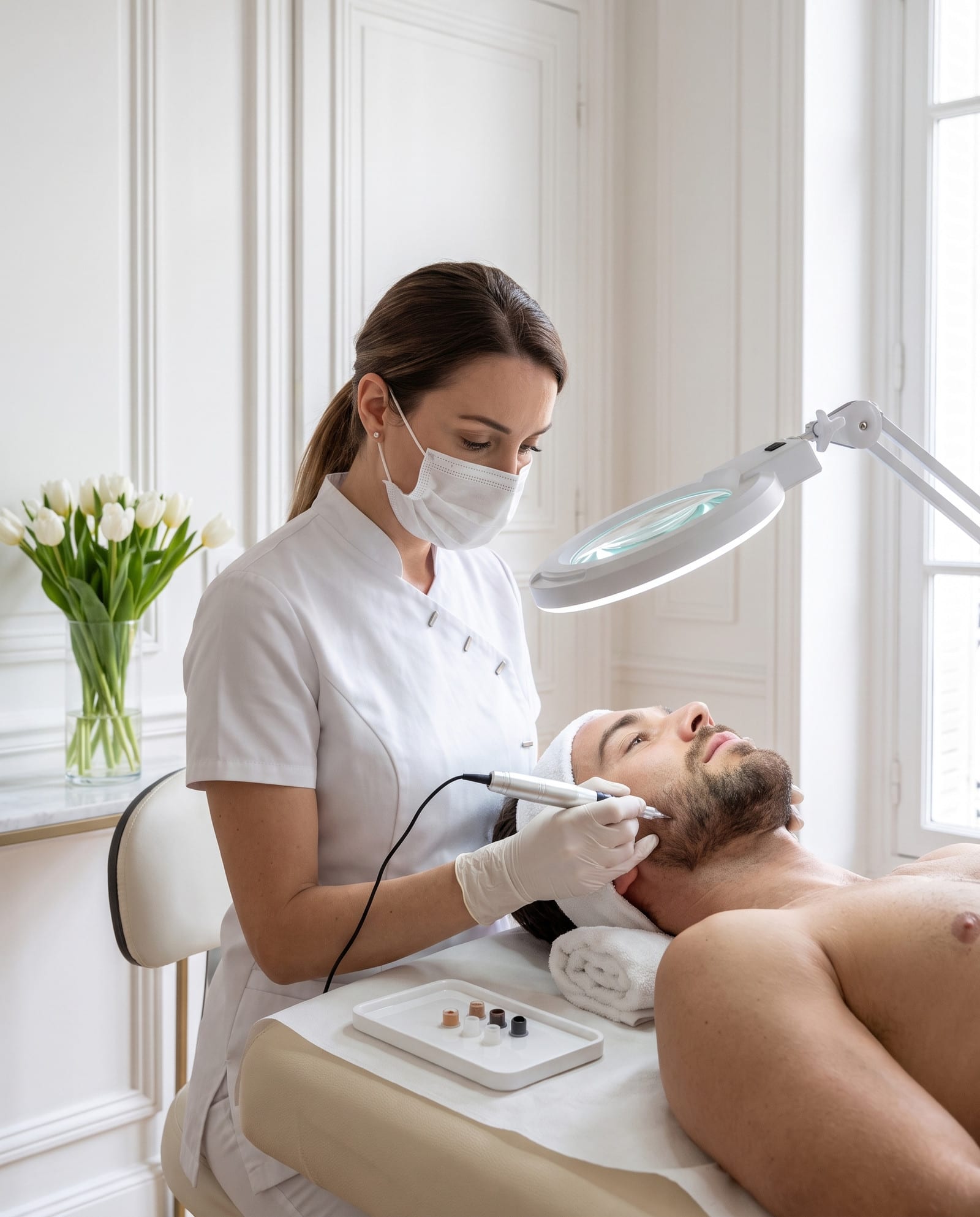
Our specialist works precisely with a needle over the gaps, drawing strokes that follow the direction of your natural hair growth. Different areas of the face — beard, moustache, cheeks — can be done in one session or split across several, depending on the scope of work.
- 04
Healing and first results
Straight after the treatment, the skin looks slightly reddened and the pigment appears more intense than it will once healed. For a few days, avoid shaving with a sharp razor over the pigmented area, and protect the skin from water and sun. Over the following weeks, the colour settles and may lighten slightly.
- 05
Touch-up after 4–6 weeks
A touch-up is standard practice. This session fills in any spots where the pigment absorbed unevenly or faded faster. The final result only shows after this touch-up. Further refresh sessions, every few years, maintain the result.
What beard PMU can achieve — and what we don't promise
Honesty matters here, because results vary depending on your starting skin condition, the density of your natural growth, and how precisely the pigment was matched.
- Optical density balancing — for many men, the result looks very natural after just the first session; gaps disappear into the surrounding growth.
- A sharper beard and moustache contour — the line becomes more even and defined, giving your beard a "groomed" look even without trimming.
- Scar camouflage — pigment can significantly disguise scars within the beard area; deep or wide scars may need several sessions.
- Results that last several years — beard PMU is long-lasting, but not permanent. The pigment gradually fades, and you can refresh it every few years.
What PMU won't do: it won't trigger new hair growth, change skin texture, or remove deep scars. If an area has no natural growth at all, the pigment alone will look more like a "treatment" — this needs assessing before the session, not after.
Combine with — what's worth adding
Beard PMU pairs well with other treatments — both those for facial skin and those focused on hair. It helps to know what makes sense, and in what order.
Scalp mesotherapy
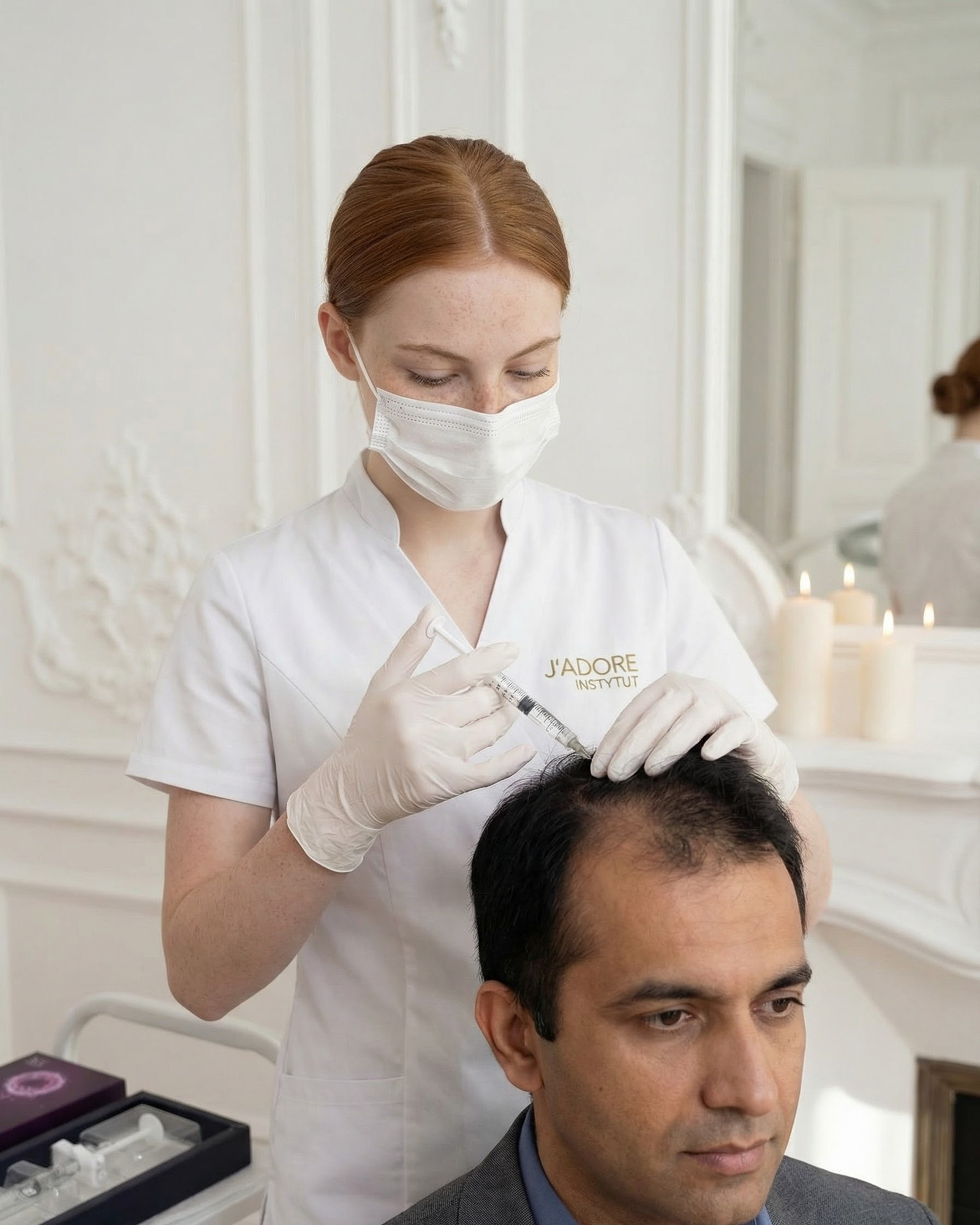
If you have gaps in your beard and thinning hair on your scalp, scalp mesotherapy can strengthen active follicles. Facial hair and scalp hair are treated separately, but if you have both concerns, it's worth planning them alongside each other. PMU and mesotherapy don't interfere with one another.
Facial cleansing and peels
Regular cleansing and gentle peels keep the skin beneath your beard in good condition, which helps the PMU pigment last longer. We recommend these after healing is complete, not right before or during the treatment.
Facial microneedling
Microneedling improves skin texture and can help revitalise scarred areas, which makes later touch-up pigmentation easier. It should be done at least a few weeks before your PMU session, or after healing is complete.
SMP (scalp micropigmentation)
If you're dealing with both beard gaps and scalp hair loss, beard PMU and SMP are related techniques that can be planned with the same specialist. Separate sessions, separate healing, but a consistent overall look.
Questions we're always asked
Does it hurt? With local anaesthetic, most men describe the treatment as tolerable. Discomfort depends on skin sensitivity and the area — the upper lip and jawline tend to be more sensitive than the cheeks. Overall, this isn't a treatment that needs general anaesthesia or a day off to recover.
Will people notice? Straight after the treatment, yes — the skin is reddened and the pigment more intense. After a few days of healing and the touch-up, most men find the result practically invisible as an intervention. People see a beard, not a treatment.
How long do the results last? The pigment fades gradually over several years — faster with heavy sun exposure, slower with proper care and SPF on the face. A touch-up every few years maintains the result. It doesn't disappear suddenly — it fades evenly.