Why you're losing hair — the mechanism, not folklore
Androgenetic alopecia (AGA) is the most common cause of hair loss in men. No, you can't blame it on hats, hair gel or stress — though stress does play a part.
The mechanism unfolds in four steps:
- The enzyme 5-alpha-reductase converts testosterone into dihydrotestosterone (DHT).
- DHT binds to androgen receptors in the follicles on your crown and temples.
- Bound DHT miniaturises the follicles. With each growth cycle, the hair grows thinner, the growth phase shortens, and shedding speeds up.
- After a dozen or so cycles, the follicles disappear completely. No therapy can bring them back.
Factors that can speed up hair loss:
- Stress — telogen effluvium (excessive shedding during the resting phase) can compound AGA.
- Nutritional deficiencies — iron, zinc, biotin, vitamin D.
- Smoking — reduces microcirculation in the scalp.
- Excessive styling — traction alopecia from tight hairstyles is no myth.
The Norwood scale — where you stand, and why it matters
The Norwood-Hamilton scale is a 7-stage classification system for male pattern baldness. Where you sit on this scale determines which treatment options are realistic for you.
- Norwood I — no visible recession of the hairline. Time for prevention.
- Norwood II — slight recession at the temples. The first warning signs.
- Norwood III — clear recession, sometimes thinning at the crown. This is where real intervention begins.
- Norwood IV — significant hair loss at the crown and temples, with a band of hair preserved in the middle.
- Norwood V — the balding areas merge, and the remaining band of hair is thin.
- Norwood VI — only a narrow strip of hair remains at the back and sides.
- Norwood VII — the most advanced form — hair remains only at the back and low on the sides.
PRP — your own blood as a treatment for hair loss
PRP (platelet-rich plasma) is drawn from your own blood. It's been used in medicine since the 1990s — the procedure is simple and well documented.
How the treatment works:
- We draw a small amount of your blood, as with a standard blood test.
- The blood is spun in a centrifuge to separate out the platelet-rich fraction.
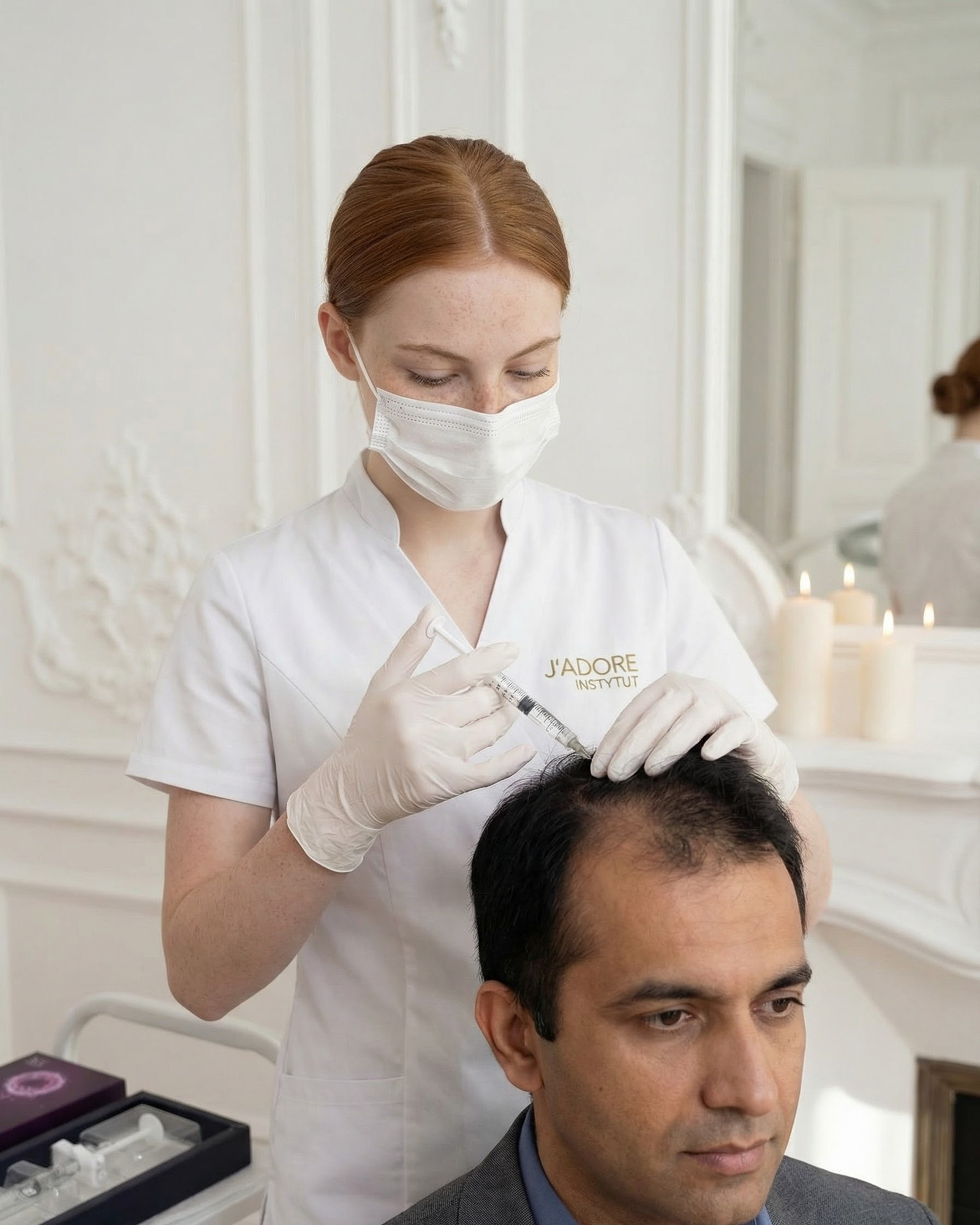
- We inject the concentrated PRP — roughly 3–5 times more platelets than in normal blood — into the scalp, targeting thinning areas.
The platelets release growth factors — signalling proteins that tell cells to grow, divide and repair. The key growth factors in PRP include PDGF (stimulates division of the hair papilla cells), VEGF (improves blood supply to the follicles) and EGF (supports regeneration of the follicle epithelium).
Hair mesotherapy — a cocktail delivered straight to the root
Scalp mesotherapy delivers a series of micro-injections containing active ingredients directly around the hair follicles. It isn't an alternative to PRP — more a complement, or an option for those who prefer a different mechanism of action.
A standard mesotherapy cocktail for hair may include:
- Biotin (vitamin B7) — a cofactor for keratin.
- Zinc — may help regulate the enzyme that produces DHT.
- Dexpanthenol (pro-vitamin B5) — strengthens the hair shaft and improves hydration.
- Hyaluronic acid — hydrates the scalp and improves microcirculation.
- Copper peptides — may stimulate angiogenesis (the formation of new blood vessels).
- Minoxidil (optional) — dilates blood vessels and may extend the hair's growth phase.
Pharmacology — the tablet and the solution that actually work
Two medications have proven efficacy for male pattern baldness. They're worth knowing, because they often form the foundation on which a treatment protocol is built.

FUE transplants — when it's the only option
FUE (Follicular Unit Extraction) is the gold standard in hair transplantation. It involves extracting individual follicular units from a donor area — the back of the head, where DHT has no effect — and implanting them into balding areas.
When a transplant is worth considering:
- Norwood V and above — follicles at the crown are dead, and no therapy can revive them.
- Norwood III–IV with an insufficient response to PRP or mesotherapy — after a year of treatment without satisfactory results.
- Stable hair loss — a transplant makes sense once your hair loss has stabilised. Otherwise, there's a risk of further loss around the transplanted hair.
Realistic expectations — stabilisation is a success
The most important thing to understand: with androgenetic alopecia, stabilisation is a success. Stopping further hair loss is already a win.
Regrowth is possible, but limited. PRP and mesotherapy can thicken miniaturised hairs in many patients and bring them back to visibility. They cannot revive dead follicles. That's why time is the most valuable resource — every month of delay means more follicles that may pass the point of no return.
At J'ADORE INSTYTUT, we offer PRP for hair and scalp mesotherapy — the two most effective non-invasive methods for tackling androgenetic alopecia. We start with trichoscopy, which shows the real condition of your follicles, not guesswork. From there, we build an individual treatment protocol.