First, distinguish a short stimulus from a warning signal
Removing a hair from the follicle can cause a pinch, a prick or a second of burning. Eyes may water, even though no one is touching their surface. Such a reaction is often automatic and passes quickly. It does not indicate a "low threshold" or the exceptional effectiveness of the shaping. It is information that the stylist can use to change the pace.
Increasing skin burning, severe pain, sudden swelling, blistering, bleeding or feeling unwell are treated differently. In such cases, do not grit your teeth until the end of the defined arch. Work must be stopped, the area examined and further steps taken appropriate to the reaction. A clear contour does not justify continuing despite an alarm.
Agree on a simple stop signal before the first movement. You can ask for a moment, a mirror or to opt out of a given method. Consent to shaping does not mean consent to every subsequent hair without discussion. Comfort begins with the ability to stop the procedure, not with a declaration that "you definitely won't feel a thing".
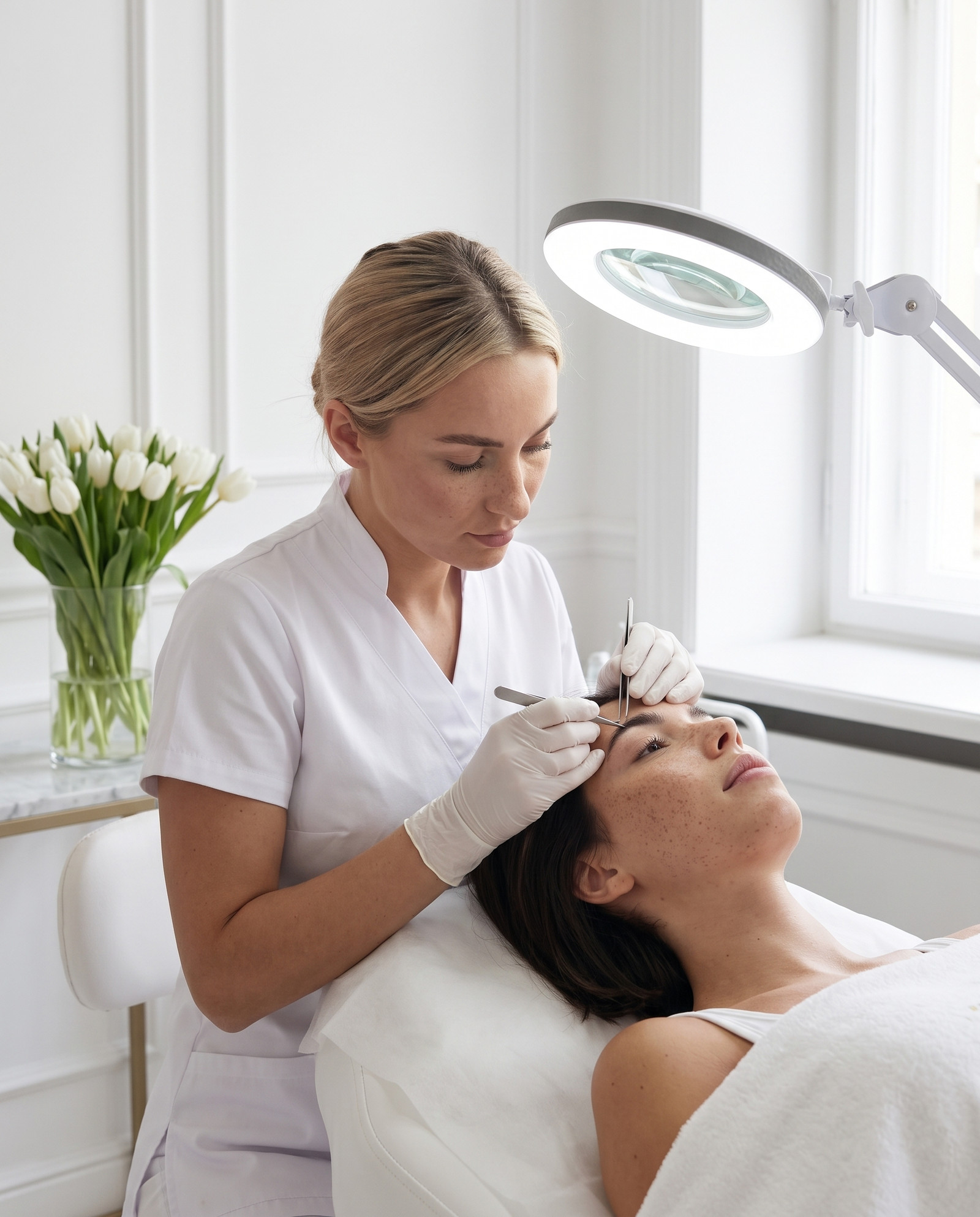
Tweezers distribute the sensation into individual points
- A single event. With tweezers, each movement is a separate stimulus, followed by a moment of pause.
- A predictable rhythm. Removing individual hairs under the arch allows for easy prediction of the work pace.
- Sum of stimuli. With more regrowth, accumulated, small impulses can be more tiring for the skin than one short, intense treatment.
Tweezers give the stylist the opportunity to check the shape frequently. This is important for a person who wants to work in stages: a few hairs, a glance in the mirror, a decision on the further scope. Such control does not remove sensations, but it limits the impression that the entire change is happening without your consent.
A scene from the salon: the first part of the brow goes calmly, but under the highest point, the eyelid begins to twitch involuntarily. Instead of speeding up, the specialist pulls the skin taut, changes the angle of the grip and takes a short pause. If the discomfort decreases, she continues point by point. If it increases, the choice of method or scope must be discussed again.
Wax provides one distinct moment over a larger area
The comfort of wax depends not only on pain. The condition of the barrier matters. Retinoids, acids, recent exfoliation, irritation or dryness in the brow area must be disclosed before the treatment. On skin weakened by active skincare, the technique may be unsuitable, even if it was well tolerated previously.
After removing the wax, temporary heat and a pink colour may appear. The stylist should see the skin, not immediately cover it with further stimuli. A sensation that fades quickly is different from burning that becomes stronger. In the latter case, inform us immediately, without waiting for the second brow to be finished.
Thread creates a rhythmic series moving along the contour
- Mechanism of action. With threading, the twisted thread catches hairs one by one; therefore, the sensation resembles quick, small pinches moving along the line.
- No breaks. Unlike wax, there is no single detachment, and compared to tweezers, there is no clear break after each removed hair.
- Subjective sensations. For some, the rhythm of the thread's work is easy to get used to, while for others, the repetitiveness of this process proves tiring.
The absence of a depilatory product on the surface does not mean the absence of a reaction. The thread works mechanically close to the skin, and hairs are still being removed. Redness, tenderness or watering may occur. Claiming that threading is always "painless" or automatically best for every complexion would be dishonest.
If you are most concerned about a lack of control, ask for a short test section away from the most sensitive part of the arch. After a few movements, you can assess whether the rhythm is acceptable. Such a test does not predict the entire skin reaction, but it allows you to decide consciously instead of finishing with a method chosen solely from a description.
A practical example: someone knows tweezers, but before an important meeting, they want to try threading for the first time because they heard the treatment would be gentler. After a short test, it turns out that the quick series irritates them more than individual movements. Returning to tweezers is not a mistake or a wasted visit. It is the result of real sensory information. In another case, the same test may lead to the opposite conclusion. The method must fit the person in the chair, not an opinion read on the internet.
The same tool can be felt differently under and over the brow
- Varied structure. The brow area is not a uniform field, as thin skin closer to the mobile eyelid and places more tightly stretched by mimicry react to stimuli in different ways.
- Direction of growth. Hairs growing at different angles mean that the same tool can be felt differently depending on the area of work.
- Body reaction. A person calm while tidying the space between the brows may start to tear up during work just under the arch.
Therefore, assessments like "tweezers don't hurt me" are only true in a specific context. The number of hairs, their position, the pace and the way the skin is stabilised matter. Instead of proving your resilience to yourself, describe the area: "it pinches more clearly here", "I need a break on this side", "the heat lasted longer than usual".
A precise message allows you to change the order. You can move to a less sensitive section, return after a moment or leave a single hair if its removal does not clearly change the contour. Brow architecture does not require victory over every hair visible in magnification.
The state of the skin on the day of the visit is more important than the reputation of the method
Before shaping, do not try to "prepare" the area with an additional peel. Also, do not test a new serum, mask or anaesthetic agent on your own. Every additional product makes it difficult to distinguish a normal short stimulus from a reaction to an ingredient. Come with information about your skincare, not with a layer of experiments.
Fatigue and tension do not damage the skin, but they can change perception. If you are in a hurry for your next meeting, every movement may seem longer. A few calm minutes for conversation, comfortable head positioning and establishing the scope gives more than an assurance that the treatment "will only take a moment".
Anaesthesia is not a standard response to shaping
Cosmetic brow shaping usually takes place without anaesthesia. Stimuli are short, and the scope is small. Applying an anaesthetic preparation without indication does not solve the problem of choosing a method, but it can introduce an additional ingredient close to the eye and change the perception of signals from the skin.
Do not use an anaesthetic cream purchased for another procedure on your own. The safety of a preparation is determined by its composition, location, skin condition and instructions for use, not by the label "for pain". If the fear of shaping is great, a better plan is a smaller scope, working in stages, a test section or sticking to a known technique.
When even a gentle touch of the area is painful before the visit, the goal should not be to suppress the signal. You need to determine the cause of the ailment in a proper consultation. Shaping is not a resilience test and does not serve to diagnose pain in the face or eye.
Comfort is built by small decisions made during the process
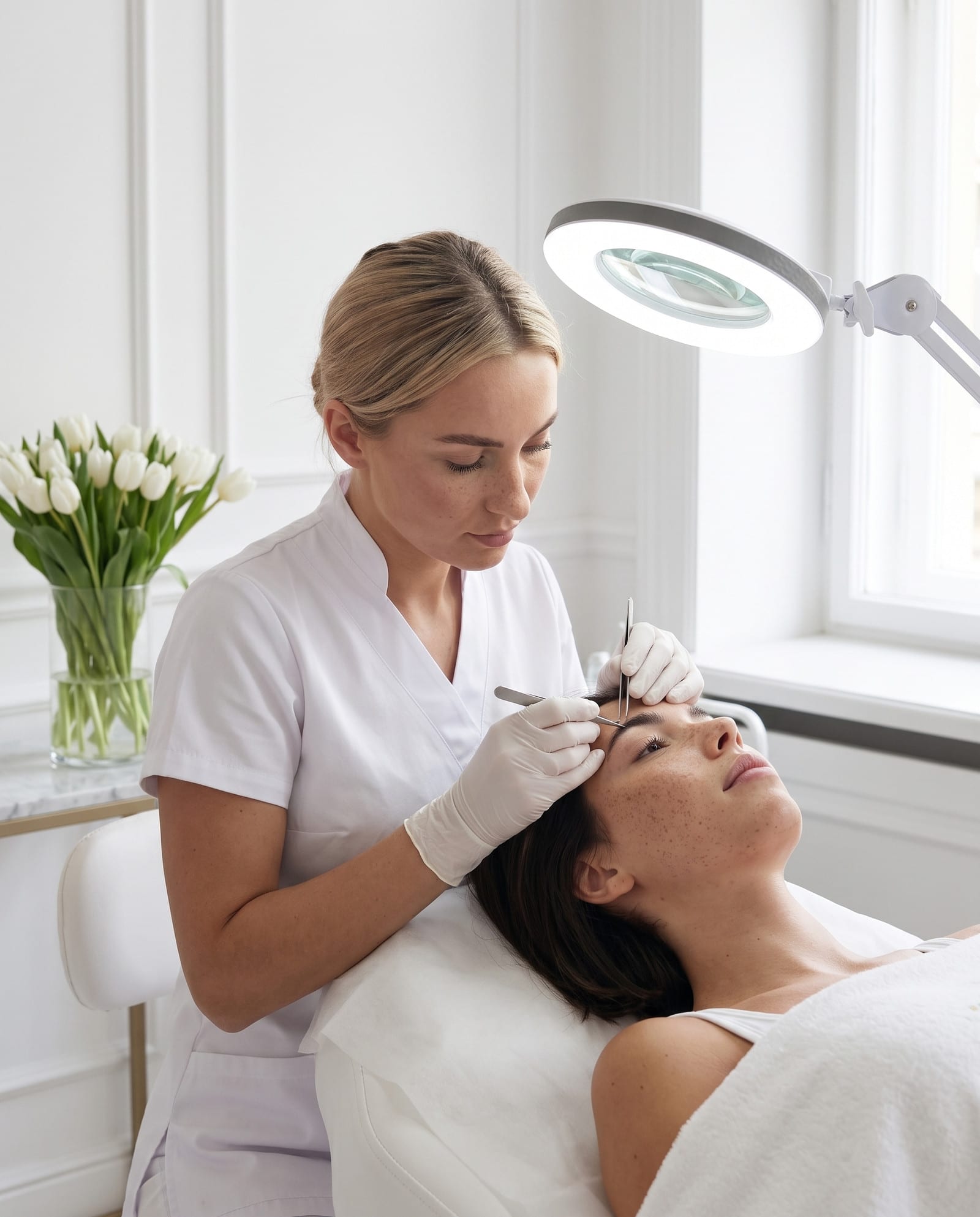
- Stable head support. It ensures precision of movements and eliminates unnecessary muscle tension.
- Skin tension. It facilitates the work of tools and minimises discomfort during hair removal.
- Predictable movement. It allows you to stay calm and avoid reflexively clenching your eyelids or raising your brows.
- Announcement before changing the method. It enables you to prepare for a different type of stimulus, which reduces the feeling of chaos.
You can breathe normally, not clench your eyelids and not raise your brows in anticipation of a tug. Excessive mimicry makes it difficult to assess the line and increases the feeling of chaos.
Ask for the work to be divided into short sections. A finished contour does not have to be created on one side immediately, while the other remains untouched. Alternating tidying allows you to compare the brows more often and stop when the effect is already sufficient. A smaller number of movements also means fewer stimuli.
A cool compress can be an element of soothing temporary heat if the specialist deems it appropriate. Do not apply random ice cubes directly to the skin at home. Intense cold is also a stimulus, and the eye area requires common sense.
The least unpleasant method does not always lead to the best decision
Choosing according to only one criterion can lead nowhere. Wax can be short, but it does not fit every barrier. Tweezers provide control, but with a large scope, they mean many repetitions. Thread does not require a depilatory preparation, but it has a characteristic rhythm. The technique must simultaneously suit the skin, the number of hairs and the arch design.
It is often sensible to combine: a larger section is tidied with one method, and individual spots are refined with another. This does not mean that the person "could not withstand" the full procedure. It is a technical decision for fewer unnecessary movements and better contour control.
If the previous visit was difficult, describe it without labels. Instead of "wax is terrible", say whether the problem was the heat of the product, the detachment, persistent burning or redness the next day. Each of these details leads to a different conversation about an alternative.
The first shaping should leave room for a later opinion
Before your first treatment, the greatest stress is often not the pain, but the fear of losing too many hairs. Tell us you want to maintain the thickness and see the result after a small step. Your stylist can first tidy up the obvious regrowth outside the target contour, and only then ask about further correction.
The mirror during the process is not for checking every movement. It provides a common point of reference. You can assess whether your face still looks like yours, whether the arch has become too sharp, and whether continuing makes sense. This conversation reduces tension more effectively than rushing.
Brow shaping is not a permanent tissue remodelling. The result changes with regrowth, but removing too many hairs before an important occasion cannot be reversed the same evening. A cautious first range is therefore both an aesthetic and a comfort decision.
Brow shaping in Warsaw: choose a location without rushing
Information about the service and city booking can be found on the brow shaping in Warsaw page. You can choose from two J’ADORE INSTYTUT salons: Żelazna 59, 00-848 Warsaw, open from Monday to Saturday 8–21 and on Sunday 11–19, as well as Mińska 29A/46, 03-808 Warsaw, open from Monday to Saturday 9–21.
For your first shaping, leave a few minutes of buffer in your calendar. Dropping in exactly between work and a train encourages agreeing to the fastest option, which is not necessarily the best fit for your skin. Tell us upon arrival if a previous technique caused a strong reaction or if the area is more sensitive today.
Two locations do not mean two standards of sensation — your threshold and skin condition remain your own. When booking next time, keep a note of which method was used and how long the reaction lasted. This is a more practical note than just "it was fine" or "it hurt".
Four sentences are enough before the first movement
Say: "I use these active products", "I tolerated this method best last time", "I am particularly sensitive in this area", and "I want to keep the current thickness". These four messages organise the choice of tool, range and pace without guesswork.
During the treatment, describe the change, do not judge yourself. "It stings, but it passes quickly" is different information from "the burning increases after every movement". The first allows us to plan pauses; the second may mean we need to stop. Silence does not help the stylist distinguish between concentration and a real problem.
The most honest answer to the title question is: shaping can be felt, but the nature of the stimulus can be predicted and managed. Tweezers, wax and thread do not compete for a pain-free medal. They are three ways of working that must be adapted to your current skin, the specific contour and your consent at every stage.