Before you start exfoliating — what a peel actually does
Skin renews itself constantly. Epidermal cells, known as keratinocytes, form in deeper layers and travel towards the surface. They eventually shed naturally — this normal cycle takes several weeks. A peel interferes with this rhythm. It accelerates, stimulates or directs renewal where the skin cannot manage it alone. Depending on its formulation and concentration, the signal may remain in the epidermis, reach the dermal-epidermal junction or extend deeper into the dermis.
This depth of action divides peels into three main classes. It is not about the intensity of visible exfoliation. Skin may look almost unchanged after a very gentle enzyme peel. What matters is the level at which the renewal signal has been triggered. The surface is not everything. Sometimes, the less dramatic the exfoliation, the longer-lasting the result.
Superficial peel — the first level of treatment
Superficial peels work within the epidermis or close to its border with the dermis. This is the broadest and most commonly used category. It includes AHA acids — glycolic, mandelic and lactic acid — lower concentrations of salicylic acid, and enzyme formulations such as papain and bromelain. They all weaken or break down the bonds between dead epidermal cells. This gives the skin a renewal signal without disrupting deeper structures.
- Glycolic acid — the smallest AHA molecule. It penetrates fastest and works throughout the epidermis. It may smooth texture, improve radiance and support hydration. Results are often visible after several sessions in a series.
- Mandelic acid — a larger molecule that penetrates more slowly. It is gentler for vascular and reactive skin. It combines exfoliating action with a mild antibacterial effect, which can be valuable for combination skin prone to imperfections.
- Lactic acid — has an additional property: it binds water. A lactic peel exfoliates while also supporting hydration. It is therefore suitable for dry, dull skin.
- Enzymes (papain, bromelain) — work differently from acids. They do not lower pH. Instead, they digest proteins that bind dead cells together. The result is gentler, contact time is shorter, and the skin is less red after the treatment. You may barely feel this type of peel, yet your skin will still respond.
Depigmenting peel — the goal: even skin tone
A depigmenting peel is not so much a separate type of acid as a specialist strategy. It is a complex protocol in which ingredients, and their combinations, are selected to reach the layers of skin where hyperpigmentation originates. Sun-induced hyperpigmentation, post-inflammatory hyperpigmentation and melasma are conditions in which melanocytes, or pigment cells, work overtime. Changing the texture of the epidermis alone will not stop them.
This is why depigmenting formulations combine several mechanisms at once. Exfoliating ingredients open the way to deeper layers. Brightening ingredients — kojic acid, arbutin, vitamin C, niacinamide and sometimes retinol — interfere directly with melanin production or its transport towards the surface. The result is not simply a “brighter face after exfoliation”. It is the inhibition of excessive pigment activity at its source, for long enough that the renewed epidermis contains less pigment.
General brightening peel
evens skin tone and radiance
- Exfoliates dead epidermal cells
- Improves radiance and smooths texture
- Excellent for tired, dull skin
Depigmenting peel
targets melanin production
- Combines exfoliation with inhibition of melanogenesis
- Works on more deeply rooted hyperpigmentation
- Requires a series + SPF as a condition for effectiveness
Peptide peel — when skin needs regeneration, not exfoliation
Compared with classic acids, a peptide peel works very differently — which is why it can be underestimated. It does not exfoliate mechanically or chemically as aggressively as AHA acids. Instead, it delivers peptide signals to the skin that mimic natural processes of communication between cells. Peptides are short chains of amino acids. They are information fragments that the skin “reads” and responds to by producing collagen, accelerating regeneration and calming inflammation.
A peptide peel is therefore stimulatory rather than destructive. It does not damage the outer layer to force renewal. Instead, it supports the cellular dialogue lacking in mature, tired skin, or skin affected by prolonged stress or excessive sun exposure. After this treatment, skin often looks calmer and fuller — rather than as though something has just been removed from it.
How peel depth affects results and recovery time
There is no better or worse peel — only one that is suitable or unsuitable. The key is simple: the deeper the signal reaches, the stronger the regenerative response. However, the skin also needs longer to return to normal. A very superficial peel may be more of a routine skincare treatment than an intervention. The skin responds quietly and quickly. A medium-depth peel requires several days of caution and barrier care.
- 01
Superficial (epidermis)
Exfoliation and a signal within the epidermis. Skin may be slightly pink immediately after the treatment. Most people can return to normal activities the next day, with no visible exfoliation or only very slight exfoliation. A series of several sessions every few weeks.
- 02
Deep superficial (dermal-epidermal junction)
The signal reaches deeper, and exfoliation may be more visible for 2–4 days. Skin tone and texture improve more noticeably after each treatment. The skin requires gentler care for several days — no mechanical exfoliation, and SPF is essential.
- 03
Medium-depth (dermis)
A strong regenerative signal with visible exfoliation lasting several days. A noticeable improvement in texture, density and skin tone after healing. Longer intervals between treatments and more thorough skin qualification are required. Reserved for specialist indications.
It is worth knowing that a series of several superficial peels may provide a comparable or even better long-term result than one deep treatment. Recovery time is significantly shorter and the risk of post-treatment hyperpigmentation is lower. This is why salon protocols rarely follow the principle that deeper is better. Instead, they rely on selecting the right frequency and depth for the skin condition and treatment goal.
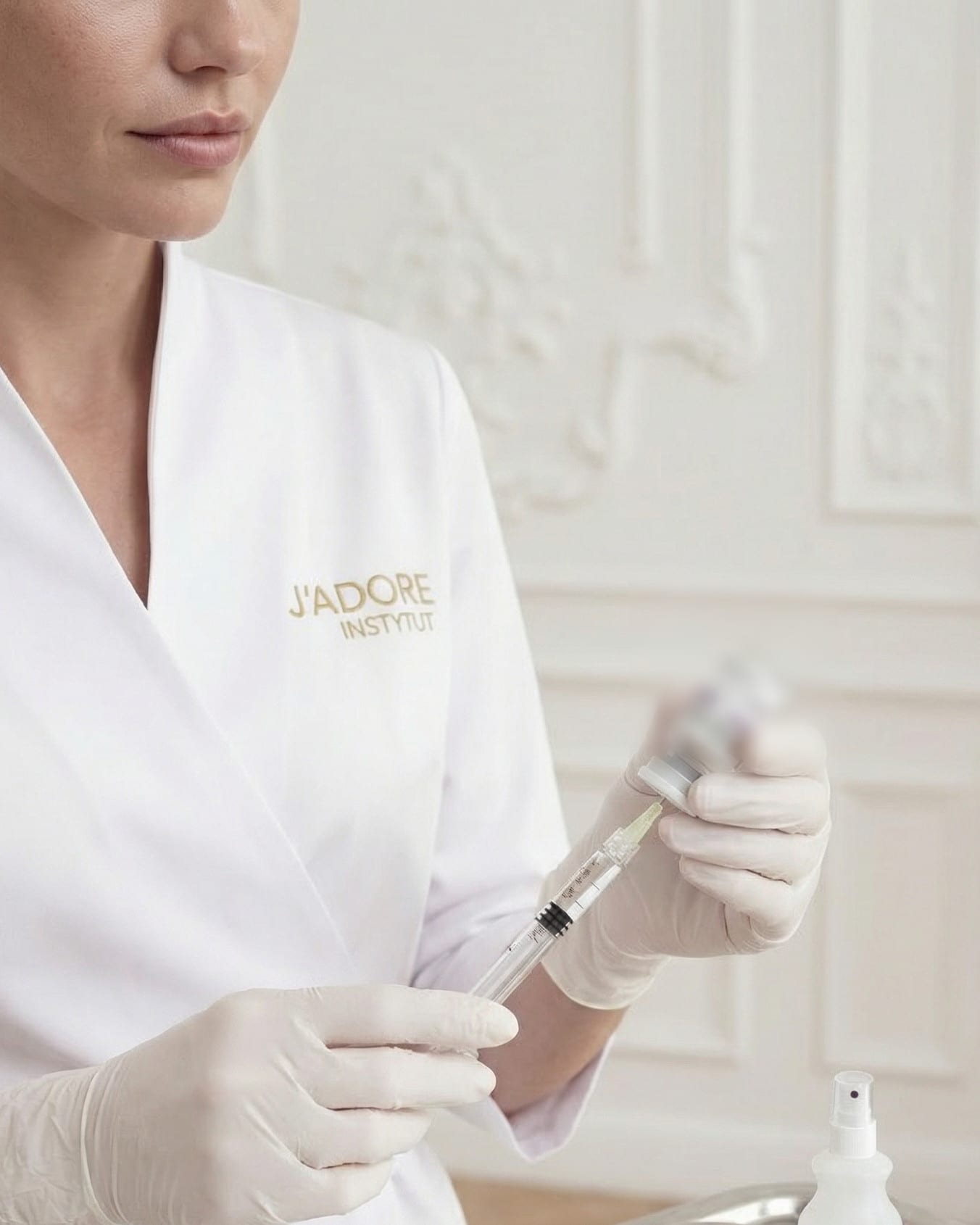
Combining peels with other treatments
Peels rarely work best in isolation. Their role fits into a broader skincare protocol — as an element of a series or preparation for another treatment. Exfoliated, renewed epidermis absorbs active ingredients more effectively. Skin stimulated after a peel responds more efficiently to biostimulators or mesotherapy. This is why salons often combine peels with treatments that work deeper or through another mechanism — to enhance and prolong the result.
Peel + mesotherapy
Exfoliated epidermis creates an open pathway for active ingredients delivered through mesotherapy. Regenerating cocktails, hyaluronic acid and vitamins work more effectively in freshly renewed skin.
A series of depigmenting peels + biostimulator
Even skin tone through a series of depigmenting peels, followed by improved skin condition and density with a biostimulator — a dual approach to skin quality and tone.
Peptide peel + carboxytherapy
Peptide stimulation and tissue oxygenation through carboxytherapy — a combination that addresses both regenerative signals and skin blood flow. It works synergistically to improve firmness and radiance.
Superficial peel + laser treatment
A series of tone-evening peels to prepare for or maintain the effects of laser treatments for hyperpigmentation. Peels work between laser sessions, keeping the skin in a state of active renewal.
When a peel is not right for you — without the myths
Peels have contraindications, and it is worth discussing them openly. Not to alarm you, but to avoid unsuitable decisions. An active skin infection, such as herpes, open inflammatory lesions, recent burns or mechanical skin injuries are absolute reasons to postpone a peel. The same applies to pregnancy. Many acids do not have sufficient safety data for this period, so caution is the general rule.
Skin accustomed to retinoids or undergoing isotretinoin treatment requires a more cautious approach. Both the type of peel and the intervals between treatments are selected individually. The same applies to reactive skin with active rosacea or a tendency towards severe redness. In these cases, a good specialist will suggest a different protocol or a treatment based on a different method. Not qualifying for treatment is not a refusal — it protects the result.