Why grey hair looks different on different men
The same biological process — pigment loss in the hair follicle — can look like a stylish silver accent on a fifty-year-old, or like tired, old hair on someone ten years younger. Several factors decide this at once: the speed of greying (fast onset often gives sharper transitions), distribution (temples, crown, all over), hair structure (thick greying hair is very visible) and — paradoxically — how you feel about your grey hair. A man who wants to look mature and confident? Grey serves him well. A man who feels it's ageing him and flattening his features? The same amount of grey becomes a problem.
The second scenario isn't a weakness — it's simply a sign that something is worth doing. And this is where the real question begins: how to get a natural result, one that doesn't give away that you've done anything.
The "dyed" look — where it comes from and how to avoid it
Classic box colouring works like this: one colour, applied to the whole head, covers grey strands evenly. The result is immediate — and immediately recognisable as a treatment: too uniform a colour, too intense, with none of the natural variation real hair has. Then, after three weeks — regrowth. A grey strip at the root, flat colour everywhere else. It's a combination that gives itself away.
Full colouring (box dye)
what it looks like in practice
- uniform colour along the full length
- no variation, unlike natural hair
- visible regrowth after 3–4 weeks
- sheen often too intense on grey hair
Technique-based colouring (salon)
why it looks natural
- tonal variation — lighter and darker strands
- grey partly preserved, partly blended in
- regrowth merges into the colour instead of contrasting
- the result can be subtle or bold — your choice
The key is tonal variation: natural hair is never a single colour. It has different shades along the strand, different depth near the scalp and at the ends, and areas of light and depth. Techniques like blending and balayage recreate this effect — which is why grey hair integrated this way looks like "your own", not like a dye job.
Techniques that actually work for men's grey hair
A few approaches used with men — they differ in how much they intervene and in the final result:
- Blending. The goal isn't to hide grey hair, but to integrate it visually with the rest. A stylist selects a shade close to your natural colour and applies it selectively, so grey strands are "woven in" rather than covered. Regrowth builds up gradually, without a sharp line.
- Grey blurring. A technique that softens the boundary between grey and darker hair — especially effective at the temples and hairline. Instead of one hard colour line, you get a gradual transition. For many men, this is enough: hair looks darker and less "aged", but the result stays very natural.
- Men's balayage (shadow root). Colour is applied freehand, without foil, to selected sections, following the natural growth pattern. Grey strands can be kept and treated as light highlights — they become part of the design, not a flaw.
- Toning colour (partial coverage). If you want a gentle reduction in the proportion of grey without full coverage, semi-permanent toners apply colour that fades gradually over a few weeks, with no sharp regrowth line. A good option for a first attempt: you get to see how you look with less grey, without an irreversible step.
Is every greying man a candidate for colouring?
No — and not everyone should be. A few scenarios:
- You're happy with your grey. Do nothing. Optionally, look after the hair's condition — grey hair tends to be drier and coarser, and healthy grey hair looks completely different from neglected grey hair.
- You're not keen on the grey visually, but want a very natural result. Blending or grey blurring — techniques where the result is mainly visible to you.
- You have a lot of grey and want to darken it substantially. Full colouring or toning — but only with a colourist who knows how to avoid a "plastic" look on grey hair. Grey hair takes colour differently from dark hair — without the right technique, the result can look metallic or too intense.
- You've just started greying and there isn't much grey yet. Often the best moment for blending — the grey strands are few, easy to integrate gently, and you gain plenty of time before the situation becomes more demanding.
Hair condition: the base without which colouring doesn't make sense
Grey hair has a different structure from dark hair: it's coarser, rougher, often drier — and it takes colour much worse if neglected. Sometimes a man arrives for colouring with hair so damaged, or with roots so oily and ends so dry, that the result will be uneven regardless of technique.
Before colouring — and regularly outside it — grey hair needs proper care:
- Silver or purple (anti-yellow) shampoo. Grey hair tends to yellow, especially with smoking, hard water and sun exposure. A toning shampoo neutralises the yellow tint and keeps grey looking cool and fresh.
- Conditioner or mask. Grey hair is more porous — without hydration, it becomes frizzy, stiff and dull. Conditioner after every wash is the minimum; a weekly mask makes a real difference to the structure.
- Sun protection. UV accelerates yellowing of grey hair and fades any applied colour. In summer, use a spray or product with UV filter after styling.
What to expect during your visit — the first time
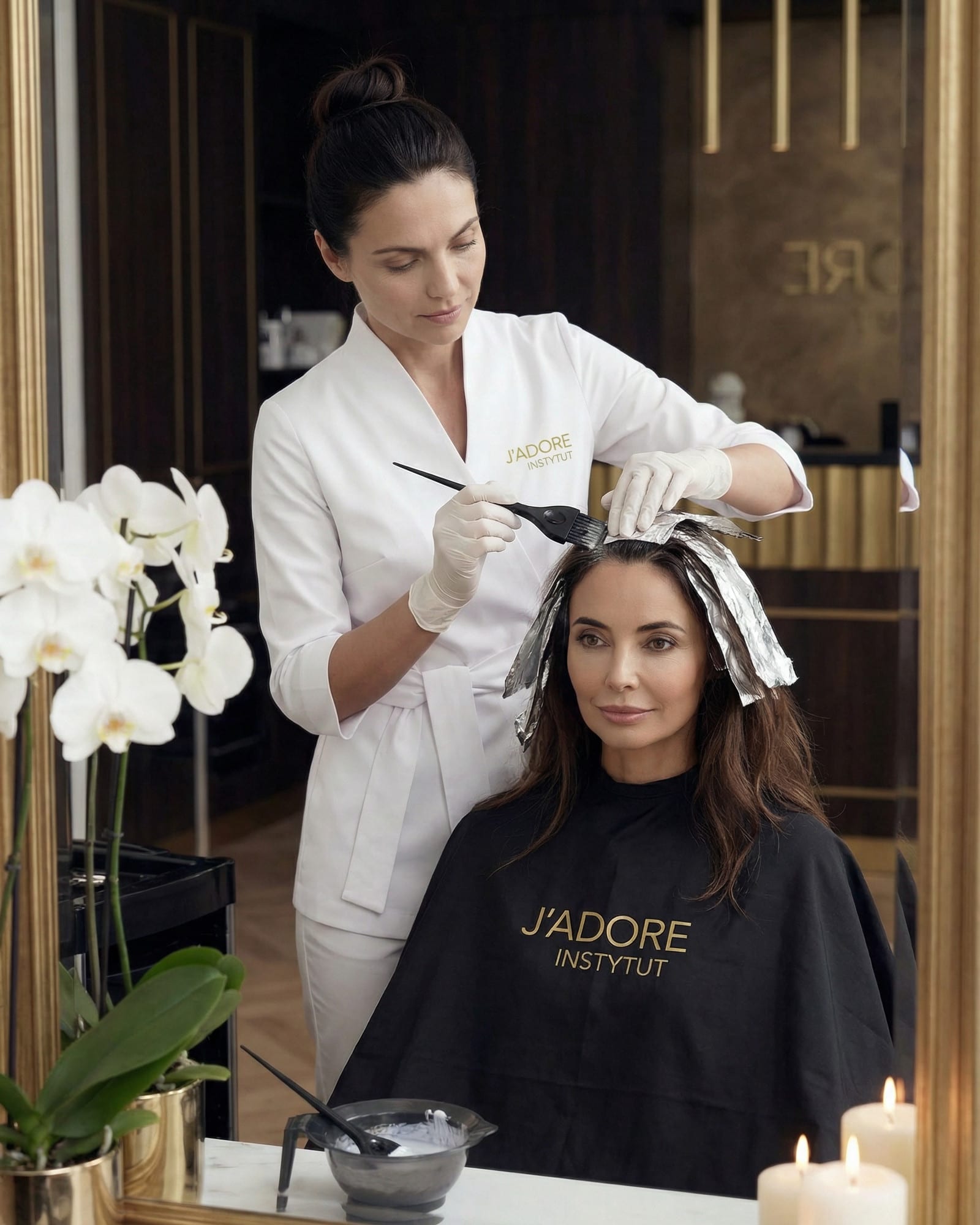
Many men put off a salon visit because they don't know what to say — and fear leaving with something completely different from what they wanted. A few practical points:
- 01
Consultation before colouring
Your stylist examines the hair and assesses the percentage of grey, structure and condition. This is the moment to say what you want to avoid — for example, too dark or too flat a result — rather than describe a specific colour. A good stylist will suggest the technique themselves.
- 02
Shade selection
With blending, the starting point is your natural darker colour, not a ready-made shade from a chart. Your stylist may mix several tones to achieve the right sense of depth and natural variation.
- 03
Selective or full application
Depending on the technique, colour is applied selectively — to strands or sections — or all over, with the colour carefully distributed. With foil-free techniques, the result often only becomes visible after rinsing, once the hair has cooled.
- 04
Toning (optional)
After colouring, many colourists apply a toner — a semi-permanent pigment that seals the hair structure and smooths the colour. The result is more defined, and colour lasts longer.
- 05
Styling and aftercare discussion
This is when you learn which shampoo to use and when to come back. With blending or grey blurring, that's usually in 6–10 weeks, not 3.
What you can expect — and what you can't
An honest list, because inflated expectations only lead to disappointment:
- You can expect: a naturally-looking colour that doesn't read as "dyed"; less visible grey without a flat, single-tone result; regrowth that builds up gradually, without a sharp dividing line.
- You can expect: a better-looking hairstyle without a radical change. For many men, colouring plus proper care alone makes hair look thicker and healthier — grey tends to make it look optically thinner.
- Don't expect: to reverse the greying process — pigment doesn't come back. You can reduce the proportion of grey, but you can't "undo" biology. Don't expect a permanent effect without maintenance, either — every technique needs follow-up visits, just at different intervals.
- Don't expect: a miracle in one visit if the hair is damaged or badly neglected. In that case, the first visit may be mostly about care — and that's fine.