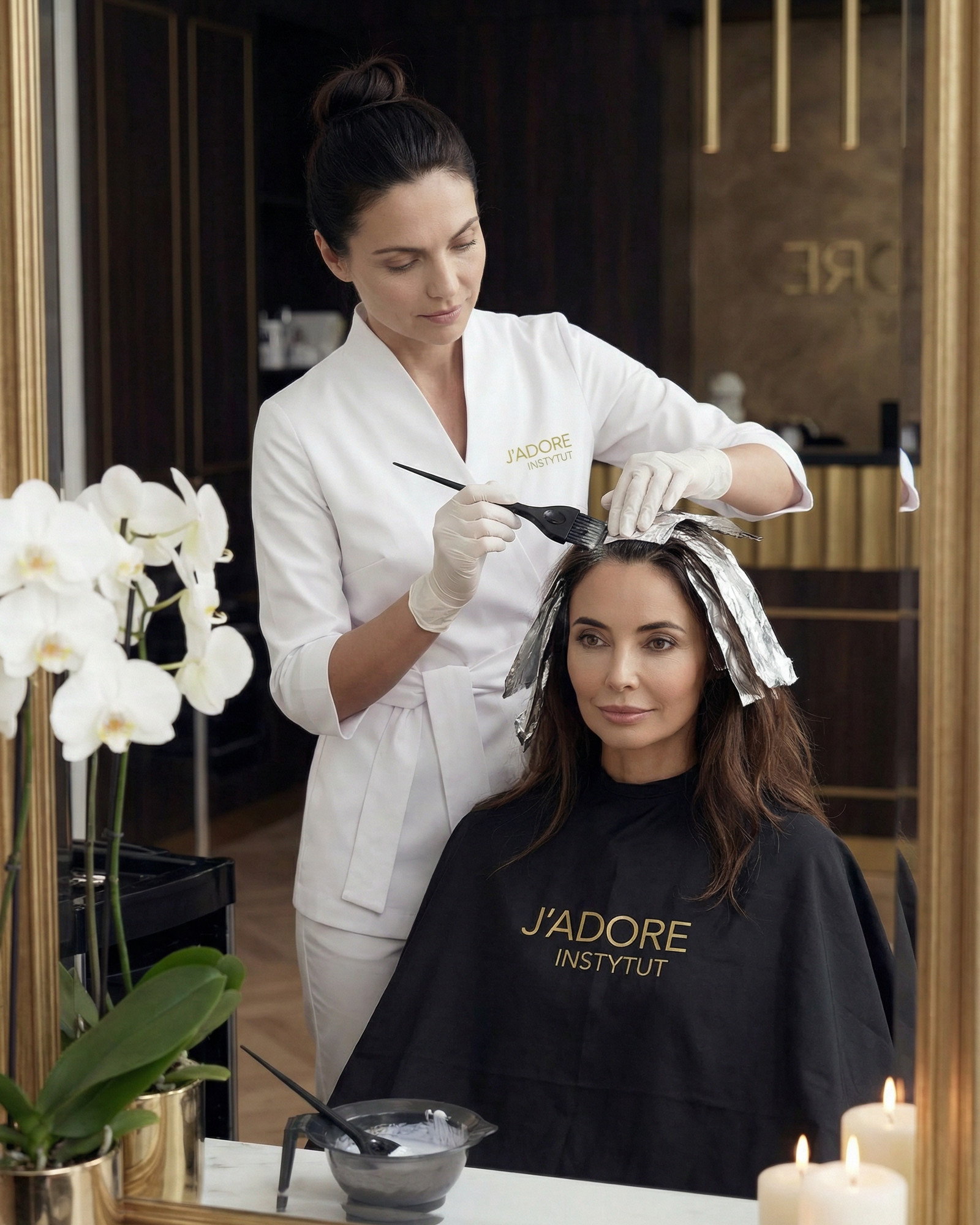
Toning corrects the shade, but does not replace lightening
A toner works mainly on the colour direction: it can cool, warm, deepen or even out the shade on a previously lightened base. It is a good choice when the level of brightness is already right, and the problem is a yellow, too cool or faded tone. It usually ages more gently because the pigment washes out gradually.
However, it will not turn dark hair into a light blonde. If the hair has not been lightened beforehand, the toner has a limited scope of action. The promise of significant lightening through "delicate toning" alone is a confusion of two processes.
Highlights break up a uniform colour and soften the regrowth line
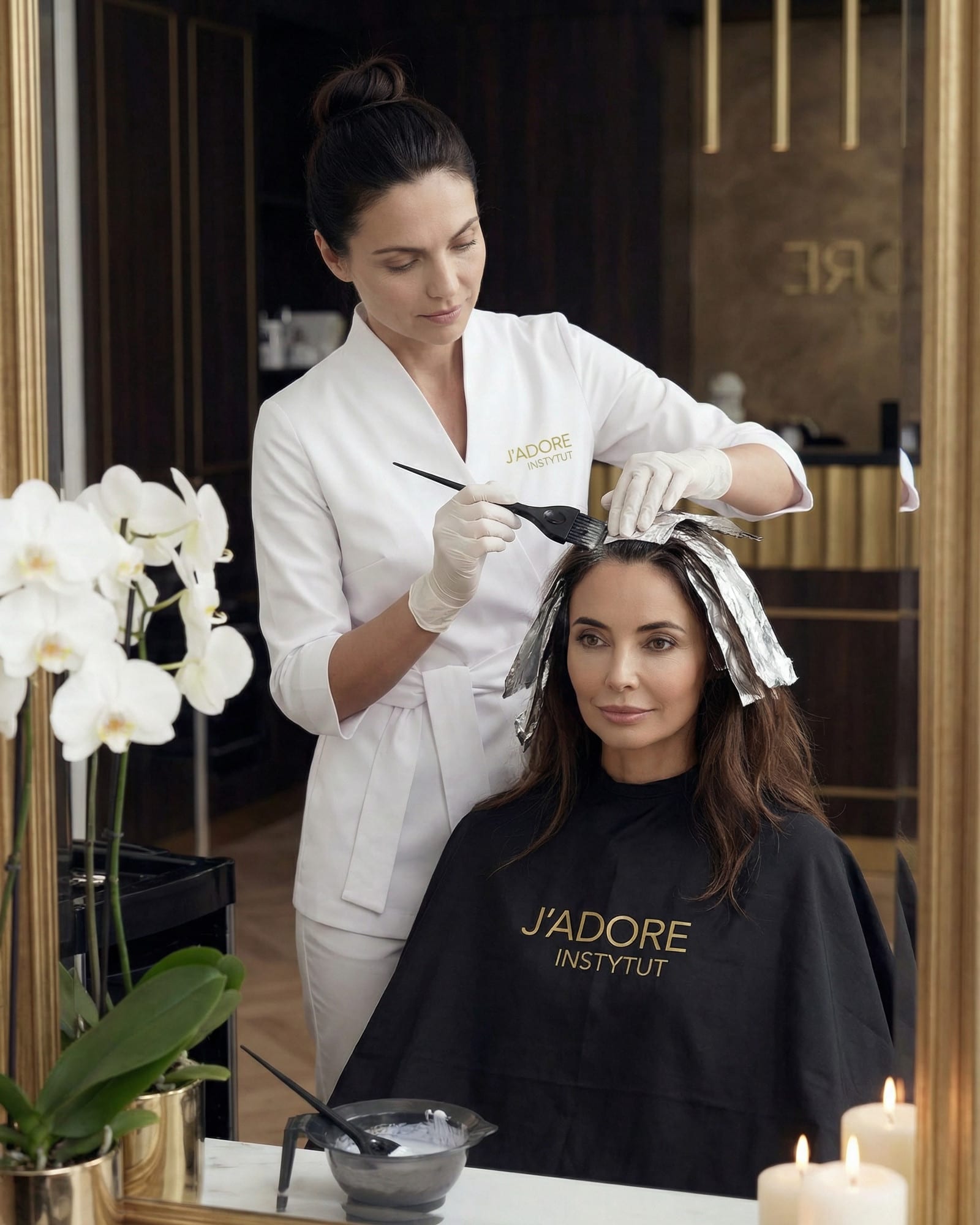
Highlights are chosen when the goal is light, multidimensionality and a less distinct regrowth line. You do not need to lighten the entire mass of hair. The way of sectioning, the thickness of the strands and the distance from the scalp decide whether the effect will be subtle, contrasting or resemble a full blonde.
This method is sometimes better than full lightening for someone who does not want frequent visits or has hair with limited tolerance for chemicals. However, it will not give a perfectly uniform light colour from roots to ends. Natural variation is precisely its advantage.
Full lightening gives the biggest change and the smallest margin for error
Lightening removes part of the natural or artificial pigment. The greater the difference between the base and the goal, the more stages may be needed. Repeatedly dyed hair reacts unevenly: the regrowth, lengths and ends have a different history and strength.
Full lightening is better when you really care about a light, uniform base and accept the maintenance and regular work with regrowth. Highlights are better when the priority is soft regrowth. Toning wins when the brightness is already achieved, and the shade is the issue.
Less intervention
toning or highlights
- shade correction or spot lighting
- gentler regrowth
- smaller change possible during one visit
Greater change
full lightening
- light base on a larger area
- more distinct regrowth
- higher demands on condition and care
Permanent dye and semi-permanent colouring solve different problems
Permanent dye makes sense for a lasting change of base or the need to cover greys, depending on the formula and diagnosis. Semi-permanent colouring is used more for refreshing, deepening or correcting the tone. If you do not want a permanent regrowth line, a gentler method may be more appropriate, even if the effect lasts for a shorter time.
Do not assume that "ammonia-free" automatically means no chemical reaction or no risk of allergy. The safety and burden on the hair are determined by the entire product, the concentration, the method of use and the condition of the skin and fibre. If you have a history of allergic reactions, you must inform the salon before the service.
Decolourisation is not a faster synonym for regular dyeing
Removing accumulated artificial pigment is sometimes necessary before changing the colour direction. This is a correction, not a routine addition. The result depends on the number of layers, the type of products used previously and porosity. Sometimes it is more sensible to stop at a warmer transitional stage than to force a cool blonde in one day.
Colouring will not repair hair damaged by lightening. Conditioning products can improve slip, shine and the feel of the surface, but they will not restore the fibre to its pre-damage state. If the ends are breaking, an alternative to another process may be a break from chemicals and a haircut.
Also compare how the colour will age
- Toning washes out gradually; the frequency of refreshing depends on the shade and care.
- Highlights usually give a less sharp border, but their tone can also change.
- Permanent colour creates a more readable regrowth, especially with high contrast.
- Full blonde requires protection of the lengths and controlling subsequent applications at the roots.
A photo from the day of the visit does not show this process. Before choosing, ask how the method looks after a few weeks, what happens to the regrowth and which home products can change the shade.
A Warsaw plan should include two salons, but one diagnosis
J’ADORE INSTYTUT operates in Warsaw at Żelazna 59 and Mińska 29A/46. Service details are on the Warsaw colouring page. Regardless of the location, ask for a plan including the method, the limit of possible change and the way of further maintenance.
The decision is simplified by one sentence: choose toning for the shade, highlights for light and soft regrowth, and full lightening only when you need a light base and your hair condition allows it. An alternative method is always better when it achieves the goal with less intervention.
The starting point changes the ranking of methods
On natural, undyed hair, the choice is usually more predictable than on lengths covered with several layers of pigment. A natural base can be lightened according to its level and the revealed background. Artificial colour has its own history: dark particles can remain unevenly, and regrowth can react faster than the lengths. Therefore, the same inspirational photograph leads to a different method for a brunette without colouring and for someone who has been applying brown every month for years.
With greys, there is a second goal: covering or consciously blending in silver hair. Full coverage usually creates a more distinct regrowth line. Highlights can disperse the contrast and allow the grey to become part of the composition, but they will not turn every grey hair into an identical pigment. Toning can change the tone of light strands, but its covering ability depends on the formula. The method is therefore also chosen according to whether you want to hide greys or softly integrate them.
Curly hair requires thinking about the distribution of light in the curl. Very fine, regular strands can disappear optically or create random spots when the curl settles differently. On straight hair, every section line is visible. This does not mean that one technique is intended exclusively for a given type. It means that a photo of the effect on a different structure is not a reliable forecast.
Condition sets a limit before aesthetics. If hair is brittle, excessively stretchy when wet or breaks along the lengths, another full lightening may be a bad choice regardless of the desired shade. Then the alternative is optical work: a few strategic highlights, deepening the colour with a toner, darkening the roots or a haircut. It does not give an identical goal, but it allows you to avoid losing hair in the pursuit of brightness.
A warm stage is not always a mistake to be cooled immediately
Lightening reveals successive warm backgrounds. Yellow, orange and red are not automatically proof of poorly performed work; they can be a stage resulting from the starting level. A toner neutralises part of the unwanted shade, but it does not significantly increase brightness. If the base has remained too dark, a very cool toner can dull it instead of creating a clear blonde.
Warm beige is sometimes a better alternative to ash when the hair has stopped at a level that cannot be safely lightened further. It allows you to obtain a coherent, wearable colour without forcing another stage. A cool shade is better only when the base is sufficiently light and even. The choice of temperature should also take into account the complexion, natural eye framing and the rate of washing out.
Home neutralisers can change the assessment. Violet works mainly on yellow tones, it does not solve an orange base. Blue pigment on very porous ends can settle more strongly. If you are planning further colouring, inform your hairdresser about masks and shampoos with pigment. A product considered to be for care can still leave colour that will affect the next recipe.
Regrowth is a project, not a defect appearing after the service
With colour applied from the scalp, natural regrowth creates a readable border. The greater the contrast between the base and the lengths, the faster it becomes visible. Highlights started slightly further away or dispersed at the roots can give a softer transition. In turn, someone who wants the maximum light blonde from the very scalp must accept more frequent and more precise renewal.
There are techniques combining lightened strands with shadow at the roots. Their advantage is soft growth and the possibility of less frequent renewal of the entire length. The limitation is the lack of uniform brightness from the scalp. This is not a worse version of blonde, but a different answer to the client's calendar. If you travel, work shifts or do not want to keep track of short intervals, the way of growing out may be more important than the effect in the first week.
With grey hair, regrowth is additionally assessed according to distribution. A cluster at the temples behaves visually differently than an even admixture. Full coverage may be best for someone who does not want to see silver. For another, blending will be better because it reduces the contrast between visits. No method wins in isolation from tolerance for regrowth.
How to compare cost without posing as a recipe specialist
The price depends not only on the name of the technique, but also on density, length, amount of product, number of stages, correction of old pigment and time. A shorter list of activities does not always mean a simpler service. Precise, fine highlights may require many sections; correction of bands — separate formulas on different parts. Ask for the scope, not a slogan.
When comparing places, check if the valuation includes toning after lightening, care, drying and a possible haircut. Do not assume automatically that every item must be in the package. It is important that the rules are known before starting and that the hairdresser obtains consent if the live diagnosis changes the plan. The cheapest option stops being cheap when it skips a stage needed to obtain an even colour.
The cost of maintenance is sometimes more reliable than the price of the first visit. Full lightening at the scalp may require more frequent work with regrowth; highlights — less frequent refreshing of the distribution, but periodic toning. Intense colour may need pigmented products. Before deciding, ask for a yearly scenario: not an amount, but the number and type of anticipated visits.
Four examples where an alternative is truly better
The first case: natural dark blonde with a few grey hairs and a dislike for regular root maintenance. A few highlights can blend the silver better than a solid colour. The second case: the lightened length is bright enough, but it has turned yellow after the summer. Toning is more sensible than further lightening, as the shade is the issue, not the level.
The third case: multi-coloured dark brown hair that needs to become a light, cool blonde for an event in a week. A wearable intermediate stage or abandoning a major change might be better; the calendar does not change hair strength. The fourth case: very damaged ends and healthy roots. Instead of pulling lightener through the whole length, the stylist can work only on the roots, refresh the tone of the lengths, and plan a haircut.
In every example, the losing method may still be technically possible. It is not, however, the best for your goal, condition, or lifestyle. An informed choice is not about finding the strongest technique. It is about finding the least invasive approach that provides a result you can maintain without constantly rescuing your hair.
A five-step decision: from goal to method
First, define the change without a technical label. Instead of "I want balayage", say: I want it lighter around the face, a soft root, and the possibility of less frequent visits. Or: I want a solid cool blonde from the scalp and I accept frequent maintenance. The technique is the stylist's answer to the conditions, not the client's duty. Two people showing the same photo might choose different solutions if one wants low maintenance and the other maximum brightness.
The second step is separating level from tone. The level tells you how light the hair is; the tone tells you if we perceive it as cool, neutral, golden, or copper. If only the yellowing of the already light length bothers you, ask for a toner. If the hair is too dark, neutralisation alone will not be enough. This simple division prevents booking a gentle service with an expectation it cannot meet.
The third step is history and a test. List your recent processes, including home pigments, henna, keratin straightening, and lightening. For a major change, agree to a test stage if the specialist recommends it. The test does not promise identical behaviour for the whole head, but it can reveal strands where further lightening would be too risky.
The fourth step is choosing the regrowth method. Look at examples of not just fresh work, but also the effect after a few months. Ask what will happen if you delay your next visit. A method that looks perfect only with a strict calendar will be a poor choice for someone wanting flexibility.
The fifth step is the limit. Establish how the stylist will know when to stop the process and what the aesthetic plan will be then. Colouring should not end in damage just because a bright goal was agreed upon earlier. A responsible change may require two stages, a warmer tone, or leaving some hair darker. If you do not accept any intermediate variant, it is better to postpone the service than to force a result.
Before choosing, perform a daily life test. Count how often you wash your hair, whether you swim, how much you use thermal tools, and how much time you spend in the sun. Frequent washing rinses out toner faster, high temperature affects condition, and radiation changes colour. A method good in controlled conditions may prove demanding in your rhythm. You do not have to subordinate your life to your hair; you can choose a shade and placement that better withstands everyday life.
Check the compatibility of the goal with your natural base. A very cool light blonde on dark roots means constant work with exposed warmth and contrast. Multidimensional beige or strands around the face can provide radiance with less interference. If, however, you really want a solid platinum and are ready for the maintenance, subtle highlights will be a half-measure. An alternative is better only if it achieves the most important part of the goal.
Ask the stylist to point out a method they do not recommend, and why. The ability to reject options shows more than a list of services. A good recommendation has an opportunity cost: you give up maximum brightness for the sake of condition, or a soft root for the sake of a solid colour. When this cost is named, the decision stops being a guess.
After the consultation, you should be able to explain in your own words why this particular method was chosen. If the only argument is its trendy name, return to the goal. Toning is chosen for correcting the shade, highlights for building light and a softer root, and full lightening for creating a light base on a larger surface. Permanent dye is used for a lasting change or a specific way of working with greys. Every technique has a limit and none rebuilds damaged hair. The best plan is not the one that uses the most stages, but the one whose result remains good after washing out the salon styling and can be maintained in a normal week. When changing salons, bring the history of formulas if you received one, and mention all corrections made after the previous visit. Do not try to unify the roots with a home dye the day before. A new layer of pigment takes away a clear starting point from the stylist and can turn a simple service into a correction. An informed choice of method starts from the true state of the hair, not from the state corrected just before the consultation.