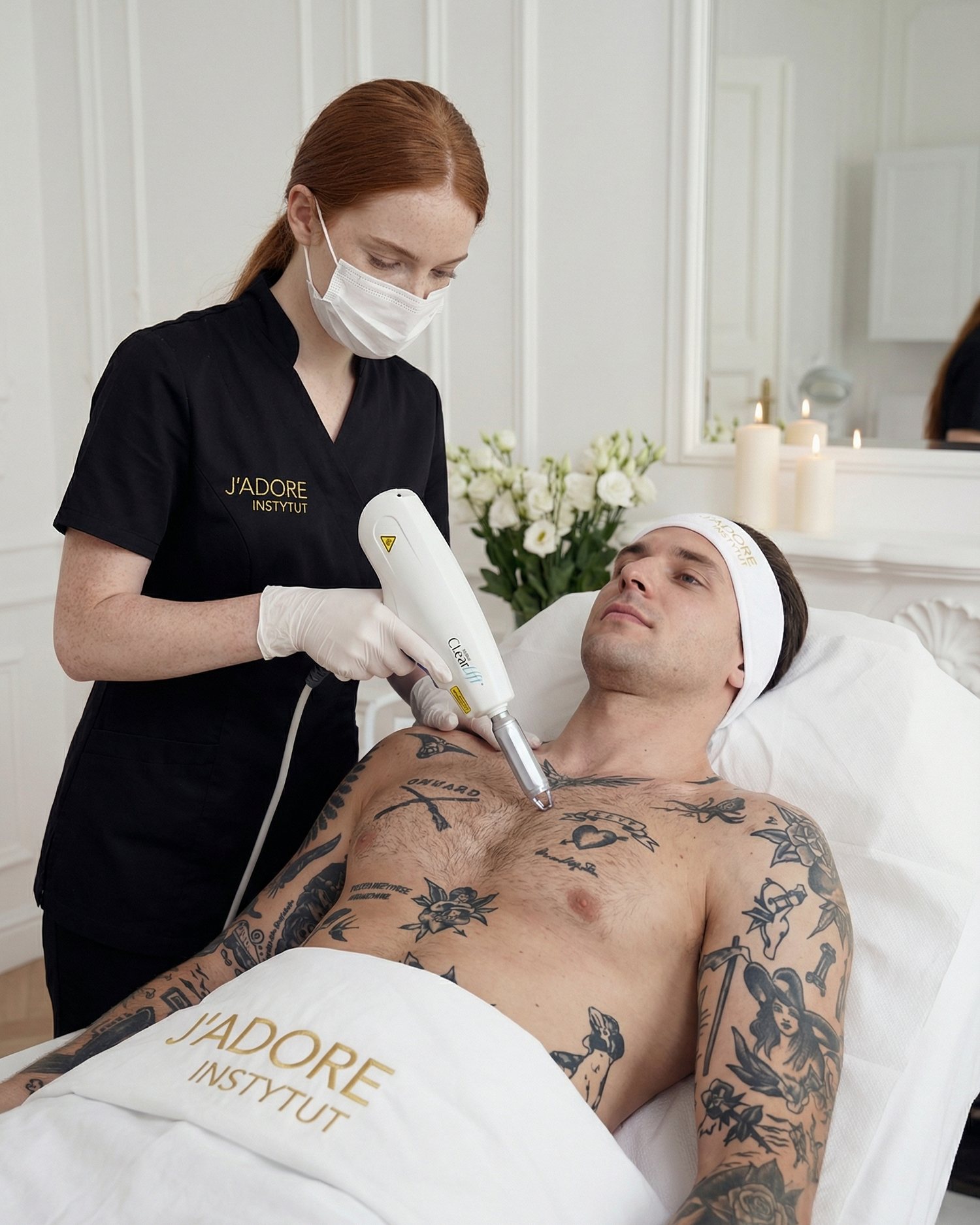
Surface area defines the work zone, but it does not predict the number of visits
Price lists often divide tattoos by size because it is a clear way to estimate session time. A larger surface area means more pulses, cooling, materials and time. It does not follow, however, that two designs in the same size category will fade in the same way.
A sparse ornament with a lot of uncovered skin may require less work than a black rectangle of the same dimensions. For large projects, the zone is sometimes divided into stages to limit the burden on the skin and maintain control over healing. Ask whether the quoted item applies to the entire design, one part or a specific amount of work time.
Pigment colour can extend the plan more than an extra centimetre
The Q-Switch Nd:YAG laser uses, among others, a 1064 nm wavelength for dark pigments and 532 nm for warmer shades. Black usually reacts more predictably than green, turquoise, blue, yellow or mixed shades. A multi-coloured tattoo is not a single task; each colour may have its own pace and limitations.
If a clinic only prices by surface area, ask how they treat resistant colours and whether they have technology suitable for the entire palette. A cheaper series on a device that only responds well to some pigments may end in the necessity of finding another method. It is not a saving to pay for pulses that do not have a good target.
Clearer plan
fewer unknowns
- black or dark ink
- one known colour
- goal: significant lightening
- no multiple touch-ups
Plan with a larger margin
more unknowns
- many colours
- light pigment blends
- unknown PMU composition
- layers after a cover-up
Professional contouring and touch-ups increase density, which a photo does not always show
A tattoo artist may go over a contour multiple times, add shading or correct a faded fragment. Each layer increases the amount of pigment. Once removal begins, lighter shading often fades faster, while a strong line remains. The valuation should take this history into account, even if you do not know the ink brand.
An old cover-up can be particularly complex. The top layer of black may hide a red or blue design that will reveal itself after a few sessions. The initial prognosis must then be updated. A clinic that provides a rigid total price without a disclaimer about hidden layers is promising knowledge it does not have.
- Disclose every touch-up and previous laser treatment.
- Show an old photo of the tattoo, if available.
- Point out raised contours and scars visible under light.
- Do not assume that the age of the design automatically means easy removal.
Full removal and lightening for a cover-up have different final budgets
For a cover-up, the goal does not have to be skin without the slightest trace. The tattoo artist determines how light a base will allow for a new project to be built safely. A few well-planned lightening sessions may finish the task earlier than attempting to remove the last shadow.
With full removal, the end of the series can be slower. Resistant particles remain, or those that are deeper or in a colour that responds less well to the technology. A further session should be justified by the expected benefit and the condition of the skin. Paying for subsequent treatments just because "something is still visible" is not always sensible.
Consultation and a test for difficult pigments protect against a costly mistake
Qualification includes skin condition, tan, illnesses, medications, tendency for abnormal scarring, pregnancy, breastfeeding and treatment history. For permanent makeup or unknown pigment, a test on a small fragment can show whether the colour will darken or change tone. This is particularly important for brows.
A test is not an unnecessary extra if its result can change the entire strategy. The cost of a small trial is lower than correcting an unforeseen colour change over the entire area. Ask when the test is assessed and whether the next stage begins only after healing.
Intervals between sessions are part of the service, even if they have a value of zero in the price list
The treatment repository usually indicates six to eight weeks between sessions, depending on healing and the specialist's assessment. The skin regenerates, and your body removes the fragmented pigment. Shortening the breaks to close a package faster may increase the risk of irritation, pigmentation disorders and scarring.
Good service includes the possibility of rescheduling a visit when your skin is not ready, or if a tan or infection has appeared. Before purchasing a series, read the validity and rescheduling rules. A package that forces a treatment on unhealed skin is poorly constructed regardless of the discount.
- 01
Session
Breaking down part of the pigment using parameters selected for the colour and skin.
- 02
Healing
Protection against friction, infection and the sun; without accelerating the scabs.
- 03
Fading
Your body works for the following weeks, even when the surface already looks calm.
- 04
New plan valuation
After healing, you can assess the remaining ink and the sense of a further session.
Cooling, hygiene and the condition of the device should not be a place for a discount
A laser requires an efficient system, regular maintenance, precise parameter selection, eye protection, and a trained operator. BRAIN confirms that the Q-MASTER Plus is an active Q-switched Nd:YAG laser located at Żelazna 59 and outlines its service schedule. This proves that the device is equipment requiring maintenance, not a one-off purchase without further costs.
You do not need to review technical documentation before every visit. However, you may ask about the model, wavelengths, the operator's training, and the protocol for adverse reactions. Protective goggles, a clean workspace, and a medical history interview are not "premium" features. They are the standard.
- Never agree to a treatment without eye protection.
- Do not treat pain and extensive blistering as a necessary price for effectiveness.
- Do not choose a clinic that cannot name the laser it uses.
- Do not pay in advance for a full series without assessing your first reaction.
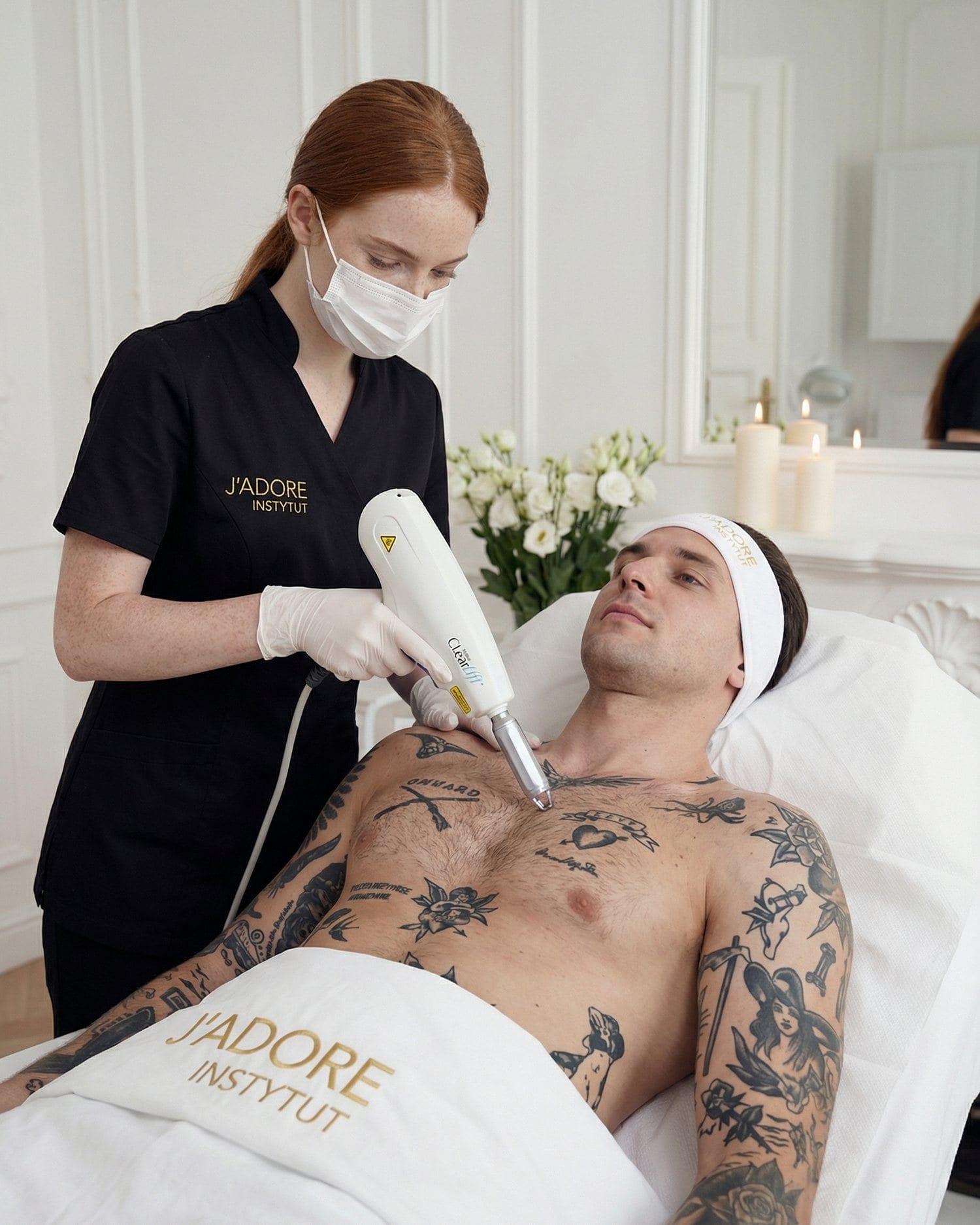
Aftercare influences the total cost more than any decorative package.
After the treatment, you need simple instructions, area protection, and an SPF filter on exposed skin. Do not scratch scabs, do not overheat the area, and do not expose it to the sun. Swimming pools, saunas, intense exercise, and tight clothing may irritate the fresh area in the first few days.
The highest cost arises when improper healing leads to hyperpigmentation, hypopigmentation, or scarring. Therefore, plan your treatment for a time when you can follow the aftercare instructions. A session before a beach holiday, sunbed use, or a mountain trip is a false economy, even if the appointment is discounted.
The price of anaesthesia and cooling only makes sense in the context of safe parameters.
Tattoo removal is noticeable. Short pulses are often compared to rubber band snaps, and sensitive areas can be quite painful. Clinics use cooling and sometimes offer anaesthetic preparation according to the protocol. This may affect the price or the duration of the visit, but it should not be used to force parameters that your skin cannot tolerate.
Lack of pain is not the only measure of a well-performed session, just as severe pain does not prove effectiveness. Parameters are selected based on the pigment, skin phototype, location, and previous reaction. If the operator ignores your reported burning sensation, does not check your skin, or insists that extensive blistering is necessary, stop the treatment.
Before booking, check whether the consultation, cooling, and follow-up are included in the stated price. Ask what to do in the evening, how to protect the area, and who to send a photo of any worrying reaction to. Post-session care is part of the real value, even if it does not consume another pulse.
The price of a series also increases due to a poorly chosen time of year.
A fresh tan is a reason to postpone laser therapy. Melanin in the skin competes for energy, which increases the risk of burns, hyperpigmentation, and hypopigmentation. If the tattoo is on your forearm, calf, or neck and you cannot protect it from the sun, a series started before the holidays may be put on hold for several months.
A pause does not necessarily harm the result, but it affects your budget and the target date, especially if you are planning a cover-up. Account for the season, holidays, and the time required for full healing before new tattooing. Purchasing a package with a short validity period just before summer is risky if the agreement does not provide for medically justified breaks.
Warsaw: settle the plan separately for Żelazna and Mińska.
Before your first visit, take a neutral photo of the healed design and write down your goal in one sentence. At the consultation, ask for an indication of which elements are more or less predictable: which colour should react to the available wavelengths, where dense layers are visible, whether there are signs of scarring, and what level of lightening is reasonable. Do not expect a promise of an exact number of sessions; expect criteria by which the prognosis will be adjusted.
In your calculations, also include time. Between treatments, you do not pay the clinic, but you protect your skin, avoid sunbeds, adjust your training, and wait for the next assessment. If the end date is important, the cost of haste may prove to be the highest: an interval that is too short increases the risk, and a schedule that is too tight before summer ends in a standstill. The schedule is an element of value just as real as the laser.
J'ADORE INSTYTUT has locations at Żelazna 59 and Mińska 29A/46. The availability of a specific device and the scope must be confirmed upon booking; BRAIN assigns the Q-MASTER Plus to Żelazna. Current price list items are on the city tattoo removal page. Send a photo only via the official channel indicated by the Instytut or book a consultation — do not publish the design with your data in a random place.
If you are choosing between locations, do not assume that every technology is available in both. Confirm the device, the operator, and the possibility of a follow-up after the session. A shorter commute is an advantage only if the location addresses the colours and risks of your specific tattoo.
The best comparison of offers has four columns: the price of a single session, the estimated scope, the technology suitable for the colours, and the rules for assessment after healing. Only then look at the package discount. In tattoo removal, a cheap visit can be expensive if it does not bring you closer to your goal or increases the risk of a mark. You are paying for the decision of when to use the laser — and when not to use it.