A stretch mark is not a skin imperfection — it is a scar within the skin
Let us start with one sentence that clarifies the whole subject: a stretch mark is a scar. It is not discolouration, ‘stretched skin’, or dryness that can be corrected with more cream. It is an actual rupture of the dermis — the deeper layer where collagen and elastin form the framework that gives skin its elasticity. When skin stretches faster than its fibres can remodel, this framework ruptures beneath an intact epidermis. The surface remains whole — which is why a stretch mark cannot simply be ‘rubbed away’. The damage lies beneath it.
The easiest way to understand this is to picture fabric. Imagine an elastic material stretched too suddenly: the top layer holds, but the weave beneath it tears along lines of tension. In skin, this ‘line’ is the stretch mark itself. It runs perpendicular to the direction of stretching. This is why stretch marks on the abdomen during pregnancy differ from those on the thighs after rapid weight gain, or on the shoulders of a teenage athlete.
- What drives them — it is not just ‘stretching’. Mechanical tension in the skin is one factor, but cortisol is equally important — a hormone that weakens collagen synthesis. This is why stretch marks often appear during hormonal upheaval: pregnancy, puberty, rapid weight changes and steroid treatment.
- Why they appear so quickly. Skin remodels its framework slowly, over months. When stretching outpaces this remodelling — as it always does during pregnancy or a growth spurt — rupture is virtually unavoidable. It is not the result of ‘poor skincare’.
- Why they are so persistent. A scar does not rebuild the skin’s original woven structure. Instead, connective tissue forms in a different arrangement — parallel, simply to close the gap as quickly as possible. It functions adequately, but looks and behaves differently from healthy skin. This creates the characteristic sheen and indentation.
The colour of a stretch mark is a clock — and it only moves in one direction
This is where the part that truly changes decisions begins. A stretch mark passes through phases, and its colour is the best free indicator of the phase your skin is in. Put simply, a scar has its own calendar, and we read it through its colour.
RED stretch mark
inflammatory phase / ‘living’ scar
- pink, red, sometimes bluish or purple
- may be slightly raised and can itch
- active inflammation is taking place beneath the surface
- blood vessels and repair cells are still active
WHITE stretch mark
mature phase / ‘settled’ scar
- pearly, silvery, eventually white
- often slightly indented, smooth and shiny
- the inflammation has long subsided
- tissue poor in blood vessels and cells, ‘quiet’
The red colour comes from the fact that the scar is well supplied with blood and inflamed — this is the stage when the body is still completing repair. Over time, the blood vessels recede, inflammation subsides, and the tissue becomes poor in blood vessels and cells. This causes the whiteness, sheen and indentation. This is the key to the entire article: a treatment does not ‘turn back time’; it works with a process already taking place in the skin. In a red stretch mark, this process is still active — so it is easier to guide it in the right direction. In a white stretch mark, it stopped long ago — it needs to be restarted from scratch, which is much more difficult.
Shockwave therapy — a mechanical alarm clock for the skin
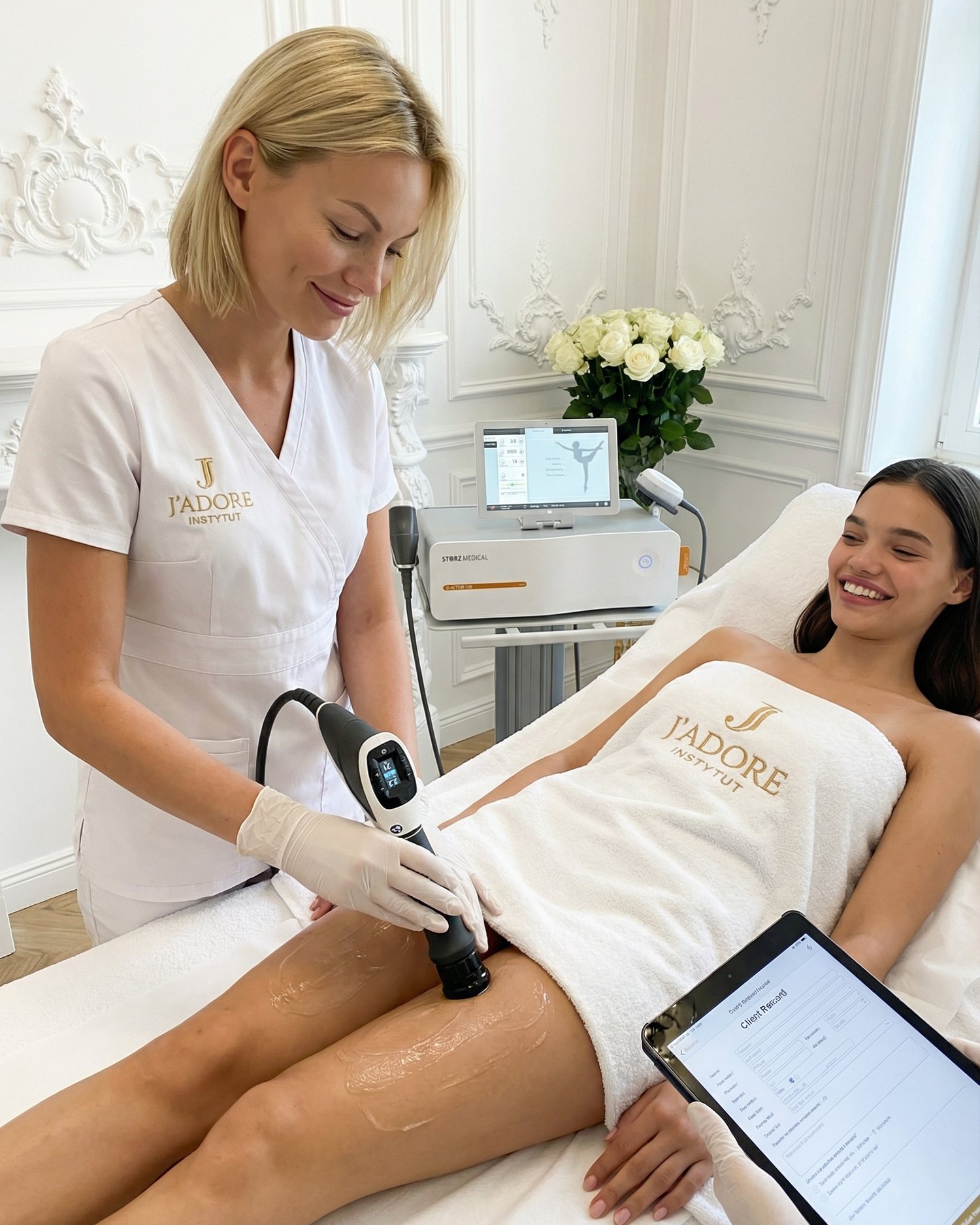
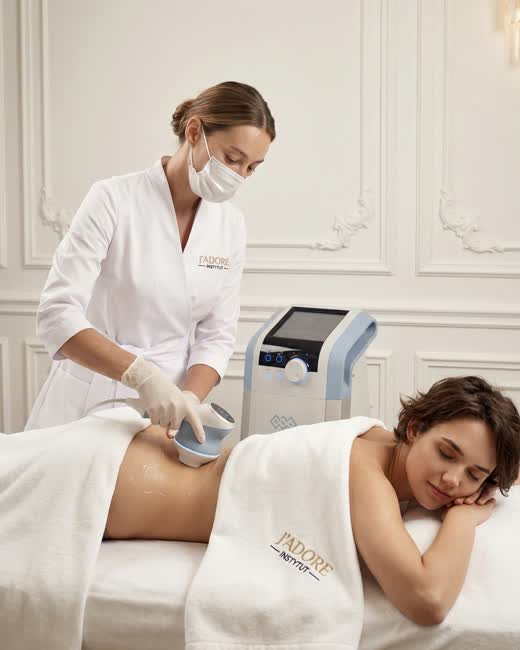
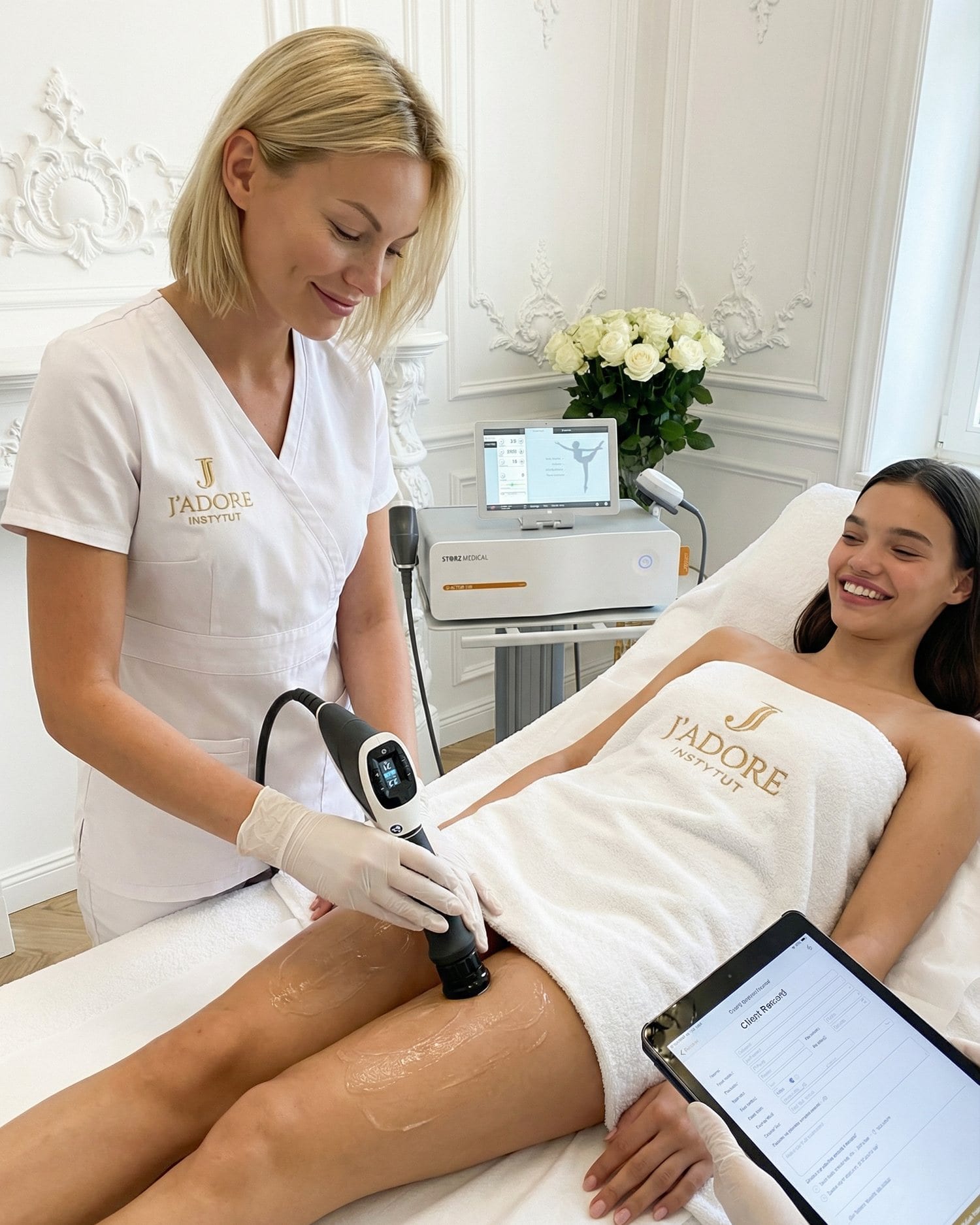
The first tool has nothing to do with light or needles. Shockwave therapy (ESWT) uses an acoustic pressure pulse — a short wave of mechanical energy delivered through the skin and into the tissue by the treatment head. It is not electricity, laser treatment or heat. It is a purely mechanical stimulus that works through the tissue from within, reaching areas where cream cannot.
What does it do to a stretch mark? First, it relaxes and mobilises dense, weakened scar tissue. Second — and more importantly — it stimulates fibroblasts, the cells that produce collagen, to work again in an area that has long since ‘given up’. Put simply, shockwave therapy acts as an alarm clock for dormant tissue. It does not introduce anything new; it reminds the cells that there is still work to complete. It also improves microcirculation, supporting nourishment and regeneration in the area.
It offers the greatest potential for fresh, red stretch marks — while tissue is still responsive, the shockwave adds a stimulus to ongoing repair and can noticeably improve the texture and skin firmness around them. For white stretch marks, it works more slowly and mainly as support. It improves texture and elasticity in the area, but rarely resolves the concern on its own. Importantly, it does not break the skin with a needle and requires no downtime. Only temporary redness may occur after the treatment, and this usually settles within hours.
Fractional laser — controlled ‘damage’ so the skin repairs itself more effectively
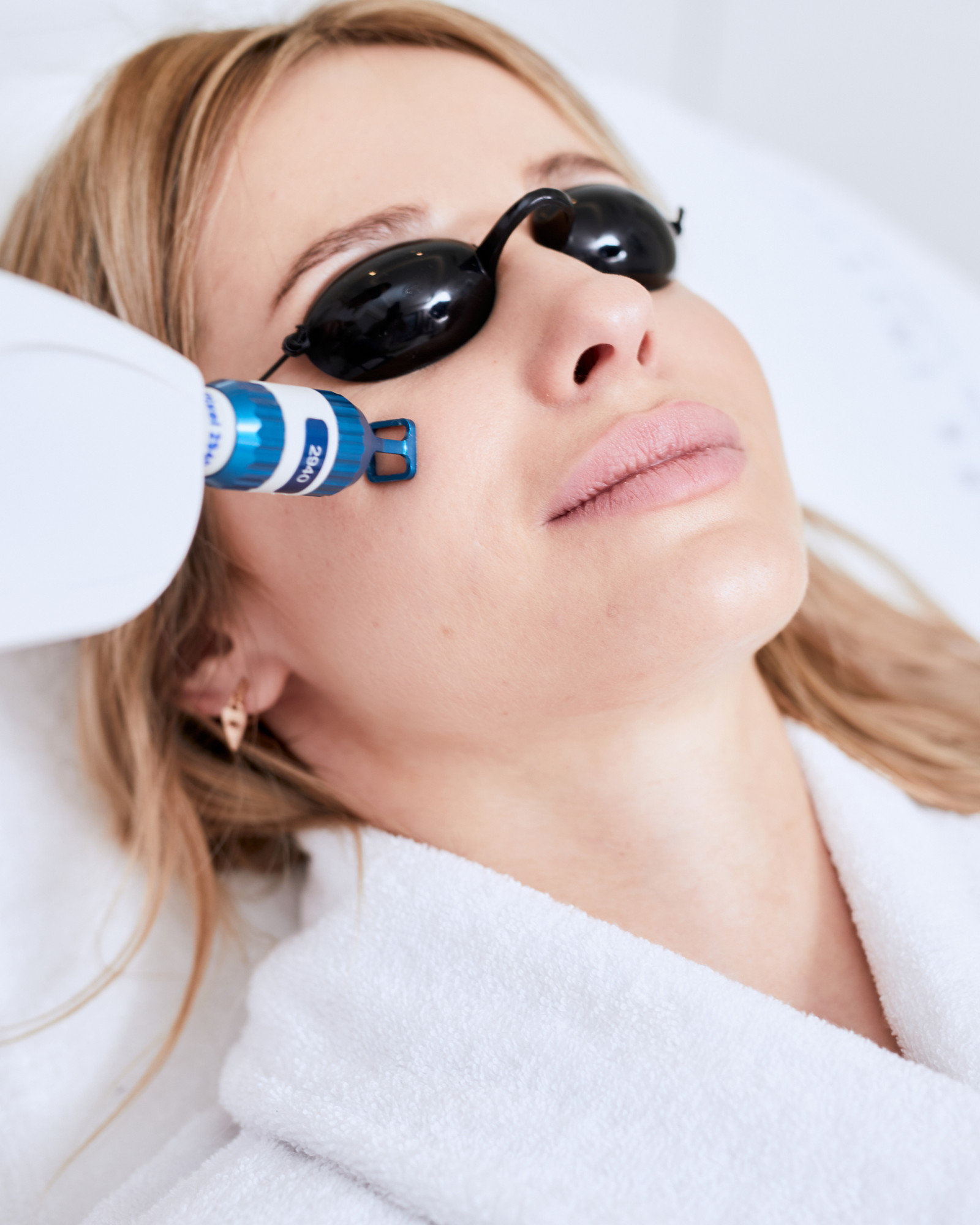
The second tool works very differently. Here lies a paradox that can be difficult to accept intuitively: a fractional laser deliberately and in a controlled way damages the skin, prompting it to rebuild more effectively. Rather than using one continuous beam, it creates a grid of thousands of microscopic columns. Each one treats a tiny section of tissue, while leaving healthy skin intact around it. These ‘bridges’ of healthy tissue act as a cell reservoir that accelerates healing and guides remodelling — which is why treatment is fractional rather than performed across the whole surface at once.
The most important sentence about laser treatment is counterintuitive: the laser does not smooth the scar — your own body does. The laser simply provokes the skin to repair itself in a controlled way, activating a repair cascade and new collagen production. This is why the result develops over weeks and months, rather than immediately after leaving the salon. It is also why scars and stretch marks are usually treated in a series.
- The non-ablative version heats the skin and prompts remodelling without disrupting the surface. It is gentler, with shorter downtime, and convenient for an active lifestyle. More sessions are often needed for a comparable result.
- The ablative version disrupts the skin surface — it is the strongest option for texture, scars and resistant stretch marks. A stronger effect comes at a cost: a genuine recovery period, when the skin may look worse for a few days before it looks better. This is a normal course, not a complication.
Why red stretch marks respond faster, while white ones take more time
Now that we know both mechanisms, it is easy to understand why colour determines the response to treatment. Both shockwave therapy and laser treatment essentially do the same thing: they trigger collagen remodelling in the skin. Their tools differ — a mechanical impulse versus light — but their aim is the same. Since both add ‘fuel’ to the repair process, their effectiveness depends on whether there is still something in the scar to stimulate.
In a red stretch mark, repair is still ongoing. There are blood vessels, active cells and inflammation, which — although it sounds negative — means the tissue is still ‘working’. The treatment connects with this activity and strengthens it. In a white stretch mark, this activity has long subsided. The tissue is quiet and poor in blood vessels and cells. The treatment must first awaken an inactive process before it can guide it. This is a longer route and usually requires more sessions, without a guarantee of a complete result.
What can realistically be done — and where to start
Since a stretch mark is a scar with its own timeline, there is no single ‘miracle treatment for stretch marks’. A sensible approach is different: first identify the stage — red or white — then select the right tool, or often a combination of tools, for that specific stage and area. Broadly, the approach looks like this:
Fresh stretch marks (red)
the window of greatest potential
- shockwave therapy — a stimulus for ongoing repair
- fractional laser — remodelling texture and colour
- injection support to nourish the skin
- aim: stop and calm an ‘active’ scar
Older stretch marks (white)
more difficult, but not hopeless
- a stronger fractional laser in a series
- wave therapy — supportive, for texture and skin firmness
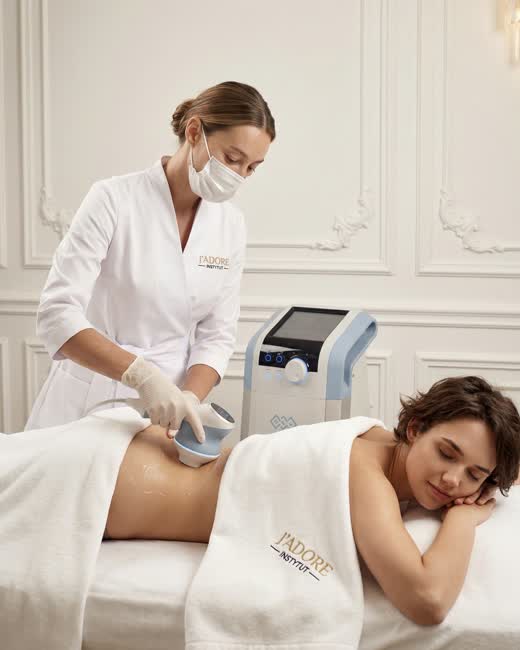
- microneedling / RF to support collagen
- aim: reactivate the process and improve visibility
What they have in common
what always matters
- a consultation that establishes the stage and plan
- realistic expectations: improvement, not ‘disappearance’
- SPF protection for the stretch mark area
- patience — results develop over several weeks
Each of these pathways involves a separate group of treatments. This is where the role of the text ends and consultation begins. An article or a body lotion advert cannot determine what stage your stretch marks are currently at, your skin tone, or what genuinely makes sense — and what is not worth doing. That requires an assessment of your individual skin. Below, we have grouped our treatments according to this logic, so it is clear what each one is for.