
How hair grows — and why it matters
To understand an ingrown hair, you first need to understand how a hair reaches the surface at all. Every hair grows from a follicle bulb sitting deep in the skin, and its path to the surface runs through a narrow channel — the hair follicle. The hair is directional: it grows at a set angle, always in the same direction, and this geometry normally lets it push through the skin unimpeded and emerge on the surface.
The problem starts when this natural path is disrupted. A hair trying to grow but meeting an obstacle — thickened epidermis, a blocked follicle opening, a tip cut at the wrong angle — starts growing in a different direction. Instead of emerging, it curls parallel to the skin's surface or turns back and grows inward. The body reads it as a foreign object and responds with inflammation — hence the redness, bumps and pain.
The razor: why it's part of the problem
A razor cuts the hair right at the skin's surface — and that's exactly where the issue lies. After shaving, a short stump remains with a sharp edge, like a sharpened needle. That stump has only one job: to grow. But to do that, it has to pierce the epidermis again — and if anything gets in its way, instead of emerging, it turns toward the path of least resistance: sideways along the skin, or back inward.
On top of that, razors often shave against the grain — opposite to the natural direction of growth — to get the smoothest possible finish. This produces a very short hair that grows back at an even sharper angle, with an even greater tendency to turn inward. The less often you shave, the less bothersome the problem seems — but then the hair is longer and more flexible, which still makes it easy to send into a spiral.
Razor / shaving
Cuts right at the surface
- Leaves a sharp stump at skin level
- Doesn't remove the follicle bulb — hair grows back immediately
- Shaving against the grain encourages ingrowth
- Every shave is a new risk
Removal (wax, sugaring)
Removes the hair along with the bulb
- A hair pulled from the root grows back finer and softer
- The tip of a regrowing hair is rounded, not sharp
- Longer gap between sessions
- With regularity — hairs weaken over time
This leads to a conclusion that surprises many people: if you regularly struggle with ingrown hairs, switching your hair removal technique — from shaving to waxing or similar — often does more than any cream or exfoliant. Not because wax is inherently "healthier", but because it changes how the hair grows back.
Three conditions that cause hairs to turn inward
Ingrown hairs aren't down to bad luck. They follow a pattern — and they usually develop when several factors converge at once. Understanding them gives you a concrete plan of action.
- 01
Thickened epidermis blocks the opening
Skin renews itself constantly — dead cells shed and make way for new ones. When this process slows down (dry skin, lack of exfoliation, clogged pores), a thicker layer of epidermis forms on the surface, literally blocking the exit from the follicle. The hair keeps growing, but the opening is closed — so all it can do is turn sideways.
- 02
Sharp hair tip after shaving
A razor cuts the hair perpendicular to its shaft, leaving a sharp, pointed stump. This kind of tip is more prone to catching on the follicle's side wall than the rounded tip of a hair regrowing after being pulled out. It's simple physics: a sharp end turns more easily than a rounded one.
- 03
Hair that's too thick or too curly
People with naturally thicker or curlier hair statistically have more problems with ingrowth — not because of their skin, but because of geometry. Curly hair naturally tends to curl into a spiral even as it grows, and thick hair puts more pressure on the follicle walls. This means these people need more rigorous prevention, not less.
What exfoliation actually does — and what serum does
The beauty market has responded to the ingrown hair problem with a flood of products: mechanical exfoliants, acid serums, toners, oils. Some of them can genuinely help — but only once you understand what they do and don't do.
- Mechanical exfoliation (fine-grained, for body skin) — removes dead epidermal cells and helps clear follicle openings. It works preventatively: used regularly before hair removal and between sessions, it reduces the risk of a blocked opening. It won't cure a hair that's already ingrown under the skin — but it makes new ones less likely to form.
- Acid serum (AHA/BHA) — acids such as glycolic (AHA) or salicylic (BHA) chemically exfoliate the epidermis and penetrate slightly deeper than mechanical exfoliation. BHA is particularly valued for a tendency toward ingrowth, as it works inside the follicle opening. These can help many people — but they require regular use and the right concentration. Good products in this category are a supporting tool, not a cure-all.
- Hydration — dehydrated skin means a thicker, less flexible epidermis. A daily body cream or oil (especially after hair removal) helps keep skin soft and more permeable for regrowing hair.
- Picking and squeezing — effectiveness: temporary. Risk: infection, scarring, dark hyperpigmentation. If you're tempted to pull out an ingrown hair, it's better to wait until it comes closer to the surface on its own, disinfect, extract it with the tip of a needle — and avoid squeezing around it.

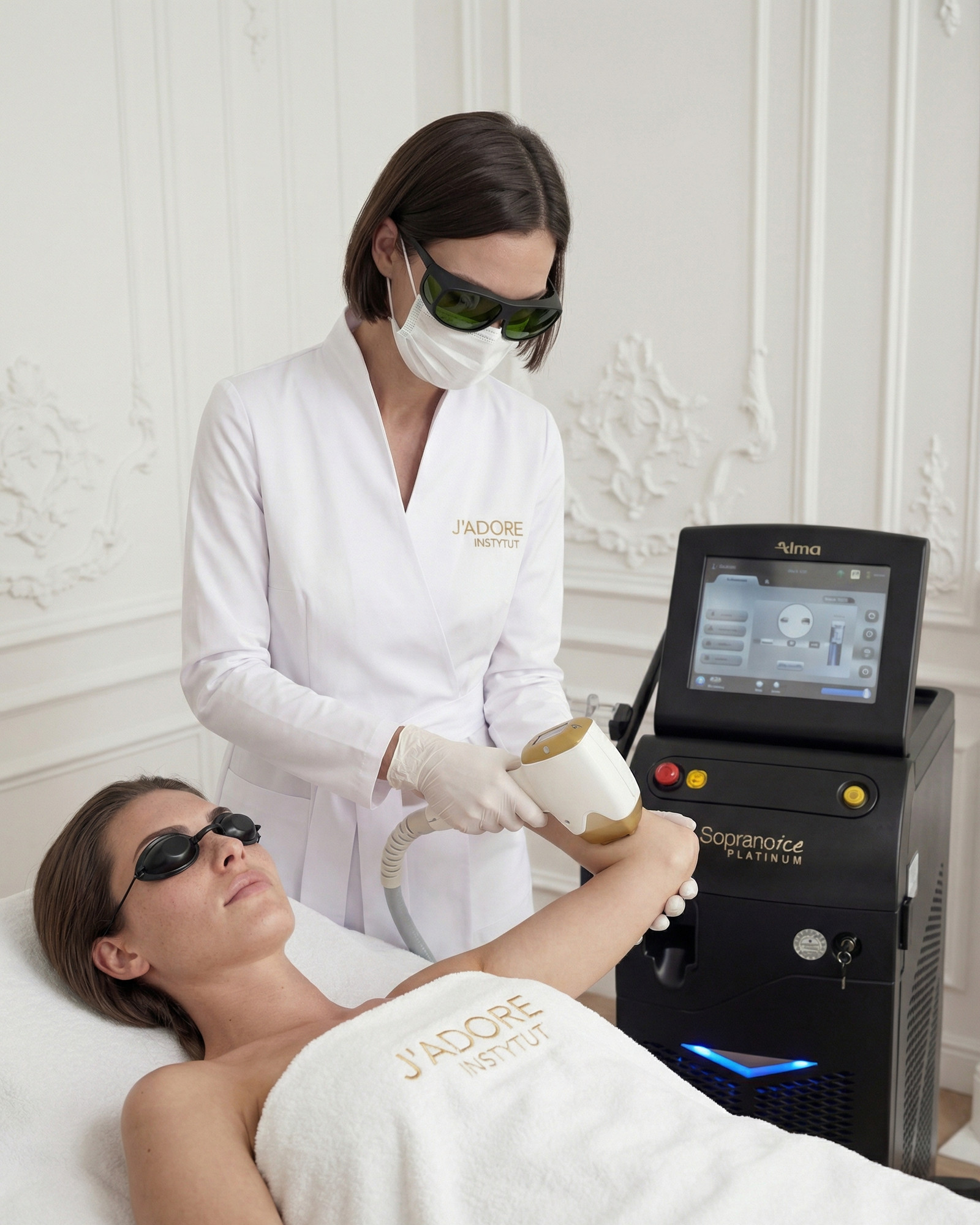
Laser hair removal — a method aimed at the source of the problem
All the strategies described above — exfoliation, serum, changing technique — address the effect or prevention. There's one tool that targets the cause: laser hair removal. It sounds like an investment, but for many people struggling with chronic ingrowth, it turns out to be the more sensible long-term choice over years of spending on products and maintenance treatments.
The laser targets the hair follicle bulb — that's where it concentrates energy, damaging it enough that the hair stops growing or grows back much weaker. No bulb — no hair. No hair — no ingrowth. For many people, after a full course of treatments, the ingrown hair problem simply disappears — not because the skin has improved, but because there's nothing left to turn inward.
An important note: laser hair removal doesn't work instantly, and it's not identical for everyone. It requires anywhere from a few to over a dozen sessions (the course is tailored individually), with results building gradually between sessions. The best outcomes are seen in people with strong contrast between dark hair and light skin — but the technology keeps evolving, and many modern devices now handle a much wider range of skin tones than a few years ago. It's always worth starting with a consultation.
Action plan: step by step
Put together, everything in this article gives you a concrete plan — from the simplest to the most comprehensive. It's worth starting with the steps that cost nothing but a habit, and seeing whether the problem eases.
- 01
Change your hair removal technique
If you shave with a razor, try waxing or sugaring for three months. It's a single change that, for many people, does more than a whole cabinet of products.
- 02
Exfoliate 2–3 times a week
Mechanical or chemical exfoliation (glycolic acid, salicylic acid) on legs, groin and other treatment areas — a few days before the session and regularly between sessions. Keep the habit up.
- 03
Moisturise daily
Soft, hydrated skin means a thinner epidermis and an easier path for the hair to break through. Body cream or oil after every shower — not just before hair removal.
- 04
Don't pick, don't squeeze
If the ingrown hair sits deep, leave it. If it has come close to the surface on its own — disinfect, use a needle, extract the tip. Squeezing and scratching leave hyperpigmentation and a risk of infection.
- 05
Consider laser hair removal
If the problem keeps returning despite home care and a change of technique — book a laser consultation. It's a method aimed at the cause, not just the effects.