Smell reaches the brain directly — bypassing the filters
Before we look at why a particular oil affects mood, it helps to understand one thing about smell that sets it apart from the other senses. Sight, hearing, touch, taste — each of these passes through the thalamus, a kind of central relay station in the brain, which filters and organises incoming signals before they reach awareness. Smell is the only sense that skips this step entirely. Scent molecules travel from the olfactory receptor straight to the limbic system — the evolutionarily oldest part of the brain, where emotions, memory and autonomic responses are managed.
This explains a few phenomena that seem irrational at first glance. Why the smell of pancakes on a Sunday afternoon instantly takes you back in time. Why an ex-partner's perfume can catch in your throat on a crowded train. And why the aromas chosen for a massage can genuinely affect your tension levels, how you sleep that night, and how you feel the next day — regardless of the technique the therapist uses. This isn't a suggestion effect. It's a neuroanatomy effect.
The second route by which essential oils work is absorption through the skin. Oil molecules are small enough to pass through the skin barrier and enter the bloodstream — and from there reach internal organs and the nervous system. This effect is slower than the olfactory route, but longer-lasting — which is why a massage with oils works differently from simply inhaling an aroma. Touch and scent reinforce each other.
Calming oils — for when the body is running at full speed
When someone arrives for a massage tense, with tight shoulders and a head full of to-do lists, aromatherapy can shorten the time the body needs to actually let go. Certain oils act on the parasympathetic nervous system — the one responsible for "rest and digest" mode, as opposed to fight or flight. In many people, the scent alone starts the shift between these states before the therapist has even made the first warming movement.
- Lavender — a classic for good reason. One of the most extensively studied calming aromas. Often used for tension, difficulty falling asleep, and nervous over-reactivity. Its effect is gentle and broad-acting — it doesn't put you to sleep mid-afternoon, but it does lower the nervous system's alert level.
- Bergamot — citrus, but without the stimulating edge. Often described as "relaxing upward" — it eases tension without weighing you down. Worth trying for those who find classic lavender a little too old-fashioned.
- Sandalwood — warm, deep, earthy. Works especially well on tension in the lower body, and on thoughts that won't slow down. Often paired with back and neck massage.
- Roman chamomile — softer than sandalwood, gentle in scent. Recommended for emotional tension — when the issue isn't physical but psychological: anxiety, irritability, sensory overload.
Stimulating oils — for when you need to pull yourself together
Massage is associated with rest — and rightly so. But not every client arrives wound up. Some arrive tired but wired, foggy after a long flight, sluggish in winter, or struggling to concentrate. In these cases, stimulating oils can turn a massage from a relaxation session into something better described as activation — something you leave not sleepy, but ready.
- Peppermint — cooling and sharp. Boosts circulation, sharpens perception, refreshes a tired mind. Often used on the head, neck and temples.
- Rosemary — herbal, slightly camphoraceous. Traditionally linked to improved circulation and sharper focus. Works well on the legs and on heavy, "weighed-down" muscles.
- Eucalyptus — clearing, deep-breath scent. Particularly useful when the breathing is shallow, the chest muscles are tight, or you simply want the feeling of your lungs opening up. It affects your sense of physical space.
- Grapefruit and lemon — light, sunny citrus notes. Lift the mood without stimulating the nervous system in a way that keeps you awake later. A good choice for a morning appointment.
Mood-shifting oils — when it's about emotion, not energy
The third category is the hardest to describe, because it deals with something more subtle than "relaxing" or "energising". Some oils don't calm or activate — they work on emotional tone. On how you relate to yourself for the next few hours. On something you might call a baseline mood.
For grounding
when you feel "outside yourself", scattered
- Vetiver — earthy, deep, anchoring
- Cedar — dry, woody, stabilising
- Patchouli — intense, warm, strongly "earthy"
For lifting the spirits
when mood is flat and the body feels heavy
- Rose — floral, sensual, gently uplifting
- Neroli — delicate florality, subtle joy
- Ylang-ylang — exotic, sensual, relaxing at the same time
In aromatherapy, rose isn't just about scent — it has a place in traditional medicine as an oil linked to the emotional and feminine sphere. Neroli, distilled from bitter orange blossom, is similarly described as easing low mood and difficult transitions. This isn't a promise of a therapeutic effect — it's more a long-standing observation that certain aromas tend to shift mood in a particular direction for many people.
Blends and synergy — why the sum is greater than the parts
Most aromatherapy massages don't use a single oil — they use a blend. And this is where a separate body of knowledge comes in. Essential oils interact with one another — some aromas amplify each other's effect, some soften each other's sharpness, and others create something entirely new when combined. In aromatherapy, this is called "synergy" — an effect that exceeds the sum of its ingredients.
- Lavender + sandalwood — a combination that relaxes and grounds at the same time. Lavender "calms the mind"; sandalwood "slows the body". Together they work on both levels.
- Peppermint + eucalyptus — a classic breathing opener. Menthol from the peppermint widens the sense of space; eucalyptus deepens it. Together they create an experience many clients describe as "the first deep breath in a week".
- Bergamot + neroli — light, floral-citrus. They lift the mood without overwhelming — good where subtlety is needed: for emotional sensitivity, or after a difficult time.
- Rosemary + black pepper — circulation-boosting. Dynamic, warming. Paired with sports massage or drainage techniques.

What does the treatment involve? — from choosing a scent to the effect
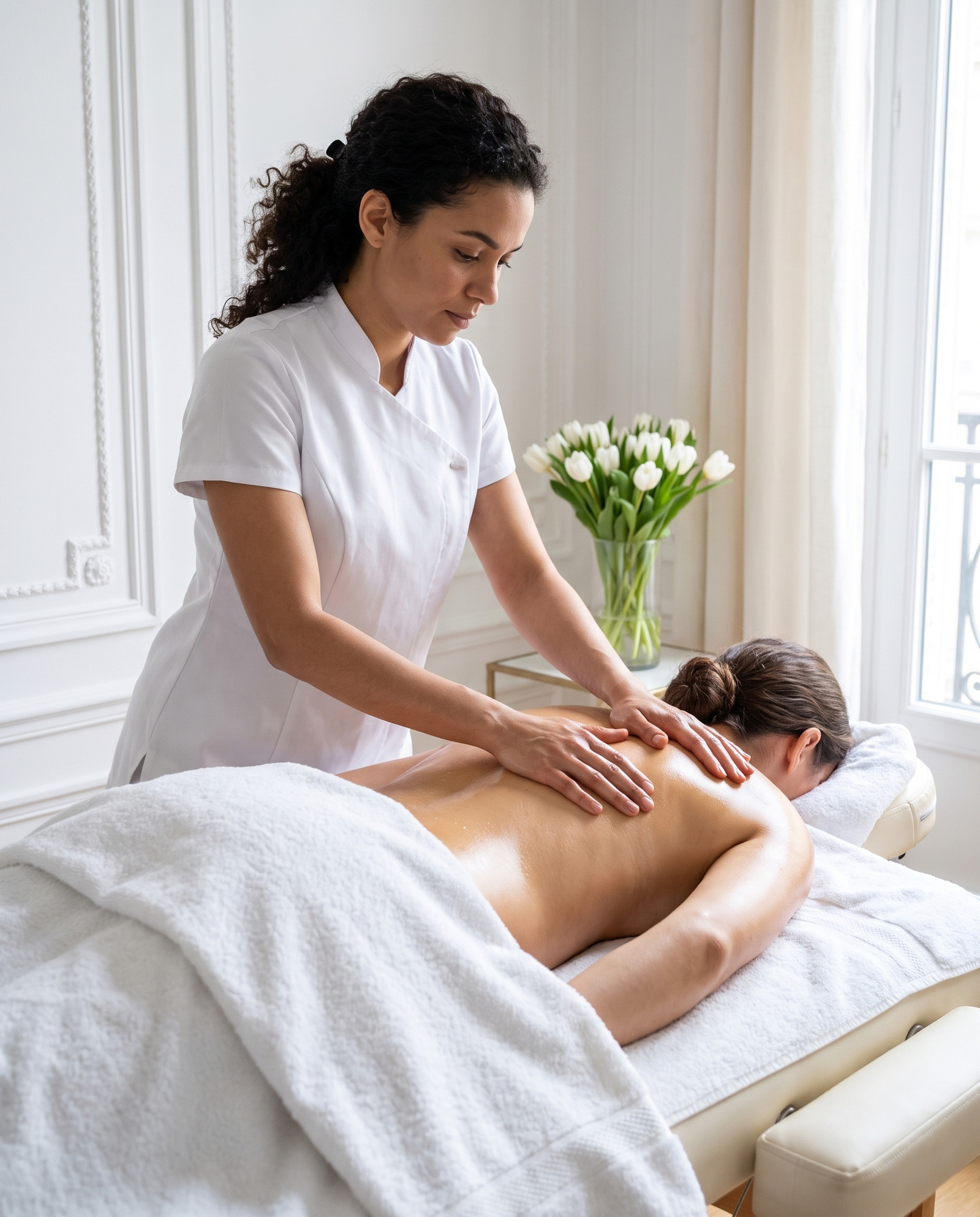
An aromatherapy massage involves several steps before the therapist's hands even begin to move. In a well-run salon, you don't simply lie down on the table with "some scented oil". There's a short conversation — about your mood, your needs, any allergies, whether you'd prefer to feel calmed or energised, and whether you have scent preferences or a clear dislike of a particular aroma. Based on this, the therapist selects the blend. The oils are then diluted in a carrier oil, which nourishes and hydrates the skin at the same time.
- 01
Short consultation
The therapist asks about your mood, physical state, scent preferences, and any allergies or contraindications.
- 02
Blend selection
Essential oils are diluted in a carrier oil — the proportions depend on the goal and on your skin's sensitivity.
- 03
Activating the aroma
Even before the treatment starts — a light rub of the blend between the palms, and the first contact with the scent; the limbic system begins to respond.
- 04
Massage
Techniques adapted to the goal — relaxation (slow, deep strokes), activation (rhythmic, moderately firm), drainage (directional). The oils absorb through the skin in parallel with the scent's effect.
- 05
After the treatment
The oils keep working for several hours after the massage ends. It's worth leaving the residue on your skin — don't wash it off straight away.
Not every aroma suits everyone — the individuality of scent perception
There's one point rarely discussed openly in aromatherapy: scent is deeply subjective. Not just at the level of taste — "I like lavender, I don't like patchouli" — but at the neurological level. People differ in the number and type of olfactory receptors they have. Some can't detect certain scent compounds at all (so-called specific anosmia). Others are highly sensitive to particular aromas. And olfactory memory is so personal that the same oil can trigger relaxation in one person and discomfort in another — through association with something unpleasant from the past.
That's why a good aromatherapy massage isn't chosen from a list — it's a conversation. The therapist may offer a few options to smell before the treatment and watch how you respond. This isn't a sensory game — it's diagnosis. The body often shows what it needs: relaxing aromas trigger a physical loosening of the shoulders, stimulating ones a slight holding of the breath. These signals matter, and they're worth reading.
Aromatherapy and classic massage — what it adds, what it can't replace
Aromatherapy is a layer, not a substitute. A massage with aromatherapy oils is still a massage: its effectiveness depends first on the quality of the therapist's hands, their knowledge of anatomy, and their feel for pressure and rhythm. Aromas strengthen the effect, direct it in a particular direction, and deepen relaxation or activation — but they don't create an effect out of nothing.
What aromatherapy adds
a layer added to the massage
- A faster shift into relaxation mode (limbic system)
- Directing the effect: towards calming, activation or a mood shift
- Absorption of ingredients through the skin, alongside the mechanical work
- A deeper and longer-lasting effect on mood, hours after the treatment
What aromatherapy can't replace
the foundation stays the same
- The therapist's technique and knowledge
- Work on specific muscle tissue
- The results of deep, sports or therapeutic massage
- Medical consultation for pain-related conditions
In other words: it's worth asking for aromatherapy, but it's just as important to choose the right type of massage. When tension is chronic and deeply rooted in the muscles, a change of scent alone won't resolve it. When mood is the main need, aromatherapy can be the ingredient that determines the quality of the whole experience.
Relaxation massage
A natural pairing — calming oils (lavender, bergamot, sandalwood) deepen the relaxing effect of classic techniques. Together they work on both levels: the body and the nervous system.
Aromatherapy body massage
A dedicated treatment — here aromatherapy is the central element, not an add-on. The therapist selects the blend for your specific need before the session.
Candle Massage
The warmth of melted wax and essential oils sink deeper into warmed skin. An exceptional combination for dry skin and deep-seated tension.
Oriental / sensory ritual
A multi-stage experience where aromatherapy accompanies the whole ritual — from oil bath to massage. For those seeking an all-round effect, not just relaxation in one area of the body.