Your skin needs time to regenerate after treatment
When you stand in front of the mirror after finishing cancer treatment, your skin tells the story of the last few months. It is thinner, more reactive and sometimes simply tired. It is natural that you want to regain your former look as soon as possible, but in medical micropigmentation, haste is the worst advisor. Your skin needs time to regain stability before we introduce the first pigment.
It often happens that during the first consultation, we agree together that it is worth waiting another month or two. This is not a refusal, but an expression of care to ensure the result is lasting and aesthetic. If the skin is still in an active phase of regeneration, the pigment may take unevenly, and the healing process can be unpredictable. Patience at this stage allows us to work on tissue that is ready to receive the pigment.
- Observe whether your skin reacts with burning to your daily skincare products.
- Check if there are any small breakouts or redness in the area where the brows are to be created.
- Always consult your oncologist or dermatologist if you have doubts about the condition of your skin.
Understanding your skin's needs is the first step to success. When we both agree that the right moment has come, we will proceed with full calm. Safety and health are always more important than an immediate result, which is why we place such great importance on you feeling comfortable at every stage of this journey.
Doctor's approval is the foundation of your safety
In the world of medical micropigmentation, safety is not just a formality but an absolute priority. Before we think about the brow design, we must be sure that your skin is ready to receive the pigment. This is why the foundation of our cooperation is the approval of your doctor — an oncologist or dermatologist. They are the person who best knows your treatment history, immune status and the specific needs of your body. During a follow-up visit, it is worth asking your doctor directly: "In my current health situation, can I undergo brow micropigmentation?". Often a short conversation is enough to get a clear answer, which provides peace of mind for both you and the person performing the treatment.
- Prepare a list of questions for your doctor, taking into account the type of therapy you underwent.
- Ask for an opinion regarding skin stability and its ability to regenerate after the treatment.
- Make sure that your doctor does not see any contraindications in the context of the medications you are taking.
It happens that in response you will hear a suggestion to hold off on the treatment for a few more weeks or months. In such a situation, it is worth changing your perspective: this is not a failure or a delay in returning to yourself. It is an expression of the utmost care for your own health. Skin after chemotherapy or in the course of autoimmune diseases can be thinner and more sensitive, so patience is your greatest ally here. If your doctor recommends time for regeneration, treat it as an investment in better pigment retention in the future. Good skin condition is a guarantee that the final result will look natural and will last for a long time.
- Why must a doctor approve the treatment?
Your doctor has full knowledge of your health status, which allows us to exclude risks associated with disrupting the epidermal barrier at a time when the body still needs support after treatment.
- What if the doctor recommends waiting longer?
This is a signal that your skin needs more time for full stabilisation. It is worth trusting this opinion and returning to the topic of micropigmentation at the time indicated by the specialist.
Remember that the final word always belongs to medicine. Our role begins the moment you receive the green light. Thanks to this, we can work in an atmosphere of calm, focusing solely on ensuring you can feel like yourself again. Safety and health are always more important than haste in the pursuit of an aesthetic result.
Brow design starts with your photo from before the illness
When you decide to restore your brows, the most important starting point is not a catalogue of trendy shapes, but your own face from before the illness. Instead of imposing current trends, together with the linergist, we look at your photos from the times when you felt your best. These photographs are the most valuable clue that allows us to understand the natural arch, density and character of your brows. Thanks to them, we avoid the "new face" effect and focus on returning to what is most authentic and familiar to you.
Design with a photograph
- Restoring the natural arch
- Maintaining your proportions
- Returning to a familiar look
"Catalogue" design
- Imposing a trendy shape
- Risk of changing facial expression
- Loss of individual features
The design process is a time for a calm conversation. The linergist applies an initial sketch with a pencil, taking into account the anatomy of your face and how skin after treatment reacts to touch. This is a moment where there is no room for haste. We review the sketch together, make adjustments and check if every line harmonises with your facial expressions. Only when you look in the mirror and see yourself, and not a stranger, can we move to the next stage.
- Prepare 2-3 photos where the shape of your brows from before the treatment is clearly visible.
- Remember that the initial sketch is the time for your comments — do not be afraid to say how you feel.
- Trust your intuition: you are the one who will look in the mirror every day.
This stage is crucial for your psychological comfort. Agreeing on the shape together is the foundation upon which we build a sense of security. When you accept the design, we take the burden of daily brow drawing off you, giving you the certainty that the final result will be a natural extension of your personality. Precise reproduction of the details you remember from your photos allows us to close the difficult stage of treatment and return to everyday life with a smile.
The micropigmentation technique differs from classic makeup
In medical micropigmentation, the technique differs significantly from what we know from classic permanent makeup. When we work on skin after cancer treatment or in the course of autoimmune diseases, the priority is respect for its altered structure. Such skin can be thinner, more sensitive and may react differently to the introduced pigment, so instead of a strong, uniform filling, we choose more subtle methods that allow for a gradual build-up of the effect.
A key element is the choice of pigment. Skin after therapy often changes its tone — it may be more sallow, red or simply have a different shade than before the illness. The linergist does not choose a colour "from a catalogue", but analyses your current complexion so that the dye harmonises with it rather than standing out as an artificial patch. The goal is to create brows that look natural, not "drawn on".
This technique does not interfere with hair follicles because we introduce the pigment shallowly, into the layers of the epidermis. Thanks to this, the treatment does not affect whether your own hairs will grow back in the future. We restore the look of the brows — their shape, density and direction — giving you comfort and confidence while you return to everyday life in peace.
The first days after the treatment require your attention and patience
The healing process after medical brow micropigmentation requires, above all, calm from you. Skin that has gone through the difficult experience of treatment may react to the introduction of pigment slightly differently than healthy skin. The first days are a time when your main task is observation and following aftercare instructions.
- 01
Days 1–2
You may feel slight swelling or redness. The pigment seems very intense at this time, even exaggerated – this is a natural stage that does not reflect the final result.
- 02
Days 3–5
A feeling of tightness and small scabs appear. This is a key moment when the skin begins to regenerate and the pigment stabilises in the epidermis.
- 03
Days 7–14
The scabs fall off on their own. During this time, the colour may seem too light or even almost invisible, which often causes anxiety, although it is a transitional stage.
On the third day after the treatment, itching often appears. This is a signal that the skin is healing, but under no circumstances should you scratch your brows or remove the scabs that appear. If you remove them prematurely, you risk removing the pigment along with the epidermis, which will lead to uneven colour. In such moments, reach for the recommended regenerating ointment, which will bring relief and support the rebuilding process.
- Do not touch your brows with dirty hands and avoid contact with water on the first day.
- Use only moisturising preparations indicated by the linergist, avoiding products with acids.
- Give up saunas, swimming pools and intense physical exercise for the time indicated in the instructions.
- Remember that the final shade of the brows will emerge only after full skin regeneration, i.e. after about a month.
Understanding that the colour suddenly fades after a week is extremely important for your psychological comfort. After the scabs fall off, the pigment often seems to "disappear" or become very transparent. This does not mean that the treatment was unsuccessful – it is a natural process in which the dye settles into the deeper layers of the epidermis. Patience during this period will allow you to avoid unnecessary stress, and during the touch-up, we will assess together if minor adjustments are needed to achieve the intended effect.
The touch-up is the moment to refine details
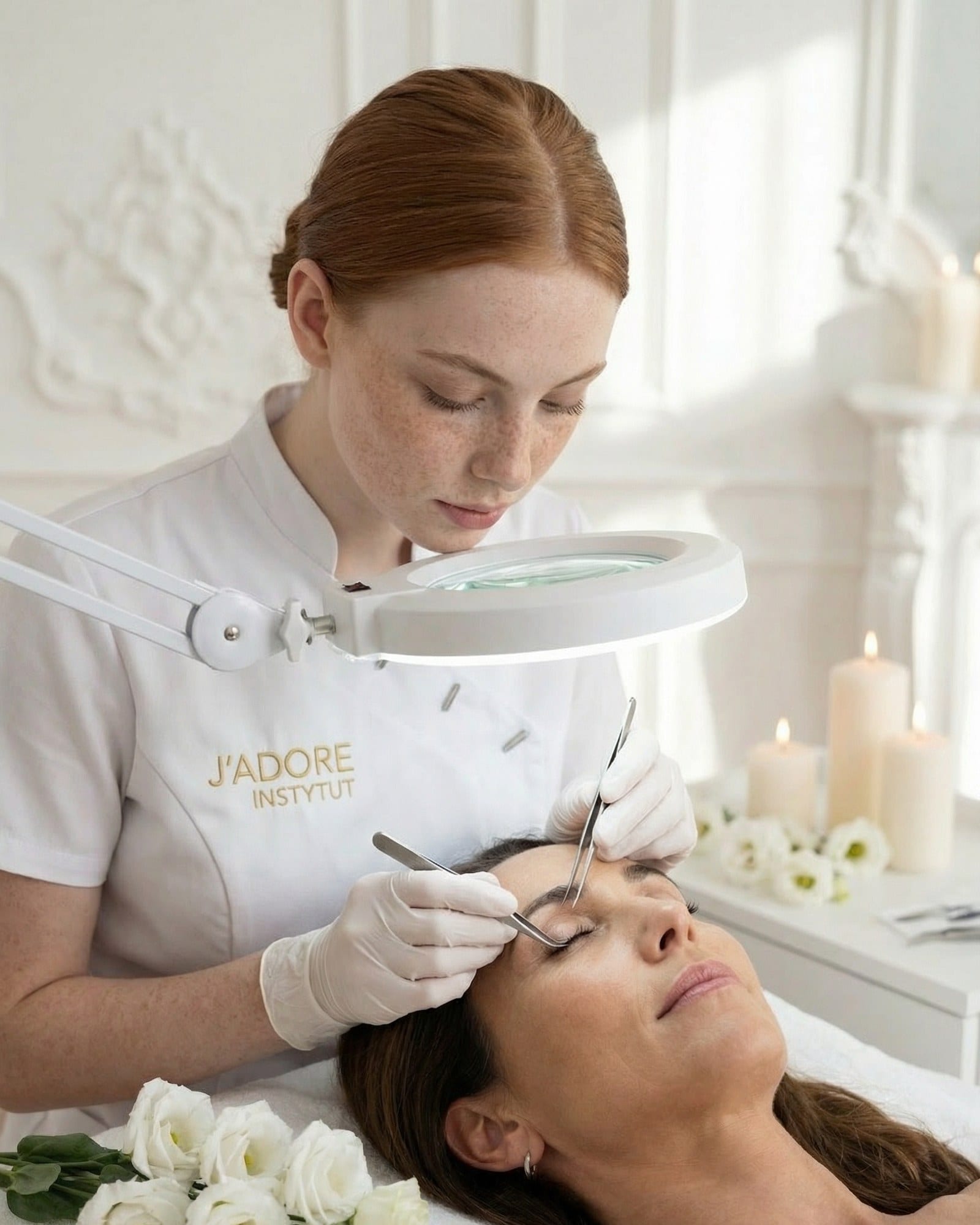
The touch-up, planned about four to six weeks after the first meeting, is an inseparable stage of medical micropigmentation. Many people ask why the target effect cannot be achieved in one go. The answer lies in respect for your skin, which after an illness can be more demanding and unpredictable. During the first visit, we work cautiously to see how the tissue accepts the dye. Thanks to this, we avoid excess pigment and give the skin space for calm regeneration.
A safe start
The first treatment is about building a foundation. We choose a more subtle intensity to see how the skin reacts to the pigmentation.
Precise finishing
The touch-up allows for adding colour exactly where it is needed, without the risk of overdrawing the brows.
Only after full healing do we see how the pigment has settled in the skin. It often happens that after this time, one brow requires minimal thickening at the tail or evening out of saturation. This is a natural process that shows the skin is working. The touch-up is the moment to refine those details that determine the final, natural look. It is a time for a calm assessment of whether the shape and shade fully meet your expectations.
Home care supports the durability of the effect
Aftercare after medical brow micropigmentation is a stage where your role is crucial for the final look and durability of the pigment. Skin after cancer treatment or in the course of autoimmune diseases can be more demanding, so the "less is more" rule works best here. Your main task is to maintain cleanliness and an appropriate level of hydration without burdening the epidermis with substances that could cause irritation.
When choosing care preparations, be guided by a simple composition. Avoid products containing acids, fragrances and strong active ingredients that could affect the healing process or the pigment shade. Use only the regenerating ointment recommended by the linergist, and after full healing, switch to a delicate moisturising preparation that does not clog pores and does not cause allergic reactions.
- Apply the regenerating ointment according to the instructions, applying it in a very thin layer so the skin can breathe freely.
- Avoid touching your brows with dirty hands, which is especially important in the first days after the treatment when the epidermis is in the regeneration phase.
- Give up scrubs, rough towels and exfoliating preparations in the brow area throughout the entire healing period.
- After the skin has completely healed, include a mild care oil in your daily routine, which will help maintain epidermal elasticity and highlight the natural look of the pigment.
When the healing process is over, your most important habit will become sun protection. UV radiation is the main factor affecting faster pigment fading and changes in its shade over time. Daily use of SPF 50+ protection on the brow area is the simplest way to enjoy the treatment effect for a long time.
- Can I use any sunscreen after healing?
It is best to choose products with a high SPF 50+ filter that are intended for sensitive skin. Avoid preparations with a large amount of fragrances that could irritate the delicate skin in the micropigmentation area.
- How long do I have to use special care?
Instructions regarding the regenerating ointment apply to the healing period, i.e. usually the first few days. SPF protection and delicate moisturising are habits worth maintaining permanently to protect the pigment from fading.